How to Read a PKCERT Advisory in Pakistan: Severity, Affected Systems and What to Do
Learn to read a National CERT advisory in Pakistan: the ID date, the summary box, mandatory actions and exposure signs, using the 21 October 2026 notices.
To read a PKCERT advisory, check four things in this order: the severity and scope in the Document Summary box, the fixed versions or actions in the Remediation section, the date in the advisory ID, and the Indicators of Exposure list. Then decide whether the advisory names a product you run.
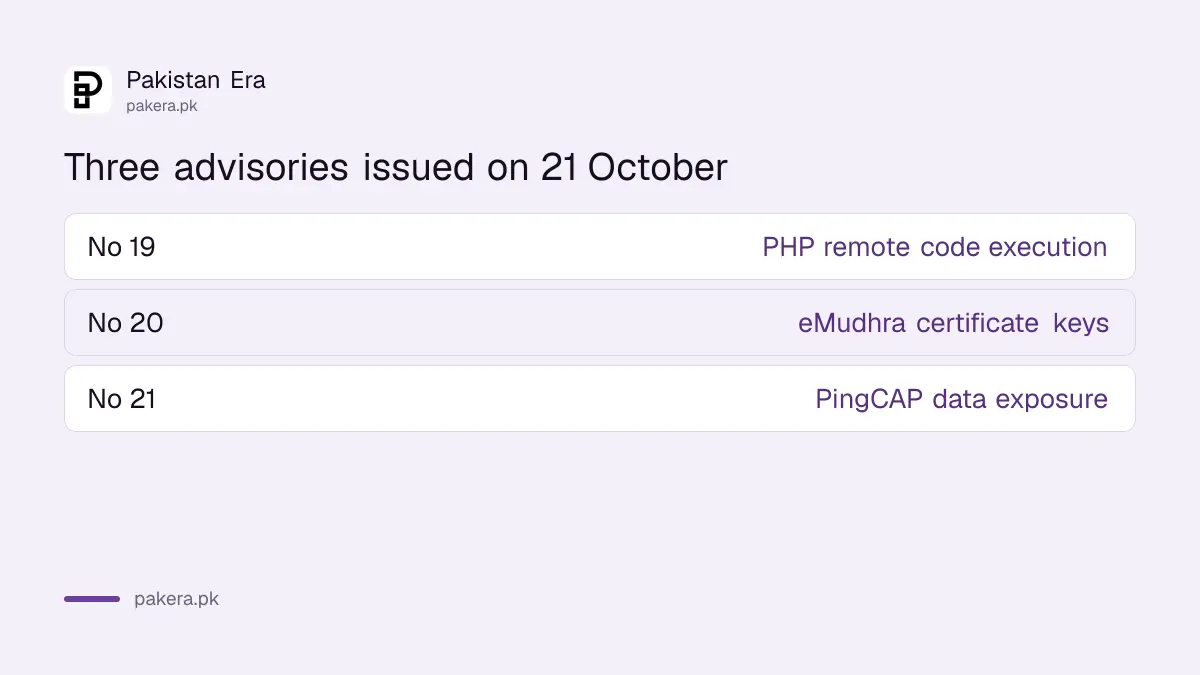
National CERT, Pakistan's cyber emergency response team, has published 20 numbered advisories on pkcert.gov.pk in 2026, listed up to No 21, with No 9 not shown. They are written for IT teams, so a business owner can find them heavy. We read three of the latest, numbers 19, 20 and 21, issued on 21 October 2026, and noted what they share.
The advisory ID carries the number and the date
An ID such as NCA-19.211026 reads as advisory number 19 followed by 21-10-26. The three advisories we read share the suffix 211026 and were issued on 21 October 2026. Check this date first, because a patch listed as "expected" may have shipped since.
The date matters because advisories are snapshots. Advisory No 19 on PHP said fixes were reportedly expected, while the PHP project had already published them on the same day. The ID format is our reading of the pattern, not a rule PKCERT states.
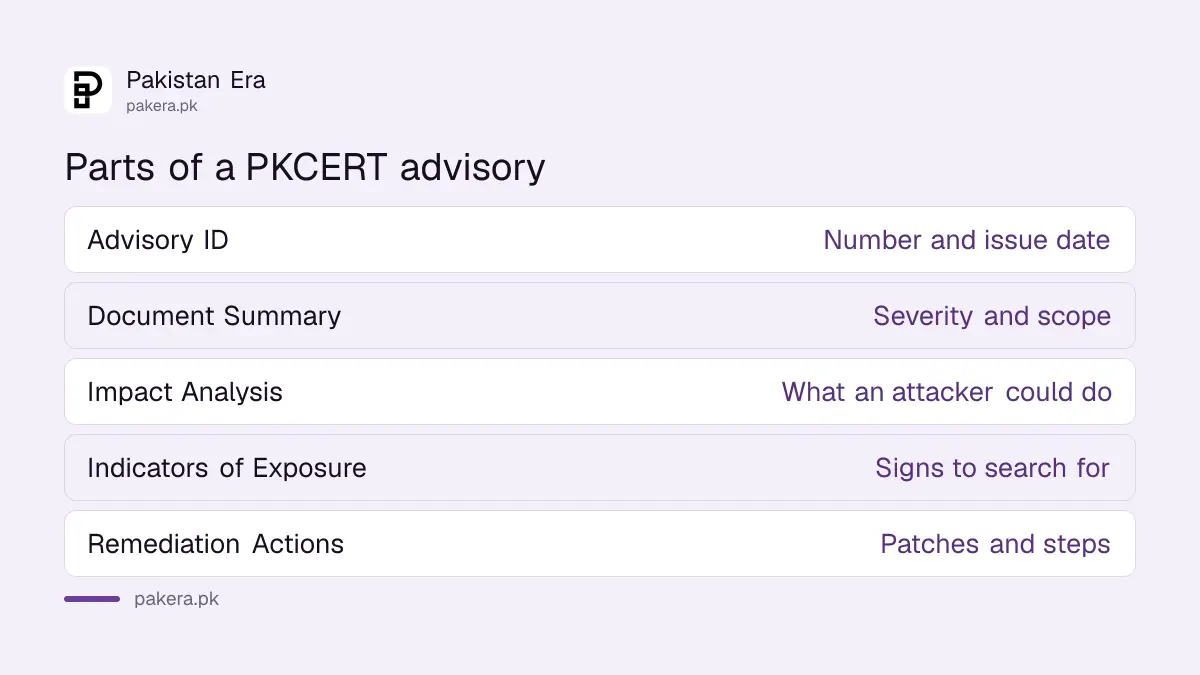
| Part of the advisory | What to look for | Why it matters |
|---|---|---|
| Advisory ID | Number and issue date | Tells you how old the facts are |
| Document Summary | Severity, scope, user action needed | Tells you if it is about you |
| Impact Analysis | What an attacker could do | Tells you what is at stake |
| Indicators of Exposure | Signs to search for | Tells you what to check |
| Remediation Actions | Patches and steps | Tells you what to do |
The Document Summary box tells you in ten seconds if it is about you
The box lists threat type, severity, attack vector, whether login is needed, whether a user must click, a risk rating and the scope. Scope names who is affected, such as government portals, banks, hosting providers or "all organisations running" a product.
Read "authentication required" and "user interaction" together. If both are none, as in the PHP advisory, an attacker needs no login and no click, so waiting is costly. If a user must click, awareness training helps. If the scope does not match anything you run, you can stop.
Remediation is a table of actions, and "mandatory" means act first
Each advisory has a Remediation Actions section, usually a table with categories like patch deployment, exposure reduction and monitoring. Items marked mandatory come first. A second table often lists vendor patch versions, which you compare with what you actually run.
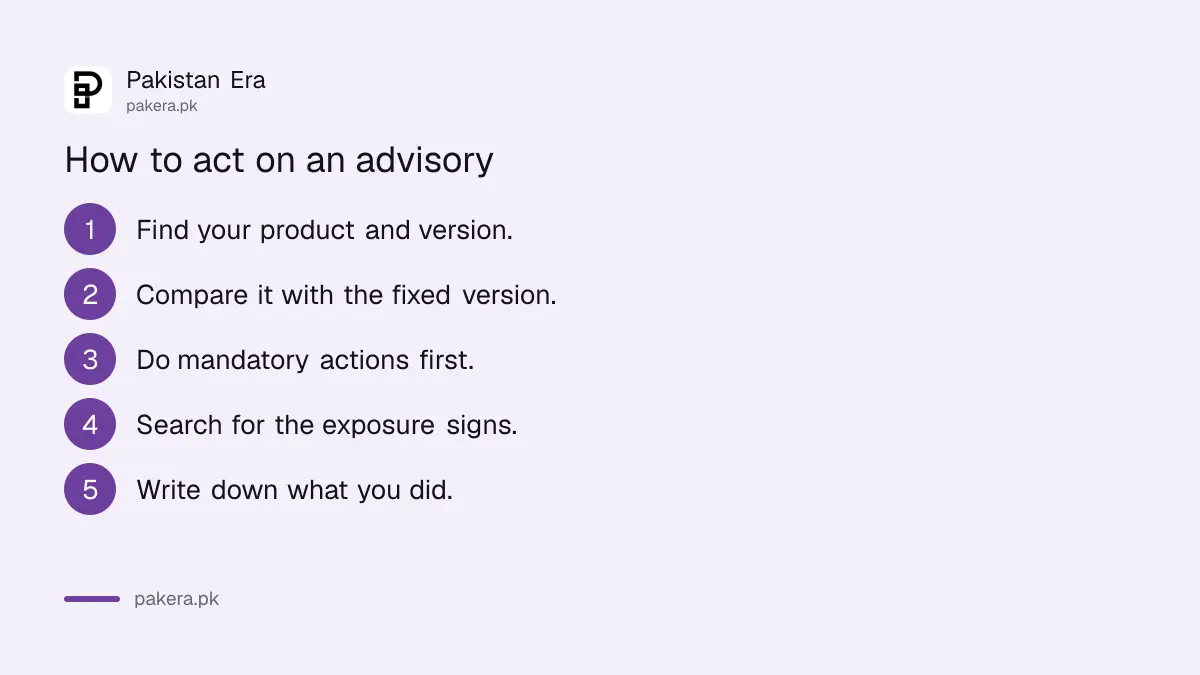
- Find the product and version you run in the vendor table.
- Check whether your version is older than the fixed one.
- Do the mandatory actions before the optional ones.
- Search your systems for the Indicators of Exposure.
- Write down what you did and when.
Treat community-sourced version numbers as leads, not proof
Advisory No 20 says some package versions come from a community-maintained remediation tracker, and tells readers to check the upstream project before deploying. That honesty is useful. Look for a verification status line or note in any advisory and follow it.
Advisory No 19 has a reference table that marks which sources are confirmed, partial or provisional. Where the advisory itself is unsure, confirm with the vendor's own page. For web software, that means the project's own site, such as the PHP project's page, before you rely on a number.
Report an incident using the contacts at the end
Every advisory page footer gives National CERT's address in Islamabad, a phone number and email. The incident advisories also give an incident portal and cert@pkcert.gov.pk. Use them if you find a sign of compromise, not for general questions.
For fraud and crime against a person, the route is different. See PKCERT or NCCIA: which one to report to. To avoid being fooled by a copied notice, check whether a viral government notice is fake and download advisories only from pkcert.gov.pk.
A worked example with the PHP advisory
Take advisory No 19. The ID shows number 19 and 21 October 2026. The summary box shows a severity of Critical, a score of 9.2, no user interaction and a scope that covers anyone running PHP on a public site. That alone tells a shop owner to ask the host about PHP.
Next, the remediation table lists asset identification, exposure reduction, patch deployment and monitoring. The patch table lists PHP 8.5, 8.4, 8.3 and 8.2 and says no upstream fix is expected for 8.1 and older. The indicators list names new PHP files in upload folders. In ten minutes you know what to ask, what to check and what to change.
The same method works for advisory No 21, which has a different shape: no software patch, but key rotation and log review. That is why reading the remediation table matters more than the headline.
Common questions about PKCERT advisories
Where do I find PKCERT advisories?
On the Advisories page of pkcert.gov.pk, which lists them by number for each year.
Are the advisories only for companies?
They are written for organisations and IT teams, but individuals and small shops can use them to learn what to update.
What does the severity rating mean?
It is National CERT's rating of the risk, such as High or Critical. The summary box also gives the technical score where one exists.
Do I need to do anything if I do not run the product?
No. Check the scope line, and if it does not match your systems, skip it.
How do I know an advisory is real?
Open it from pkcert.gov.pk itself, not a forwarded PDF. Fake notices circulate.
How we verified this
What we checked, where we read it, and what we could not confirm.
Last checked 22 October 2026. We read National CERT's advisories No 19, No 20 and No 21 in full, plus No 18 in part, and the list at pkcert.gov.pk/advisories. The advisory ID date format is our reading of the pattern. PKCERT does not publish a guide to its layout that we could find.
About the author

Technology Journalist & Multimedia Producer
Ahmad Ali is a technology journalist and multimedia producer at Pakistan Era, joining the team in October 2026. He covers consumer technology and digital life for Pakistani readers, combining research with hands-on product testing.