How to Register a Hindu Marriage in Punjab, KP, Balochistan and Islamabad: 15 Days and a Shaadiparat
Hindu marriages in Punjab, KP, Balochistan and Islamabad must be registered within 15 days for a shaadiparat. See the 4 conditions, documents and penalties.
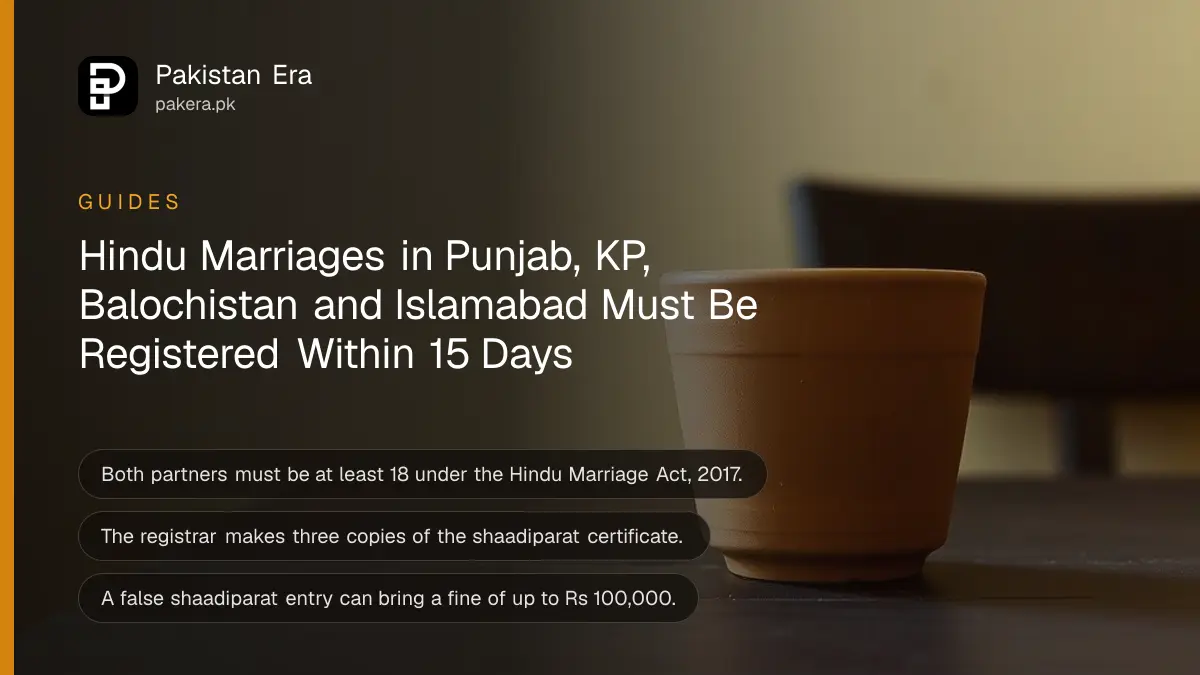
In Punjab, Khyber Pakhtunkhwa, Balochistan and Islamabad, a Hindu marriage must be registered within 15 days of the ceremony under the Hindu Marriage Act, 2017. The government-appointed marriage registrar, or a person he authorises from the local Hindu community, enters it in a shaadiparat, the official marriage certificate, made in three copies. Both partners must be at least 18, and failing to register can bring a fine of up to Rs 1,000 or three months in jail.
Sindh has its own law, so Hindu couples there follow a different process, set out in our guide to registering a Hindu marriage in Sindh. This page is for everyone else. We read the federal Hindu Marriage Act, 2017 on the Pakistan Code on 20 October 2026.
The 2017 Act was passed by Parliament after the Punjab, Khyber Pakhtunkhwa and Balochistan assemblies asked it to legislate, under Article 144 of the Constitution. That is why one federal law covers three provinces and the capital.
Four conditions make a Hindu marriage valid
Section 4 sets four conditions. Both partners must be of sound mind and able to consent. Both must be at least 18. They must not be within the prohibited degrees of relationship. And neither may have a living spouse, with one narrow exception.
| Condition | Rule in the Act | Effect if broken |
|---|---|---|
| Consent | Both of sound mind and able to give valid consent | Marriage voidable if consent was forced or obtained by fraud |
| Age | Both at least 18 | Voidable, plus 3 to 6 months' simple imprisonment or a fine up to Rs 5,000 |
| Relationship | Not within the prohibited degrees | Void, plus the same punishment as underage marriage |
| Living spouse | Neither may have a living spouse | Void, and treated as bigamy under the Penal Code |
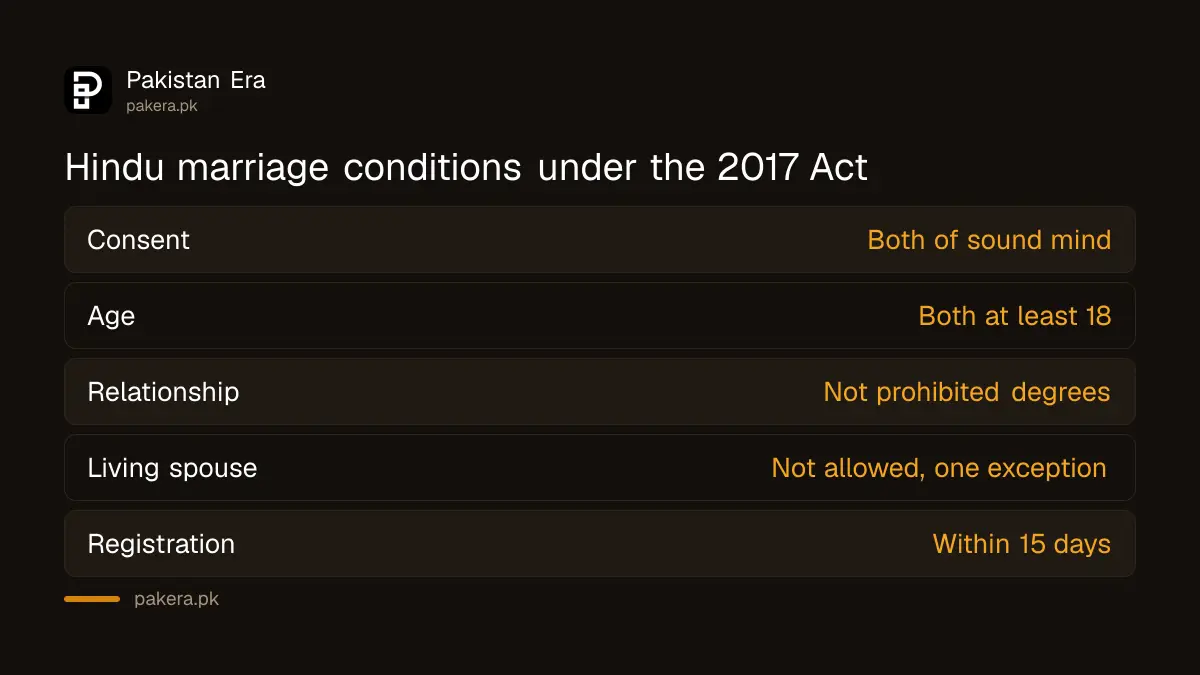
The exception to the living spouse rule is narrow. It applies only where the living wife cannot conceive a child and has been medically declared so. Outside that case, a second marriage while the first spouse lives is void.
Section 5 leaves the ceremony to the couple. The marriage may follow the customary rites and rituals of either partner. The law does not prescribe the ceremony. It prescribes the registration.
Register within 15 days through the marriage registrar
Section 6 makes registration compulsory within 15 days of the ceremony. The government appoints marriage registrars by gazette notification for each district or area, and a registrar can authorise a person from the local Hindu community to do the registration.
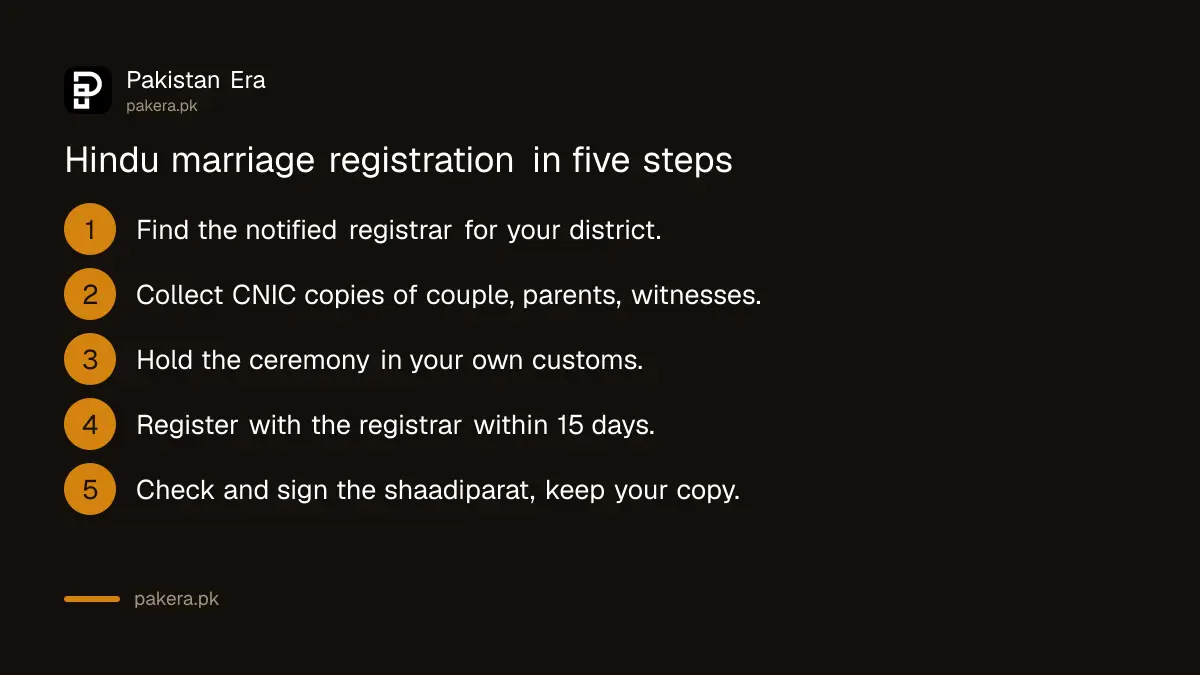
- Before the wedding, ask your mandir committee or union council who the notified Hindu marriage registrar is for your district.
- Collect CNIC copies of the bride, the groom, both fathers, both mothers and two witnesses.
- Hold the ceremony in your own customs.
- Within 15 days, give the particulars to the registrar or his authorised person.
- Check every entry on the shaadiparat before the bride, groom, witnesses and registrar sign.
- Keep your copy. The registrar keeps one as a public record, and each partner gets one.
The shaadiparat form in the Act's schedule asks for the date and place of marriage, the union council, tehsil and district, and for each partner their full name, CNIC, parents' names and CNICs, date of birth, temporary and permanent address, marital status and number of dependents. Two witnesses sign with their CNIC numbers.
Until rules are made, the Act says the schedule's shaadiparat is the form to use. The register is open for inspection, and certified extracts are available for a prescribed fee. We could not find the fee.
Penalties for late or false registration
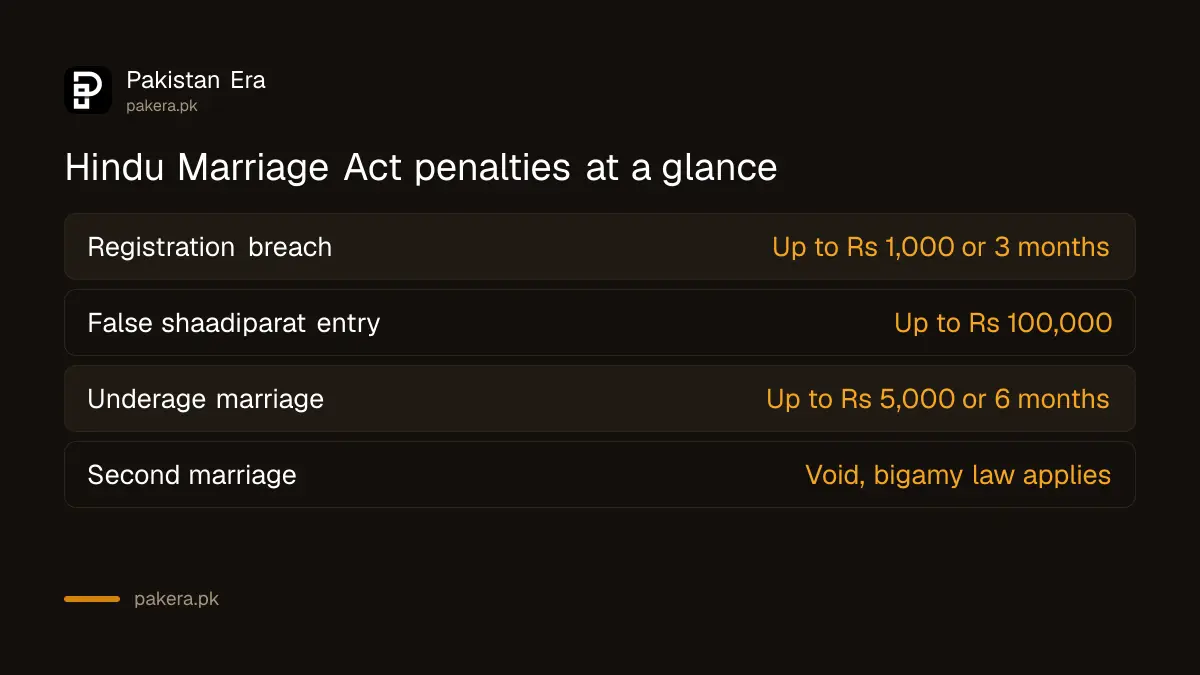
The Act punishes three things. Breaking the registration rules can bring up to three months' simple imprisonment, a fine up to Rs 1,000, or both. A false entry in the shaadiparat can bring one to six months, or a fine up to Rs 100,000. Underage or prohibited marriages carry three to six months, or up to Rs 5,000.
All these offences are non-cognizable, so the police cannot arrest without a court's order. Section 24 says they are tried by a Magistrate First Class, but only on a written complaint by the marriage registrar. In practice, the registrar is the person who starts any case.
The Act also covers separation and remarriage
Petitions under the Act go to the Family Court. Either partner can seek termination of the marriage on grounds such as cruelty, two years' desertion, conversion or serious illness. Couples living apart for a year or more can file jointly, and widows have a clear right to remarry after six months.
For mutual consent, section 15 needs both partners to petition together after living separately for a year or more. The court decides between six and 18 months after the petition. After a decree, section 16 lets either partner marry again six months after the final decision.
A wife has extra grounds in section 12(2). She can seek termination if the husband has not maintained her for two years, has been jailed for four years or more, or if she was married before 18 and repudiated the marriage before turning 18. Section 13 protects her financially. The court will not end the marriage without arrangements for the children's maintenance.
After registration, you may want your marital status changed on the CNIC. The steps to update your CNIC after marriage need a marriage certificate, and the shaadiparat is that document. In Punjab, a household may also qualify for the Punjab Minority Card.
Common questions
Where does the Hindu Marriage Act, 2017 apply?
In Islamabad Capital Territory, Punjab, Khyber Pakhtunkhwa and Balochistan. Sindh has its own Hindu marriage law.
How many days do we have to register a Hindu marriage?
Fifteen days from the ceremony, under section 6 of the Act.
What is a shaadiparat?
The certificate of a Hindu marriage issued by the marriage registrar. The Act's schedule sets its form, and three copies are made.
What is the minimum age for a Hindu marriage?
Eighteen for both partners. A marriage below that age can be annulled and is punishable.
Are marriages before 2017 still valid?
Yes. Section 19 says all Hindu marriages solemnized before the Act commenced are deemed valid.
Can a Hindu widow remarry?
Yes. Section 17 gives her the right to remarry of her own will six months after her husband's death.
How we verified this
What we checked, where we read it, and what we could not confirm.
We read the Hindu Marriage Act, 2017 (Act No. VII of 2017) on the Pakistan Code on 20 October 2026, including its shaadiparat schedule. We could not find notified rules, lists of marriage registrars by district, or the fee for a certified extract for Punjab, KP, Balochistan or Islamabad. Ask your district administration or union council which registrar is notified before the wedding.
About the author

Public Services and Education Journalist
Fajr Riaz is a journalist and content writer at Pakistan Era, based in Lahore. She covers the questions people meet in everyday life in Pakistan: how a public service works, what a change in the rules means, and where to find a reliable answer.