How to Register a Hindu Marriage in Sindh: 45 Days, Union Council and Certificate
Register a Hindu, Jain or Sikh marriage in Sindh: the 45 day deadline, Union Council, four certificate copies, two witnesses and how old marriages are recorded.
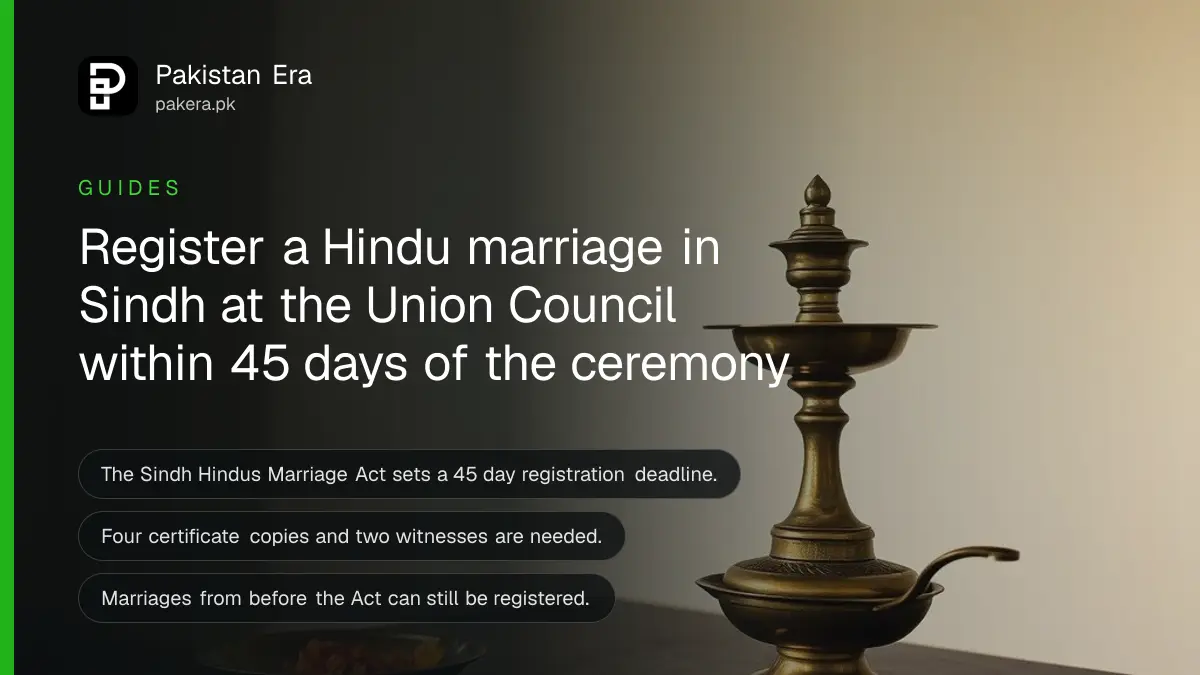
Short answer: A Hindu, Jain or Sikh marriage in Sindh must be registered with the Union Council or ward where the ceremony took place, within 45 days. You take four filled copies of the marriage certificate, two witnesses and the couple's CNICs. The officer stamps the entry, keeps one copy and gives the rest back to you.
The certificate is the proof you will need later for a CNIC change, a passport, a spouse visa or an inheritance claim. Sindh has its own law for this. The other provinces and Islamabad follow a different, federal Act with a 15 day limit, set out in how to register a Hindu marriage in Punjab, KP, Balochistan and Islamabad.
We read the Sindh Hindus Marriage Act, 2016 (Sindh Act No. IX of 2016), published by the Provincial Assembly on 12 April 2016, again on 8 November 2026. It applies to Hindus in Sindh. We did not visit a Union Council or test the process, so the steps below are the Act's own.
The law covers Hindu, Jain and Sikh marriages in Sindh
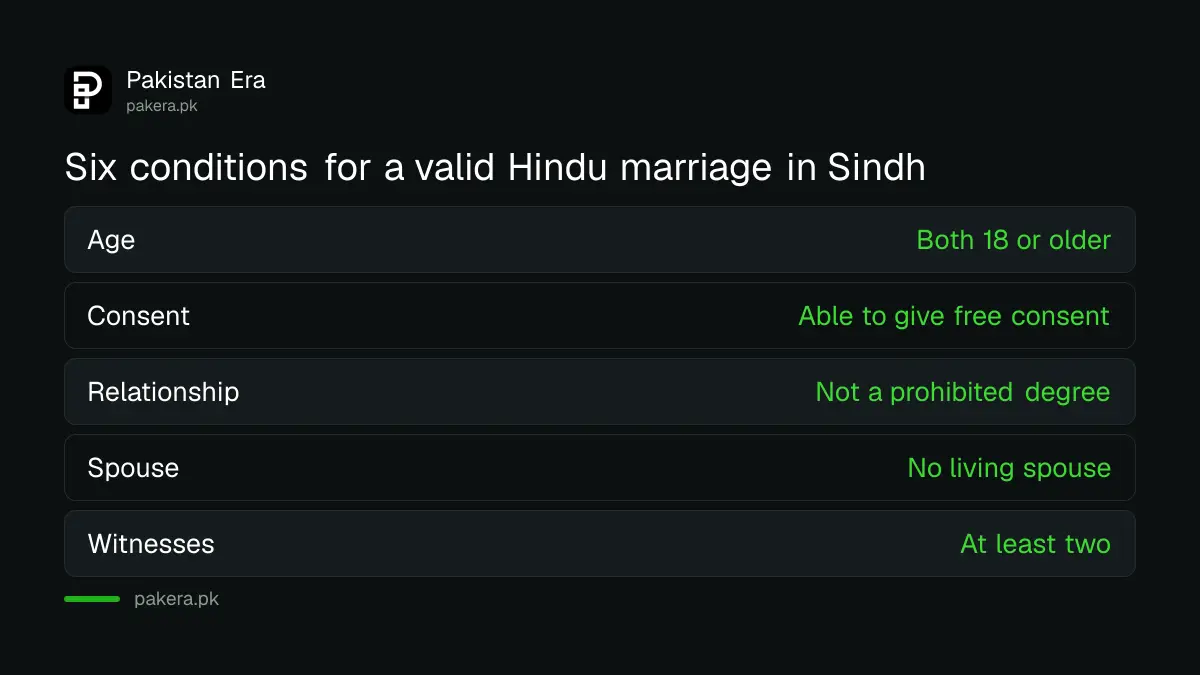
The Act extends to all Hindus in Sindh and defines a Hindu as a person who practises the Hindu, Jain or Sikh religion in any form. A marriage under it must meet six conditions, and the ceremony itself can follow the customs of either side.
- Both parties are 18 years or older.
- Both are able to give consent.
- Both give free consent, without pressure or fraud.
- They are not within a prohibited degree of relationship.
- Neither has a living spouse at the time.
- At least two witnesses are present at the solemnisation and registration.
The Act describes free consent as informed and voluntary agreement given without coercion, undue influence, fraud or misrepresentation, by an adult with full capacity.
Register within 45 days at the Union Council or ward
Every marriage must be registered with the Union Council, ward or other municipal authority where the ceremony took place, within 45 days of the solemnisation. The authority's concerned officer keeps the register and issues the certificate.
Count 45 days from the day of the ceremony, not the day of the engagement or the reception. The place that counts is where the marriage ceremony was held. If it was held in a hall in Hyderabad, go to the office that covers that hall.
| Item | What the Act says |
|---|---|
| Deadline | 45 days from the ceremony |
| Where | Union Council, ward or other municipal authority at the place of the ceremony |
| Forms | Four copies of the certificate of marriage (Schedule A) |
| Witnesses | At least two, present at solemnisation and registration |
| Who signs the register | The person solemnising, both parties, two witnesses and the officer |
| Fee | Set by government notification; we could not find it |

Four certificate copies are signed and stamped
The couple fill out four copies of the certificate in Schedule A and give them to the concerned officer. The officer checks the six conditions, certifies the certificate, keeps one copy and returns the rest to the parties.
The Schedule A form asks for the union council name, the date of marriage, and for each party the full name, CNIC number, father's and mother's names with CNIC numbers, age, addresses, marital status and religion. It then asks for the signatures of the bride and groom, the names and CNICs of the witnesses, the signature of the pandit, maharaj or person who solemnised it, and the officer's stamp.
Bring both CNICs, both parents' CNIC numbers, two witnesses with CNICs, and the person who solemnised the marriage if they can attend. Every entry in the register must carry the official stamp and be signed by all those listed.
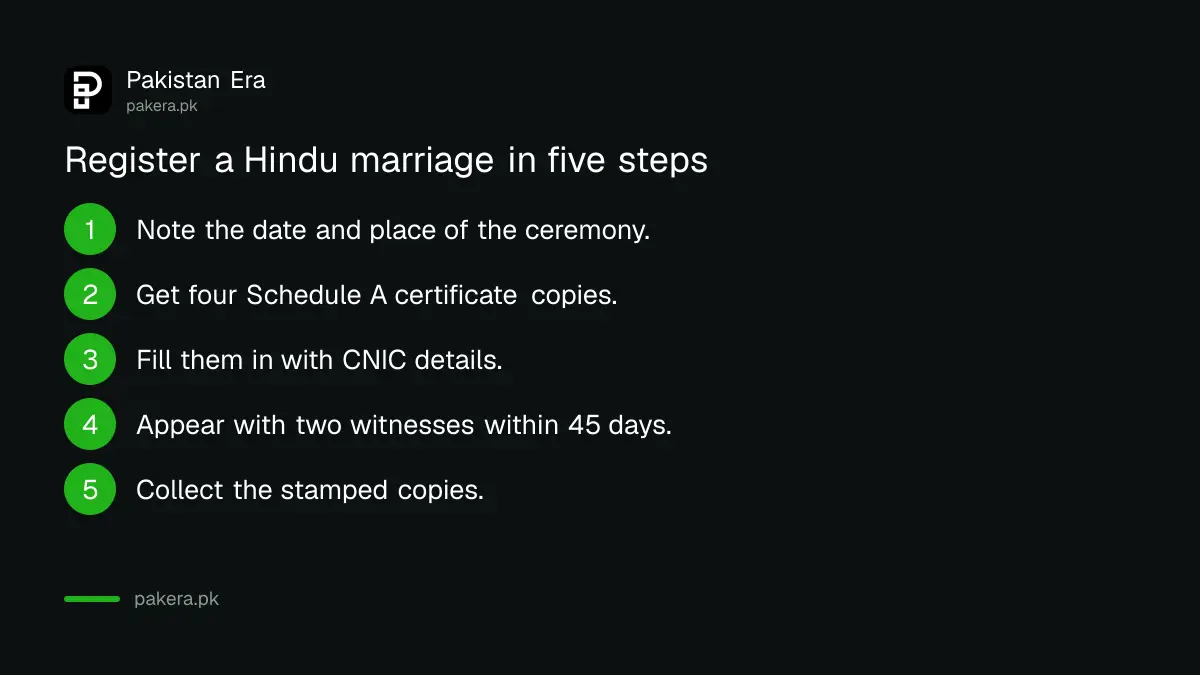
- Hold the ceremony and note its date and place.
- Get four copies of the Schedule A certificate from the Union Council.
- Fill them in with the details above.
- Appear with two witnesses before the concerned officer within 45 days.
- Collect the stamped copies and keep one safe.
Older marriages can still be registered
The Act has retrospective effect. A marriage solemnised before the Act came into force can be registered with the same procedure. The Act does not set a separate deadline for them, so a couple married years ago can still go to the Union Council.
This helps families whose marriages were never recorded. A registration certificate can then support a change of marital status on the CNIC, as in how to update your CNIC after marriage. General rules on marriage papers for other communities are in the guide to nikah registration.
The text we read shows the section on punishment for non-registration as omitted. Earlier reports spoke of a Rs 1,000 fine. We could not confirm any fine from the Act, so do not rely on one, and do not treat the deadline as optional either. A late registration is better than none. If a family member is pressured into a marriage or faces violence, see how to get a protection order in Sindh.
Using the certificate abroad or after a divorce
A spouse visa application usually asks for a marriage certificate attested by the Ministry of Foreign Affairs. The MOFA steps are the same for any marriage certificate issued in Pakistan, and they are set out in how to attest a nikah nama at MOFA for a spouse visa. Get the Union Council entry first, because MOFA attests only a certificate that is already registered.
The Sindh Act we read covers registration only. For Muslim couples, divorce registration runs through the union council's arbitration council under a different law; the Islamabad version is in how to register a divorce in Islamabad. Ask a lawyer before you assume either process applies to a Hindu marriage.
Common questions
Is registration compulsory for Hindu marriages in Sindh?
Yes. The Act says every marriage solemnised under it shall be registered within 45 days. We found no penalty in the text we read.
Which religions does the Act cover?
It covers a person who practises the Hindu, Jain or Sikh religion in any form. The certificate form also lists Buddhist as a religion option.
Where do I register?
Register at the Union Council, ward or other municipal authority where the marriage ceremony took place. The concerned officer keeps the Marriage Register.
What is the minimum age?
Both parties must be 18 or older. The Act also requires free consent and at least two witnesses.
How much does registration cost?
The Act leaves the fee to a government notification. We could not find that notification, so ask the Union Council for the rate in writing.
Can I register a marriage that happened years ago?
Yes. The Act has retrospective effect and allows earlier marriages to be registered with the same procedure.
How we verified this
What we checked, where we read it, and what we could not confirm.
We read the Sindh Hindus Marriage Act, 2016 as hosted by the Sindh Prosecution Department. That text already shows section 8 (the penalty) as omitted, so it reflects at least one later change. We did not find the fee notification or the rules framed under section 10. This page is general information, not legal advice.
Last checked 8 November 2026. Source: Sindh Hindus Marriage Act, 2016 (Sindh Prosecution Department).
About the author

Senior Writer, Public Services and Technology
Shahid joined us in 2024 as an author. He is a senior contributor to Pakistan's leading technology websites. He writes detailed articles, mostly covering his expertise in the latest tech, mobiles, apps, gadgets, and step-by-step guides. His ideology is to help people understand the latest trends and explain complex methods through very easy-to-understand guides.