How to Claim Workers' Compensation for Injury or Death at Work in Sindh
Claim workers' compensation in Sindh for an injury or death at work. Rs 500,000 for death, injury percentages, the notice, the Commissioner and the appeal.
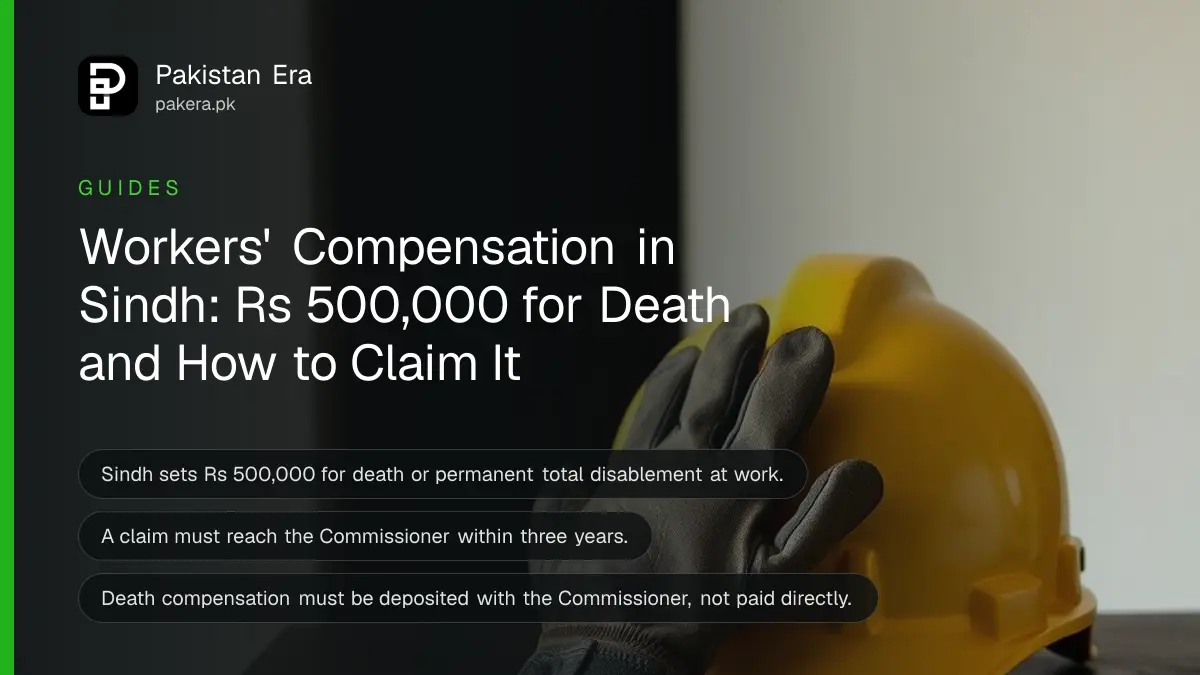
In Sindh, a worker hurt at work, or the family of a worker who died, claims compensation from the employer before the Commissioner for Workers' Compensation under the Sindh Workers' Compensation Act, 2015. Death or permanent total disablement is Rs 500,000. Give the employer notice as soon as you can, and file the claim within three years of the accident or death.
A factory floor in Korangi or a construction site in Hyderabad does not need to be careless for an accident to happen. When it does, the law puts the cost on the employer, whether or not anyone was at fault. The worker does not have to prove negligence.
| Result of the injury | Compensation under the Sindh Act |
|---|---|
| Death | Rs 500,000, deposited with the Commissioner for the dependants |
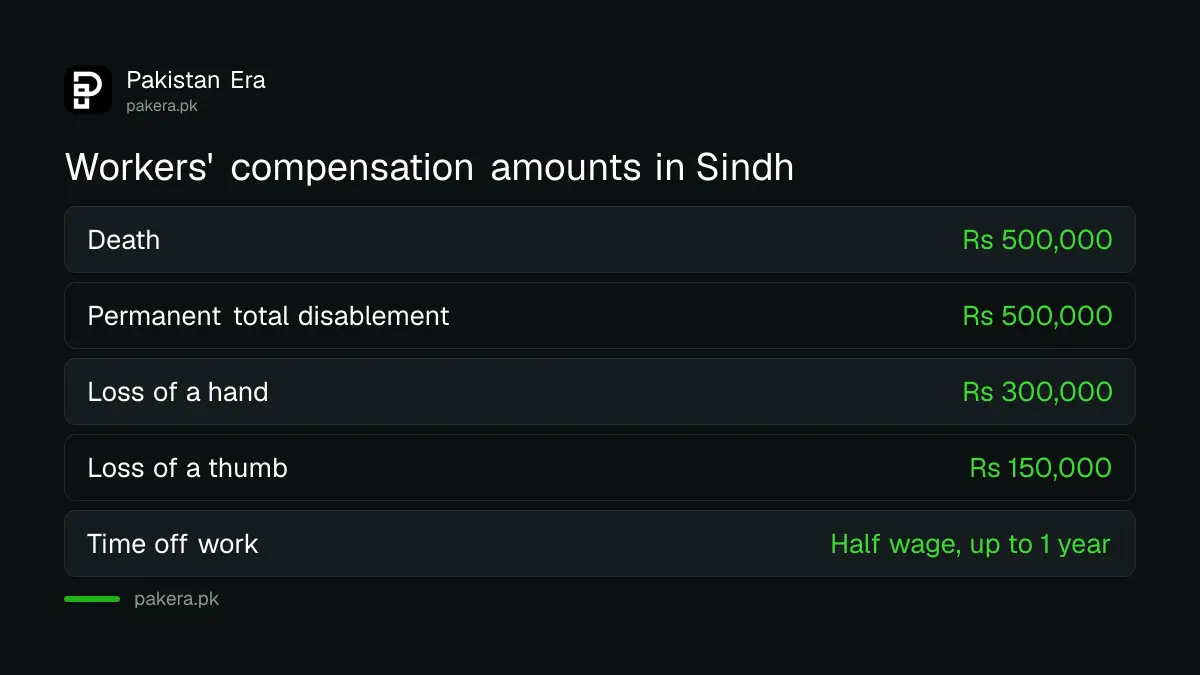
| Permanent total disablement | Rs 500,000 |
| Permanent partial disablement | A percentage of Rs 500,000, set by Schedule I |
| Temporary disablement | Half the monthly wage, paid half-monthly, for up to one year |
| Occupational disease | Half the monthly wage for up to five years |
The employer pays for any injury from an accident at work
Section 3 of the Sindh Workers' Compensation Act makes the employer liable when a worker is injured by an accident arising out of and in the course of the job. It covers factories, industrial and commercial establishments and mines, for skilled, unskilled, manual and clerical work.
The employer escapes liability in only a few cases. An injury that keeps you off work for four days or less is not covered. For injuries other than death, the employer is also not liable if the accident was directly caused by the worker being drunk or on drugs, by wilful disobedience of a safety order, or by wilfully removing a safety guard.
Death is treated differently. Those exceptions do not apply when the worker dies, so the family can claim even if the employer says the worker broke a rule.
Some diseases count as an accident too. Schedule III lists occupational diseases, including tuberculosis and silicotuberculosis. If a worker who has been with the employer for at least six months gets one of them, the law presumes it came from the job unless the employer proves otherwise.
Partial disablement is a percentage of Rs 500,000
For a permanent injury that leaves you able to do some work, the Act pays a share of the Rs 500,000 permanent total figure. Schedule I lists the share for each injury. Loss of a hand is 60 per cent, Rs 300,000. Loss of a thumb is 30 per cent, Rs 150,000.
| Injury (Schedule I) | Loss of earning capacity | Compensation |
|---|---|---|
| Amputation through the shoulder joint | 90% | Rs 450,000 |
| Loss of four fingers of one hand | 70% | Rs 350,000 |
| Loss of a hand | 60% | Rs 300,000 |
| Loss of one eye, the other normal | 40% | Rs 200,000 |
| Loss of a thumb | 30% | Rs 150,000 |
| Loss of a whole index finger | 14% | Rs 70,000 |
When one accident causes more than one injury, the percentages are added, up to 100 per cent. An injury not listed in Schedule I is paid in proportion to the earning capacity it takes away, which a doctor assesses.
For time off work, the payment is half your monthly wage, paid every half month. It starts after a waiting period of four days and runs for the length of the disablement or one year, whichever is shorter. For a worker with at least 12 months' service, the monthly wage is one-twelfth of the wages due in the last 12 months.
Give notice to the employer, then file with the Commissioner
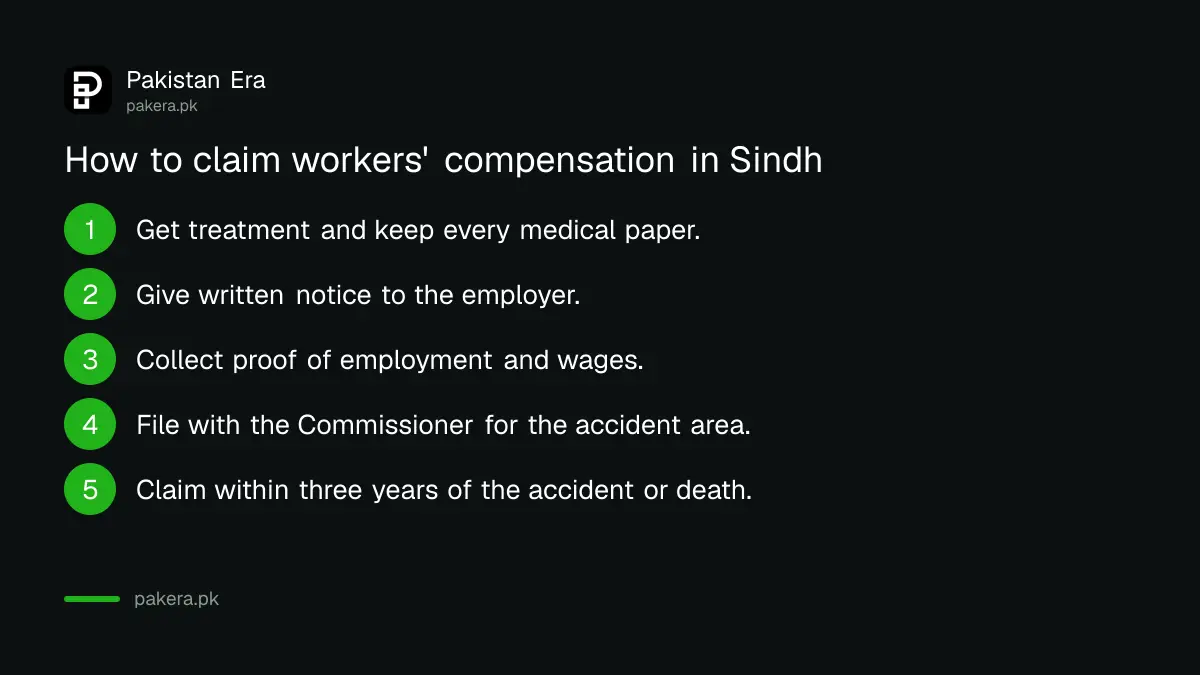
Write to the employer as soon as you can after the accident, with the injured worker's name and address, the cause of the injury in plain words and the date. Then file a claim with the Commissioner for Workers' Compensation for the area where the accident happened, within three years.
- Get medical treatment and keep every hospital slip and report.
- Send written notice to the employer or the manager: name, address, cause and date of the accident. Hand it over, send it by registered post, or write it in the notice book if the workplace keeps one.
- Collect proof of employment: an appointment letter, pay slips, a bank statement showing wages, or co-workers who can confirm it.
- Go to the Labour Directorate office for your area and ask for the Commissioner for Workers' Compensation. The Act says the Commissioner is an officer of BPS-18 or above from the Directorate of Labour.
- File the application with the facts, the relief you want, the names and addresses of both sides and the date you served notice.
- If you cannot write it, the Commissioner can have it prepared for you. Section 27 says so.
- Attend the hearings. The employer may be told to send you for a free medical examination.
A missing or late notice does not kill the claim. The Commissioner can still hear it if the worker died on the employer's premises, if the employer already knew of the accident, or if there was sufficient cause for the delay.
Death compensation must go through the Commissioner
When a worker dies, the employer cannot hand the compensation to the family directly. Section 8 says it must be deposited with the Commissioner, and a direct payment does not count as compensation. The Commissioner then divides it among the dependants and pays funeral costs up to Rs 20,000.
The employer may give the family advances of up to Rs 50,000 in total. These are taken off the compensation later. If the Commissioner learns of a death from any source, he can order the employer to send a statement within 30 days, and an employer who accepts liability must deposit within 30 days of that notice.
Dependants come in two groups. Widows, minor sons, unmarried daughters and a widowed mother qualify without proof of dependency. A widower, other parents, minor brothers, unmarried or widowed sisters and some grandchildren qualify only if they depended on the worker's earnings. The same pattern applies to the WWF death grant, which is a separate claim.
Know the limits before you go to court
Choose one route. A worker who files a civil suit for damages loses the right to claim under this Act, and a worker who files with the Commissioner cannot then sue in a civil court. An appeal against the Commissioner's order goes to the Tribunal within 60 days.
An appeal is allowed only on a substantial question of law, and usually only where at least Rs 50,000 is in dispute. An employer who appeals a lump sum award must first deposit the amount with the Commissioner. Unpaid awards are recovered like arrears of land revenue.
Workers registered with SESSI can also get medical care and cash benefits from the social security scheme, set out under SESSI benefits in Sindh. Safety duties on the employer are covered in workplace safety rules in Pakistan.
Common questions
How much compensation is paid for death at work in Sindh?
Rs 500,000 under Schedule IV of the Sindh Workers' Compensation Act, 2015, deposited with the Commissioner for the dependants.
What is the time limit for a workers' compensation claim in Sindh?
Three years from the accident, or three years from the date of death. The Commissioner can accept a late claim for sufficient cause.
Does the worker have to prove the employer was careless?
No. The employer is liable for an accident arising out of and in the course of the job, subject only to the exceptions in section 3.
Is a daily wage or contract worker covered?
The Act covers any person employed for hire or reward, whether the terms are written or not. A worker lent to another firm is covered by the firm using the worker at the time.
Can the employer pay the family directly and settle?
Not for a death. Section 8 says death compensation must be deposited with the Commissioner, and a direct payment is not treated as compensation.
Where do I appeal the Commissioner's order?
To the Tribunal under the Sindh Industrial Relations Act, 2013, within 60 days.
How we verified this
What we checked and where we read it.
Last checked 24 November 2026. We read the full text of the Sindh Workers' Compensation Act, 2015 (Sindh Act No. VII of 2016) on the Sindh Code portal: sections 2, 3, 4, 5, 8, 10, 11, 25, 26, 27 and 36, Schedule I (injury percentages) and Schedule IV (amounts). The compensation figures in the tables are Schedule I percentages applied to the Schedule IV figure of Rs 500,000. The Act names the Commissioner as an officer of the Directorate of Labour, appointed by notification for each local area.
Free on WhatsApp
Get last dates and rule changes on WhatsApp
We post new last dates, fee changes and fixes for common problems, a few short posts a day.
Follow Pakera on WhatsAppOther followers cannot see your number.
Pakera Solves It
Which online process wasted your time this week?
A portal that will not load, a form nobody explains, a complaint that went nowhere. Tell us. Every week we pick one, solve it step by step and publish the answer.
About the author

Tax, Bills and Technology Writer
Ali Akhtar is a young and curious voice here at Pakistan Era. He is currently pursuing his A-Levels and has a growing interest in Pakistan’s changing industrial landscape and educational trends. Ali likes to write in a way that helps him explain and explore the world around him. His writing reflects the perspective of the new generation navigating the evolving trends of Pakistan where technology, youth innovation, and shifting opportunities are reshaping the country’s future.