What Your Workplace Must Provide by Law in Pakistan
Water points must be marked in a language most workers read, toilets separated by sex, and an injury costing two days off is notifiable.
Drinking water points must be marked, in a language most workers understand, and must not sit within twenty feet of a latrine or washing place. That level of detail is in the law, and almost nobody knows to look for it.
We read the Factories Act, 1934 on 6 September 2026, in the text published by the Law and Parliamentary Affairs Department, Government of the Punjab.
Drinking water, and the twenty foot rule
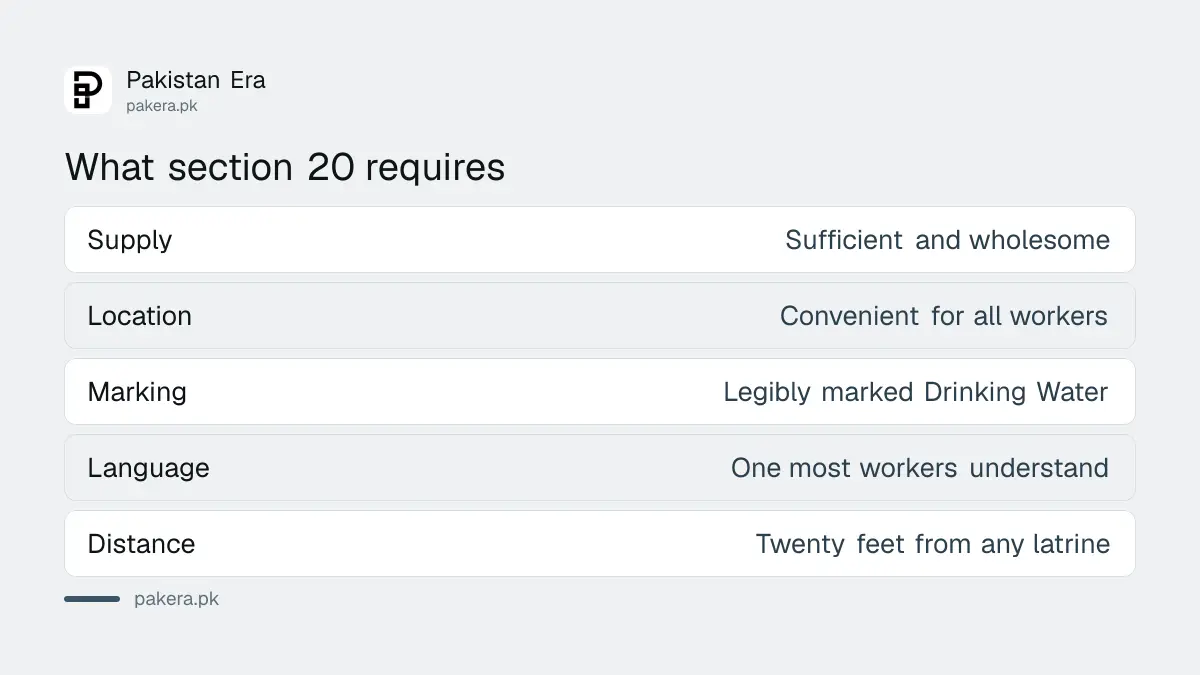
Section 20 requires every factory to make effective arrangements to provide and maintain, at suitable points conveniently situated for all workers, a sufficient supply of wholesome drinking water.
| Requirement | What section 20 says |
|---|---|
| Supply | Sufficient and wholesome |
| Location | Suitable points convenient for all workers |
| Marking | Legibly marked "Drinking Water" |
| Language | One understood by the majority of workers |
| Distance | Not within twenty feet of a washing place, urinal or latrine |
The twenty foot rule can be shortened, but only if the Chief Inspector approves it in writing. A verbal decision by a manager is not that approval.
The language requirement is the part worth noticing. A sign in English in a workplace where most people read Urdu does not meet what the section describes.
Latrines, and the separation requirement
Section 21 requires sufficient latrines and urinals of prescribed types, conveniently situated and accessible to workers at all times while they are in the factory.
It then requires that enclosed latrines and urinals be provided separately for male and female workers. Separately is the operative word, and "at all times while they are in the factory" rules out facilities locked outside certain hours.
Fire escape is a legal requirement with an enforcement route
Section 25 requires every factory to be provided with such means of escape in case of fire as may be prescribed.
It also creates the mechanism that matters. If it appears to the Inspector that a factory is not provided with the prescribed means of escape, he may serve a written order on the manager specifying the measures that should be adopted, before a date specified in the order.
So this is not advisory. There is an inspector, a written order, and a deadline. Our guide to what Rescue 1122 actually does covers the emergency service that handles fires and building collapse, and the community safety training it offers to workplaces.
Accidents that must be notified
Section 33N sets the threshold for a notifiable accident, and it is lower than people assume.
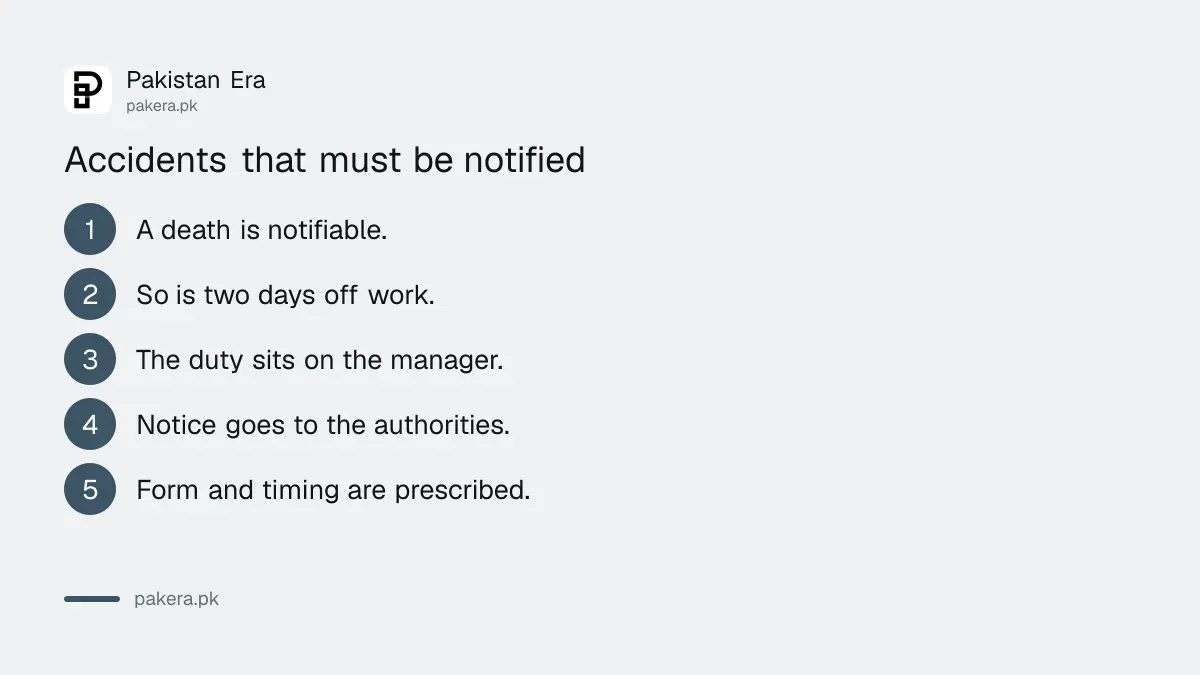
Where an accident in a factory causes death, or causes bodily injury that prevents the injured person from resuming work in the factory during the forty-eight hours after it occurred, or is of a prescribed nature, the manager shall send notice to the prescribed authorities, in the prescribed form and within the prescribed time.
- A death is notifiable.
- So is an injury keeping someone off work for forty-eight hours.
- The duty sits on the manager, not the injured worker.
- Notice goes to the authorities, not just into an internal file.
- Form and timing are prescribed rather than optional.
Two days off work is a low bar. An injury that keeps somebody home for two days is exactly the kind that gets recorded as an internal matter and goes no further, and the section says otherwise.
The wider health chapter
The same chapter covers cleanliness, disposal of wastes and effluents, ventilation and temperature, dust and fume, artificial humidification, overcrowding and lighting, each with its own section.
There are also provisions on precautions against contagious or infectious disease, on compulsory vaccination and inoculation, on rules for the provision of canteens, and for a Welfare Officer.
We have not set out each of those in detail here. The point worth taking is that the list is long and specific, so a complaint about conditions is usually a complaint about a named section rather than a general grievance.
Machinery has its own set
Fencing of machinery, work on or near machinery in motion, striking gear and devices for cutting off power, casing of new machinery, cranes and lifting machinery, hoists and lifts, revolving machinery, pressure plant, floors and stairs, pits and openings, excessive weights, protection of eyes, dangerous fumes and explosive or inflammable dust each have their own section in the Act.
Two of them restrict who may be employed on particular work. Section 28 deals with the employment of young persons on dangerous machines, and section 32 prohibits the employment of women and children near cotton openers.
What this Act covers
The Factories Act applies to factories as defined in it, which does not include every workplace. Offices, shops and other establishments fall under separate provincial legislation.
Labour is a provincial subject and the text we read is the Punjab one. Our guide to what your employer must display at work covers the notice board requirements, and our guide to overtime and working hours covers hours and double pay from the same Act.
Common questions
Does my workplace have to provide drinking water?
Section 20 requires a sufficient supply of wholesome drinking water at points convenient for all workers.
Do the water points have to be labelled?
Yes, legibly marked "Drinking Water" in a language understood by the majority of workers.
How far must water be from toilets?
Not within twenty feet, unless the Chief Inspector approves a shorter distance in writing.
Must toilets be separate for men and women?
Section 21 requires enclosed latrines and urinals provided separately for male and female workers.
Which accidents must be reported?
A death, or an injury preventing the person from resuming work during the forty-eight hours after it occurred, or a prescribed type.
Who reports an accident?
The manager of the factory, to the prescribed authorities.
How we verified this
What we checked, where we read it, and what we could not confirm.
Last checked 6 September 2026. We downloaded the Factories Act, 1934 from the Punjab Code portal at punjablaws.punjab.gov.pk, in the text published by the Law and Parliamentary Affairs Department, Government of the Punjab, and read it. Section 20 requiring effective arrangements for a sufficient supply of wholesome drinking water at suitable points, the marking of those points as "Drinking Water" in a language understood by the majority of workers, and the prohibition on siting them within twenty feet of a washing place, urinal or latrine unless a shorter distance is approved in writing by the Chief Inspector; section 21 requiring sufficient latrines and urinals of prescribed types conveniently situated and accessible at all times, provided separately for male and female workers; section 25 requiring prescribed means of escape in case of fire and empowering an Inspector to serve a written order on the manager specifying measures and a date; and section 33N requiring the manager to notify accidents causing death or preventing a person resuming work during the forty-eight hours after the accident, are all taken from that text. The section headings for cleanliness, wastes and effluents, ventilation, dust and fume, humidification, overcrowding, lighting, contagious disease, vaccination, canteens, the Welfare Officer and the machinery provisions are also taken from that text, and we have not set out their contents here. The Act applies to factories as defined in it, and labour is a provincial subject. Nothing here is legal advice.
About the author

Tax, Bills and Technology Writer
Ali Akhtar is a young and curious voice here at Pakistan Era. He is currently pursuing his A-Levels and has a growing interest in Pakistan’s changing industrial landscape and educational trends. Ali likes to write in a way that helps him explain and explore the world around him. His writing reflects the perspective of the new generation navigating the evolving trends of Pakistan where technology, youth innovation, and shifting opportunities are reshaping the country’s future.