Overtime Pay and Working Hours in Pakistan
Overtime starts after nine hours a day or forty-eight a week, and it is paid at double. What counts towards your ordinary rate.
Overtime is paid at twice your ordinary rate. Not time and a half, not a flat allowance. Double.
It starts after nine hours in a day or forty-eight hours in a week, and it is in the Factories Act, 1934, which we read on 6 September 2026 in the text published by the Law and Parliamentary Affairs Department, Government of the Punjab.
The thresholds
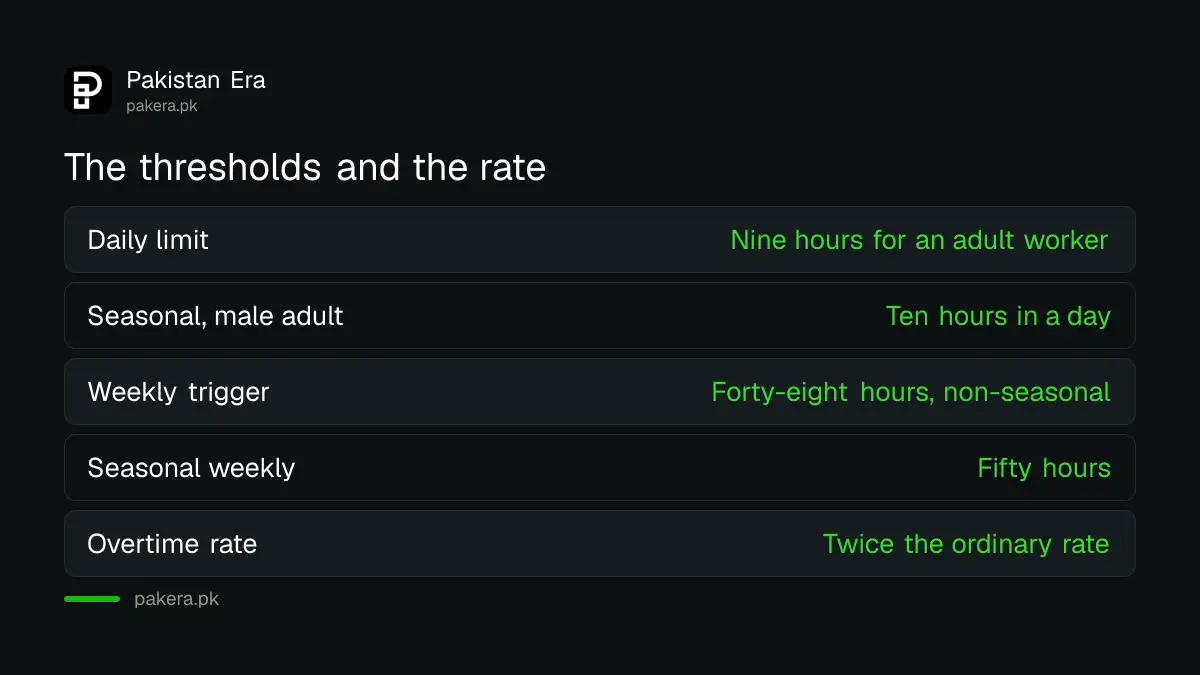
| Situation | What the Act says |
|---|---|
| Daily limit | Nine hours for an adult worker |
| Seasonal factory, male adult | Ten hours in a day |
| Overtime trigger, non-seasonal | Over nine hours a day or forty-eight a week |
| Overtime trigger, seasonal | Over nine hours a day or fifty a week |
| Overtime rate | Twice the ordinary rate of pay |
Note that the weekly trigger works on its own. Nine hours a day across six days is fifty-four hours, so a worker can stay inside the daily limit every single day and still be owed overtime on the week.
What counts as your ordinary rate
Section 47 defines it, and the definition is wider than basic salary.
Ordinary rate of pay means all remuneration capable of being expressed in terms of money which would be payable to a worker if the terms of the contract were fulfilled. It then excludes the value of house accommodation, supply of light, water, medical attendance and other amenities.
So allowances paid in money are part of the base the doubling applies to, while accommodation and utilities provided in kind are not. If your overtime is being calculated on basic pay alone while you also receive cash allowances, that is worth a question.
You can be required to work it
Section 47-A is short and worth knowing before you refuse. Any adult worker may be required to work overtime, provided the working conforms to the Act and the rules made under it.
So overtime is not automatically voluntary. What it is, always, is payable at double, and the daily and weekly limits still apply on top.
Rest intervals are separate from hours
Section 37 requires periods of work in a day to be fixed so that no period exceeds six hours, and so that no worker works more than six hours before having an interval for rest.
That is not the same as a lunch break by custom. It is a limit on how long a stretch of work can run before a break is due, and it applies regardless of how the total day is arranged.
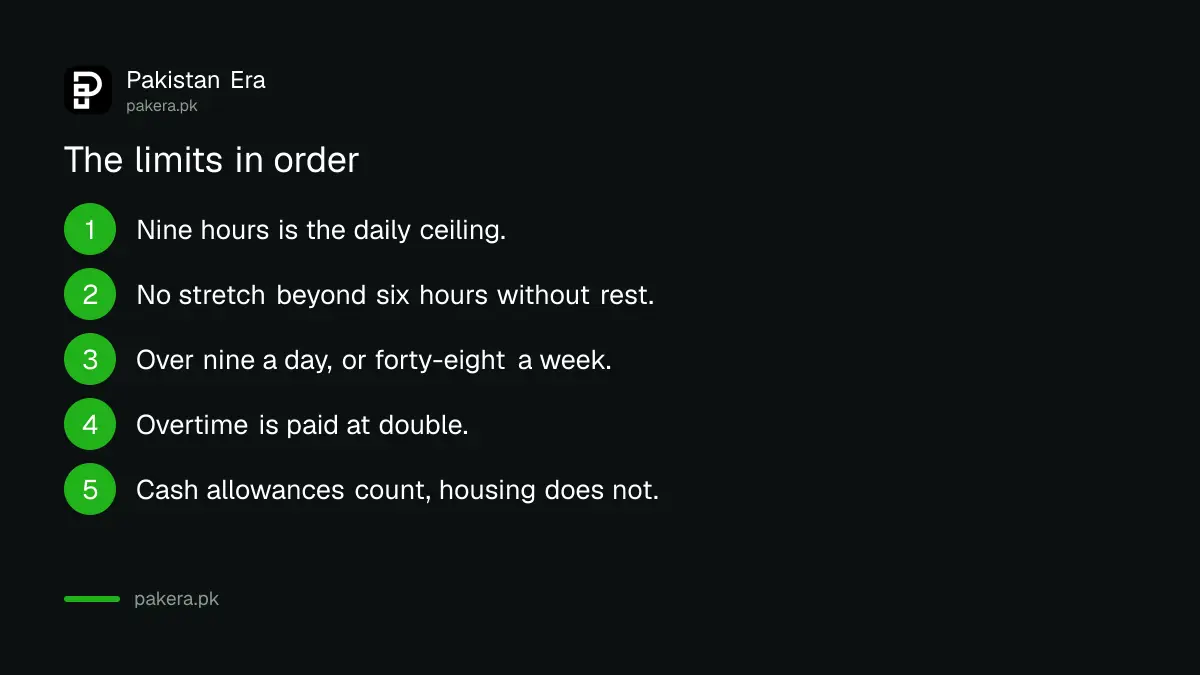
- Nine hours is the daily ceiling for an adult worker.
- No single stretch may exceed six hours without a rest interval.
- Over nine in a day, or forty-eight in a week, is overtime.
- Overtime is paid at twice the ordinary rate.
- Ordinary rate includes cash allowances, not accommodation.
You cannot be worked across two factories
Section 48 restricts double employment. No adult worker shall be allowed to work in any factory on a day on which he has already been working in another factory, except in prescribed circumstances.
That matters where one owner runs two units and moves people between them. Hours worked in the first do not reset because the second is a different registered factory.
Night shifts and which day they count against
Section 46 deals with a shift that runs past midnight, and it decides which day your hours land on.
Where a worker works a shift extending over midnight, the ensuing day is deemed to be the twenty-four hours beginning when that shift ends, and the hours worked after midnight count towards the previous day. The Chief Inspector may direct otherwise for a specified factory or class of workers.
That rule is what stops a night shift being counted twice, or being split so that neither day appears to breach the limit.
What this Act covers, and what else applies
The Factories Act applies to factories as defined in it. Many other employees are covered by the Standing Orders Ordinance instead, and shops and offices fall under separate provincial legislation.
Our guide to leave entitlement at work covers annual, casual, sick and paternity leave from the same Act, and our guide to what your employer must display covers the requirement that working hours and wage rates are posted where you can read them.
Labour is a provincial subject, so each province administers its own version with its own amendments. The text we read is the Punjab one.
If overtime is not being paid
Keep your own record of hours, daily, with dates. A dispute about overtime is almost always a dispute about how many hours were worked, and the worker with a contemporaneous record is in a very different position from the one relying on memory.
Our guide to misconduct and dismissal rules sets out the process an employer must follow if raising it leads to trouble, including the requirement for written notice within one month and an independent inquiry.
Common questions
What is the overtime rate in Pakistan?
Section 47 entitles a worker to pay at twice the ordinary rate of pay for overtime worked.
When does overtime start?
After more than nine hours in a day, or more than forty-eight hours in a week in a non-seasonal factory. Seasonal factories use fifty hours a week.
What is the daily hours limit?
Nine hours for an adult worker, with ten permitted for a male adult worker in a seasonal factory.
Does my allowance count towards the overtime rate?
Ordinary rate of pay covers all remuneration expressible in money, excluding accommodation, light, water and medical attendance.
Can I refuse overtime?
Section 47-A says an adult worker may be required to work overtime, provided it conforms to the Act and the rules.
How long can I work before a break?
No period of work may exceed six hours before an interval for rest.
How we verified this
What we checked, where we read it, and what we could not confirm.
Last checked 6 September 2026. We downloaded the Factories Act, 1934 from the Punjab Code portal at punjablaws.punjab.gov.pk, in the text published by the Law and Parliamentary Affairs Department, Government of the Punjab, and read it. Section 36 limiting an adult worker to nine hours in a day with ten permitted for a male adult worker in a seasonal factory; section 37 requiring periods of work to be fixed so that no period exceeds six hours and no worker works more than six hours before an interval for rest; section 47 entitling a worker to twice the ordinary rate of pay for work beyond nine hours in a day or forty-eight hours in a week in a non-seasonal factory, or fifty hours in a week in a seasonal factory, together with the explanation defining ordinary rate of pay as all remuneration capable of being expressed in terms of money payable under the contract, excluding the value of house accommodation, supply of light, water, medical attendance or other amenity; section 47-A providing that an adult worker may be required to work overtime where it conforms to the Act and rules; section 48 restricting work in a factory on a day the worker has already worked in another factory; and section 46 on shifts extending over midnight, are all taken from that text. The Act applies to factories as defined in it, and labour is a provincial subject, so other provinces administer their own versions. Nothing here is legal advice.
About the author

Senior Writer, Public Services and Technology
Shahid joined us in 2024 as an author. He is a senior contributor to Pakistan's leading technology websites. He writes detailed articles, mostly covering his expertise in the latest tech, mobiles, apps, gadgets, and step-by-step guides. His ideology is to help people understand the latest trends and explain complex methods through very easy-to-understand guides.