How to Get a Protection Order Against Domestic Violence in Sindh
Get a domestic violence protection order in Sindh: who can apply, the 7 day first hearing, what the court can order, the 1094 helpline and the breach penalty.
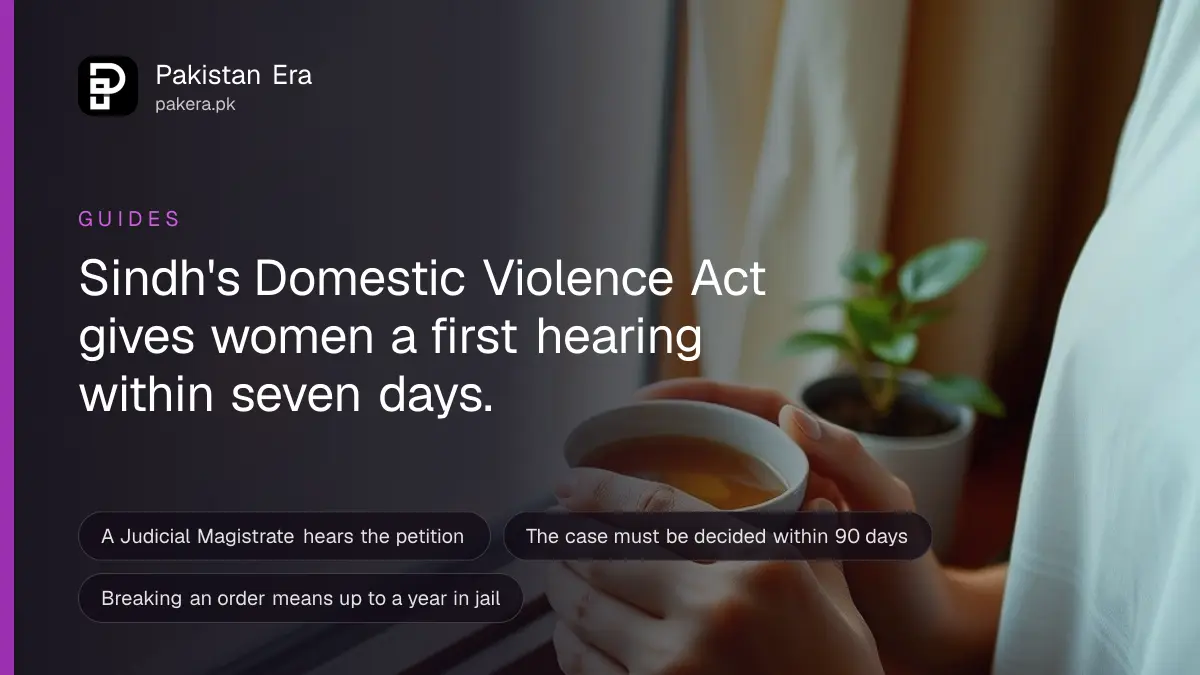
In Sindh, a woman, child or vulnerable person facing domestic violence can ask a Judicial Magistrate for a protection order. The first hearing must be within seven days, and the case must end within ninety days. For help right now, call the Women Development Department helpline 1094, or the police on 15.
Those two numbers come first because a phone call is faster than any court. If you are in danger, call before you read on.
We read the Domestic Violence (Prevention and Protection) Act 2013 on the Sindh Code, and the Act with its 2016 Rules as published by the Sindh Judicial Academy, on 1 October 2026. We also read the helpline list of the Sindh Commission on the Status of Women.
Who can ask for a protection order in Sindh
Any woman, child or vulnerable person who lives, or once lived, in the same home as the abuser can apply. The abuser can be a husband, parent, in-law or other relative. Someone she authorises, or an informer, can file for her.
The Act calls the person harmed the aggrieved person. A vulnerable person means someone at risk because of old age, mental illness or disability. A child is anyone under 18, including an adopted, step or foster child.
Domestic violence under section 5 is wider than beating. It covers:
- Hurt, assault and wrongful confinement, as the Penal Code defines them.
- Emotional and verbal abuse, such as insults, threats of divorce, false claims about her character, or calling her barren to justify another marriage.
- Stalking, harassment and sexual abuse.
- Economic abuse, meaning cutting her off from money or resources she would normally have.
How to get a protection order, step by step
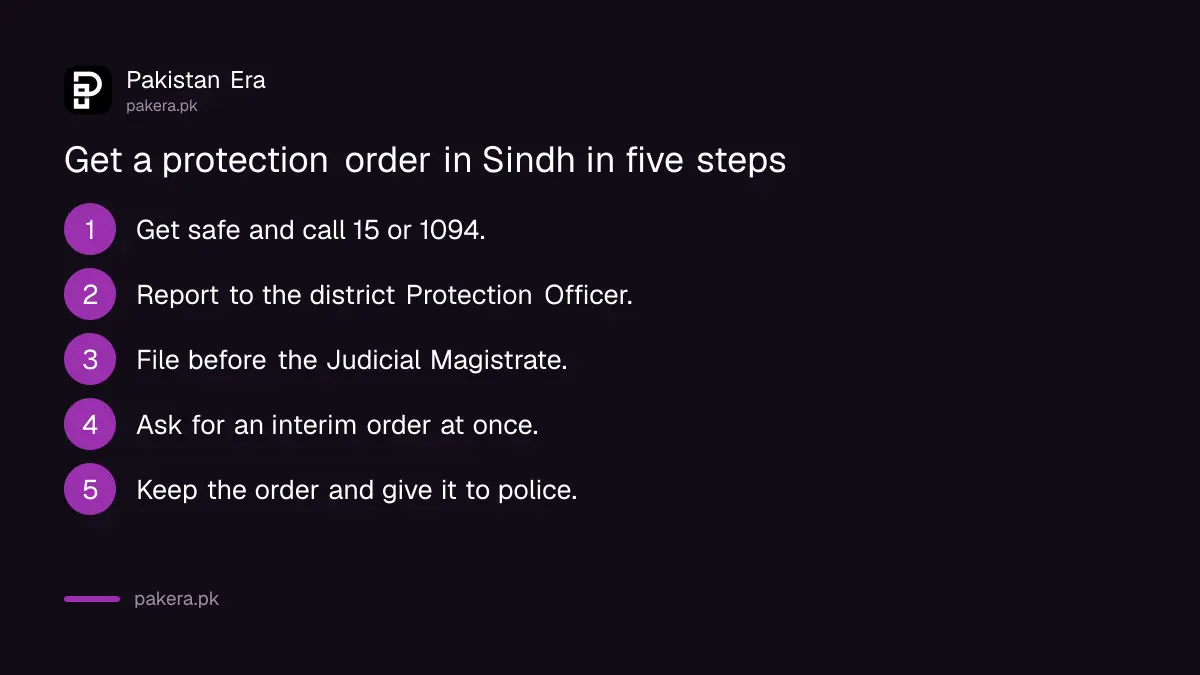
Go to the Protection Officer or a lawyer, file a petition before the Judicial Magistrate where you live or last lived together, and ask for an interim order at once. The court can act on your affidavit alone.
- Get safe first. Call 15 if you are in danger. Call 1094 for advice and referral.
- Contact the district Protection Officer. The 2016 Rules say the Women Development Department appoints one in each district of Sindh, with preference for women. You can report to this officer orally or in writing, and you get a free copy of what is recorded.
- Get a medical check if you are injured. The Protection Officer can arrange it. The report is evidence.
- File the petition. It goes to the court of a Judicial Magistrate first class where you live or work, or where you and the abuser last lived together.
- Ask for an interim order. Section 10 lets the court make an order on your affidavit if the petition shows violence, or a likelihood of it.
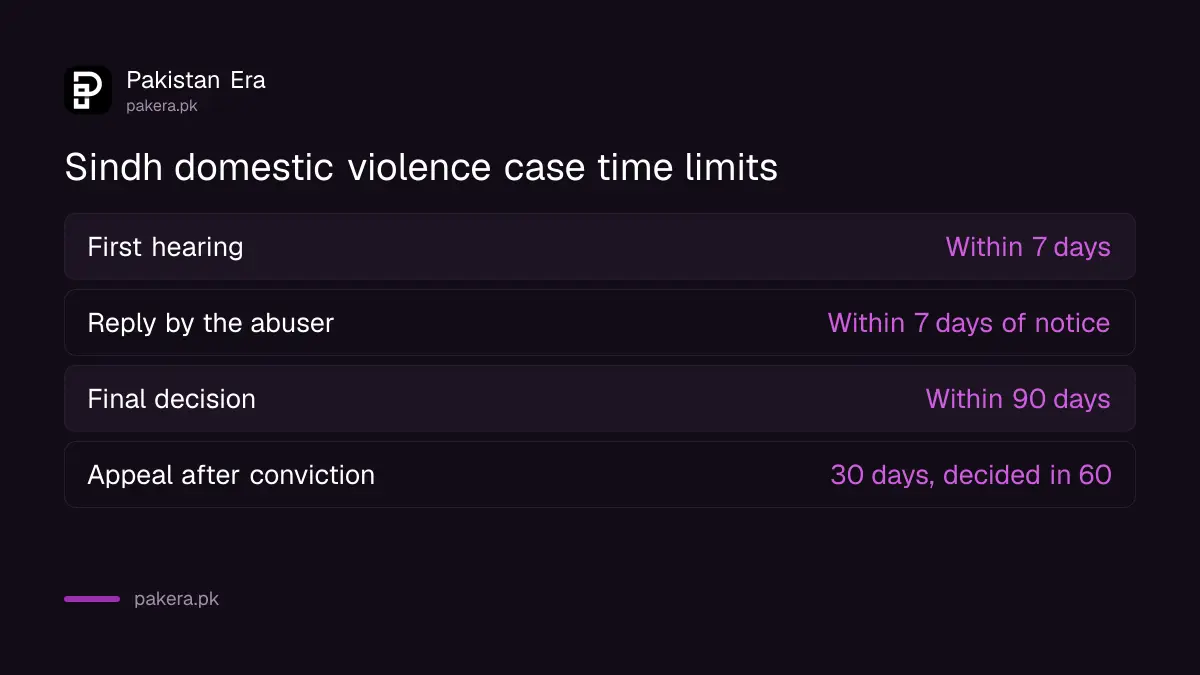
- Attend the first hearing. It must be fixed within seven days of the petition. The other side gets seven days to reply.
- Keep the order with you. The court sends copies to the police station and the service provider in the area.
If you cannot pay a lawyer, the Protection Officer's duties under section 22 include making sure you get legal aid.
What a Sindh protection order can do
The court can stop the abuser from contacting you, keep him away from your work or a child's school, and stop him from forcing you out of the home. It can order the police to protect you and order money to be paid.
| Order | What it can require | Section |
|---|---|---|
| Protection order | No violence, no contact by phone or online, stay away from work, school and helpers | 11(1) |
| Residence order | No eviction, keep him or his relatives out, or pay for other housing | 11(2) |
| Police help | The nearest police station must protect you and help carry out the order | 11(5), 11(7) |
| Return of property | Give back your valuables and documents | 11(8) |
| Monetary relief | Medical costs, lost earnings, damaged property, maintenance | 12 |
| Custody | Temporary custody of a child, with extra protection in sexual abuse cases | 13 |
Section 9 says she cannot be evicted from the household without her consent, whether or not she owns any part of it. That matters, because the threat of being thrown out is often what keeps women silent.
If he does not pay, section 12 lets the court order his employer to pay her straight from his salary. The money order can sit alongside a family court maintenance case. The way to claim maintenance in a Punjab family court shows how such a case runs, though Sindh family courts follow Sindh's own version of the 1964 Act.
Breaking the order is a crime
A man who breaks an interim or final protection order can be jailed for up to one year, fined up to Rs 20,000, or both. The offence is cognizable, so the police can arrest without a warrant.
Section 15 says the offence is also bailable and compoundable. Compoundable means the case can be settled between the parties. Section 16 gives a convicted person thirty days to appeal, and the Sessions Court must decide within sixty days.
The order stays in force until the aggrieved person asks for it to end. Under section 14, either side can ask the court to change it if circumstances change. She can apply again after it ends.
If the police refuse to act, note the date, time and the officer's name. You can later check FIR status in Sindh by case number.
Sindh helplines for domestic violence
The Sindh Commission on the Status of Women lists 1094 for the Women Development Department, 15 for police and 1121 for the Sindh child protection authority. Its own office line is 021 9921 1110.
| Who | Number |
|---|---|
| Women Development Department helpline | 1094 |
| Police emergency | 15 |
| IGP complaint cell | 9110 |
| Human Rights Ministry helpline | 1099 |
| Sindh child protection authority | 1121 |
These numbers are on the Commission's emergency contacts page. A wider list of emergency helpline numbers in Pakistan covers the other provinces. Women in Punjab use a different law, and the route to a protection order in Punjab has its own clocks and helpline.
Common questions
Which court hears a domestic violence case in Sindh?
The court of a Judicial Magistrate first class, where the woman lives or works, or where the couple last lived together.
How fast does the court act?
The first hearing must be within seven days and the petition must be decided within ninety days. An interim order can come sooner.
Can someone else file for me?
Yes. A person you authorise, an informer, or the Protection Committee if you want it, can file.
Can my husband throw me out of the house during the case?
No. Section 9 says you cannot be evicted without your consent, except in accordance with law. The court can also make a residence order.
Is threatening divorce domestic violence under the Sindh law?
Yes. Threats of divorce are listed under emotional and verbal abuse in section 5.
Does the Act protect children too?
Yes. It covers children under 18 living in the same home, including step, adopted and foster children.
How we verified this
What we checked, where we read it, and what we could not confirm.
Last checked on 1 October 2026. We read the Domestic Violence (Prevention and Protection) Act 2013 (Sindh Act XX of 2013) on sindhlaws.gov.pk, sections 2, 5, 6, 7, 9 to 16 and 22. We read the Act with the Domestic Violence (Prevention and Protection) Rules 2016, as compiled up to 2024 by the Sindh Judicial Academy, for rules 15 and 30 on Protection Officers. We read the Sindh Commission on the Status of Women emergency contacts page for the helplines. We did not call 1094, and we could not find an official list naming each district's Protection Officer, so ask at the helpline or the district Women Development office.
About the author

Public Services and Education Journalist
Fajr Riaz is a journalist and content writer at Pakistan Era, based in Lahore. She covers the questions people meet in everyday life in Pakistan: how a public service works, what a change in the rules means, and where to find a reliable answer.