How to Remove Tea and Coffee Stains From Clothes in Pakistan: 6 Steps for Fresh and Old Chai Stains
Remove tea and coffee stains from clothes in Pakistan: rinse cold from the back, rub in liquid detergent, soak an hour in washing powder, never iron it first.
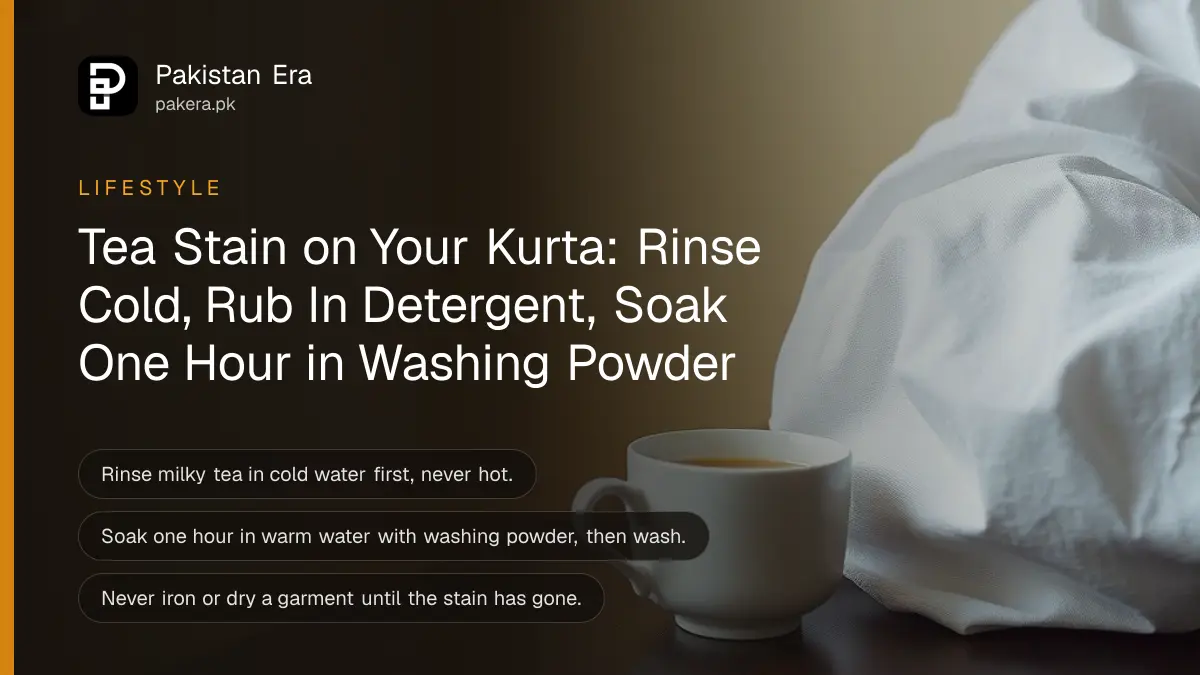
To remove a tea or coffee stain, rinse it under cold water from the back, rub in a little liquid detergent, then soak the garment for one hour in warm water with washing powder before a normal wash. Do not iron or dry it until the mark is gone. For an old, dried chai stain, repeat the soak.
Tea stains are the most common kitchen mark in a Pakistani home. A cup of doodh patti spills on a white kurta, a drop of coffee lands on an office shirt, and by evening it is a brown ring. The good news is that both stains are "bleachable". Detergents with oxygen bleach break them down, so most come out at home.
Tea and coffee stains come out best when treated within the hour
Tea and coffee stains are tannin stains. They are easiest to remove while still wet. Heat and time set them, so rinse at once, keep the stain damp, and wash the same day. Never put a stained garment in the dryer or under an iron.
The Texas A&M extension stain guide puts it simply: time and heat exposure make stains harder to remove. An iron is the worst enemy here. Ironing over a faint tea mark can fix it into the cotton for good.
Doodh patti and milky coffee add one more problem. Milk is a mix of protein and fat. Protein sets in hot water, so the first rinse must be cold, even though the soak later is warm.
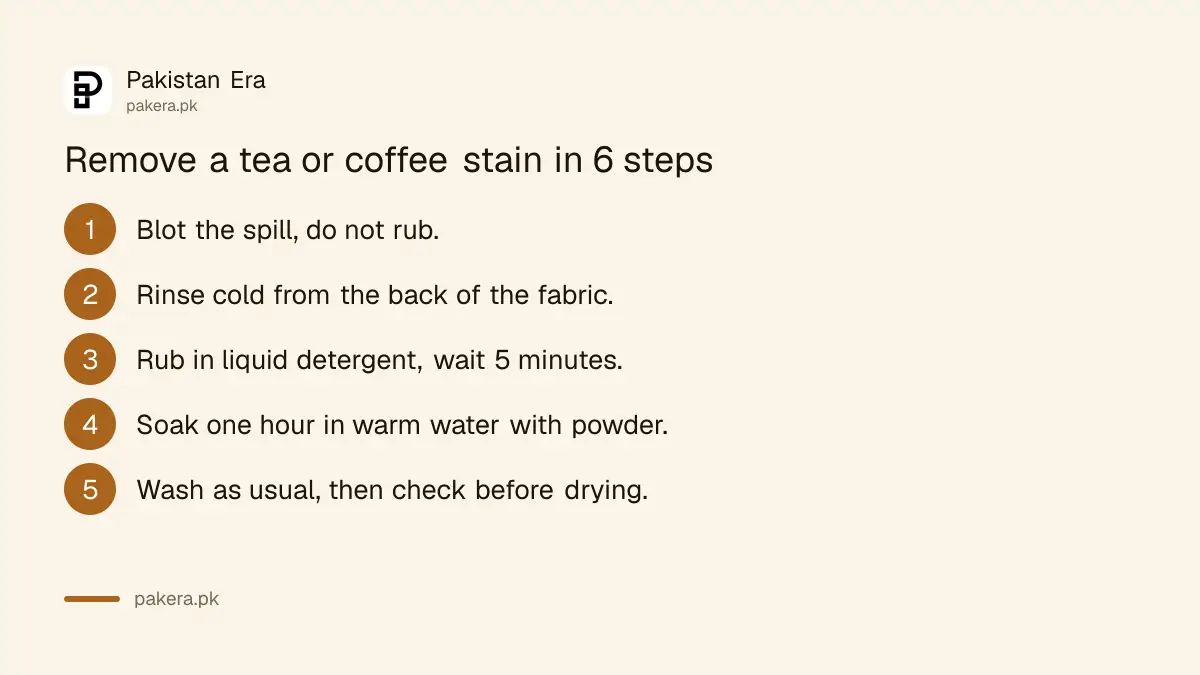
How to remove a fresh tea or coffee stain in 6 steps
Work from the back of the fabric, use cold water first, then liquid detergent, then a one hour warm soak in washing powder. Finish with a normal wash at the highest temperature the care label allows. Check the spot before drying.
- Blot, do not rub. Press a clean white cloth or tissue on the spill to lift as much liquid as you can. Rubbing pushes the tea deeper.
- Rinse from the back with cold water. Turn the garment inside out and hold the stain under a cold tap, so the water pushes the stain out the way it came in.
- Rub in liquid detergent. Put a few drops of liquid detergent on the stain and work it in gently with your fingers. Leave it for 5 minutes.
- Soak for one hour. Fill a bucket with warm water and dissolve half a scoop of washing powder in it. Soak the garment for one hour. If it floats, put a white towel on top to keep it under.
- Wash as usual. Squeeze out the extra water and wash with similar colours, at the temperature shown on the care label.
- Check before drying. Look at the spot in daylight while it is still wet. If a shadow remains, repeat steps 3 to 5. Only dry it once the mark has gone.
Washing powder matters in step 4. Many powders contain an oxygen bleach, and that is the part that breaks down the brown colour. Plain soap does far less.
The right fix depends on the fabric
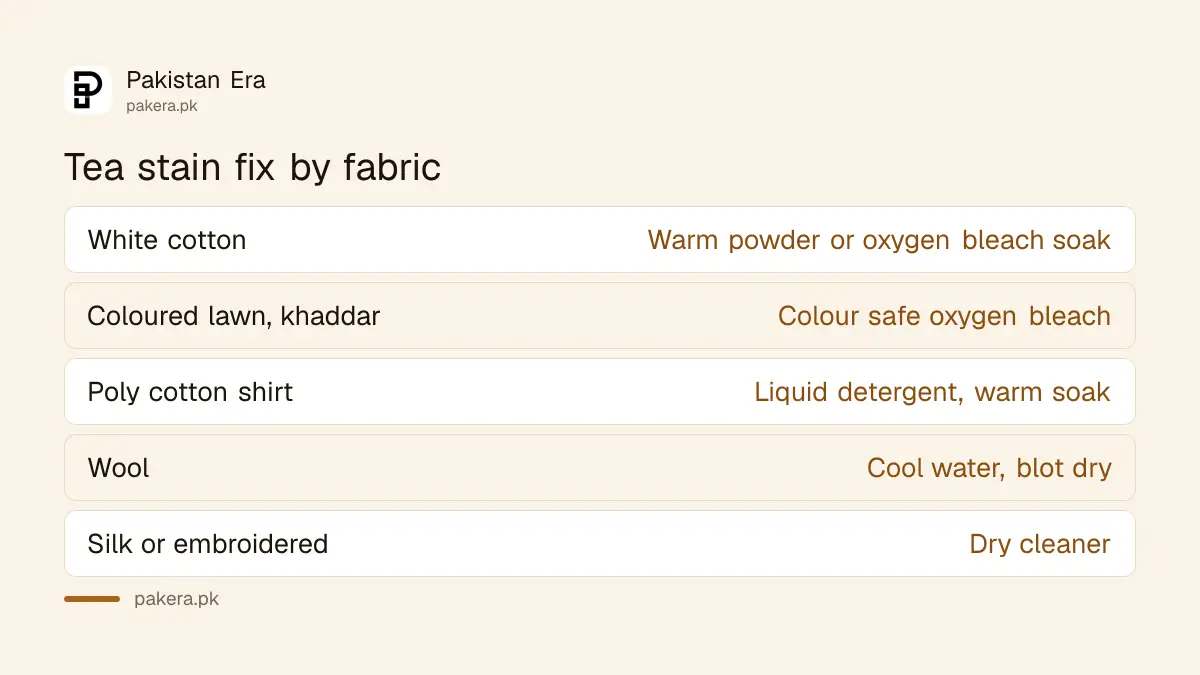
White cotton can take oxygen bleach and warm water. Coloured lawn and khaddar need a colour safe soak. Wool, silk and chiffon need cool water and a gentle hand. Embroidered and dry clean only clothes should go to a dry cleaner.
Read the care label symbols before you start. The bleach triangle tells you what the fabric can take: an empty triangle means any bleach, a triangle with two lines means non-chlorine bleach only, and a crossed triangle means no bleach at all.
| Fabric | What to use | What to avoid |
|---|---|---|
| White cotton shirt or kurta | Warm soak with powder detergent or oxygen bleach | Ironing before the stain is out |
| Coloured lawn or khaddar | Liquid detergent, then a colour safe oxygen bleach soak | Chlorine bleach |
| Poly cotton office shirt | Liquid detergent and a warm soak | Very hot water |
| Wool sweater or shawl | Cool water and a wool detergent, blot dry | Hot water, chlorine bleach, rubbing |
| Silk, chiffon, embroidered | Dry cleaner | Home bleach of any kind |
For wool, cold water and blotting are safer than any soak. The same rules that apply when you wash wool and cashmere at home apply to a tea drip on a sweater: no heat, no wringing, no rubbing.
Old and dried tea stains need more than one soak
A tea stain that has dried, or been washed and dried once, can still lighten. Soak it in oxygen bleach in water as hot as the fabric allows, for several hours, then wash. Two or three rounds are normal for an old brown ring.
Oxygen bleach works best in hot water, above about 54 degrees Celsius, according to the Texas A&M guide. That suits white cotton. For coloured clothes, use the warmest water the label allows and a longer soak instead.
Test any product first on a hidden part such as the inside hem. Rinse it and let it dry. Fabric looks darker when wet, so a colour change may only show once dry. If nothing changes, the product is safe for that garment.
Chlorine bleach is a last resort, and only for white cotton that is colourfast. Never use it on silk, wool or stretch fabric. Dilute it in water first, never pour it straight on the stain.
Common mistakes make a tea stain permanent
Hot water on milky tea, rubbing hard, ironing over a faint mark and drying in the sun before checking are the four mistakes that set tea stains. Each one fixes the colour into the fibre, so the stain stays after every later wash.
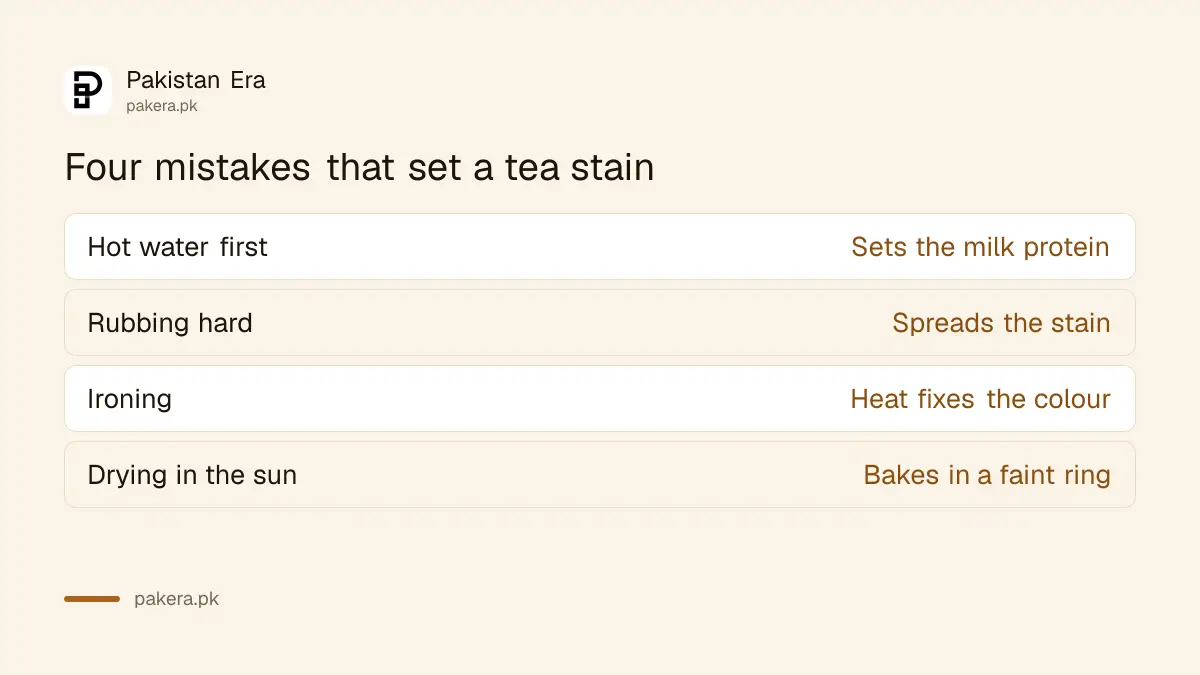
- Hot water first. It cooks the milk protein in doodh patti into the cloth.
- Rubbing hard. It spreads the stain and roughs up the fibres, so the patch looks dull even after cleaning.
- Ironing. Heat sets the stain. Check every shirt before you press it.
- Drying in strong sun. A faint ring left on a wet kurta becomes a fixed mark once it bakes dry on the roof.
Food stains often travel together. If the same shirt also has a curry or oil spot, treat the grease first with liquid detergent, the same way you would remove oil and makeup stains, then do the tea soak.
Common questions
Does baking soda remove tea stains?
It can help a little on a fresh stain, but a liquid detergent rub followed by a soak in washing powder with oxygen bleach works better. Baking soda alone rarely clears a dried brown ring.
Can I use lemon on a tea stain?
On white cotton, a little lemon juice is a mild bleach and can lighten a mark. Do not use it on coloured or printed clothes, because it can lighten the dye along with the stain.
Why did the tea stain come back after drying?
It was not fully removed. Wet fabric hides a faint ring, and drying shows it again. Check the spot in daylight while still wet, and repeat the soak before drying.
Is coffee harder to remove than tea?
Both are tannin stains and both respond to the same soak. Black coffee is often darker, so it may need a second round. Milky coffee needs the cold rinse first, like doodh patti.
Can a tea stain be removed from a school shirt?
Yes. A white cotton or poly cotton school shirt can take the full method: cold rinse, liquid detergent, a one hour warm soak in washing powder, then a normal wash. Do it the same evening.
How we verified this
What we checked and where we read it.
We checked these steps on 15 November 2026 against two sources. The Texas A&M AgriLife Extension Quick Stain Removal Guide for washable fabrics (L-5199) gives the general rules: treat quickly, blot from the back, test on a hidden area, never dry a stained garment, oxygen bleach works best in hot water, and no chlorine bleach on silk, wool or spandex. The detergent maker Ariel's page on removing coffee and tea stains gives the one hour warm soak with washing powder, and its milk stain page explains why milk protein should not meet hot water. Lemon use is common home practice, not from either source.
About the author

Lifestyle & Clothing Writer
Mahnoor Siddiqui is a lifestyle and clothing writer at Pakistan Era, joining the new lifestyle desk in November 2026.