Laundry Symbols Meaning in Pakistan: Every Care Label Symbol for Washing, Drying and Ironing (Chart)
What every laundry symbol on a clothes label means: tub numbers, bars, bleach triangles, drying squares, iron dots and dry clean letters, in one chart.
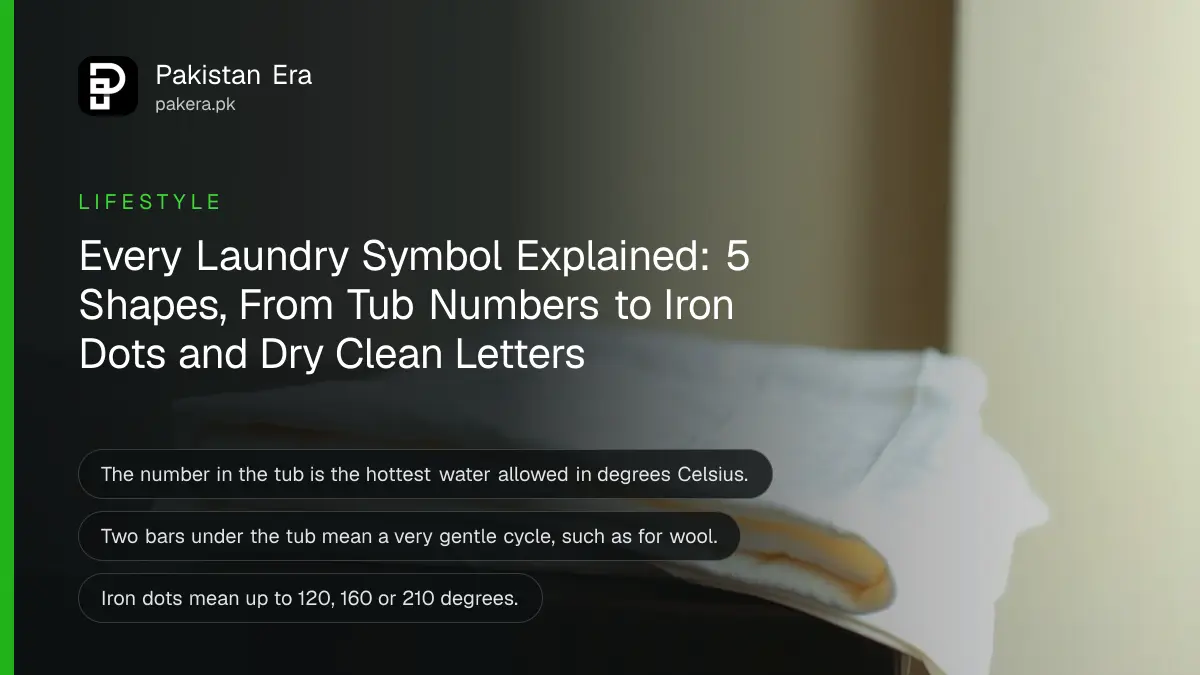
Clothes care labels use five basic symbols: a tub for washing, a triangle for bleach, a square for drying, an iron for pressing and a circle for professional cleaning. A number in the tub is the hottest water allowed in degrees Celsius. Dots on the iron mean low (120 degrees), moderate (160) or hot (210). A cross through any symbol means "do not". We took every meaning below from GINETEX, the international body that owns the care symbol system, and checked it on 5 November 2026.
Most suits, sweaters and jackets sold in Pakistan carry these labels, including export-quality pieces from Faisalabad and Sialkot. Yet many of us wash everything the same way and dry it on the roof. That is how a wool sweater shrinks to a child's size or a black khaddar suit turns grey by February. Two minutes with the label saves the garment.
Washing symbols: the tub, its number and its bars
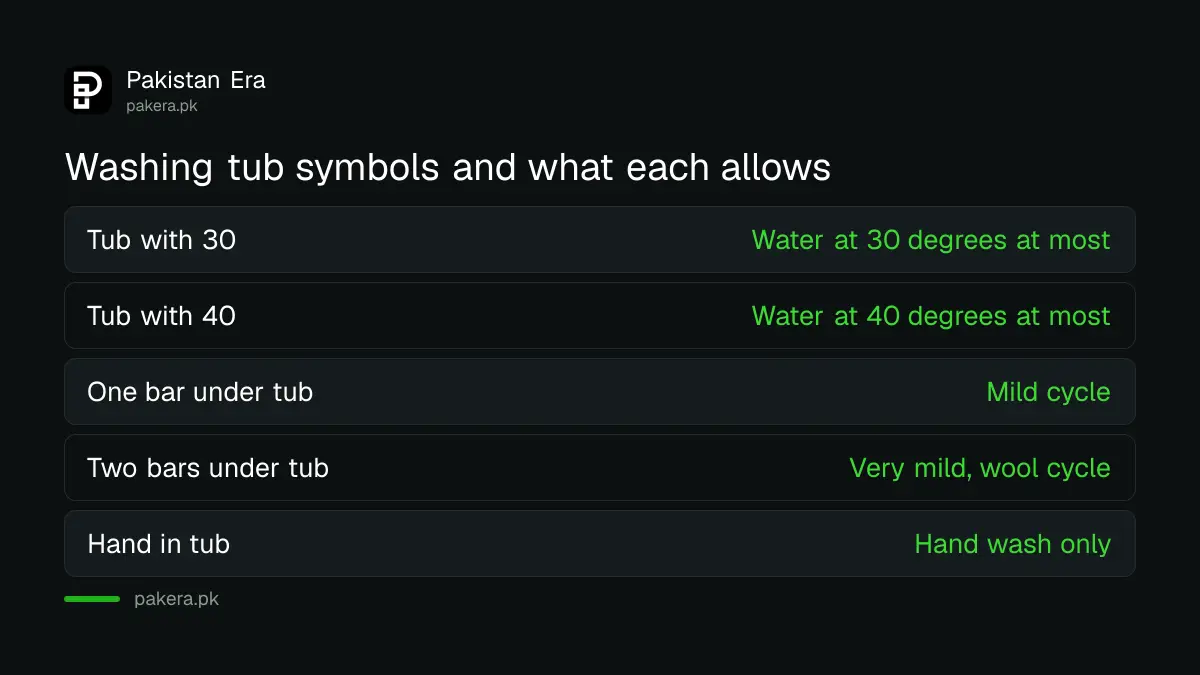
The tub tells you how to wash. The number inside is the maximum water temperature in degrees Celsius. One bar under the tub means a gentler machine cycle, two bars mean a very gentle cycle such as a wool programme, and a hand in the tub means hand wash only.
| Symbol | Meaning | In practice |
|---|---|---|
| Tub with 30 | Wash at 30 degrees at most | Cold or barely warm water |
| Tub with 40 | Wash at 40 degrees at most | Warm, not hot to the hand |
| Tub with 60 | Wash at 60 degrees at most | Hot, for towels and white cotton |
| Tub with 95 | Boil wash allowed | Sturdy white cotton and linen |
| One bar under the tub | Mild cycle, less spinning and rubbing | Synthetic or "easy care" setting |
| Two bars under the tub | Very mild cycle | Wool or delicate programme |
| Hand in the tub | Hand wash only, 40 degrees at most | No machine, no wringing |
| Crossed tub | Do not wash | Usually dry clean only |
Most Pakistani homes do not heat washing water to an exact number. A simple rule: if the water feels hot to your hand, it is already above 40 degrees. Sweaters, shawls and most winter suits carry 30 or 40, or a hand. Wash them in water from a tap that has not been heated.
The bars matter as much as the number. A semi-automatic machine has no wool cycle, so for a two-bar label, wash by hand or keep the machine wash to a few minutes with no spin. Our steps to wash wool and cashmere at home show how.
Bleach symbols: the triangle
The triangle tells you which bleach is safe. An empty triangle means any bleach is fine. A triangle with two diagonal lines inside means oxygen bleach only, never chlorine. A crossed triangle means no bleach at all, so skip the bleach and any detergent that contains it.
- Empty triangle: chlorine or oxygen bleach allowed. Usually on white cotton.
- Triangle with two lines: non-chlorine, oxygen-based bleach only. Common on coloured cotton.
- Crossed triangle: no bleach. Usual on wool, silk, dark colours and prints.
Chlorine bleach is the strong liquid sold for whitening clothes and cleaning floors. It strips colour from a printed lawn or khaddar suit in seconds and weakens wool. When in doubt, leave it out.
Drying symbols: the square
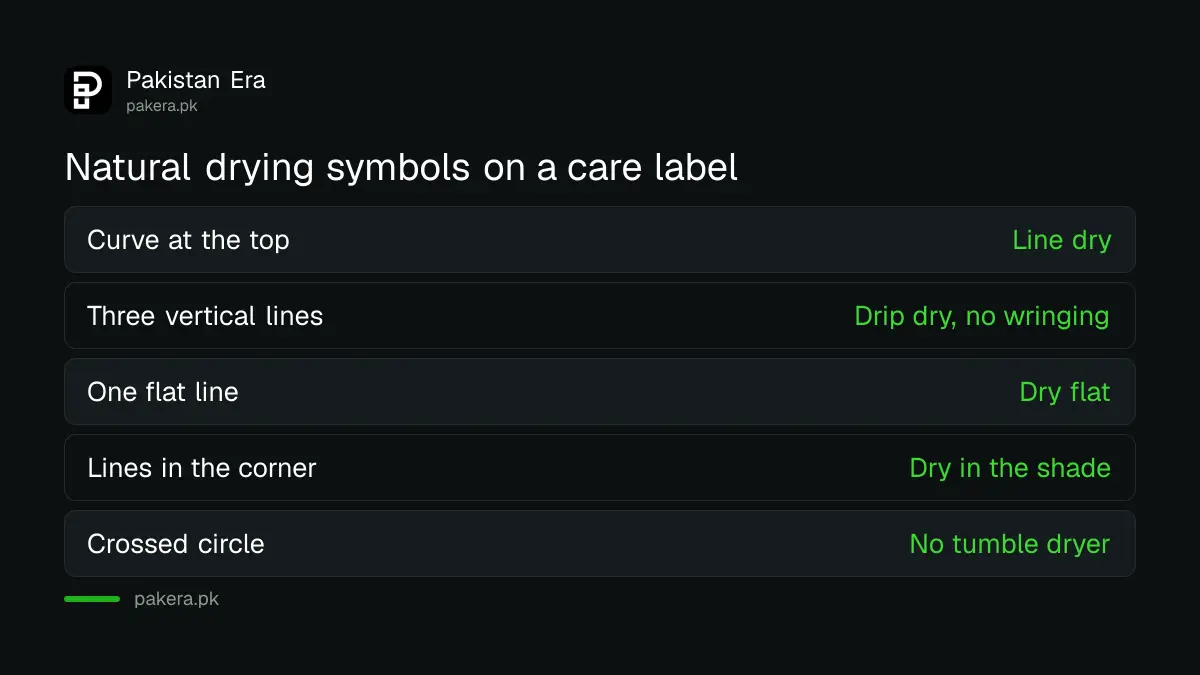
The square is for drying. A circle inside the square means a tumble dryer, and dots show the heat. Lines inside a square with no circle mean natural drying: a curve at the top for line dry, three straight lines for drip dry, one flat line for dry flat, and two diagonal lines in the corner for dry in shade.
| Symbol | Meaning |
|---|---|
| Square, circle, one dot | Tumble dry on a mild setting (GINETEX gives about 60 degrees) |
| Square, circle, two dots | Tumble dry on a normal setting (up to 80 degrees) |
| Square with a crossed circle | Do not tumble dry |
| Square with a curve at the top | Line dry |
| Square with three vertical lines | Drip dry, hang without spinning or wringing |
| Square with one flat line | Dry flat on a towel or rack |
| Two diagonal lines in the corner | Dry in the shade, added to any of the above |
The shade lines are the ones most often ignored here. Pakistani winter sun on a rooftop is strong enough to fade dark wool and deep dyes. If the label shows the shade corner, dry the garment indoors or on a covered balcony. The flat line matters for heavy knits: hanging a wet sweater stretches it by several inches.
Ironing symbols: the iron and its dots
The iron symbol shows the highest safe heat. One dot is low, up to 120 degrees, for synthetics and acrylic. Two dots are moderate, up to 160 degrees, for wool, silk and polyester blends. Three dots are hot, up to 210 degrees, for cotton and linen. A crossed iron means do not iron.
| Iron symbol | Maximum heat | Typical fabrics |
|---|---|---|
| One dot | 120 degrees | Acrylic sweaters, nylon, polyester linings |
| Two dots | 160 degrees | Wool, silk, viscose, blended karandi |
| Three dots | 210 degrees | Cotton, khaddar, linen |
| Crossed iron | Do not iron | Some velvets, sequins, printed transfers |
GINETEX also lists a low setting where steam may damage the fabric, shown with crossed lines below the iron. Most household irons mark their dial with the same one, two and three dots, so you can match the label to the dial directly. Iron dark khaddar and karandi inside out. Our rules to wash khaddar without fading explain why.
Professional cleaning symbols: the circle
A circle is meant for the dry cleaner, not for you. A letter P or F inside means the garment can be dry cleaned with the solvent that letter names. A W means professional wet cleaning. A crossed circle means do not dry clean. Bars under the circle ask for a gentler process.
- P: dry cleaning with perchloroethylene or hydrocarbon solvents.
- F: dry cleaning with hydrocarbon solvents only, a gentler choice.
- W: professional wet cleaning, with one or two bars for mild and very mild.
- Crossed circle: no dry cleaning. Usually the label allows a hand wash instead.
Show the label to the dry cleaner when you hand over a wedding sherwani, a coat or an embroidered shawl. If they cannot tell you which process they use, ask before you leave the piece.
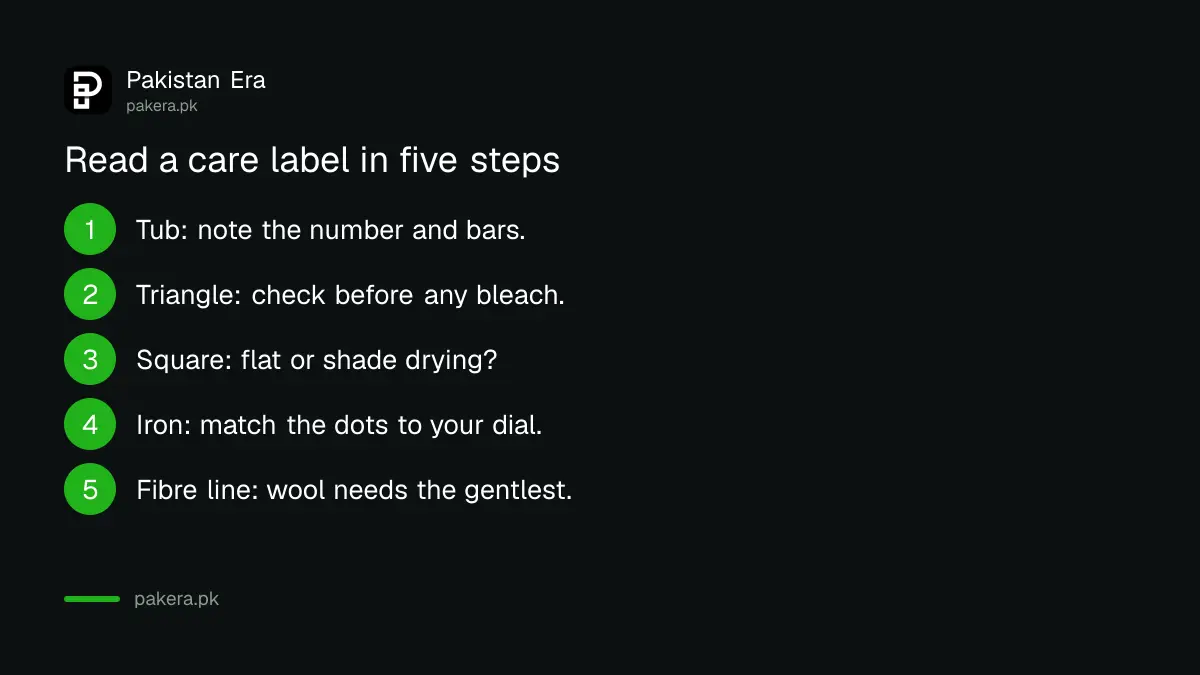
Read a care label in five steps
Read the symbols left to right: wash, bleach, dry, iron, professional care. Labels follow this order, so it is quick once you know it. Then check the fibre content line, because it tells you why the symbols are strict.
- Find the tub and note the number and any bars. That sets the water and the cycle.
- Check the triangle before adding any bleach or whitening powder.
- Look at the square. Flat line or shade corner? Keep it off the hanger or off the roof.
- Match the iron dots to the dial on your iron.
- Read the fibre line. Wool, cashmere, silk and viscose always need the gentlest option on the label.
Unstitched fabric often comes without any label. Ask the shop for the fibre content and save it in your phone with the bill. If a suit fades or shrinks while you followed the label exactly, that is a fault worth raising with the brand, and the exchange days at each brand are short.
Common questions
What does 30 in a tub mean on a clothes label?
Wash at no more than 30 degrees Celsius, which is cold to slightly warm water.
What do two lines under the washing symbol mean?
A very gentle cycle, with little spinning or rubbing. It usually means wool or a delicate fabric.
What does the square with a circle mean?
Tumble drying. Dots show the heat, and a cross through it means do not tumble dry.
How many dots on the iron is wool?
Two dots, up to 160 degrees. Cotton is three dots and synthetics one dot.
What does a P in a circle mean?
The garment can be professionally dry cleaned with perchloroethylene or hydrocarbon solvents. It is a sign for the dry cleaner, not for home washing.
What does the square with a line at the top corner mean?
Diagonal lines in the top corner mean dry in the shade. Keep the garment out of direct sun.
How we verified this
What we checked, where we read it, and what we could not confirm.
We read the care symbol list on the GINETEX care labelling page (ginetex.net) on 5 November 2026, which gives the washing temperatures, the meaning of the bars, the bleach, drying and ironing settings, and the professional cleaning circles. The visual descriptions of each symbol and the P and F letters follow the standard care label system that GINETEX publishes. The practical tips for Pakistani homes are our own general advice and were not tested on a particular garment.
About the author

Lifestyle & Clothing Writer
Mahnoor Siddiqui is a lifestyle and clothing writer at Pakistan Era, joining the new lifestyle desk in November 2026.