How to Wash Khaddar and Karandi Suits Without Fading in Pakistan: 8 Rules and a Colour Test
How to wash khaddar and karandi suits in Pakistan without fading or colour bleeding: a 2 minute dye test, 8 washing rules, ironing heat and fixing a bleed.

Wash a khaddar or karandi suit inside out in cold water, on its own for the first two or three washes, with a mild liquid detergent, and dry it in the shade. That stops most fading and colour bleeding. Test the dye first by pressing a wet white cloth on an inside seam. If colour comes off, wash that suit alone every time until it stops. Never soak a printed or dark suit overnight.
Khaddar is a thick, slightly coarse cotton cloth, and karandi is a textured, often blended fabric. Both are the winter staples of Pakistani wardrobes, from office wear to weddings. Both also come in deep colours and bold prints that can fade or run if you treat them like summer lawn. Here is how to keep them looking new for more than one season.

Test the colour before the first wash
A two-minute test tells you whether a new suit will bleed. Do it before it goes near any other clothes.
- Wet a corner of a plain white cotton cloth or a cotton bud.
- Press it firmly on an inside seam or the hem allowance of the shirt, dupatta and trouser.
- Hold for a few seconds, then look at the white cloth.
- If colour transfers, the suit will bleed. Wash it alone in cold water until the rinse water runs clear.
- If nothing transfers, it is still safest to wash it with similar colours only.
Test the dupatta separately. Dupattas are often dyed or printed separately from the shirt and can behave differently.
Khaddar and karandi need slightly different care
Khaddar is sturdy but shrinks and fades if washed hot. Karandi has a raised, textured surface that can rough up and pill if rubbed. Check the care label on ready-to-wear, and ask the shop for care advice on unstitched fabric.
| Step | Khaddar | Karandi |
|---|---|---|
| Water | Cold or lukewarm | Cold |
| Method | Hand wash or gentle machine cycle | Hand wash preferred, or delicate cycle in a mesh bag |
| Detergent | Mild liquid detergent | Mild liquid detergent, small amount |
| Rubbing | Light, only on stains | Avoid, it roughs the texture |
| Drying | Inside out, in the shade | Inside out, in the shade, not over a hot rod |
| Ironing | Medium heat, inside out | Low to medium heat, with a cloth on top |
On the care label, the number in the wash tub is the hottest water allowed, and a hand in the tub means hand wash only. Under the international GINETEX care system, one dot on the iron symbol means a sole plate of at most 120 degrees, and two dots mean at most 160 degrees.
Eight rules that stop fading
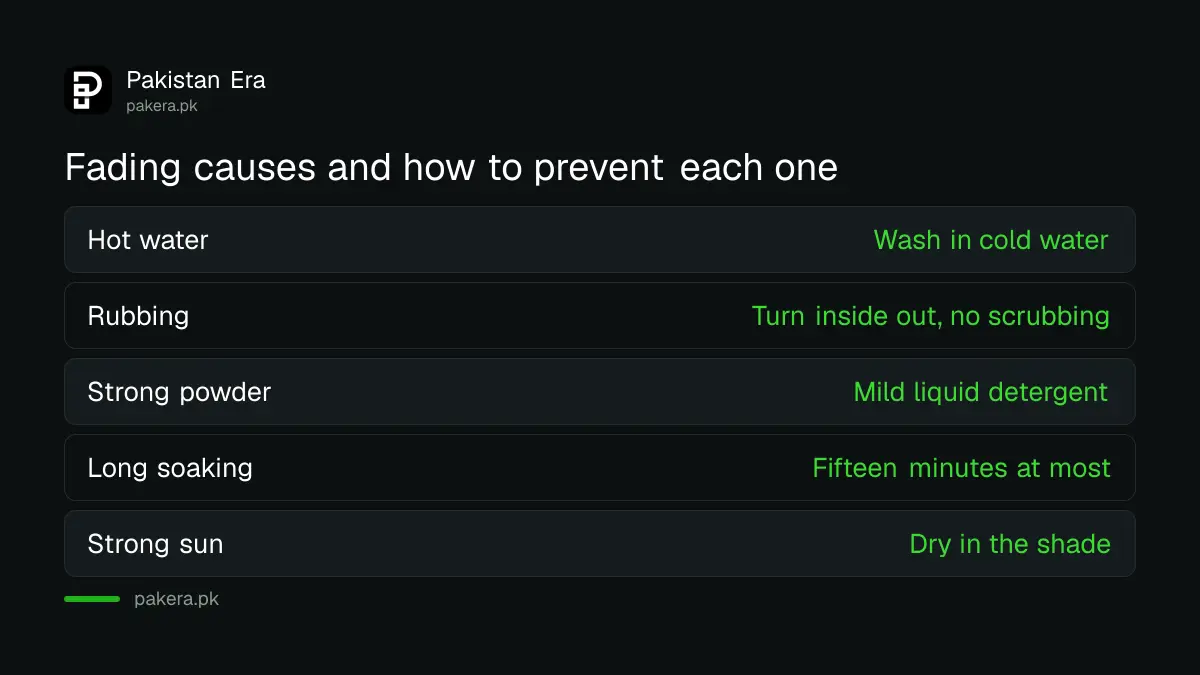
Fading comes mainly from heat, friction, strong detergent and sunlight. Each rule below reduces one of them.
- Cold water. Hot water opens up the fibres and releases dye.
- Inside out. The outer face, where the print is, gets less rubbing.
- Mild liquid detergent. Strong powders and anything with bleach strip colour. Dissolve detergent in the water before adding clothes.
- Short soak only. Ten to fifteen minutes is plenty. An overnight soak lets dye spread into white areas of a print.
- Wash dark suits alone for the first few washes, then with similar colours.
- Gentle spin. A fast spin twists heavy khaddar and sets creases.
- Shade drying. Strong winter sun on a rooftop still fades deep colours. Dry inside out, in the shade, and bring clothes in as soon as they are dry.
- Wash less often. Airing a suit after one wear and spot cleaning small marks saves a full wash.
Some families add a handful of salt or a little vinegar to the first soak. It is a home remedy rather than a guarantee, so still follow the rules above.
What to do if a suit has already bled
Act while the clothes are still wet. Once colour stains dry, especially after ironing, they are much harder to remove.
- Separate the stained item at once and do not put it in the dryer or iron it.
- Rewash the stained white or light item in cold water with a little detergent.
- For white cotton only, an oxygen-based stain remover may help. Check the care label first. A triangle with two lines means only oxygen bleach is allowed, and a crossed triangle means no bleach at all.
- Never use chlorine bleach on coloured khaddar or karandi, or on any wool blend.
If a brand-new suit bleeds badly or the print runs on the first gentle wash, that may be a fault. Keep the suit, the receipt and photos. Most brands ask for damage to be reported within a few days, and J., for example, asks for photos within 3 days of delivery. Our guide to return and refund rights explains your options, and in Punjab you can file a consumer complaint online if the seller refuses.
Press, store and reuse winter suits
Iron khaddar and karandi inside out, while still very slightly damp, at the heat the label allows. Pressing a thin cotton cloth on top protects embroidery and stops shiny patches on dark colours.
At the end of winter, wash every suit before storing it. Sweat and food marks attract insects and turn yellow in storage. Fold suits with the embroidered side inward, store them in cotton bags or a clean trunk with a cloth lining, and keep them away from damp walls. Air them once in summer. If your winter wardrobe also includes wool shawls or sweaters, they need even gentler care, with cool water and drying flat. With the cold season starting, our winter 2026 outlook shows when the heavier fabrics will be needed in your area.
Common questions
Can I wash khaddar in a washing machine?
Yes, on a gentle cycle with cold water and a low spin, if the care label allows machine washing. Turn it inside out first.
Does khaddar shrink after washing?
It can, especially in hot water or a hot dryer. Washing in cold water and drying in the shade keeps shrinkage to a minimum.
How do I stop a new suit from bleeding colour?
Wash it alone in cold water for the first few washes, inside out, with a mild detergent, and do not soak it for long.
Why does karandi go rough after washing?
Rubbing and strong spinning rough up its textured surface. Hand wash gently, avoid scrubbing and dry it in the shade.
Can I iron karandi directly?
It is safer to iron inside out at low to medium heat, with a thin cotton cloth on top to protect the texture and colour.
Can I return a suit that bleeds on the first wash?
Possibly, if you report it quickly. Most brands want faults reported within a few days with photos, and many refuse items that have been washed for other reasons.
How we verified this
What we checked, where we read it, and what we could not confirm.
We read the care symbol meanings on the GINETEX care labelling page (ginetex.net) and J.'s returns page (junaidjamshed.com) on 4 November 2026. The washing methods are general home care guidance and were not tested on a specific suit. Always follow the care label or the shop's advice for your fabric, which takes priority.
About the author

Lifestyle & Clothing Writer
Mahnoor Siddiqui is a lifestyle and clothing writer at Pakistan Era, joining the new lifestyle desk in November 2026.