Wedding Dress Trial Fitting Checklist in Pakistan: 10 Checks to Make at the Tailor
Check a wedding dress at the tailor's trial in 10 points: shoulder, armhole, bust, length in heels and zip, plus the movement test and what can be altered.
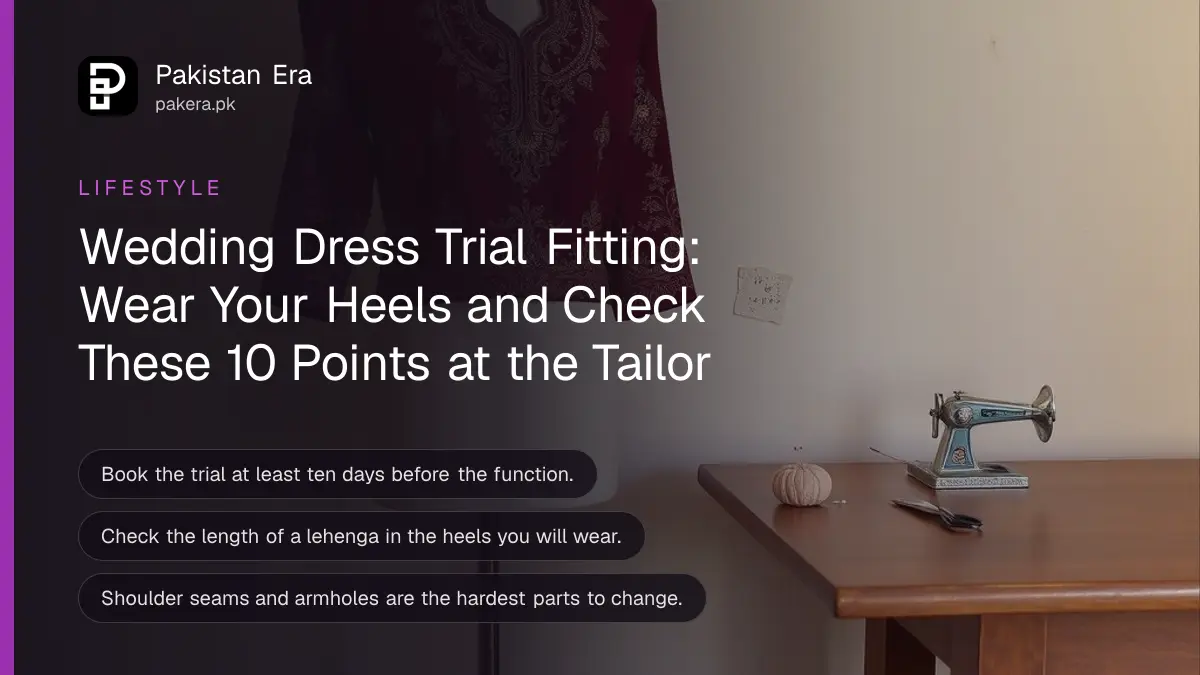
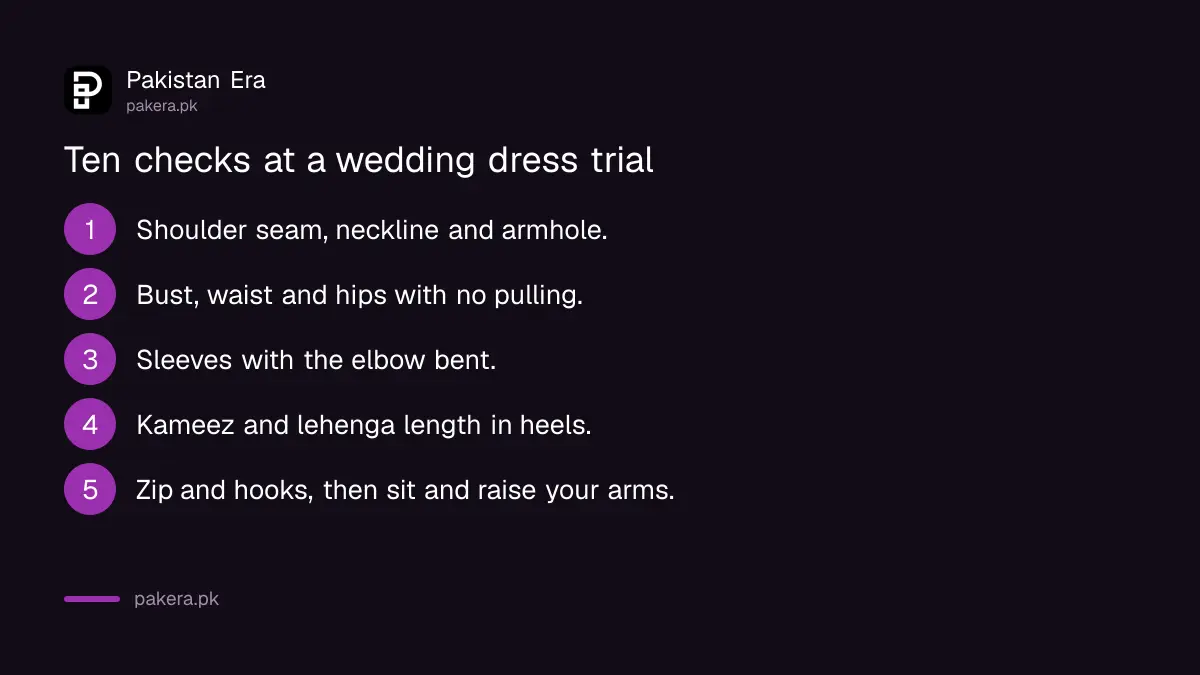
At a tailor's trial fitting, wear the heels and undergarments you will wear on the day, then check ten points: shoulder seam, armhole, bust, waist, hips, sleeves, neckline, kameez length, lehenga or trouser length, and the zip. Sit, raise both arms and walk before you say it is fine. Ask for the trial at least ten days before the function, so there is time for a second fitting.
In December, a tailor in any Pakistani city may be stitching dozens of wedding suits at once. A trial is the one chance to catch a tight armhole or a short hem while it can still be fixed. Five minutes of checking saves a ruined evening.
| Check | How it should feel or look | Easy to fix? |
|---|---|---|
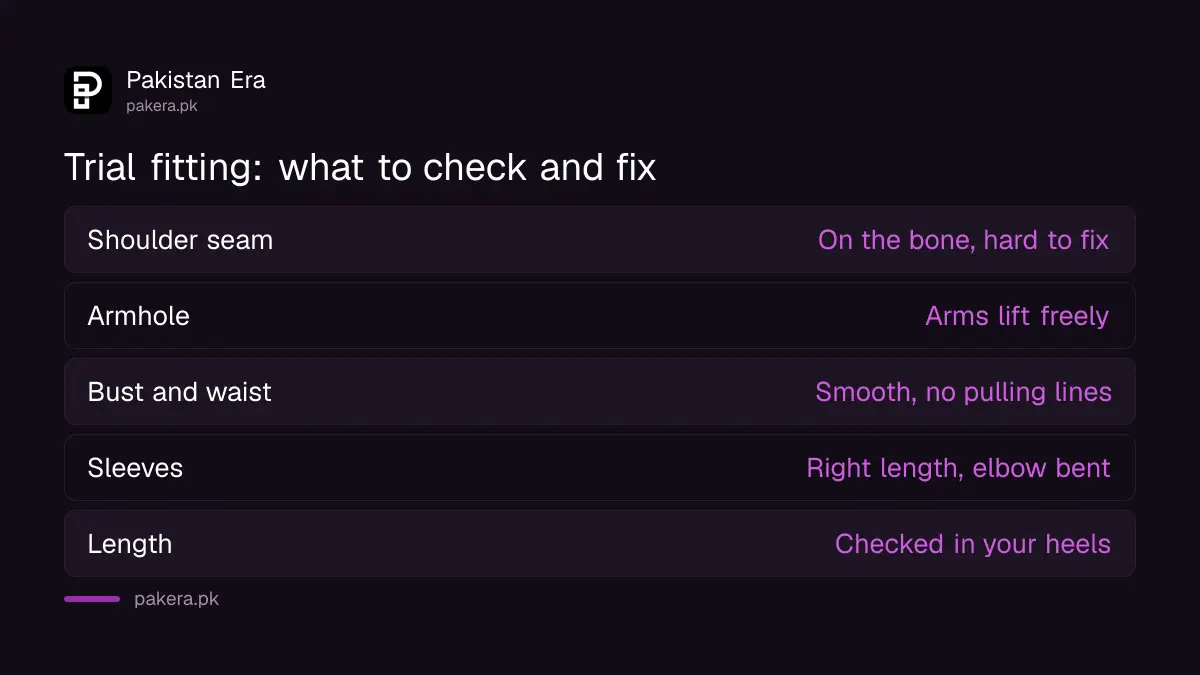
| Shoulder seam | Sits on the shoulder bone | Hard |
| Armhole | Arms lift without the kameez rising | Sometimes |
| Bust and waist | Smooth, no pulling lines | Yes, if seams have spare cloth |
| Sleeve length | Ends where you asked, arm bent | Yes |
| Kameez and lehenga length | Right height in your heels | Shorter yes, longer only with spare hem |
Bring the right things to the trial
Bring the heels or khussas you will wear, the undergarments you will wear, the dupatta and any heavy jewellery. The fit changes with each of them. A lehenga hemmed in flat slippers will be too short in heels, and a neckline can sit differently under a heavy necklace.
- Shoes: the exact pair, or one with the same heel height. Our list of bridal heels and wedding sandals shows the heel heights brands sell.
- Undergarments: the ones for the day, including any shapewear or warm inner layer.
- The dupatta: heavy dupattas pull on the shoulder and change how the neckline sits.
- Jewellery: the necklace, so the neckline depth works with it.
- Your measurement slip and receipt, with the agreed design and delivery date.
- Someone you trust to look at the back and the hem.
A winter wedding adds one more item. If you will wear a thermal or a slip under the outfit to stay warm, wear it to the trial. Layering ideas are in staying warm at an outdoor winter wedding.
Check the fit in ten points, top to bottom
Stand in front of a full mirror with good light and go from the shoulders down. Look for pulling lines, gaps and bunching. Pulling lines point to the spot that is too tight. Loose folds point to the spot that is too big.
- Shoulder seam: it should sit on the edge of the shoulder bone, not on the arm or the neck.
- Neckline: it should lie flat with no gap when you lean forward, and match the agreed depth.
- Armhole: raise both arms. The kameez should not ride up a lot or cut under the arm.
- Bust: no lines pulling towards the bust, and darts pointing at the right spot.
- Waist: close fit if you asked for it, but you should be able to breathe and eat.
- Hips: no pulling across the hips when you stand. Side slits should lie flat.
- Sleeves: bend your elbow. A fitted sleeve should not cut into the arm or ride up.
- Kameez or choli length: check it in your heels, front and back.
- Lehenga, gharara or trouser length: it should clear the floor in your heels, so you do not trip.
- Zip, hooks and dori: the zip runs smoothly and lies flat, and hooks meet without strain.
Move in the outfit before you accept it
A wedding dress has to work for hours of sitting, eating, greeting and dancing. Sit on a chair, raise both arms, hug someone, walk a few steps and climb a stair if there is one. Anything that pulls or slips now will be worse at the function.
- Sit down: the waist and hips must not dig in, and side seams must not strain.
- Raise your arms: as for a hug or a dance at the mehndi.
- Walk and turn: the lehenga or gharara should swing without catching your heels.
- Bend to pick something up: the neckline should stay in place.
- Wear the dupatta: pin it the way you will on the day and check it does not drag the shoulder seam down.
Know what a tailor can still fix
Taking in is easy; letting out depends on how much spare cloth is left in the seams. Making something shorter is easy; making it longer needs a deep hem. Moving a shoulder seam or changing an armhole on an embroidered kameez is hard work and may show.
| Problem at the trial | What to ask for |
|---|---|
| Too loose at the waist or sides | Take in the side seams |
| Too tight at bust or hips | Let out the seams, if spare cloth is there |
| Hem too long in heels | Shorten the hem, keep the border |
| Neckline too deep | Add a lining strip or a hidden hook |
| Armhole cuts in | Deepen the armhole slightly |
When you order, ask the tailor to leave spare cloth in the side seams. That one request makes most later changes possible. Before the trial, your own numbers should be ready: the steps in the kameez size chart and home measuring method show how to take them.
Get every change and the delivery date in writing
Before you leave, write each change on the receipt or the tailor's slip, with the new delivery date and any extra charge. Take photos of the agreed design and the trial. If the tailor misses the date or spoils the cloth, those papers are your proof.
- List each change on the slip, for example: "take in waist, shorten lehenga to clear the floor in 3 inch heels".
- Agree the new delivery date, at least three days before the function.
- Agree any extra charge in rupees before work starts.
- Photograph the slip, the design and the outfit at the trial.
- If the date is missed or the work is spoiled, send a written notice first. In Punjab the law gives the tailor 15 days to reply before you can file a consumer court complaint.

When the finished outfit comes home, steam it lightly rather than pressing the embroidery. The safe heat for each fabric is in ironing embroidered and velvet wedding clothes.
Common questions
How many days before the wedding should the trial be?
At least ten days before the function. That leaves time for the changes and a second fitting if the first one goes badly.
Should I wear heels to my dress trial?
Yes. Wear the exact pair you will wear on the day. The lehenga, gharara and kameez length all depend on the heel height.
Can a tailor make a tight kameez bigger?
Only if there is spare cloth in the seams. Check by turning it inside out. Ask for spare cloth in the side seams when you order.
What if the tailor does not deliver on time?
Keep the receipt and photos, and send a written notice. In Punjab the tailor has 15 days to reply, and a consumer court claim is normally filed within 30 days of the problem.
Is it normal to need a second fitting?
Yes, for wedding outfits. Heavy embroidery, lehengas and fitted cholis often need small changes after the first trial.
What should I check first at the trial?
The shoulder seam and the armhole. They are the hardest parts to change, so raise any problem there straight away.
How we verified this
What we checked and where we read it.
We checked the Punjab Consumer Protection Act 2005 on 24 November 2026. Section 28 requires a written notice to the service provider first, gives the provider 15 days to reply, and sets 30 days from the cause of action for a claim, which the court can extend for sufficient cause. Other provinces have their own consumer laws with different time limits. The fitting checks follow standard tailoring practice for Pakistani formal wear.
About the author

Lifestyle & Clothing Writer
Mahnoor Siddiqui is a lifestyle and clothing writer at Pakistan Era, joining the new lifestyle desk in November 2026.