How to Clean Black Zari and Tilla Embroidery at Home in Pakistan, and What Damages It
Zari or tilla turned black? Brush it, test a polishing cloth on one hidden thread, skip lemon and toothpaste, and know when a tailor should replace the border.
Zari or tilla that has turned black is usually tarnish on a thin silver coloured coating. Brush it gently with a soft, dry brush, then test a silver polishing cloth on one hidden thread only. Never use lemon, toothpaste, baking soda or a silver dip on the dress. If the test thread turns copper coloured, stop: the coating is wearing off, and the fix is a new border from a tailor or karigar.
Wedding season brings the trunks down. A suit that shone at a cousin's mehndi three winters ago comes out with grey or black embroidery, and the first idea at home is often lemon and salt. That usually makes it worse, and it can stain the fabric around the work.
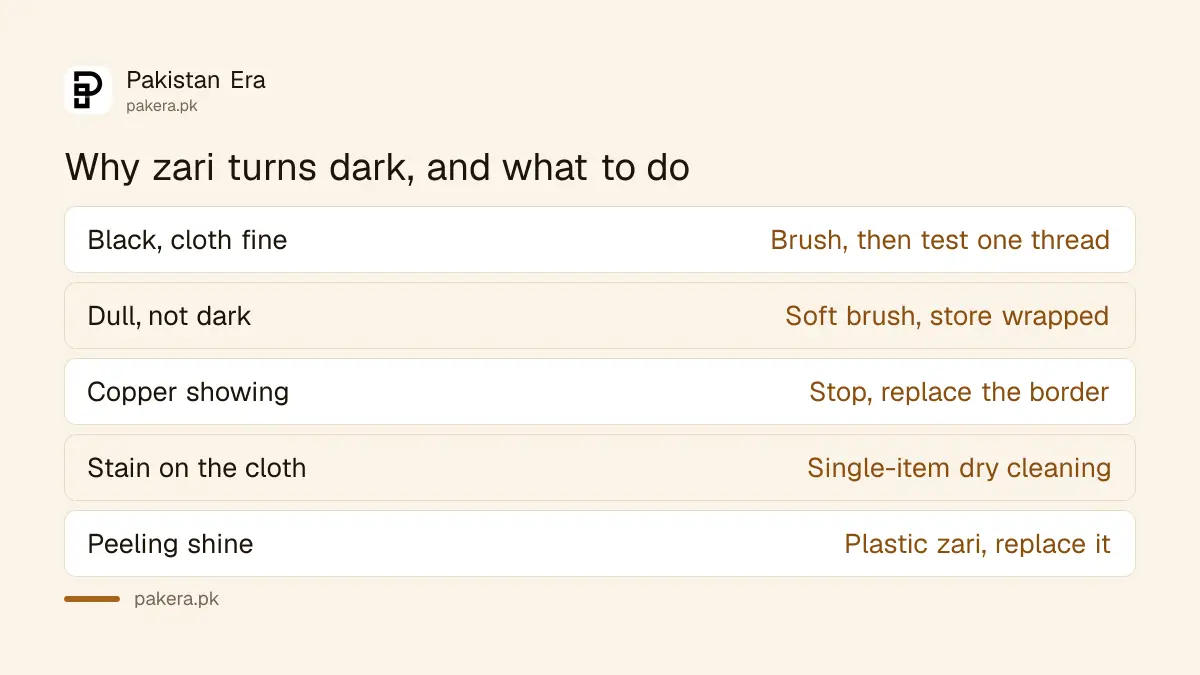
| What you see | Likely cause | What to do |
|---|---|---|
| Grey or black zari, cloth fine | Tarnish on silver coloured coating | Brush, then test a polishing cloth on one thread |
| Dull but not dark | Dust and skin oil | Soft brush, store wrapped |
| Reddish or copper colour showing | Coating worn through | Stop cleaning, replace the border |
| Dark stain on fabric next to the zari | Tarnish moving onto the cloth | Dry cleaner, ask for single-item care |
| Peeling, flaking shine | Plastic film zari breaking up | Cannot be restored, replace it |
Most zari in suits today is coated copper or plastic film
Real zari, made from silver wire, is rare and costly. Most zari, tilla, dabka and gota in Pakistani suits and bridal wear is copper wire with a thin silver layer, or a metallic plastic film. Knowing which you have decides what cleaning is safe.
Copper with a silver coating darkens in damp air, exactly like a silver spoon. Plastic film zari does not tarnish, but it can go dull, peel or crack with age and heat. Real silver zari darkens too, but it can take careful polishing better than a thin coating can.
To tell them apart, look at a loose end inside a seam, or a fallen thread. A tiny thread end held near a flame gives a quick answer, so do it only on a thread that has already come off, never on the dress:
- Metal zari: does not melt. It glows and leaves a small metal wire.
- Plastic film zari: shrinks and melts into a bead, with a plastic smell.
- Reddish metal under a silver layer: copper zari with a coating.
Clean darkened zari at home in five steps
Start with the gentlest method and stop as soon as it looks acceptable. Every rub on a coated thread removes a little coating. Work on a flat, clean surface in daylight, and test each step on a hidden part first, such as the inside of the hem.
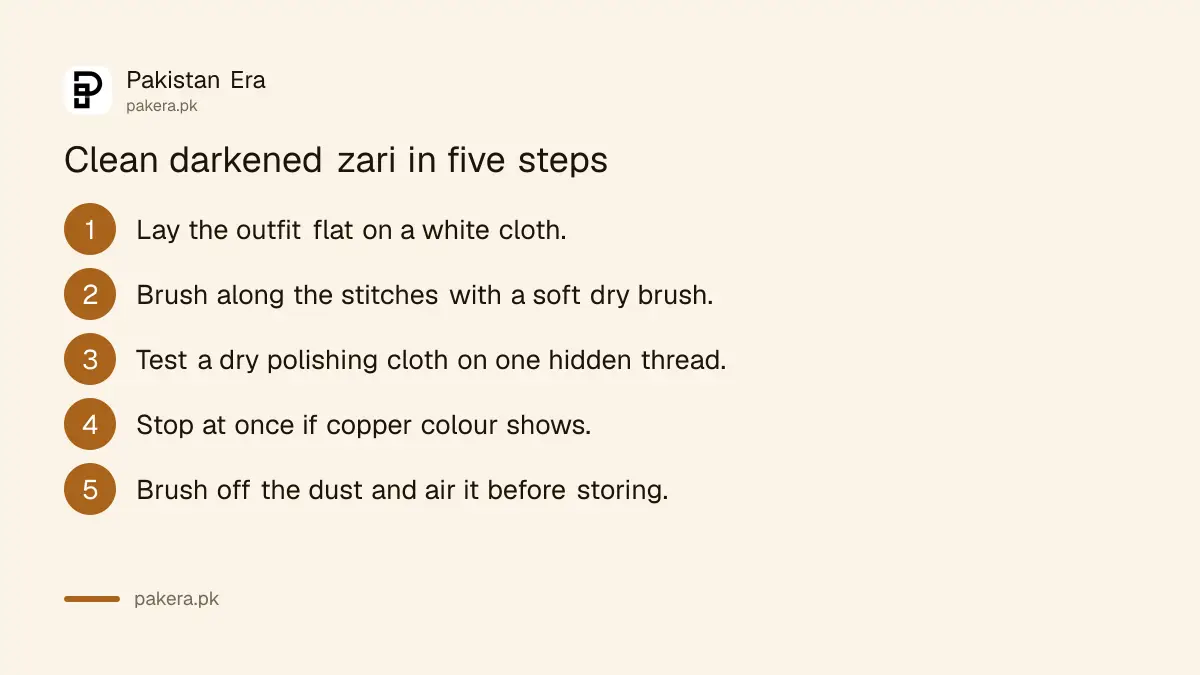
- Lay the piece flat on a clean white cloth, embroidery facing up.
- Brush off dust with a soft, dry, clean brush, such as a new makeup brush or a soft baby toothbrush. Brush along the stitches, not across them.
- Test a silver polishing cloth on one hidden thread. Use the dry cloth only, with light pressure, for a few seconds.
- Check the test thread. If it brightens and stays silver, you can buff other dark areas lightly. If any copper colour shows, stop at once.
- Brush again to lift any polish dust, then air the piece before storing it.
Polishing cloths are gentler than liquid or paste polish because they hold less abrasive. Even so, polish removes a thin layer of metal each time. On a coated thread, a dull silver is better than bright copper.
Home remedies that damage zari and the fabric
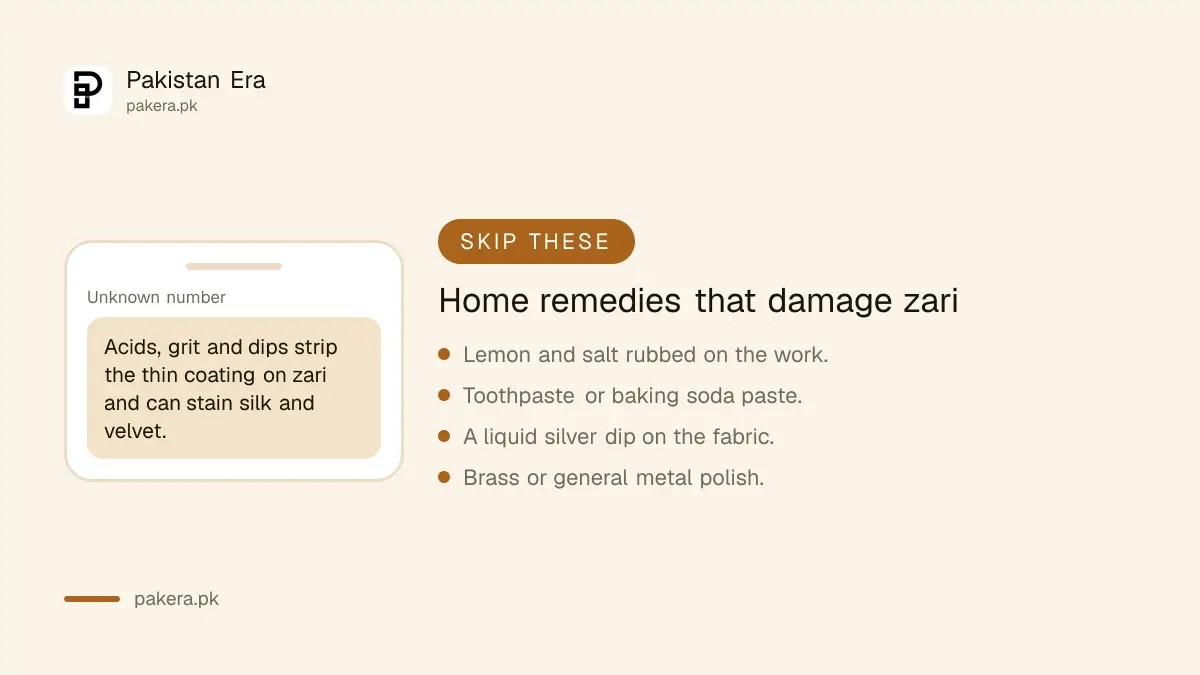
Lemon, salt, vinegar, toothpaste, baking soda and silver dips all attack the thin coating or the fabric around it. Silk, velvet and chiffon can stain or lose colour from them. The method of soaking silver in hot water with foil and washing soda is not for clothes either.
| Remedy | Why to skip it |
|---|---|
| Lemon and salt | Acid and grit, can bleach or mark the cloth |
| Toothpaste or baking soda | Scratches the coating, leaves white paste in the stitches |
| Liquid silver dip | Strong acid, harms silk and other natural fibres |
| Foil and washing soda soak | The whole outfit has to be soaked in hot water |
| Metal or brass polish | More abrasive than silver polish, strips the coating |
Washing a zari suit at home is risky for the same reasons. Water and soap speed up tarnish on metal thread, and many embroidered suits bleed colour. If the fabric itself is dirty, and especially for a velvet suit marked dry clean only, use a dry cleaner who handles one piece at a time, and point out the zari before they start.
When to replace the border instead of cleaning it
Replace the work when the coating has worn through, plastic zari is peeling, or tarnish has stained the cloth. A tailor can swap a gota or kinari border in a day or two. Hand zardozi on the body needs an embroidery karigar.
- Gota, lace or kinari borders on the dupatta hem, sleeves and daman are usually stitched on, and a tailor can unpick and replace them.
- Machine embroidered patches can sometimes be covered with a new patch or border in a matching colour.
- Hand zardozi and dabka work is restitched by a karigar, thread by thread. Ask for a price for one motif first.
- A dark stain on silk next to the work may not lift at all. Ask the dry cleaner before you spend on new embroidery.
Take a fallen thread with you to the market so the new border matches. Silver and antique gold come in many shades. Beads and sequins that come loose at the same time should be stitched back before they fall off.
Store zari so it does not turn black again
Tarnish needs damp air and sulphur in the air or nearby materials. Wool speeds it up. Keep zari dry, wrapped in white tissue or cotton, sealed in a plastic box with a few silica gel sachets, and away from wool shawls and perfume.
- Air the outfit for a few hours after each event, so sweat and damp dry out.
- Wrap the embroidered part in white acid-free tissue or a washed white cotton cloth.
- Put it in a closed plastic box or a sealed polythene bag with silica gel sachets.
- Store wool shawls and sweaters in a different box, sealed against clothes moths.
- Spray perfume on the skin before you dress, never on the embroidery.
Artificial jewellery darkens for the same reason, and keeping artificial jewellery from turning black uses a similar dry, sealed box. Before the next event, steam zari rather than pressing it, as explained in ironing embroidered wedding clothes.
Once the zari is clean, store the outfit flat in cotton so it stays bright longer.
Common questions
Why has the zari on my suit turned black?
It is tarnish. Most zari has a thin silver coloured layer over copper, and damp air, sweat, perfume and nearby wool darken it over time.
Can I clean black tilla work with lemon?
No. Lemon is an acid. It can bleach or stain the fabric and strip the thin coating on the thread. Use a soft brush and a dry polishing cloth test instead.
Will a dry cleaner make my zari shine again?
Usually not. Dry cleaning removes dirt and some stains, but it does not reverse tarnish. Ask them to cover the zari so it does not snag.
How do I know if my zari is real silver?
Look at a fallen thread. Reddish metal under a silver layer is copper zari. A thread that melts near a flame is plastic film. Pure silver wire is rare and costly.
Can a tailor replace a black gota border?
Yes. Gota, lace and kinari borders are stitched on and can be replaced in a day or two. Take a fallen thread to match the shade.
Does silica gel stop zari from tarnishing?
It slows it down by keeping the air in a closed box dry. Use it with tissue wrapping, a sealed box and no wool nearby.
How we verified this
What we checked and where we read it.
We checked the Canadian Conservation Institute's note on silver care and tarnish removal on 24 November 2026. It explains that polishing removes metal with the tarnish, that any tarnish removal can badly damage plated silver, that dips harm organic materials, and that sealed bags with silica gel reduce tarnish. The US National Park Service curatorial care of textile objects appendix notes that wool speeds tarnish on silver thread and that the tarnish can stain the cloth.
About the author

Lifestyle & Clothing Writer
Mahnoor Siddiqui is a lifestyle and clothing writer at Pakistan Era, joining the new lifestyle desk in November 2026.