How to Fix Loose Sequins and Beads on a Wedding Dress at Home in Pakistan
Fix loose sequins, pearls and stones on a wedding dress at home: tie off the thread so the line stops running, sew each piece back, glue stones the right way.
To fix loose sequins or beads on a wedding dress, first tie off the broken thread on the inside so the line does not unravel further. Then sew each sequin back with a thin needle and doubled polyester thread, two stitches through every piece, and knot it on the inside. A loose line of chain-stitched sequins can run like a ladder in seconds, so stop pulling and tie it the moment you see it.
The night before a barat is when most families find a dupatta shedding sitaray or a choli losing pearls. Nearly all of it can be fixed at home in under an hour with a needle, the right thread and a little patience. The table below matches the problem to the fix.
| Problem | Quick fix | Time |
|---|---|---|
| A few single sequins hanging | Sew each back with two stitches | 10 to 20 minutes |
| A whole line of sequins running | Tie off the end, then couch the line down | 20 to 40 minutes |
| Pearls or beads falling | Restring with doubled thread, knot every 3 to 4 beads | 15 to 30 minutes |
| Glued stones dropping off | Fabric glue on a clean spot, dry flat | A few hours to dry |
| Large patch of work gone | Take it to an embroidery karigar | A day or more |

Stop the damage first: tie off the loose thread
Much sequin and bead work on Pakistani formal wear is done with a chain stitch, by machine or on an adda frame. If one end breaks and you pull it, the whole line can come undone. Tie the broken end inside the garment before anything else.
- Turn the garment inside out and find where the thread is broken. The loose end usually hangs near the first missing sequin.
- Do not pull the thread. On a chain stitch, pulling one end undoes the loops one after another.
- Thread a needle with the loose end if it is long enough, pass it to the inside and tie two firm knots against the fabric.
- If the end is too short, make three small stitches with new thread over the last good loop to lock it.
- Keep every fallen sequin and bead in a small box or a folded paper so you can reuse them.
Some people dab a tiny spot of clear nail varnish on the knot to seal it. Use it only on the inside, on a hidden test spot first, because it can leave a shiny, hard mark on silk, chiffon and velvet.

What you need for a home repair
A thin needle that passes through the sequin hole, polyester thread in the fabric's colour or clear nylon thread, small sharp scissors and good light. A beading needle helps with small pearls. Everything is sold at a haberdashery or lace shop in most markets.
- Needle: a fine sewing needle or a long, thin beading needle. Test it through one bead first.
- Thread: polyester thread matched to the fabric, or clear nylon thread for mixed colours. Cotton thread is weaker and frays on the sharp edge of a sequin.
- Replacement sequins and beads: take a fallen piece to the shop to match the size and shine.
- Small scissors and a clean white cloth to work on.
- A thimble for thick velvet or for work through several layers.
Sew sequins and beads back in place
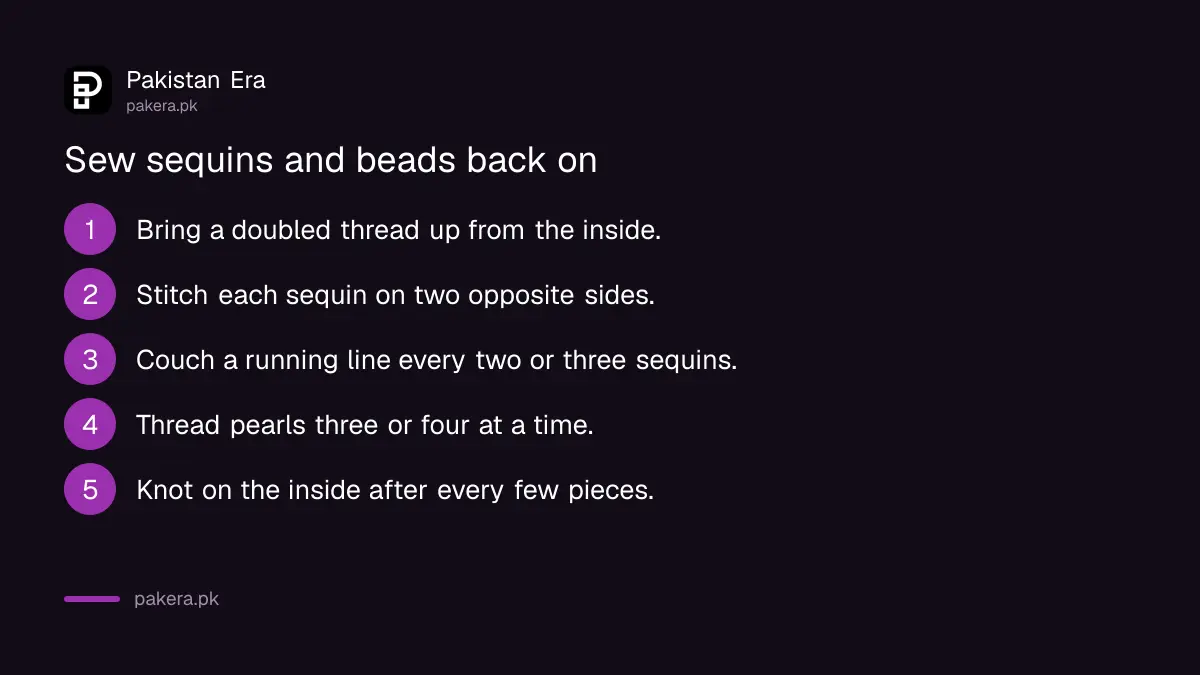
Sew from the inside so knots stay hidden. Put two stitches through each sequin, on opposite sides, so it lies flat and cannot spin. For beads, pass the needle through each bead twice. Knot on the inside after every few pieces.
Single sequins
- Knot a doubled thread and bring the needle up from the inside, where the sequin should sit.
- Pass the needle through the sequin hole and down at the edge of the sequin.
- Come up again on the opposite edge, through the hole and down.
- Knot on the inside, or carry on to the next sequin with small stitches.
A running line of sequins
- Lay the loose string of sequins back along its old line, pinned at each end.
- With new thread, make a small stitch over the string between every two or three sequins. This is called couching.
- Tie off at both ends, on the inside, with two knots.
Pearls and beads
Thread three or four beads at a time, lay them on the line, and take a small stitch back through the last bead. Knot on the inside after every three or four. If the thread breaks later, only those few beads come loose instead of the whole row.
Glued stones need fabric glue, not instant glue
Many kundan and crystal stones on formal wear are glued, not sewn. Use a glue made for fabric and clear when dry, put a very small amount on the stone, press it in place, and let it dry flat for several hours before you fold or wear the outfit.
- Clean off old glue with a fingernail so the stone sits flat.
- Test the glue on a hidden spot. Some glues mark silk and chiffon.
- Avoid instant super glue. It sets hard and white, and can bleed through thin fabric.
- Keep glued areas away from a hot iron. Steam the outfit from a distance, as set out for ironing embroidered and velvet wedding clothes.
Velvet needs extra care. Do not press the pile flat while you sew, and work from the back where you can. The steps for cleaning a velvet suit at home also explain how to lift a crushed patch afterwards.
When a new dress keeps shedding work
A brand-new outfit that sheds sequins or stones on the first wear has a fault. Stop wearing it, keep every fallen piece, take photos, and go back to the shop with the receipt quickly. Most brands want faults reported within their exchange period.
- Photograph the damaged area and the receipt on the same day.
- Take the outfit and the fallen pieces to the shop. Ask for a repair, exchange or refund in writing.
- If the shop refuses, send a short written notice with the photos.
- If nothing happens, you can file a consumer court complaint in your district.
To make repaired work last, do not hang heavy beaded pieces for long, because the weight pulls on every stitch. Fold them flat with tissue between the layers. Dark, tarnished zari next to the beads is a separate problem with its own fixes.
Common questions
What thread is best for sewing sequins?
Polyester thread in the fabric's colour, or clear nylon thread. Cotton thread is weaker and can be cut by the sharp edge of a sequin.
Why does my whole line of sequins come off at once?
It was sewn with a chain stitch. When one loop breaks, pulling the thread undoes the rest. Tie the end off on the inside straight away.
Can I use super glue on a wedding dress?
It is better not to. Super glue sets hard and white and can soak through thin fabric. Use a clear fabric glue and test it first.
Where can I buy matching sequins and beads?
At a lace or haberdashery shop in your local bazaar. Take a fallen sequin or bead with you to match the size, colour and shine.
How long does a sequin repair take at home?
A few single sequins take 10 to 20 minutes. A running line takes up to 40 minutes. A large patch is quicker and neater with a karigar.
Should I iron over sequins after repairing them?
No. Heat can melt plastic sequins and loosen glue. Steam the outfit from a distance, or iron on the back with a cloth over it.
How we verified this
What we checked and where we read it.
We checked the Canadian Conservation Institute's page on basic care of textiles on 24 November 2026, which advises against hanging heavily beaded garments, and its note on commercial dry cleaning of textiles, which says fragile attachments should be checked before cleaning and metal trims covered so they do not snag. The sewing steps are the standard hand methods used by tailors and embroidery workers for chain-stitched and beaded formal wear.
About the author

Lifestyle & Clothing Writer
Mahnoor Siddiqui is a lifestyle and clothing writer at Pakistan Era, joining the new lifestyle desk in November 2026.