Which Salary Allowances Are Taxable in Pakistan: House Rent, Medical, Company Car, Bonus and Loans
Which salary allowances are taxable in Pakistan: house rent, conveyance and bonus in full, medical up to 10% of basic exempt, company car at 5% or 10% of cost.
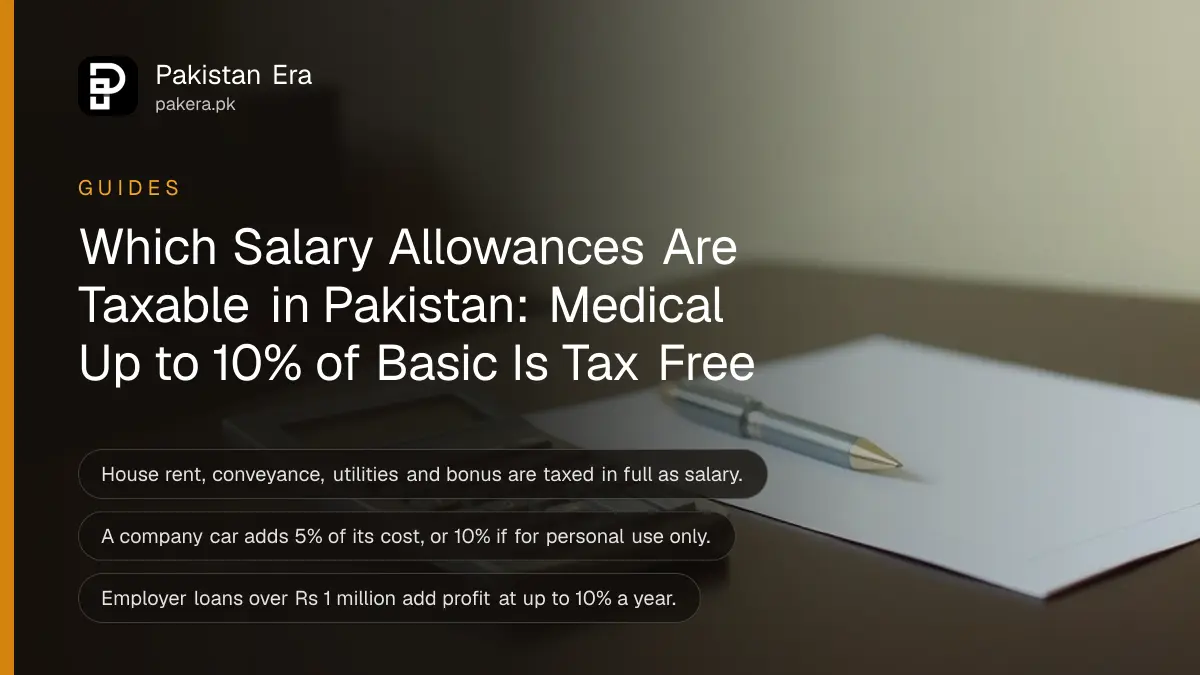
In Pakistan almost every allowance on your payslip is taxable salary. House rent, conveyance, utilities, bonus and overtime are all taxed at your slab rate. The main exception is medical: an allowance up to 10% of basic salary is tax free when your employer gives no free treatment or reimbursement. A company car adds 5% or 10% of its cost to your taxable salary.
These rules come from sections 12 and 13 of the Income Tax Ordinance, 2001, clause (139) of the Second Schedule, and rules 4 and 5 of the Income Tax Rules, 2002. Here is how each item on a typical Pakistani payslip is treated, with worked examples.
Every allowance counts as salary unless the law exempts it
Section 12(2) defines salary to include pay, bonus, overtime, commission, leave pay, any perquisite, and any allowance from the employer. That covers rent, cost of living, utilities, education, entertainment and travel allowances. Only an allowance spent wholly on the employer's work stays out.
The Finance Act, 2021 closed a common argument. An explanation to section 12(2)(c) says an allowance paid every month at a fixed amount, or as a percentage of salary, is never "spent in the performance of duties". So a fixed monthly conveyance or fuel allowance is taxable, even if you use the car for work.
Real reimbursements are different. If you spend money on the employer's behalf, for example a taxi to a client meeting, and the company pays you back against a bill, that repayment is not salary under section 12(2)(d).
How each payslip item is taxed
Allowances paid in cash are added to taxable salary at their full amount. Benefits given in kind, such as a house, car, driver or cheap loan, are added at a value set by section 13 and the Income Tax Rules. The table shows both groups.
| Payslip item | Tax treatment | Law |
|---|---|---|
| Basic salary | Fully taxable | Section 12(2)(a) |
| House rent allowance (cash) | Fully taxable | Section 12(2)(c) |
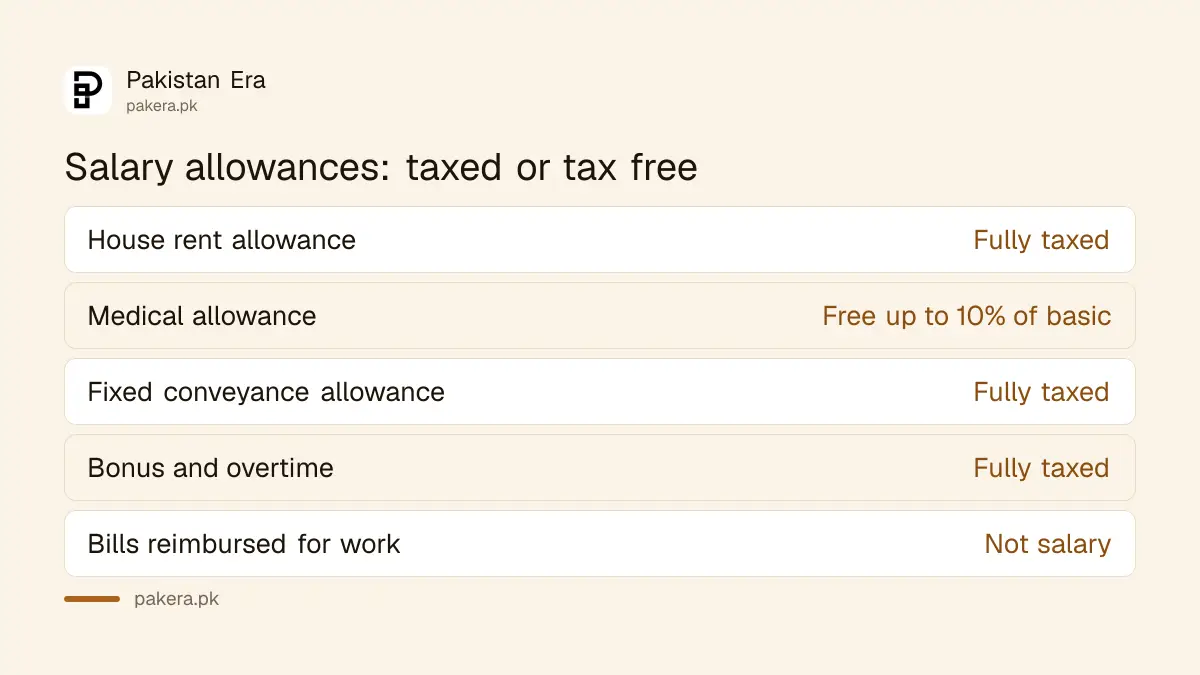
| Medical allowance (cash) | Tax free up to 10% of basic, if no free treatment or reimbursement is given | Clause (139)(b), Part I, Second Schedule |
| Free treatment or hospital bills paid by employer | Tax free, if in the job terms, with the hospital's NTN and bills attested by the employer | Clause (139)(a) |
| Conveyance or fuel allowance (fixed monthly) | Fully taxable | Section 12(2)(c), Explanation |
| Utilities allowance | Fully taxable | Section 12(2)(c) |
| Bonus, overtime, commission, leave pay | Fully taxable in the year received | Section 12(2)(a) |
| Company car with private use | 5% or 10% of the car's cost added | Section 13(3), rule 5 |
| Company house | Rent the employer would pay, at least 45% of minimum basic | Section 13(12), rule 4 |
| Driver, cook, gardener paid by employer | Their salary added, less what you pay | Section 13(5) |
| Interest-free loan over Rs 1 million | Profit at the benchmark rate added | Section 13(7) |
Medical allowance is tax free up to 10% of basic salary
Clause (139) of the Second Schedule gives two choices. Free medical treatment, or reimbursement of medical bills under your job terms, is fully exempt. If neither is given, a medical allowance up to 10% of basic salary is exempt. Anything above 10% is taxed.
For the reimbursement route, the exemption needs two things. The hospital or clinic's National Tax Number must be given, and the employer must certify and attest the bills. Keep copies, because they back the exempt figure in your return.
Example: your basic salary is Rs 100,000 a month and you get a fixed medical allowance of Rs 15,000. Ten per cent of basic is Rs 10,000, so Rs 10,000 a month is tax free and Rs 5,000 is added to your taxable salary.
A company car adds 5% or 10% of its cost
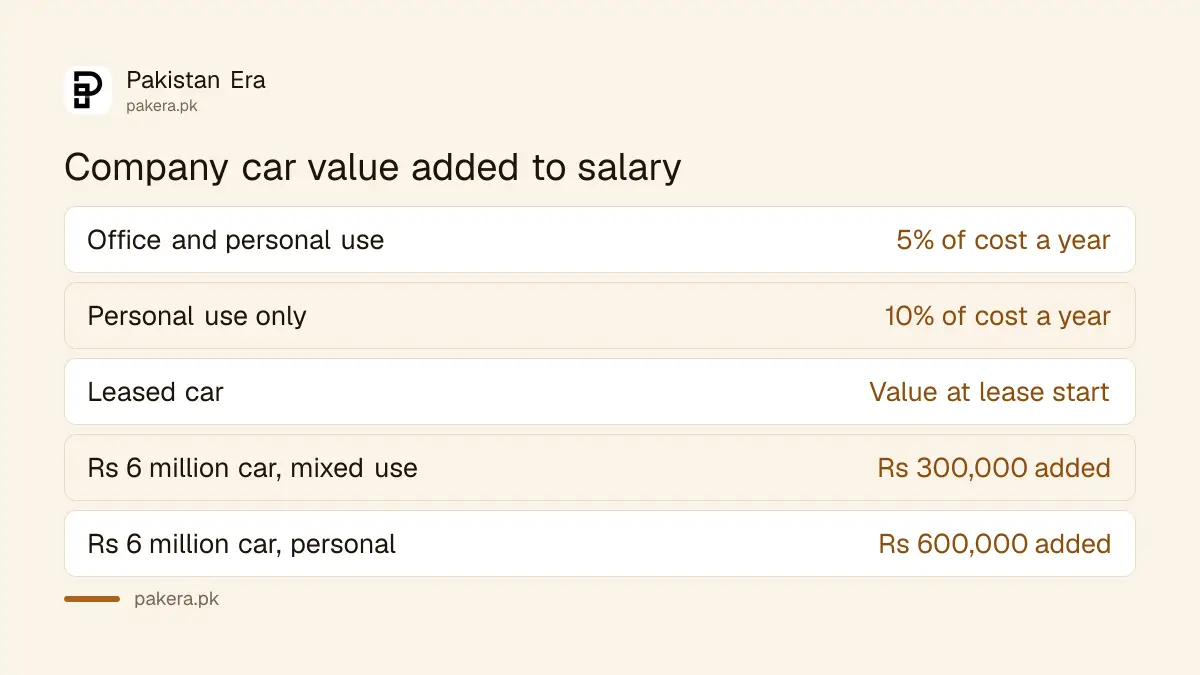
Rule 5 of the Income Tax Rules values a company car at 5% of its cost a year when used partly for work and partly for personal use. A car only for personal use is valued at 10%. For a leased car, the fair market value at the start of the lease is used.
Example: your employer bought a car for Rs 6,000,000 and you use it for office and home trips. Five per cent of Rs 6,000,000 is Rs 300,000, so Rs 300,000 a year is added to your taxable salary. If the car is for personal use only, the figure is Rs 600,000.
The same section adds a driver's salary if the company pays one for you, under section 13(5). A fixed fuel allowance on top is taxed in full as an allowance.
A company house is valued at 45% of minimum basic
Rule 4 values free accommodation at the rent the employer would otherwise pay. That value can never be less than 45% of the minimum of the basic pay scale, or of basic salary where there is no scale. Where house rent allowance is paid at 30%, the floor is 30%.
Example: you live in a company house and your basic salary is Rs 200,000 a month, with no time scale. The taxable value is at least 45% of that, Rs 90,000 a month, or Rs 1,080,000 a year, added to salary.
Cheap loans and employer-paid tax are added too
An interest-free or low-interest loan from your employer adds the missing profit at the benchmark rate, which section 13(14) caps at 10% a year. Loans up to Rs 1 million are left out. A loan your employer waives is added in full.
Example: your employer lends you Rs 3,000,000 at no interest. Profit at 10% would be Rs 300,000 a year, and that amount is added to your taxable salary. If you paid 4% (Rs 120,000), the difference of Rs 180,000 is added instead.
If your employer pays your income tax for you, section 12(3) grosses up your salary by that tax. In other words, the tax paid on your behalf is itself treated as salary.
How to check your own payslip
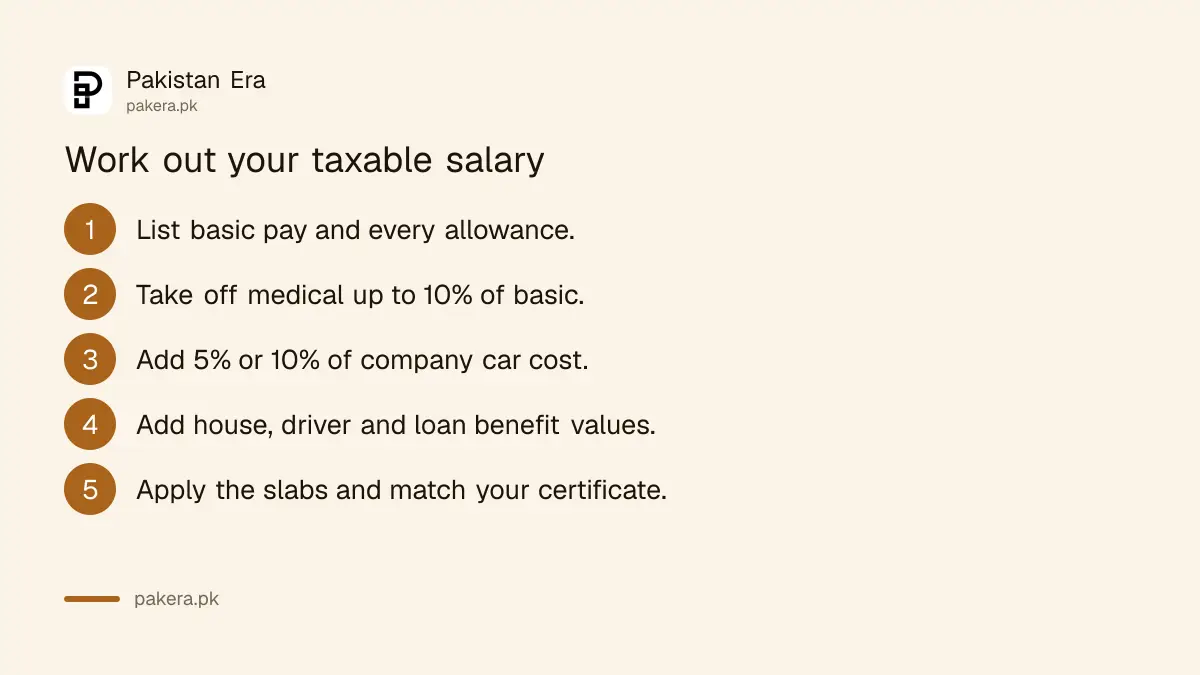
Add up every cash allowance at its full amount, take out the exempt part of medical, then add the values of any car, house, driver or loan. The total is your taxable salary. Compare it with the figure on your employer's yearly tax certificate.
- List your monthly basic salary and every allowance from the payslip.
- Take off the medical allowance up to 10% of basic, if your employer gives no free treatment or reimbursement.
- Add 5% or 10% of the company car's cost, if you have one.
- Add the rule 4 value of any company house, and a driver's or cook's salary paid by the employer.
- Add benchmark profit on any employer loan over Rs 1 million.
- Multiply by 12 and apply the salaried tax slabs for 2026-27, or use the salary tax calculator.
- Match the result with your withholding tax certificate from your employer.
If the employer has taxed something that should be exempt, ask payroll to correct it in the next month's deduction. You can also claim the excess back when you file your salaried tax return on IRIS.
Common questions
Is house rent allowance taxable in Pakistan?
Yes. A cash house rent allowance is part of salary under section 12(2)(c) and is taxed in full at your slab rate.
How much medical allowance is tax free?
Up to 10% of basic salary, when your employer does not give free treatment or reimburse your medical bills under your job terms.
Is a fixed conveyance allowance tax free?
No. A fixed monthly allowance, or one paid as a percentage of salary, is taxable under the 2021 explanation to section 12(2)(c).
Is bonus taxed at a separate rate?
No. Bonus is salary under section 12(2)(a). It is added to your income for the year and taxed at your normal slab rate.
How is a company car taxed?
Rule 5 adds 5% of the car's cost a year for mixed office and personal use, or 10% for personal use only.
Is an interest-free loan from my employer taxed?
Only if it is over Rs 1 million. Then profit at the benchmark rate, at most 10% a year, is added to salary.
How we verified this
What we checked and where we read it.
We checked sections 12 and 13 and clause (139) of Part I of the Second Schedule in the Income Tax Ordinance, 2001 amended up to 30 June 2026, and rules 3 to 7 in the Income Tax Rules, 2002 amended up to 15 September 2026, both on FBR's download server, on 15 November 2026. The worked examples are our own arithmetic on those rules.
About the author

Tax, Bills and Technology Writer
Ali Akhtar is a young and curious voice here at Pakistan Era. He is currently pursuing his A-Levels and has a growing interest in Pakistan’s changing industrial landscape and educational trends. Ali likes to write in a way that helps him explain and explore the world around him. His writing reflects the perspective of the new generation navigating the evolving trends of Pakistan where technology, youth innovation, and shifting opportunities are reshaping the country’s future.