Salaried Person Tax Return on IRIS 2026: Form 114(1) Steps, Documents and Every Common Mistake
How a salaried person files the 2026 tax return on FBR IRIS: who can use Form 114(1), the 5 documents to keep ready, 8 steps and the mistakes to avoid.
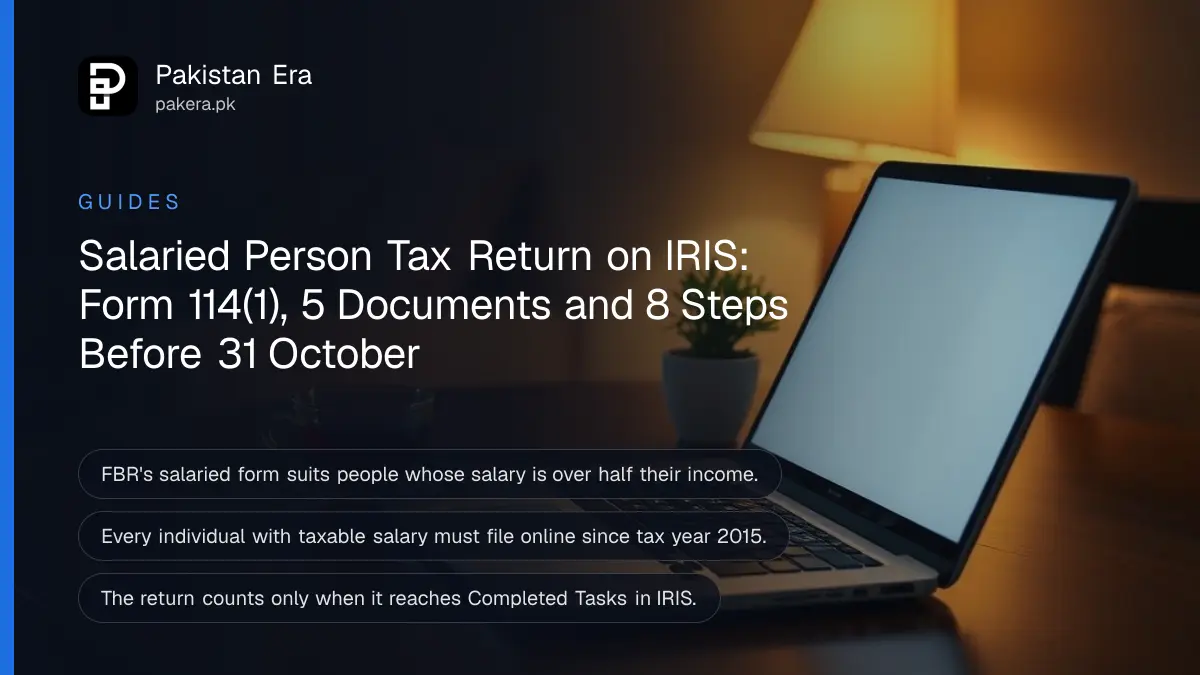
A salaried person files the tax year 2026 return on IRIS using the salaried declaration form, Form 114(1), together with a wealth statement, and the return is only filed once both forms move from Draft to Completed Tasks. FBR lets you use that simpler form if your income is only salary and other sources, with salary more than half of it. The last date is 31 October 2026.
Most of your tax is already paid. Your employer took it from each month's salary. The return is how you tell FBR so, claim the extra tax taken on your phone, bank profit or car, and get on the Active Taxpayers List for the lower filer rates. This page sets out who can use the salaried form, what to have ready, the steps in order, and the mistakes that stop a salaried return.
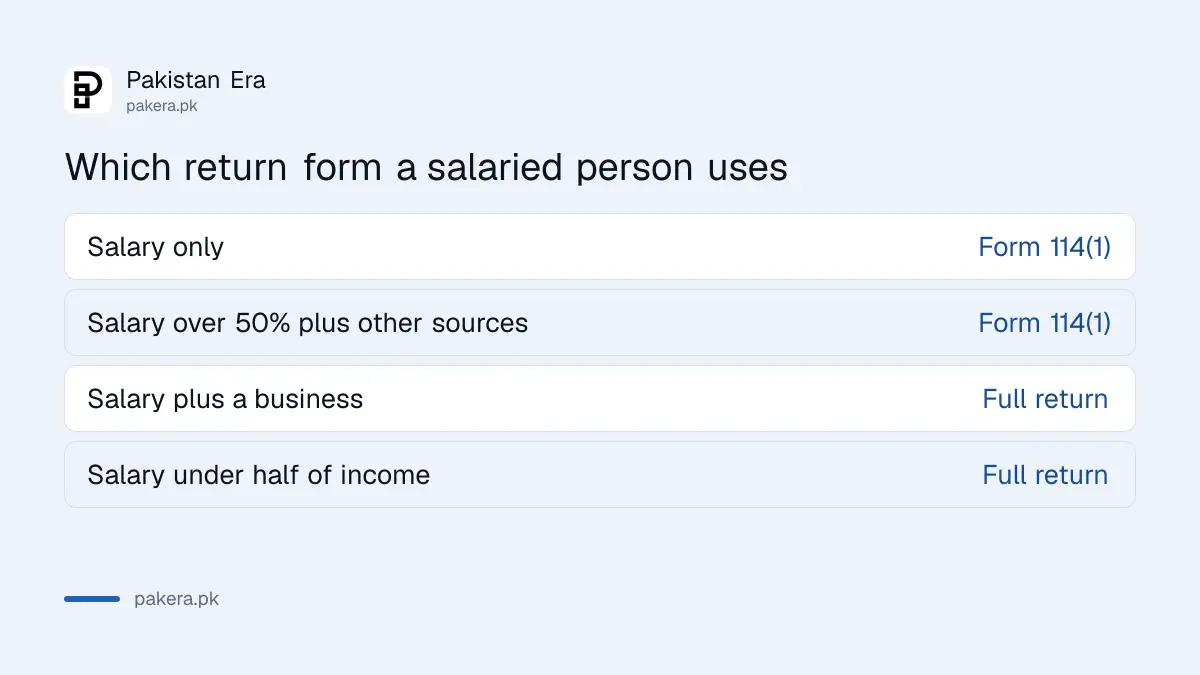
Salaried people use Form 114(1) if salary is more than half of income
FBR's filing page says salaried persons complete the declaration form 114(I) to submit their return. It is meant for people whose income comes only from salary and other sources, where salary is more than 50 per cent of total income.
| Your income | Which return |
|---|---|
| Salary only | Salaried form 114(1) |
| Salary plus bank profit or other sources, salary over 50% | Salaried form 114(1) |
| Salary plus a business or shop | Full return of income |
| Salary less than half of income | Full return of income |
| Pension only | Return with pension shown separately |
Salaried people must file online. Section 118(2A) of the Income Tax Ordinance, read with the notification printed under it, says every individual with taxable salary files electronically from tax year 2015 onwards. A paper return is not an option for you.
Have five documents ready before you log in
The salary certificate is the main one. Add your bank tax certificates, mobile tax certificates, any car registration or token tax receipts, and last year's wealth statement. With these open, the return takes far less time and the wealth statement balances on the first try.
| Document | Where you get it | What it fills |
|---|---|---|
| Annual salary certificate | Your employer's HR or accounts office | Gross salary, allowances, tax deducted |
| Bank tax certificates | Each bank, for 1 July 2025 to 30 June 2026 | Profit on savings and tax deducted on it |
| Mobile tax certificates | Your network's app or site | Advance tax on mobile load and bills |
| Vehicle tax receipts | Excise office or online receipt | Advance tax on registration and token tax |
| Last year's wealth statement | IRIS, Completed Tasks | Opening assets and liabilities |
The network certificates come from each operator, for example the steps for a Jazz tax certificate on Simosa. Filers also pay no advance tax on home electricity, as electricity bill advance tax for filers explains, so check your bills before you claim any.
File the salaried return in eight steps
Log in, open the tax year 2026 salaried declaration, enter salary from the certificate, add other income and the tax already taken, then fill and balance the wealth statement. Submit both and confirm they reached Completed Tasks. Pay any balance with a PSID.
- Log in to IRIS at iris.fbr.gov.pk with your CNIC and password.
- Open a new declaration for tax year 2026 and choose the salaried form 114(1).
- Enter your employer's name and NTN, and the gross salary and allowances from the certificate.
- Enter the tax your employer deducted, exactly as the certificate shows it.
- Add other income, such as bank profit, and the tax deducted on it.
- Add the advance tax you paid on your phone, car and similar items as tax credits.
- Fill the wealth statement and make the unreconciled amount zero.
- Submit both forms, then check they appear in Completed Tasks and save the acknowledgement.
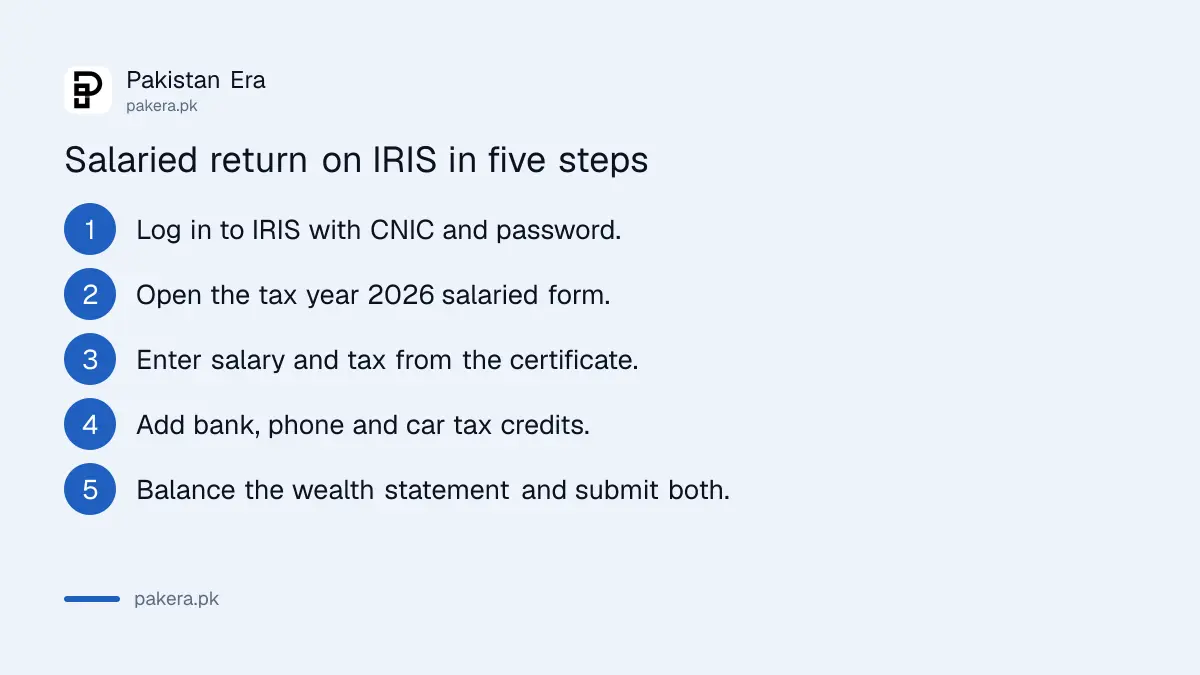
Screen names on IRIS change from year to year. We did not file a return for this page, so treat the step wording as a map rather than exact button labels. If login itself fails, fixing IRIS login errors is the place to start.
The wealth statement is filed with the salaried return
Section 116(2) requires every resident individual who files a return to file a wealth statement and a wealth reconciliation with it. FBR says the return will not submit until your wealth has changed by the same amount as your income minus your spending.
For a salaried person the sum is usually short. Take net salary after tax, add bank profit and any gifts or loans received, subtract household spending, and the result should match the growth in your assets. Filling the wealth statement so it balances has a worked example on a salary of Rs 1.8 million. Do not lower your spending figure to force a zero. That turns a mismatch into a false statement.
Check the tax figures against your payslips
Your employer must spread your salary tax across the year under section 149. The figure on your certificate should equal the total taken from your 12 payslips. If the two differ, ask HR before you file, because FBR also sees what your employer reported.
The current slabs are in salary tax slabs for 2026-27, and the tax year 2026 figures cover July 2025 to June 2026. If more tax was taken than the slabs require, the return will show a refundable amount. You claim that through a separate refund application, not the return alone.
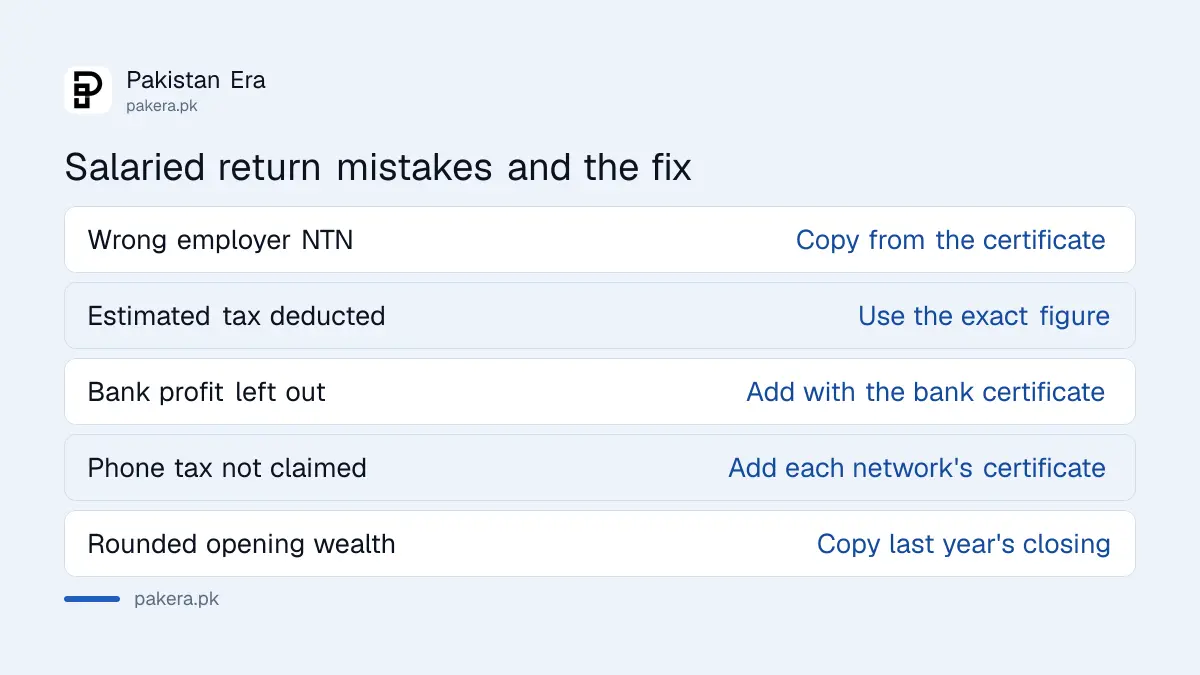
| Common mistake | What to do |
|---|---|
| Employer NTN typed wrong | Copy it from the salary certificate |
| Tax deducted entered as an estimate | Use the certificate figure, to the rupee |
| Bank profit left out | Add it with the bank's tax certificate |
| Phone tax not claimed | Add it from each network's certificate |
| Opening wealth rounded | Copy last year's closing figure exactly |
After you file, keep records for six years
FBR's filing page says anyone with taxable income must keep the records behind the return for six years. Save the salary certificate, bank and phone certificates, the acknowledgement and any PSID receipt in one folder. If you find a mistake later, the return can be revised.
FBR says a return can be revised within five years of filing, through an application in IRIS. Revising an income tax return covers the 60-day window when no approval is needed. Your name should join the Active Taxpayers List in a later weekly update, and checking your filer status shows how to confirm it.
Common questions
Who can use the salaried form 114(1)?
People whose income is only salary and other sources, with salary more than 50 per cent of the total, according to FBR's filing page.
Do salaried people have to file online?
Yes. Section 118(2A) and the notification under it require every individual with taxable salary to file electronically from tax year 2015.
What is the last date for the salaried return?
31 October 2026 for tax year 2026, after FBR's two extensions.
Do I need a wealth statement if I only earn a salary?
Yes. Section 116(2) requires every resident individual who files a return to file a wealth statement and reconciliation with it.
My employer took too much tax. How do I get it back?
File the return showing the excess, then submit a separate refund application in IRIS.
How long should I keep my salary certificate?
Six years, which is the period FBR gives for keeping return records.
How we verified this
What we checked, where we read it, and what we could not confirm.
Last checked 31 October 2026. We read FBR's pages on completing the income tax return, revising a return and record keeping, and sections 116, 118 and 149 of the Income Tax Ordinance amended up to 30 June 2026 on FBR's website. FBR's video tutorial list includes "Income Tax Return for Salaried Persons" in two parts, which we did not watch. We did not file a return for this page, so IRIS screen wording may differ from our steps.
About the author

Global Affairs & Political Economy Writer
Muhammad Hatim is a book lover who started writing because he enjoys it. At Pakistan Era he writes about international relations, geopolitics and the global economy, with a particular interest in South Asia and the forces behind current events.