Filers Pay No Advance Tax on Home Electricity in Pakistan
Section 235 does not apply to a domestic consumer whose name is on the Active Taxpayer List. A monthly saving most households never claim.
If your name is on the Active Taxpayer List, advance income tax should not be charged on your domestic electricity bill at all. The law says so in a proviso most people have never read.
That is a saving every month, on every bill, for as long as you stay on the list. It is also the most concrete reason to file a return that we have found.
We read section 235 of the Income Tax Ordinance, 2001 on 2 September 2026, in the consolidated text FBR publishes on its own download site.
What the section says
Advance tax is collected on the electricity bill of a commercial, industrial or domestic consumer, at rates in Division IV of Part IV of the First Schedule.
Then comes the proviso. The provisions of subsection 1 shall not apply to a domestic consumer of electricity if his name appears on the Active Taxpayers' List.
| Consumer | Position under section 235 |
|---|---|
| Domestic, on the ATL | The subsection does not apply |
| Domestic, not on the ATL | Advance tax is collected |
| Commercial | Advance tax is collected |
| Industrial | Advance tax is collected |
So for a household, being on the list is not a small administrative nicety. It removes a charge from a bill you pay twelve times a year.
The tax is charged on the whole bill
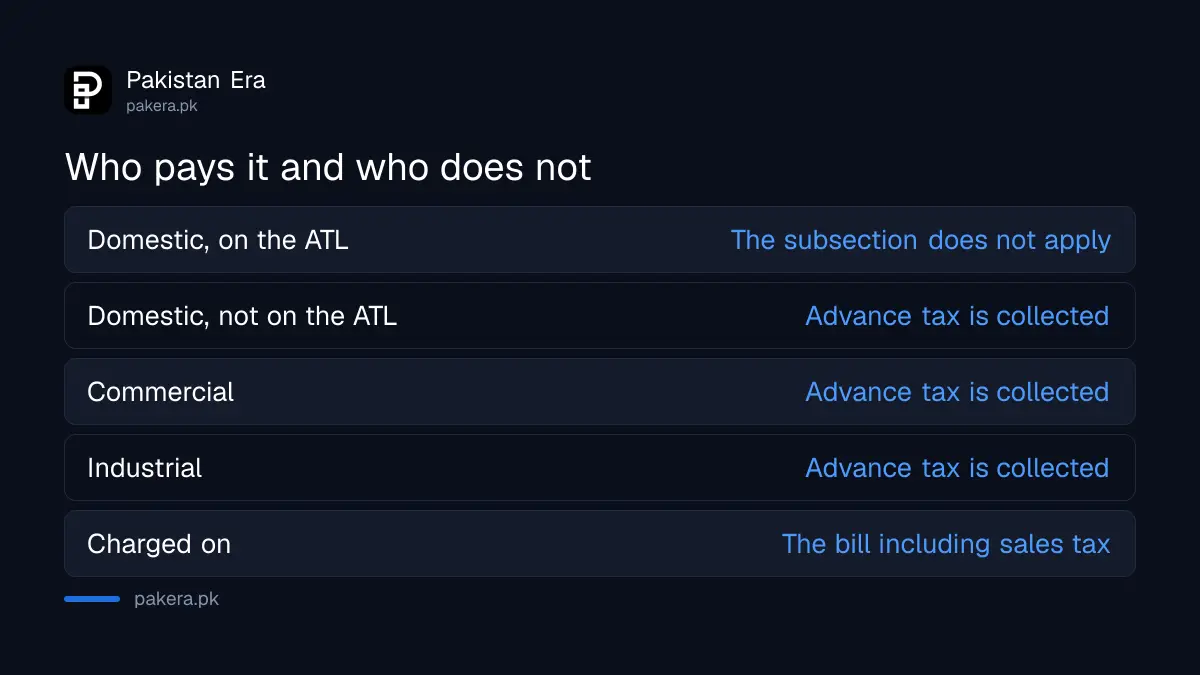
An explanation added to the section removes any doubt about the base. For the purposes of this section, the electricity consumption bill means the bill inclusive of sales tax and all incidental charges.
In other words the advance tax is worked out on the gross figure, after sales tax and other charges have already been added, not on the cost of the units alone. That is why the amount is larger than people expect when they look for it on the bill.
Our guide to what the line items on your electricity bill mean covers the rest of what is being added.
How to check whether it applies to you
Two things to look at, and both take a few minutes.
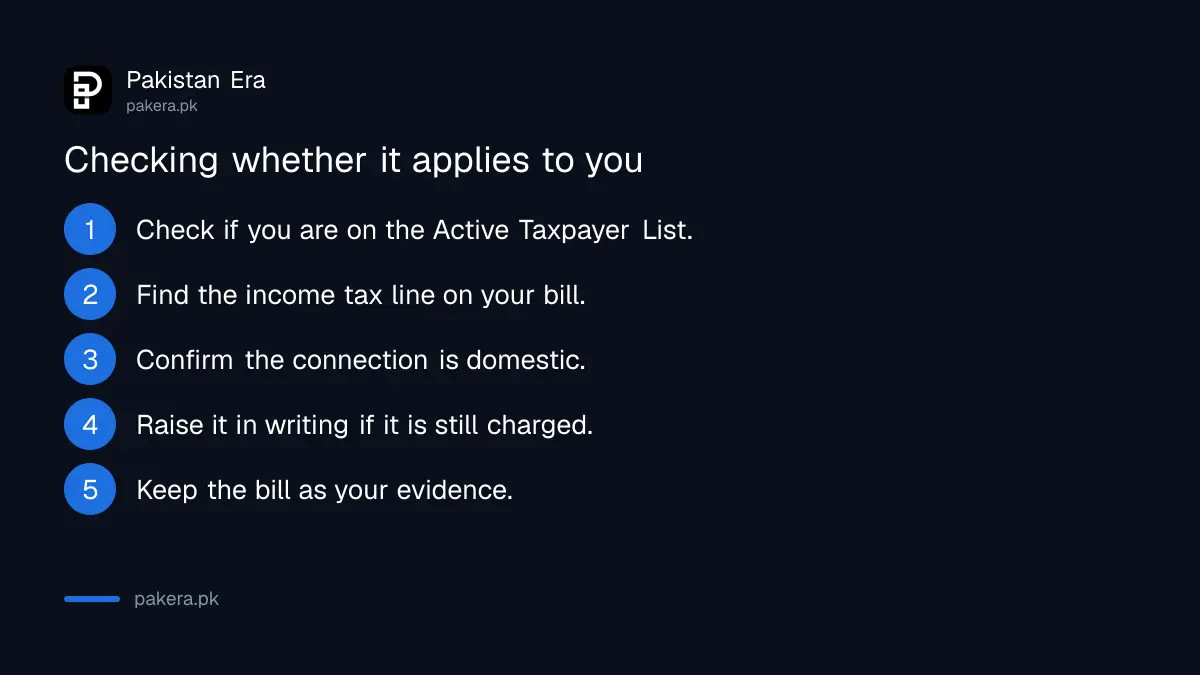
- Check whether you are currently on the Active Taxpayer List.
- Look at your latest bill and find the income tax line.
- Check the connection is a domestic one, not commercial.
- If you are on the list and the charge is still there, raise it.
- Keep the bill, because it is your evidence.
Our guide to checking your filer status covers the first step. If you are not on the list, our guide to becoming a filer sets out how, and this electricity proviso belongs in the calculation of whether it is worth doing.
If the charge is still on your bill
The exemption depends on your name appearing on the list, and the electricity company applies it from the records available to it.
Raise it with your supplier in writing, quoting section 235 and the proviso, and attach evidence that you are on the Active Taxpayer List. Keep the reference number. If nothing moves, our guide to complaining to NEPRA covers the regulator route, and our guide to overbilling covers the wider set of billing disputes.
A separate provision in the same section says advance tax shall not be collected from a person who produces a certificate from the Commissioner about their income for the tax year. That is a different route and worth asking a tax adviser about if the proviso does not fit your situation.
Why this matters more than the amount
People weigh up filing against the effort and the fees. The usual arguments are about non-filer rates on property and vehicles, which only bite when you make a large transaction.
This one is different because it is monthly and it is automatic. It applies to a bill every household already receives, without any transaction at all.
Set against that, our guide to the ATL surcharge and the 30 September deadline covers what it now costs to get back onto the list after filing late. The two figures are worth looking at together before deciding.
The rate is not in the section
Section 235 points to Division IV of Part IV of the First Schedule for the rate, which changes with each Finance Act.
We are not quoting a percentage or a slab. The consolidated Ordinance FBR publishes is amended up to 20 February 2026, which is before the Finance Act, 2026 took effect on 1 July 2026, so the table in the copy we could read is not current. Your own bill is the authority for what you are actually being charged.
Common questions
Do filers pay advance tax on electricity?
The proviso says subsection 1 does not apply to a domestic consumer whose name appears on the Active Taxpayers' List.
Does this cover a shop or a factory?
No. The proviso is for domestic consumers. Commercial and industrial consumers remain within the section.
What is the tax charged on?
The bill inclusive of sales tax and all incidental charges, according to the explanation in the section.
I am a filer but it is still on my bill. What do I do?
Raise it with your supplier in writing with evidence of your ATL status, and keep the reference number.
Is there another way to be exempt?
The section refers to producing a certificate from the Commissioner regarding your income for the tax year. Ask a tax adviser whether that fits you.
What is the rate?
We do not quote one. It sits in the First Schedule and the published Ordinance predates the Finance Act, 2026.
How we verified this
What we checked, where we read it, and what we could not confirm.
Last checked 2 September 2026. We downloaded the consolidated Income Tax Ordinance, 2001 from FBR's own download site, the version amended up to 20 February 2026, and read section 235 in it. The collection of advance tax on the electricity bill of a commercial, industrial or domestic consumer at rates specified in Division IV of Part IV of the First Schedule, the proviso stating that subsection 1 shall not apply to a domestic consumer of electricity if his name appears on the Active Taxpayers' List, the requirement that the person preparing the bill charges the tax in the manner electricity charges are charged, the explanation clarifying that the electricity consumption bill means the bill inclusive of sales tax and all incidental charges, and the provision regarding a certificate from the Commissioner, are all taken from that text. The rate is not quoted here because it sits in the First Schedule and the published consolidated text predates the Finance Act, 2026 which took effect on 1 July 2026. Whether the exemption is applied in practice depends on your electricity supplier's records, so check your own bill. Nothing here is tax advice.
About the author

Tax, Bills and Technology Writer
Ali Akhtar is a young and curious voice here at Pakistan Era. He is currently pursuing his A-Levels and has a growing interest in Pakistan’s changing industrial landscape and educational trends. Ali likes to write in a way that helps him explain and explore the world around him. His writing reflects the perspective of the new generation navigating the evolving trends of Pakistan where technology, youth innovation, and shifting opportunities are reshaping the country’s future.