SBP Annual Report FY26: Pakistan Growth Seen at 3.5% to 4.5% in FY27, Inflation to Ease
SBP's FY26 annual report on 16 November 2026 sees 3.5% to 4.5% growth in FY27, inflation easing to 5% to 7%, and a 0.1% of GDP current account deficit in FY26.
یہ صفحہ اردو میں پڑھیں
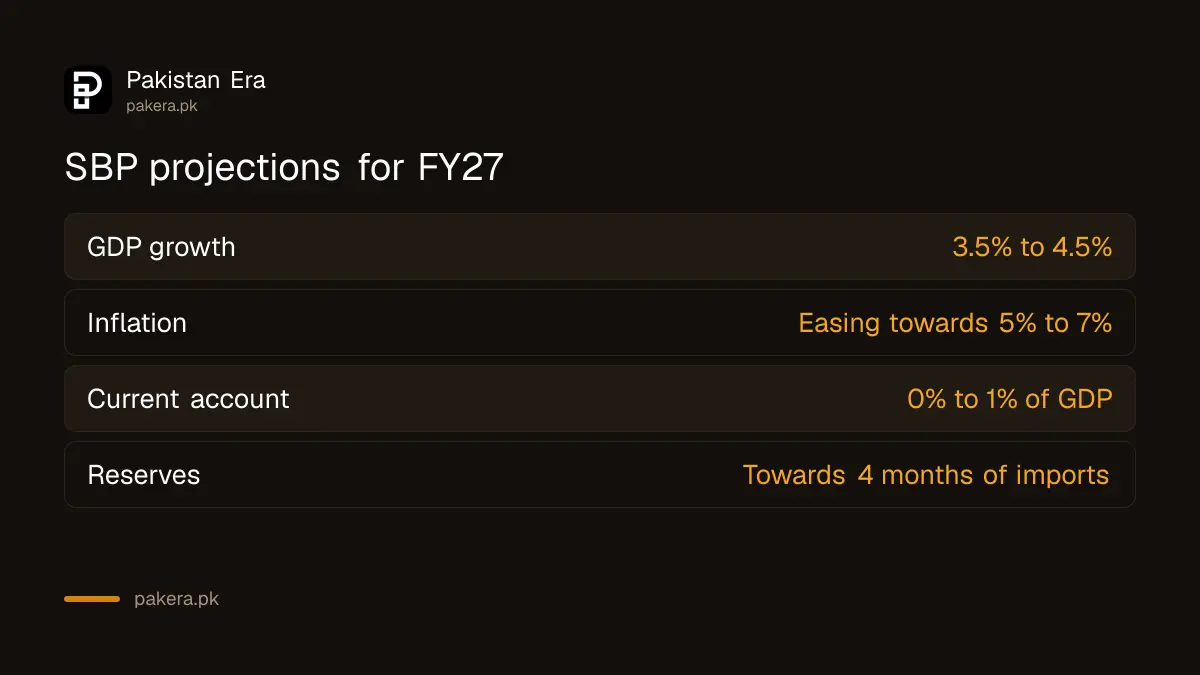
Short answer: The State Bank of Pakistan (SBP) released its Annual Report on the State of Pakistan's Economy for FY26 on Monday 16 November 2026. It projects real GDP growth of 3.5% to 4.5% in FY27, the year that runs from July 2026 to June 2027. It expects inflation to ease gradually towards its 5% to 7% target range.
The report also puts the FY26 current account deficit at just 0.1% of GDP, held down by strong remittances. It names higher global energy prices and worsening El Nino weather as the main risks to the recovery.
SBP sees Pakistan growing 3.5% to 4.5% in FY27
The SBP projects real GDP growth of 3.5% to 4.5% for FY27. In FY26, growth rose mainly because large-scale manufacturing (factory output) recovered. Preliminary data show bigger kharif crops of sugarcane, rice and maize than last year, which supports the farm outlook.
The Pakistan Bureau of Statistics has put FY26 growth at 3.65%, with the details in our page on Pakistan's revised GDP growth for 2025-26. So the SBP's range means growth could stay about the same or pick up by almost a point.
The SBP's FY27 numbers sit close to the IMF and World Bank
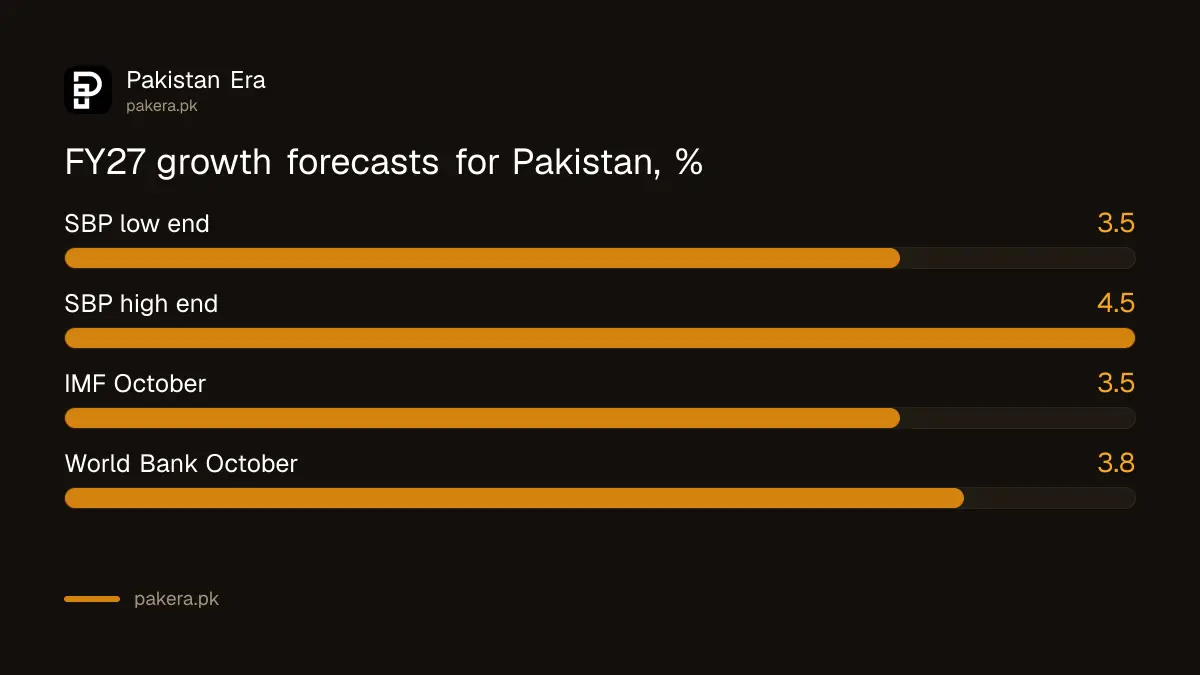
The SBP's growth range takes in both the IMF and World Bank forecasts made in October. On inflation, the SBP speaks of a target range rather than a single number, while the IMF and World Bank both expect average inflation well above 7% in FY27.
| Forecast for FY27 | GDP growth | Inflation |
|---|---|---|
| SBP annual report, 16 November 2026 | 3.5% to 4.5% | Easing gradually towards 5% to 7% |
| IMF, October 2026 | 3.5% | 9.9% average |
| World Bank, October 2026 | 3.8% | 8.2% average |
The full IMF numbers are in our page on the IMF October 2026 outlook for Pakistan, and the World Bank's in its FY27 forecast for Pakistan.
Inflation stayed near the top of the SBP's target in FY26
Average inflation in FY26 stayed close to the upper end of the SBP's 5% to 7% medium-term target, despite the oil shock from the Middle East conflict that began in late February 2026. For FY27, the SBP expects it to ease gradually towards that range.
Monthly inflation is running well above that range for now. The Pakistan Bureau of Statistics put CPI inflation at 9.6% in October 2026, down from 10.3% in September, as shown in our October 2026 inflation figures. The SBP raised its policy rate by half a point to 12% from 27 October.
Remittances held the current account deficit to 0.1% of GDP
Strong remittances from Pakistanis working abroad kept the FY26 current account deficit to 0.1% of GDP. Imports rose as the economy picked up, while exports stayed weak because of poor global conditions. For FY27, the SBP expects the deficit to stay between zero and 1% of GDP.
- Remittances: strong in FY26, and expected to stay strong in FY27.
- Imports: rose in FY26 and are expected to grow again in FY27.
- Exports: held back in FY26 by unfavourable global trends, with a moderate recovery expected in FY27.
- Reserves: rose a lot in FY26, helped by heavy SBP dollar buying in the market and a cut in its forward liabilities (dollars it had promised to pay later).
The SBP expects reserves to keep building in FY27 towards about four months of import cover, helped by the $3 billion Eurobond Pakistan raised in September 2026. Pakistan's earlier bonds are listed in our page on Pakistan's Eurobonds, coupons and maturities.
Energy prices and El Nino are the main risks
The report names two main dangers for FY27. A further rise in world energy prices would push up fuel and power costs and inflation. Worsening El Nino conditions could hurt crops. FY26 itself faced US tariff changes, monsoon floods and the Middle East conflict.
On the budget side, the report says public finances improved in FY26 as the government kept cutting its deficit and paid much less in interest.
What the SBP report means for your money
The report does not change any rate or price on its own. It is the central bank's view of where the economy is going. These are the points to watch over the coming weeks.
- Loans and savings: the policy rate stays at 12% until the next monetary policy meeting on 14 December 2026. A forecast of easing inflation is what borrowers will watch at that meeting.
- Prices: monthly inflation is still near 10%. The November CPI figure from the Pakistan Bureau of Statistics, due in early December, will show whether prices are cooling.
- Electricity and fuel: the SBP names energy prices as the biggest risk, so monthly fuel charges on power bills and petrol prices remain the items most likely to move your budget.
- Jobs and business: a recovery led by factories and bigger crops points to steadier demand, though exporters still face weak world markets.
Common questions
When did the SBP release its FY26 annual report?
The SBP released its Annual Report on the State of Pakistan's Economy for FY26 on Monday 16 November 2026.
What growth does the SBP expect for FY27?
The SBP projects real GDP growth of 3.5% to 4.5% for FY27, which runs from July 2026 to June 2027.
Will inflation come down in Pakistan?
The SBP expects inflation to ease gradually towards its 5% to 7% target range during FY27. CPI inflation was 9.6% in October 2026.
What was Pakistan's current account deficit in FY26?
The SBP puts it at 0.1% of GDP, kept low by strong remittances. It expects zero to 1% of GDP in FY27.
What are the main risks the SBP names?
Higher global energy prices and worsening El Nino conditions, which could raise inflation and hurt crops.
Does the report change the policy rate?
No. The policy rate is 12%, and the next monetary policy meeting is on 14 December 2026. More on that date is in our page on the next SBP monetary policy meeting.
How we verified this
What we checked and where we read it.
We checked this on 16 November 2026, the day the State Bank of Pakistan released its Annual Report on the State of Pakistan's Economy for FY26. The FY27 projections, the FY26 current account figure and the named risks were reported the same way across several reports of the release that day. The IMF, World Bank, PBS GDP and October CPI figures come from our earlier pages, each read from the institution's own publication. The policy rate and the 14 December meeting date are from the SBP's monetary policy schedule.
About the author

Global Affairs & Political Economy Writer
Muhammad Hatim is a book lover who started writing because he enjoys it. At Pakistan Era he writes about international relations, geopolitics and the global economy, with a particular interest in South Asia and the forces behind current events.