World Bank Forecasts Pakistan Growth at 3.8% and Inflation at 8.2% in FY27
The World Bank's October 2026 outlook sees Pakistan growing 3.8% in FY27 with 8.2% inflation, and 70 million people in poverty. See the numbers and IMF view.
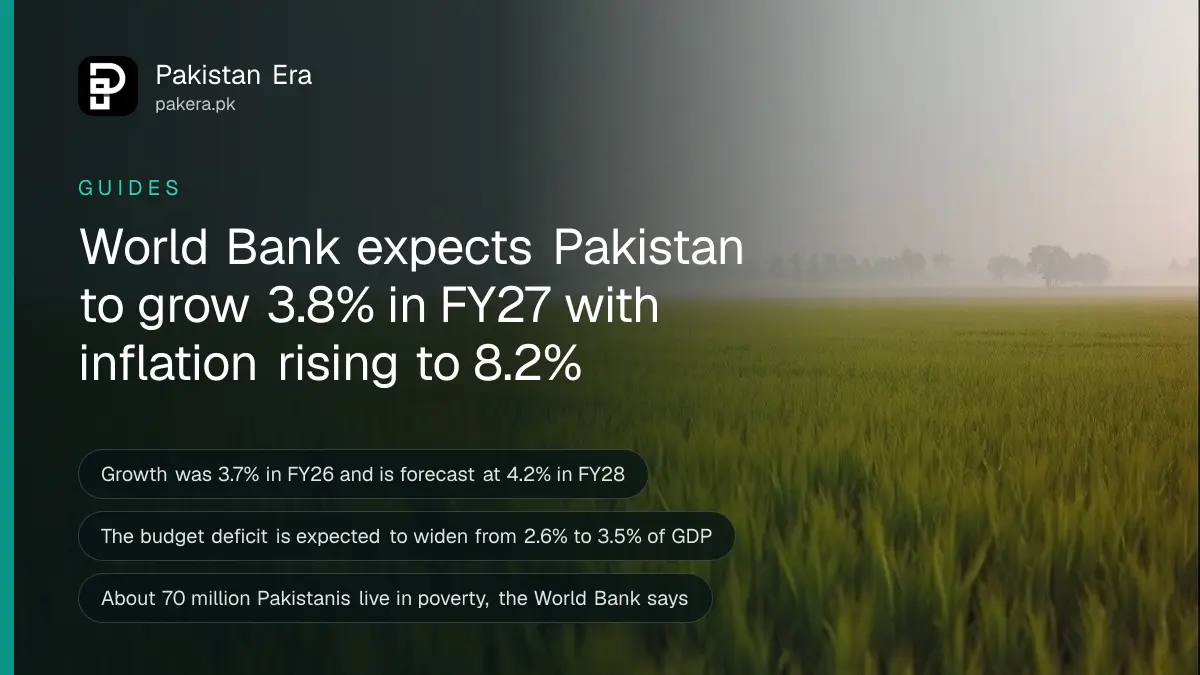
The World Bank expects Pakistan's economy to grow 3.8 per cent in FY27, the year from July 2026 to June 2027, with inflation averaging 8.2 per cent. Both numbers sit in its Pakistan country note in the October 2026 Macro Poverty Outlook, published on 6 October.
Many readers missed it. The Bank's South Asia report, which made the headlines, does not include Pakistan any more. Since 1 July 2025 the World Bank counts Pakistan in its Middle East, North Africa, Afghanistan and Pakistan region, called MENAAP. So Pakistan's forecast is in that regional set of country notes.
We downloaded the two page Pakistan note and its data sheet from the World Bank site and read both. Every number below comes from those files or the World Bank's Pakistan overview page.
The World Bank sees 3.8 per cent growth in FY27 and 4.2 per cent in FY28
The World Bank projects Pakistan's growth at 3.8 per cent in FY27, almost the same as the 3.7 per cent recorded in FY26. It expects growth to pick up to 4.2 per cent in FY28 as high energy prices ease.
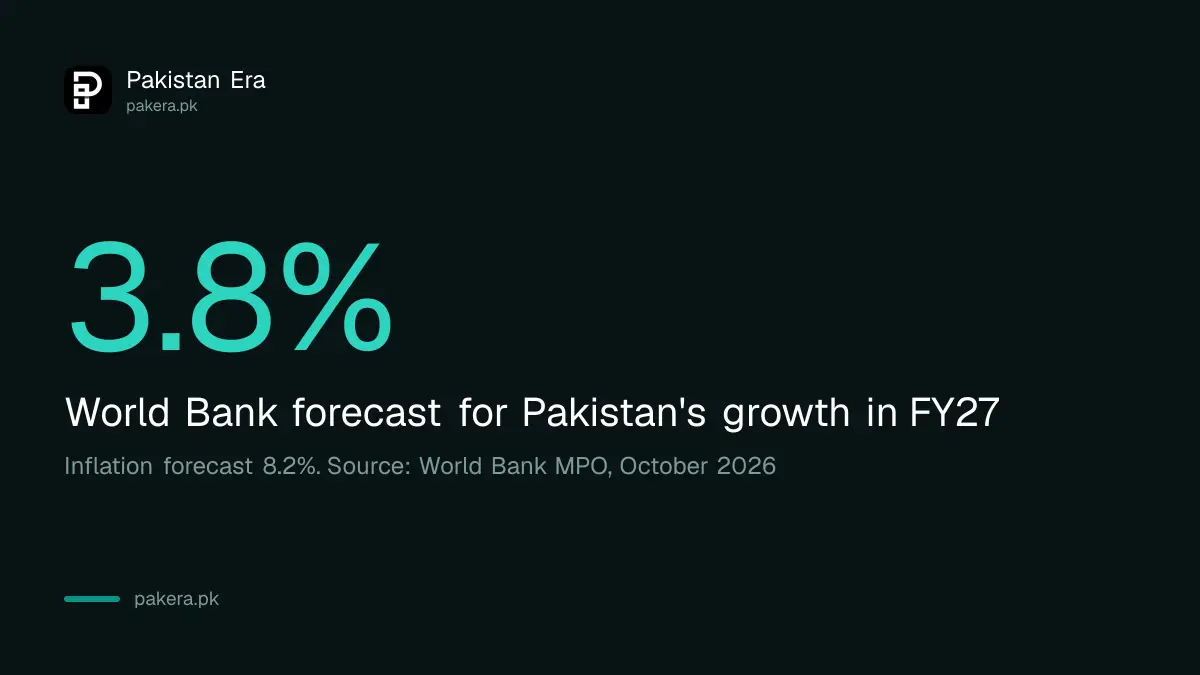
That is growth at factor cost, the measure Pakistan's own statistics office uses for its headline GDP figure. The Bank says high commodity and energy prices will weigh on services and industry this year. Livestock stays the main driver in farming, while crop output stays below its usual level.
Inflation is expected to rise to 8.2 per cent before easing to about 7 per cent
The World Bank expects average inflation of 8.2 per cent in FY27, up from 7.1 per cent in FY26. It blames the pass-through of high global commodity prices, and expects the pressure to fade by FY28, when inflation should fall to around 7 per cent.
The note links the rise to the global oil shock that reached Pakistan's prices from March 2026. Food inflation picked up in April to June 2026 because of higher fuel, freight and fertiliser costs, and because wheat prices were gradually freed. The State Bank raised its policy rate to 11.5 per cent in April 2026.
The monthly figure is already running higher. Pakistan's inflation in September 2026 was 10.3 per cent. An 8.2 per cent average for the whole year would need prices to cool in the second half.
Here is the World Bank forecast next to the IMF's April forecast
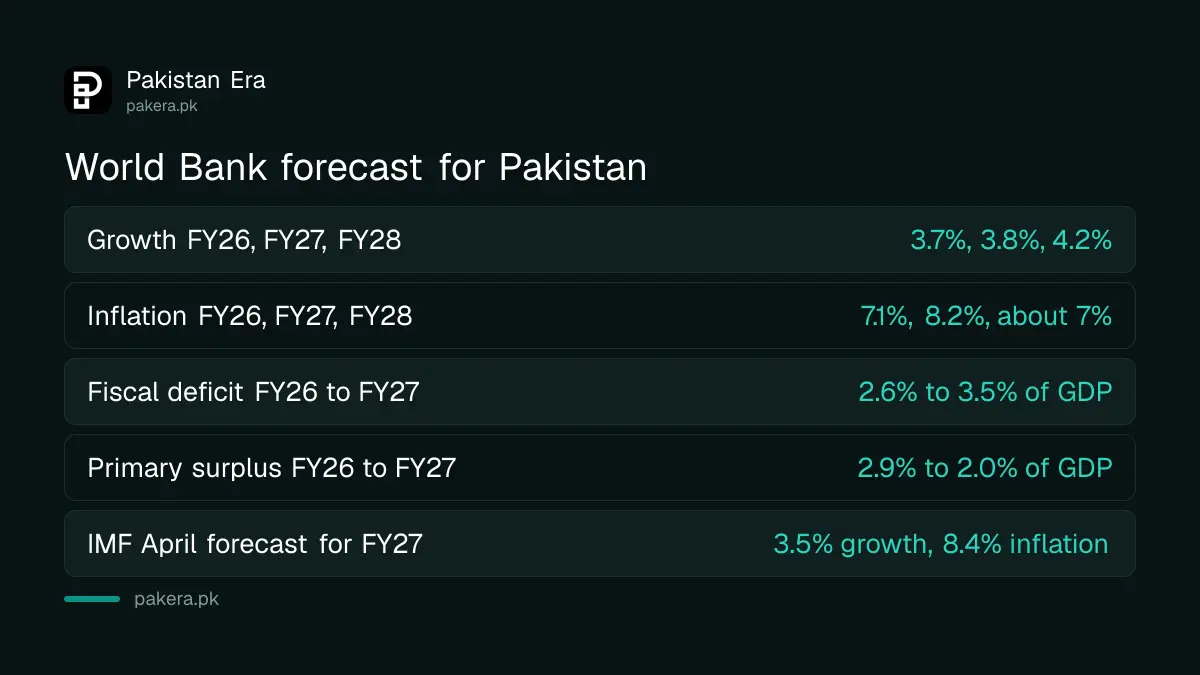
The World Bank is slightly more hopeful than the IMF on growth and slightly less worried about inflation. The IMF's April 2026 forecast for FY27 was 3.5 per cent growth and 8.4 per cent inflation. The IMF updates its own numbers on 13 October.
| Measure | FY26 actual | FY27 World Bank | FY28 World Bank | FY27 IMF (April) |
|---|---|---|---|---|
| GDP growth | 3.7% | 3.8% | 4.2% | 3.5% |
| Average inflation | 7.1% | 8.2% | About 7% | 8.4% |
| Fiscal deficit (% of GDP) | 2.6% | 3.5% | 4.0% | Not compared |
| Primary surplus (% of GDP) | 2.9% | 2.0% | 1.4% | Not compared |
| Current account (% of GDP) | Deficit 0.1% | Widening | Deficit 1.0% | Deficit 0.9% |
The IMF column comes from its DataMapper, which still showed the April 2026 figures when we checked. We set out what to watch in the October update in our note on the IMF and World Bank meetings in Bangkok.
The government deficit is expected to widen from 2.6 to 3.5 per cent of GDP
The World Bank expects the budget deficit to grow from 2.6 per cent of GDP in FY26 to 3.5 per cent in FY27. The main reason is lower non-tax income, while spending rises slowly. It says the deficit still stays within safe limits.
FY26 was helped by cheaper borrowing. Interest payments fell from 7.8 per cent of GDP in FY25 to 5.5 per cent in FY26. Tax revenue rose a little, from 12.3 to 12.5 per cent of GDP, with stronger provincial collection and the petroleum levy.
The figures do not fully agree with each other. The two page note puts the FY28 deficit at 4.0 per cent of GDP, while the Bank's Pakistan overview page says 3.9 per cent. We show the note's figure and flag the gap.
Poverty rose to 29 per cent and jobs have not kept up
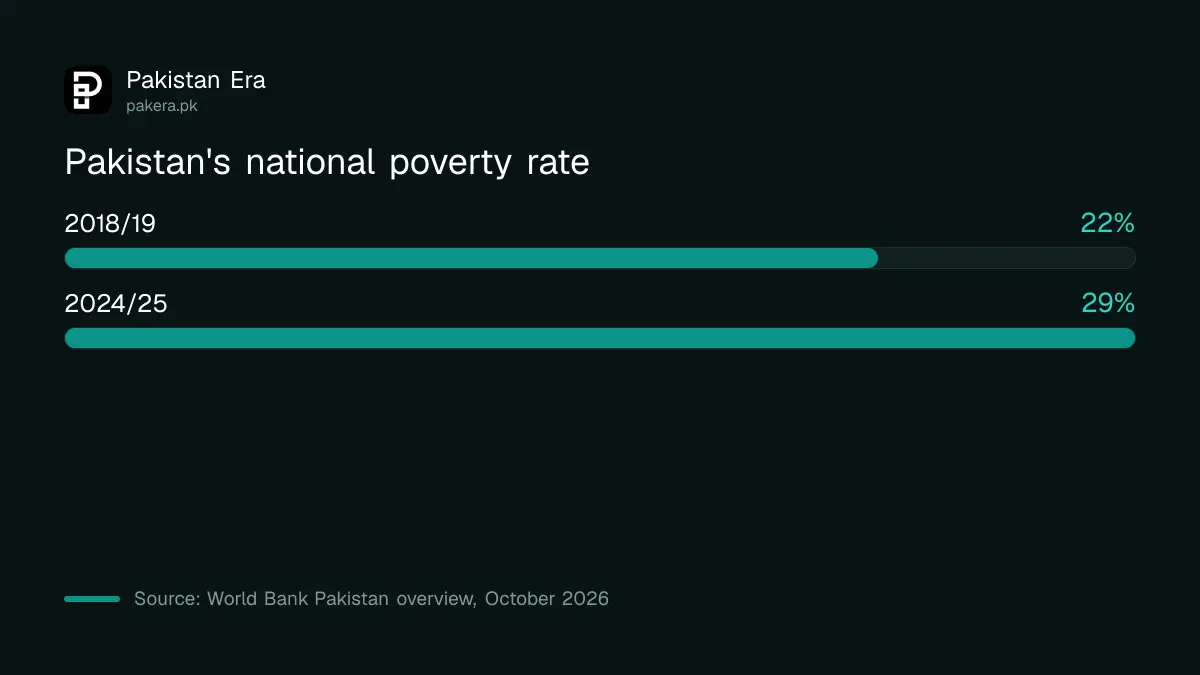
The World Bank says about 70 million Pakistanis now live in poverty. The national poverty rate rose from 22 per cent in 2018/19 to 29 per cent in 2024/25, because real wages fell and jobs did not keep pace with the people looking for work.
About 3.5 million people join the workforce every year. One in six new entrants found no work, and unemployment reached 7 per cent in 2024. Real wages fell 3.4 per cent a year between 2018/19 and 2024/25.
Income per person is growing only slowly. The Bank puts real GDP per person growth at around 1.6 per cent in FY26, because the population is still growing at about 2.1 per cent a year. Steady growth is not yet making most families richer.
The World Bank names four main risks for Pakistan
The Bank lists a long Middle East conflict, a strong El Nino, high public debt with heavy debt payments, and thin buffers as the main risks. It also notes that the current IMF programme ends in September 2027, so a medium term budget plan matters.
These are the steps the note says Pakistan should take, in its own order of priority:
- Keep budget and monetary policy careful.
- Widen the tax base.
- Let the exchange rate be set by the market.
- Keep cutting import tariffs.
- Sell more loss making state companies.
- Make business rules simpler.
The note calls the sale of Pakistan International Airlines a welcome step. It also records the good news of the year: rating upgrades by S&P to B in July and by Moody's to B3 in August, which we covered when the Moody's upgrade to B3 came out, and a $3 billion Eurobond in September.
You can check the World Bank's Pakistan numbers yourself in 3 steps
The forecast is free on the World Bank website. Open the Macro Poverty Outlook page for the MENAAP region, find Pakistan in the country list, and open the two page MPO file. The data sheet beside it holds the longer table.
Two tips. FY27 means July 2026 to June 2027, not the calendar year. And use the growth line at factor cost if you want to compare with Pakistan Bureau of Statistics figures. Our page on how to check Pakistan's economy numbers on official pages covers the State Bank and PBS side.
Common questions
What is the World Bank's growth forecast for Pakistan in 2026-27?
3.8 per cent for FY27, the year ending June 2027. The Bank expects 4.2 per cent in FY28.
What inflation does the World Bank expect in Pakistan?
An average of 8.2 per cent in FY27, easing to around 7 per cent in FY28.
Why is Pakistan missing from the World Bank's South Asia report?
Since 1 July 2025 the World Bank groups Pakistan with the Middle East, North Africa and Afghanistan. Its forecast now appears in the MENAAP Macro Poverty Outlook.
How many people are poor in Pakistan, according to the World Bank?
About 70 million. The national poverty rate was 29 per cent in 2024/25, up from 22 per cent in 2018/19.
Is the World Bank forecast the same as the IMF forecast?
No. The IMF's April 2026 forecast for FY27 was 3.5 per cent growth and 8.4 per cent inflation. The IMF publishes new figures on 13 October 2026.
How we verified this
What we checked, where we read it, and what we could not confirm.
Last checked 10 October 2026, about 5:30 am PKT. We read the World Bank's Macro Poverty Outlook page for MENAAP, published 6 October 2026, and downloaded the Pakistan MPO note and data sheet. We also read the World Bank's Pakistan overview page and the MENAAP Economic Update page for October 2026. The IMF figures are from the IMF DataMapper, April 2026 edition. The comparison table is our own.
About the author

Global Affairs & Political Economy Writer
Muhammad Hatim is a book lover who started writing because he enjoys it. At Pakistan Era he writes about international relations, geopolitics and the global economy, with a particular interest in South Asia and the forces behind current events.