Moody's Raises Pakistan to B3, Six Notches Below Investment Grade
Moody's upgraded Pakistan to B3 from Caa1. Interest now takes 35 per cent of revenue, down from 49. What it does and does not change.
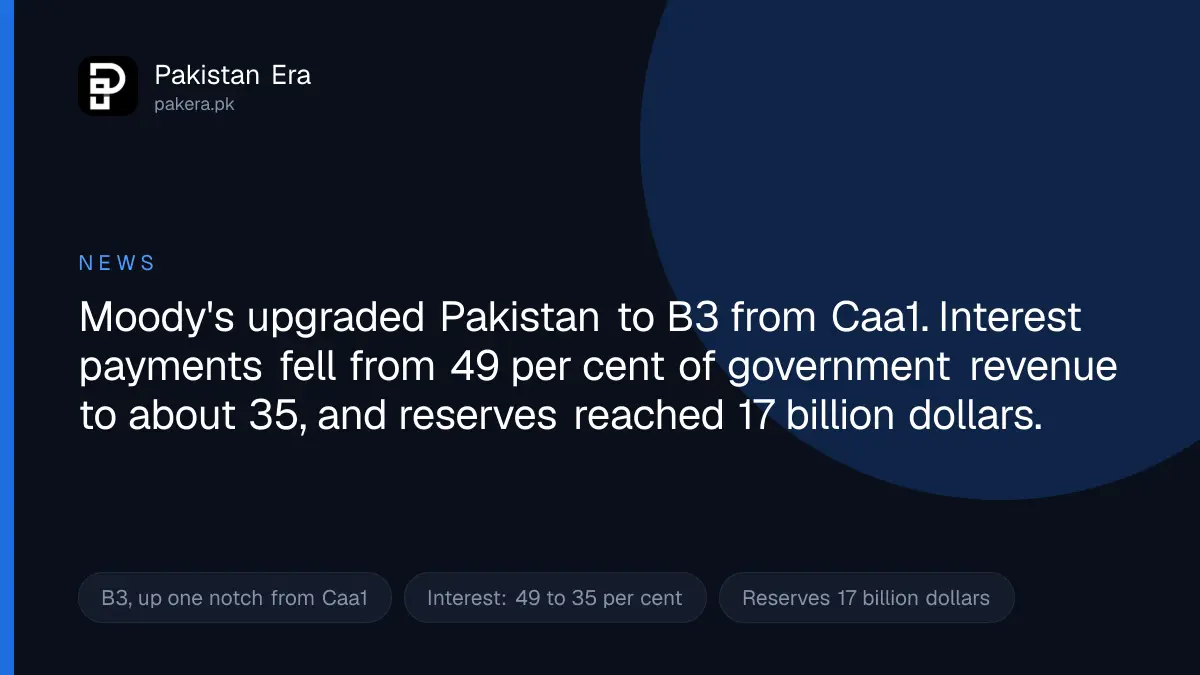
Moody's upgraded Pakistan's credit rating to B3 from Caa1 on Monday, with a stable outlook. It is one notch up, and it is the direction the country has wanted for three years.
One number explains it better than the rating letters do.
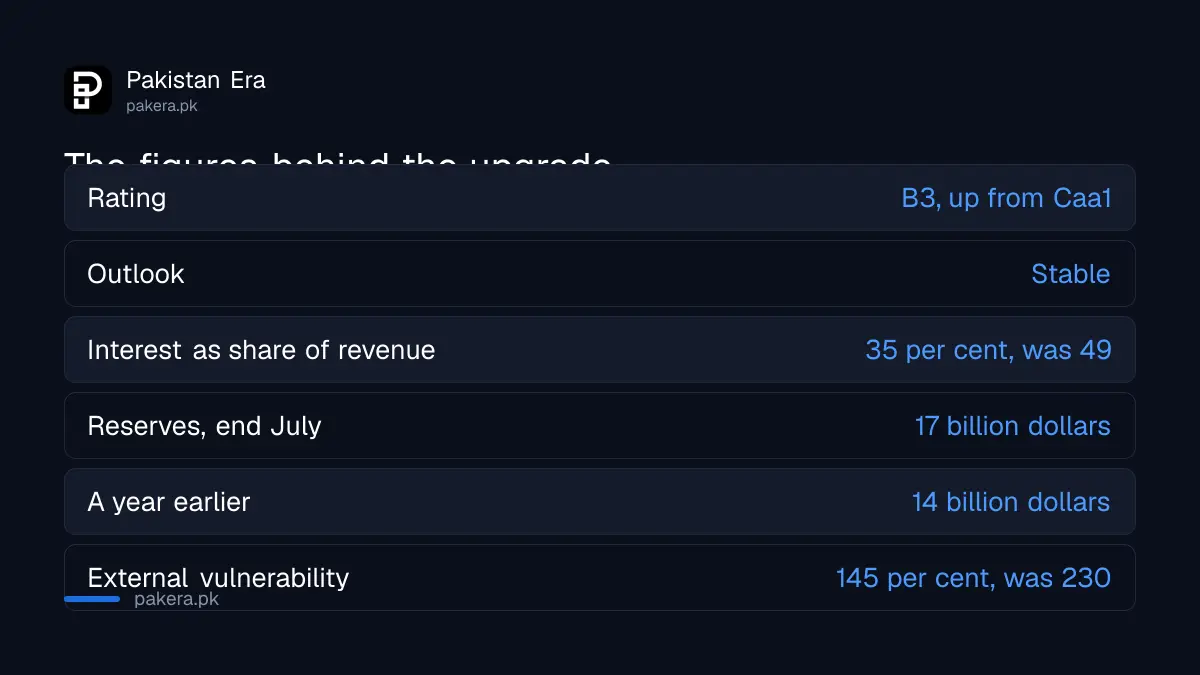
| What Moody's looked at | Now | A year earlier |
|---|---|---|
| Interest as a share of government revenue | About 35 per cent | 49 per cent |
| Foreign exchange reserves | About 17 billion dollars | 14 billion dollars |
| External vulnerability indicator | About 145 per cent | 230 per cent |
| Rating | B3 | Caa1 |
Half of what the state collected was going on interest
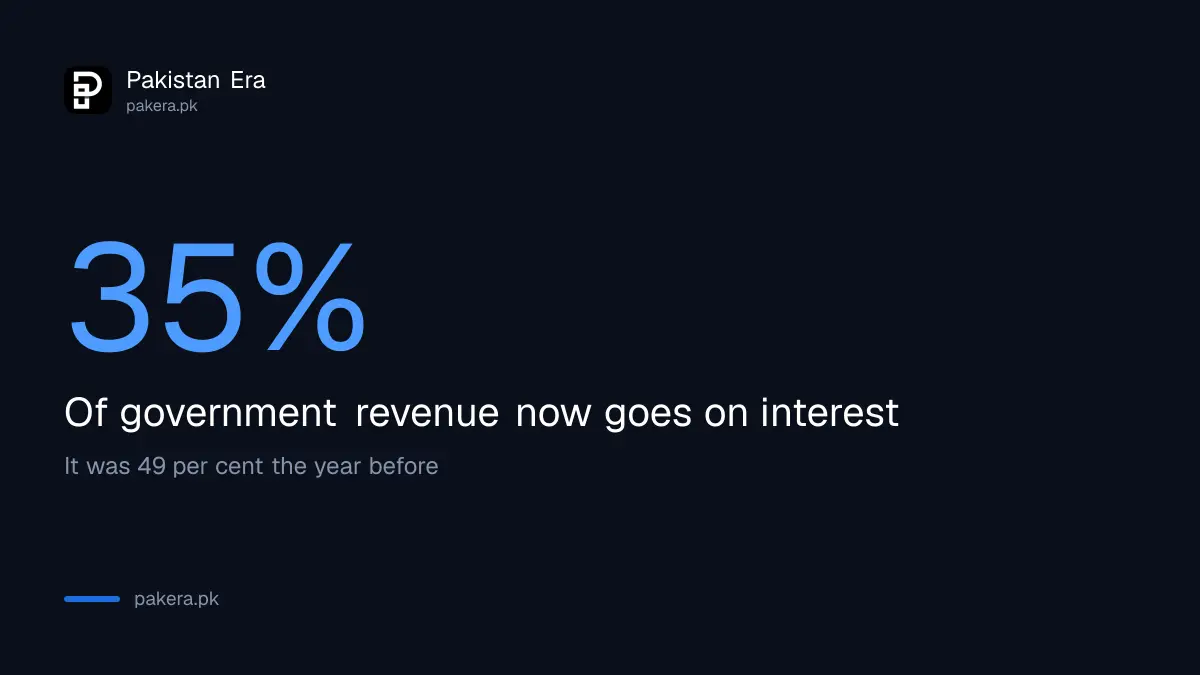
That is the line worth sitting with. In fiscal 2025, 49 per cent of everything the government collected went straight back out as interest on what it had already borrowed. Not on schools, not on hospitals, not on roads. On interest.
In fiscal 2026 that figure was about 35 per cent.
It is still enormous. A third of national revenue servicing debt leaves very little room for anything a citizen actually sees. But falling fourteen points in a year is a real change, and it is the single biggest reason the rating moved.
Moody's put it plainly: the upgrade "reflects our expectations that improvements in governance will allow the government to sustain recent improvements."
What the other numbers mean
Reserves. Foreign exchange reserves were about 17 billion dollars at the end of July, against 14 billion a year before. That is close to three months of import cover, which is the rough line at which a country stops looking like it might run out of dollars. Moody's expects 19 to 20 billion by the end of fiscal 2027.
External vulnerability. This measures how much foreign money the country needs against what it holds. It improved from 230 per cent to about 145. Lower is safer, and above 100 still means obligations exceed reserves.
Country ceilings. Moody's also raised the local currency ceiling to B1 and the foreign currency ceiling to B3. These cap how highly a Pakistani company or bank can be rated, so a better ceiling gives good local businesses room to be rated higher when they borrow abroad.
Where B3 actually sits
An upgrade is an upgrade, and this one is real. It is also worth knowing what it is an upgrade to.
Moody's investment grade ends at Baa3. Everything below that is what markets call speculative, and the rungs run Ba1, Ba2, Ba3, then B1, B2, B3.
So B3 is six steps below the lowest investment grade rating, and one step above where Pakistan was on Sunday. It is the difference between very risky and slightly less risky, not between risky and safe.
The outlook is also worth reading carefully. It is stable, not positive. Stable means Moody's currently expects to leave the rating where it is.
Moody's listed the weaknesses in the same breath
This is the part that tends to fall out of the headlines, and it comes from the same statement rather than from any critic.
Moody's said Pakistan's credit profile "remained vulnerable due to a structurally fragile external position, weak debt affordability, a still relatively narrow revenue base."
Three things there, and each is worth naming plainly:
- A structurally fragile external position. The country still depends on external financing that has to keep arriving.
- Weak debt affordability. Even after the fall, interest still takes about a third of revenue.
- A narrow revenue base. Too few people and businesses pay tax, so the same burden sits on the same shoulders.
Moody's added that the external position "remains vulnerable to shocks, particularly given still-large external financing requirements."
That third weakness is the one closest to readers of this site. A narrow revenue base is why the tax net keeps tightening on the people already inside it, which is the background to things like the Rs 25,000 late filer surcharge and the push behind this year's return deadline.
What this does not change
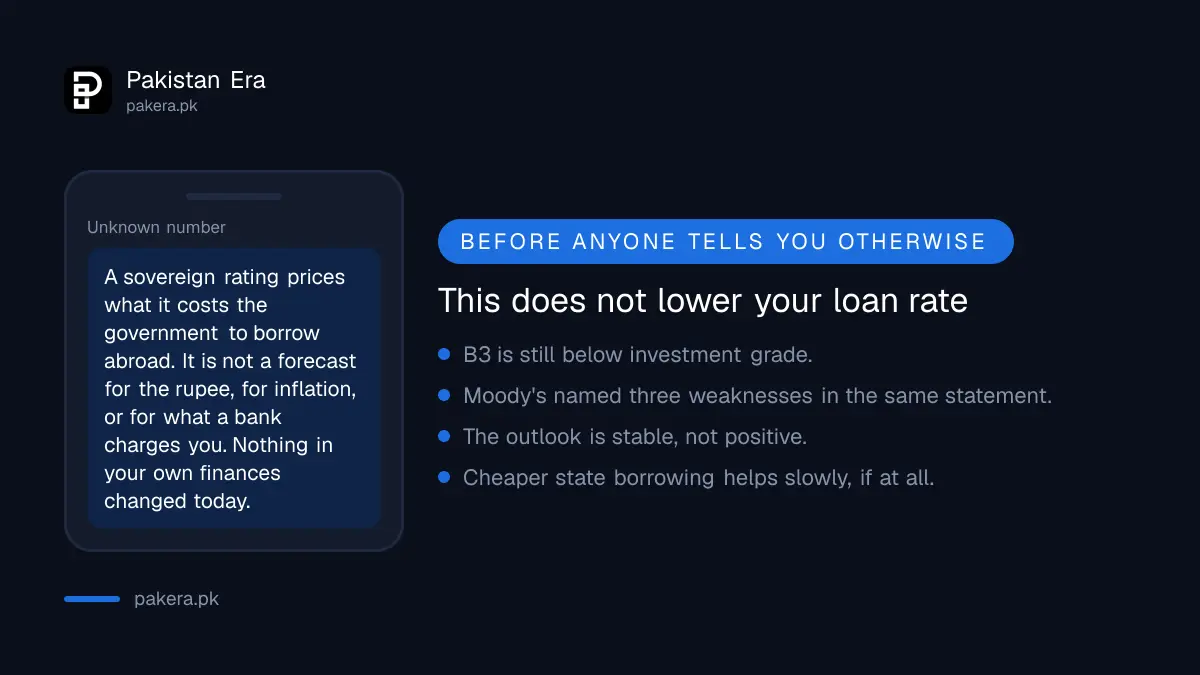
Expect a lot of commentary this week suggesting your life is about to get cheaper. Be careful with it.
A sovereign rating prices what it costs the government to borrow from foreign lenders. That is all it is. It is not a forecast for the rupee, not a prediction about inflation, and not an instruction to any bank about what to charge you.
So, concretely:
Your loan rate did not change today. What a bank charges you follows the State Bank's policy rate and the bank's own view of you.
Prices did not fall today. Nothing in a rating action touches the shelf price of anything.
The rupee is not guaranteed to strengthen. Sentiment can help, but the rate is driven by dollars coming in and going out.
What it can do, over time, is make it cheaper for the state to borrow abroad. If interest costs keep falling as a share of revenue, more of what is collected is available for everything else. That is a slow benefit, and it reaches an ordinary household indirectly if at all. It is still a better direction than the alternative.
For a worked example of how little a good headline number changes what you pay, our piece on why petrol does not get cheaper when oil does covers the same gap between a national figure and a personal one.
What we could not verify
We have not read Moody's own release, which sits behind registration. Everything above is as reported on 24 August 2026 by Dawn, Business Recorder, Geo and the state broadcaster, and the detail and quotations come from Dawn's account of the statement.
We have not independently checked the 17 billion dollar reserve figure against the State Bank's own weekly release, so it is Moody's number as reported rather than one we confirmed.
We sought no comment from the Finance Division or the State Bank.
We are not forecasting anything. Whether this holds depends on financing that has not arrived yet, and Moody's said as much itself.
The placement of B3 on the scale is arithmetic on Moody's published ladder, not a characterisation of ours.
Questions readers are asking
What did Moody's actually do?
It raised Pakistan's sovereign credit rating one notch, from Caa1 to B3, and kept the outlook stable.
Is B3 a good rating?
It is better than Caa1 and still six notches below investment grade. Markets treat everything in that range as speculative.
Why was it upgraded?
Moody's cited improved governance, easing external vulnerability and a material improvement in debt affordability, with interest falling from 49 to about 35 per cent of revenue.
Will my bank loan get cheaper?
No. A sovereign rating covers government borrowing abroad. Your rate follows the State Bank policy rate and your own bank's assessment.
Will the rupee get stronger?
Nothing guarantees it. The exchange rate depends on dollars entering and leaving the country, not on a rating letter.
What did Moody's say was still wrong?
It named a structurally fragile external position, weak debt affordability and a still relatively narrow revenue base, in the same statement.
What is a country ceiling?
A cap on how highly companies and banks in that country can normally be rated. Moody's raised Pakistan's to B1 local currency and B3 foreign currency.
About the author

Tax, Bills and Technology Writer
Ali Akhtar is a young and curious voice here at Pakistan Era. He is currently pursuing his A-Levels and has a growing interest in Pakistan’s changing industrial landscape and educational trends. Ali likes to write in a way that helps him explain and explore the world around him. His writing reflects the perspective of the new generation navigating the evolving trends of Pakistan where technology, youth innovation, and shifting opportunities are reshaping the country’s future.