IMF October 2026 Outlook for Pakistan: Growth 3.5% and Inflation 9.9% in FY27
The IMF's October 2026 outlook puts Pakistan's growth at 3.5% and average inflation at 9.9% in FY27, with debt falling to 67.7% of GDP. See the full table.
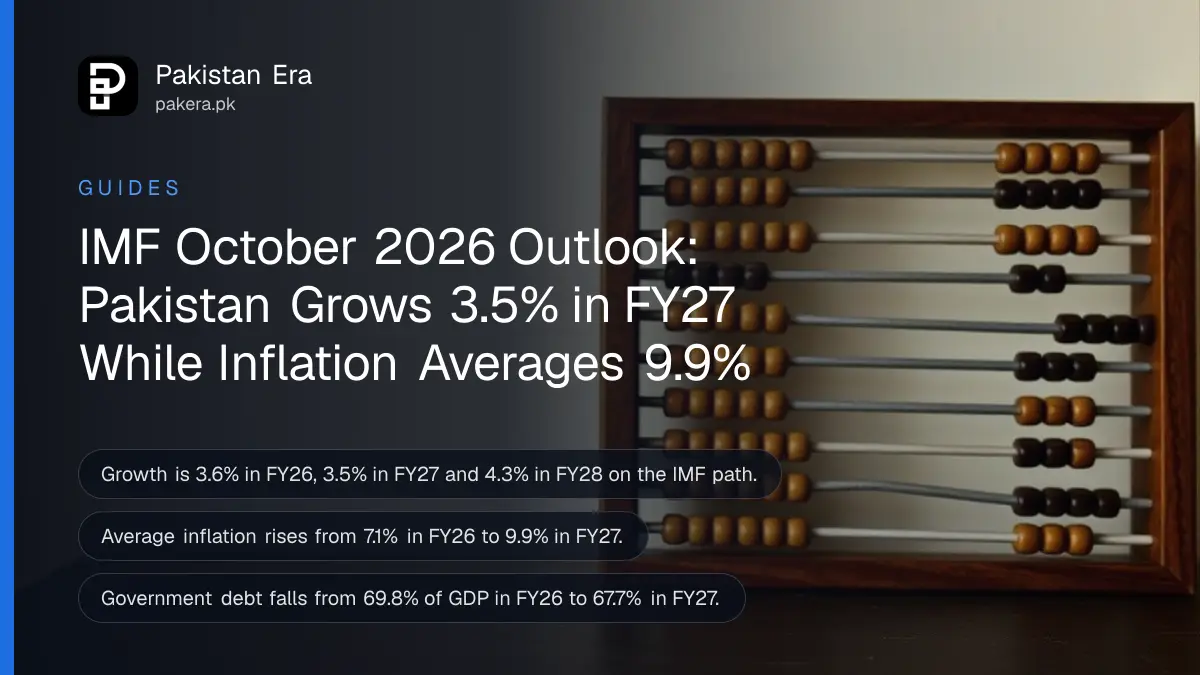
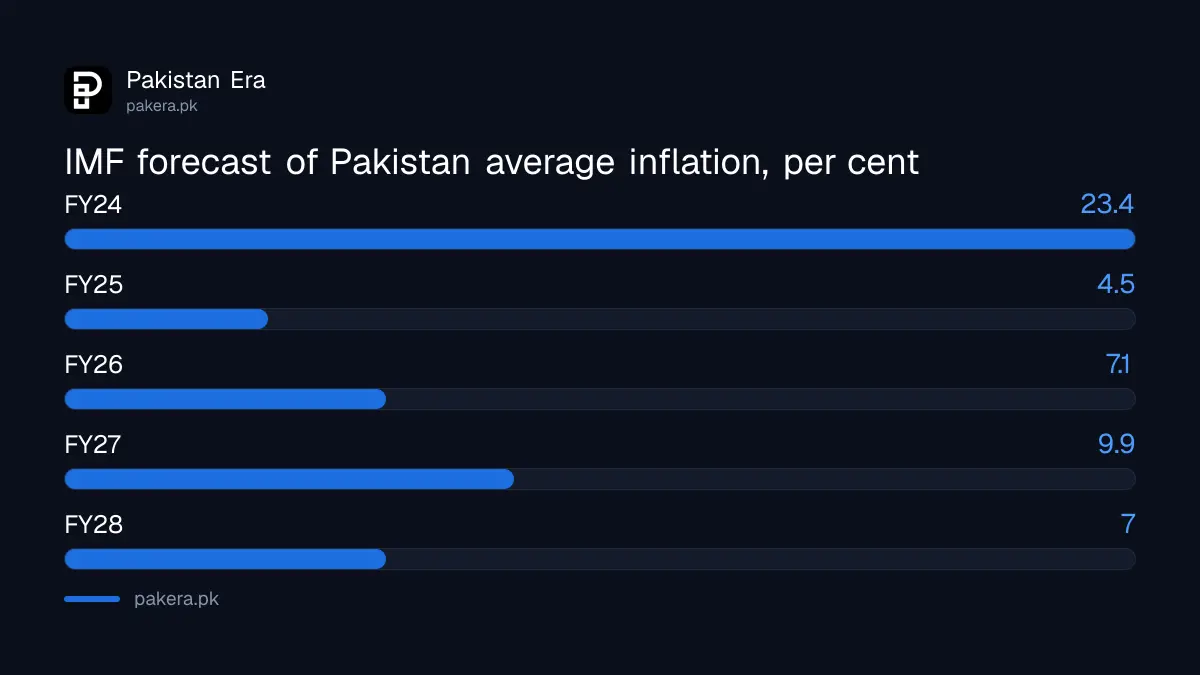
The IMF's October 2026 World Economic Outlook puts Pakistan's growth at 3.6 per cent in the financial year that ended in June 2026 and 3.5 per cent in the current year to June 2027, with average inflation rising from 7.1 per cent to 9.9 per cent. That inflation line is the one to read twice. The IMF expects prices to rise faster this year than last, not slower.
We pulled Pakistan's series from the IMF's own data service on 19 October 2026. Every series is labelled "World Economic Outlook (October 2026)". The IMF reports Pakistan by financial year and names each year by the June it ends in, so the "2027" column is July 2026 to June 2027, the year the FY27 budget covers. The IMF's own statement on the staff-level agreement gives FY26 growth as 3.6 per cent, which matches the 2026 column and confirms the labelling.
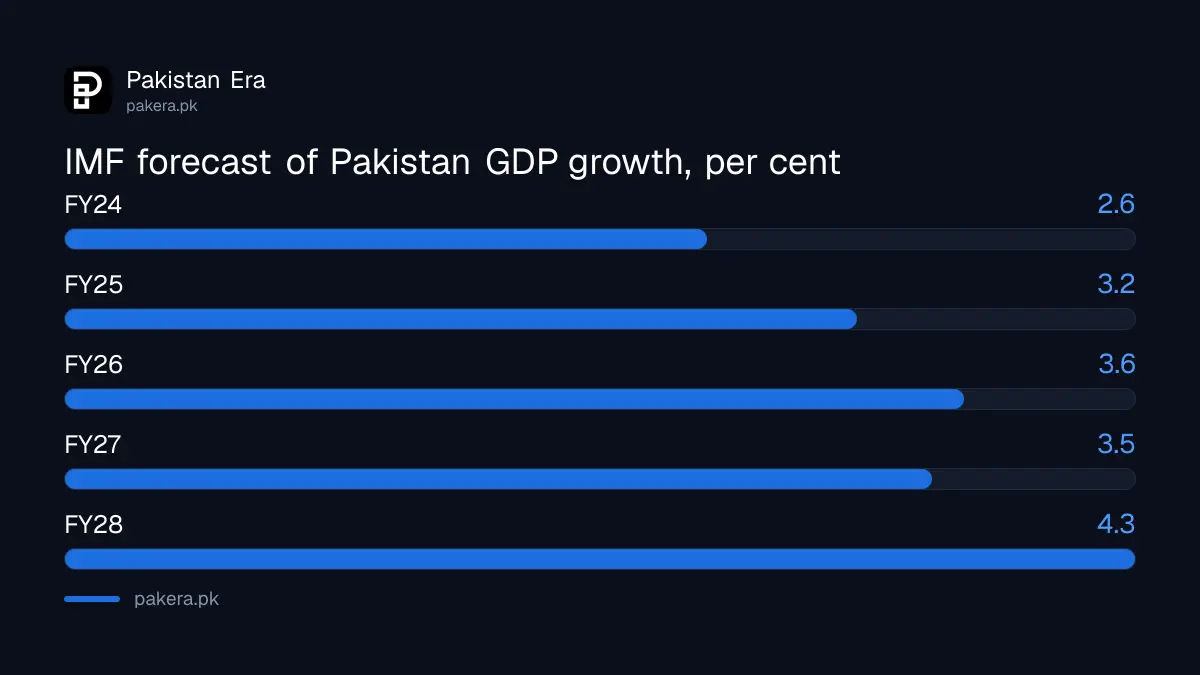
The IMF sees growth of 3.5 per cent in FY27, then 4.3 per cent in FY28
Growth slows a little this year, from 3.6 to 3.5 per cent, before the IMF expects it to pick up to 4.3 per cent in FY28 and 4.5 per cent in FY29. The economy shrank 0.2 per cent in FY23, so the recovery is real but slow, and the IMF does not see 4 per cent before FY28.
| Financial year | Real GDP growth | Average inflation | End of year inflation |
|---|---|---|---|
| FY24 (to June 2024) | 2.6% | 23.4% | 12.6% |
| FY25 | 3.2% | 4.5% | 3.2% |
| FY26 | 3.6% | 7.1% | 11.1% |
| FY27 | 3.5% | 9.9% | 8.5% |
| FY28 | 4.3% | 7.0% | 6.5% |
The government has been saying 3.7 per cent for FY26 at the Bangkok meetings, a tenth above the IMF's estimate. Both numbers are estimates until the Pakistan Bureau of Statistics publishes final national accounts. A tenth of a point is not an argument worth having.
Average inflation of 9.9 per cent in FY27 means a worse year for prices than FY26
The IMF's average inflation path is 4.5 per cent in FY25, 7.1 per cent in FY26 and 9.9 per cent in FY27. The end-of-year figures run the other way: 11.1 per cent in June 2026 falling to 8.5 per cent by June 2027. Put together, prices rose fast in the last months of FY26, so the average for FY27 is high even as the monthly rate eases.
That squares with what the Pakistan Bureau of Statistics has been printing. Inflation was 10.3 per cent in September 2026, and the detail is in our report on September 2026 inflation. The IMF's path says the rate should drift down through FY27, but a 9.9 per cent average still means a salary needs a raise of about a tenth to stand still. The table of what that raise looks like, from Rs 30,000 to Rs 150,000, is in our guide to the raise needed to match inflation.
For borrowers the message is plain. The IMF told the State Bank to keep policy "appropriately tight" until inflation returns durably to target. With an average of 9.9 per cent in prospect, a quick cut from the 11.5 per cent policy rate looks unlikely.
The current account slips back to a 1 per cent deficit in FY27
After a surplus of 0.5 per cent of GDP in FY25 and a balanced FY26, the IMF expects a current account deficit of 1.0 per cent of GDP in FY27 and 0.8 per cent in FY28. On a nominal GDP of about $450 billion in FY26, 1 per cent is roughly $4.5 billion a year of imports not covered by exports and remittances, our arithmetic.
A small deficit is normal for a growing economy. The question is what pays for it. The IMF asks Pakistan to keep adding reserves, which stood at about $21.5 billion at the end of September, and to let the exchange rate move. So the rupee is meant to absorb part of the pressure rather than the reserves.
Debt falls to 67.7 per cent of GDP and unemployment to 6.5 per cent
General government gross debt was 72.8 per cent of GDP in FY25 and the IMF expects 69.8 per cent in FY26, 67.7 per cent in FY27 and 64.5 per cent in FY28. The fiscal deficit it expects is 2.6 per cent of GDP in FY26, which matches the Finance Division's own outturn, widening to 3.5 per cent in FY27.
Unemployment, as the IMF measures it, eases from 6.9 per cent in FY26 to 6.5 per cent in FY27 and 6.0 per cent in FY28. GDP per person was $1,836 in FY26 on a population the IMF counts at 245.1 million, rising to 249.8 million in FY27. The IMF's debt line does not change what you owe on the IMF repayment schedule, which is fixed in SDR.
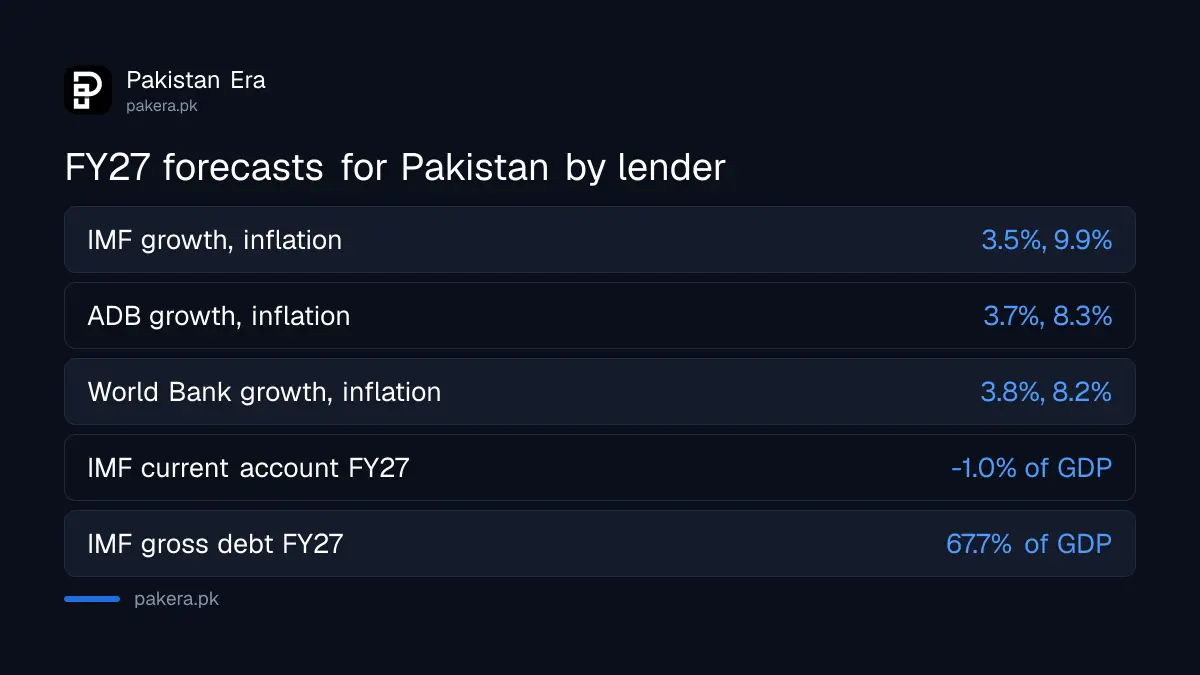
The IMF, the World Bank and the ADB disagree by less than half a point
Three lenders have published Pakistan forecasts since September. They sit close together on growth and further apart on inflation, where the IMF is the most pessimistic for FY27.
| Forecaster and edition | Growth FY26 | Growth FY27 | Inflation FY26 | Inflation FY27 |
|---|---|---|---|---|
| IMF, World Economic Outlook, October 2026 | 3.6% | 3.5% | 7.1% | 9.9% |
| Asian Development Bank, Outlook, September 2026 | 3.7% | 3.7% | 7.1% | 8.3% |
| World Bank, Macro Poverty Outlook, October 2026 | not stated on its page | 3.8% | not stated on its page | 8.2% |
The ADB figures are on its Pakistan economy page, which we read on 19 October. The World Bank figures are the ones in our 10 October report on the World Bank forecast for FY27. A gap of 1.6 points on FY27 inflation between the IMF and the World Bank is the one real disagreement, and it comes down to how much of the oil shock each expects to pass into prices.
How to pull the IMF's Pakistan numbers yourself
The IMF publishes the series in its DataMapper, and the figures update with each outlook. You do not need the full report to read them.
- Open the IMF DataMapper and choose Pakistan as the country.
- Pick an indicator: real GDP growth, inflation (average consumer prices), current account balance or gross debt.
- Check the source line under the chart. It should read "World Economic Outlook (October 2026)".
- Remember that each year is the financial year ending in June of that year.
- Treat anything beyond the current year as a projection, which the IMF revises twice a year.
Common questions
What is the IMF growth forecast for Pakistan in 2026 and 2027?
The October 2026 outlook gives 3.6 per cent for FY26, which ended in June 2026, and 3.5 per cent for FY27. It expects 4.3 per cent in FY28.
What inflation does the IMF expect in Pakistan in FY27?
An average of 9.9 per cent, up from 7.1 per cent in FY26. End-of-year inflation is expected to fall from 11.1 per cent in June 2026 to 8.5 per cent in June 2027.
Why is average inflation higher in FY27 if the rate is falling?
Because prices rose fast in the last months of FY26, so the starting level for FY27 is high. The yearly average captures that, even as the monthly rate eases.
What does the IMF say about Pakistan's debt?
Gross government debt falls from 69.8 per cent of GDP in FY26 to 67.7 per cent in FY27 and 64.5 per cent in FY28, on the IMF's projections.
How does the IMF forecast compare with the ADB and the World Bank?
Growth is within 0.3 points for FY27: 3.5, 3.7 and 3.8 per cent. On FY27 inflation the IMF's 9.9 per cent is higher than the ADB's 8.3 and the World Bank's 8.2.
How we verified this
What we checked, where we read it, and what we could not confirm.
Last checked 19 October 2026. Every Pakistan figure comes from the IMF DataMapper country profile for Pakistan, whose series are labelled "World Economic Outlook (October 2026)", read through the IMF's data interface on 19 October 2026. The ADB figures are from the ADB's Pakistan economy page, read the same day. The FY26 growth and September reserve figures are from the IMF's 7 October 2026 statement. The $4.5 billion and the raise arithmetic are our own. We could not open the full October 2026 outlook report on the IMF publications page, which still listed the July update when we checked.
About the author

Global Affairs & Political Economy Writer
Muhammad Hatim is a book lover who started writing because he enjoys it. At Pakistan Era he writes about international relations, geopolitics and the global economy, with a particular interest in South Asia and the forces behind current events.