How Big a Raise You Need to Match 10.26% Inflation in Pakistan: Table From Rs 30,000 to Rs 150,000
To match 10.26% inflation, your pay must rise 10.26%: Rs 50,000 needs Rs 55,130 now. See the table for Rs 30,000 to Rs 150,000 and the urban and rural rates.
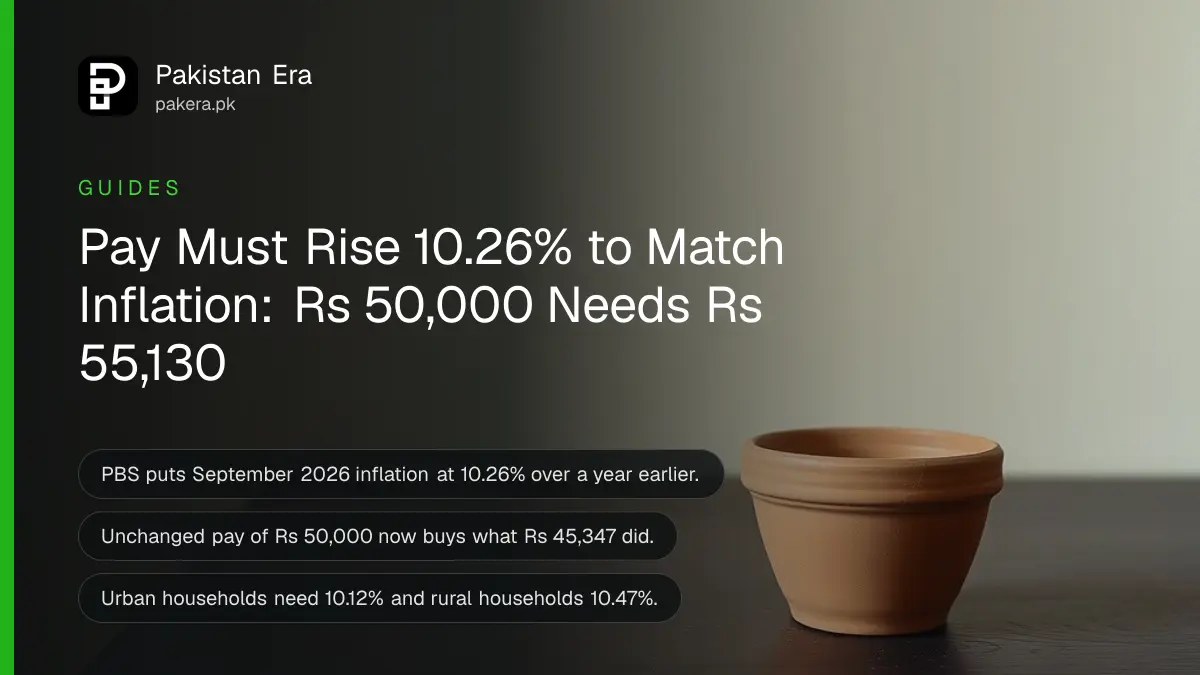
To keep the same buying power as a year ago, your pay needs to rise by 10.26 per cent. A salary of Rs 50,000 in September 2025 has to be Rs 55,130 now. If your pay did not rise, it buys only what Rs 45,347 bought a year ago, a loss of Rs 4,653 a month. The table below does the sum for six salaries.
The 10.26 per cent comes from the Pakistan Bureau of Statistics (PBS). Its press release for September 2026 says consumer prices rose 10.26 per cent over September 2025. We read that release on 14 October 2026. The sums in this guide are ours.
A raise of 10.26 per cent keeps your buying power level
PBS measures prices with the Consumer Price Index, or CPI. It was 304.33 in September 2026 and 276.01 in September 2025. Divide the first by the second and you get 1.1026. Multiply your old pay by 1.1026 to find what you need now.
This is a break-even raise. It does not make you better off. It only stops you from getting poorer. Anything below it is a pay cut in real terms, even if the number on the payslip went up.
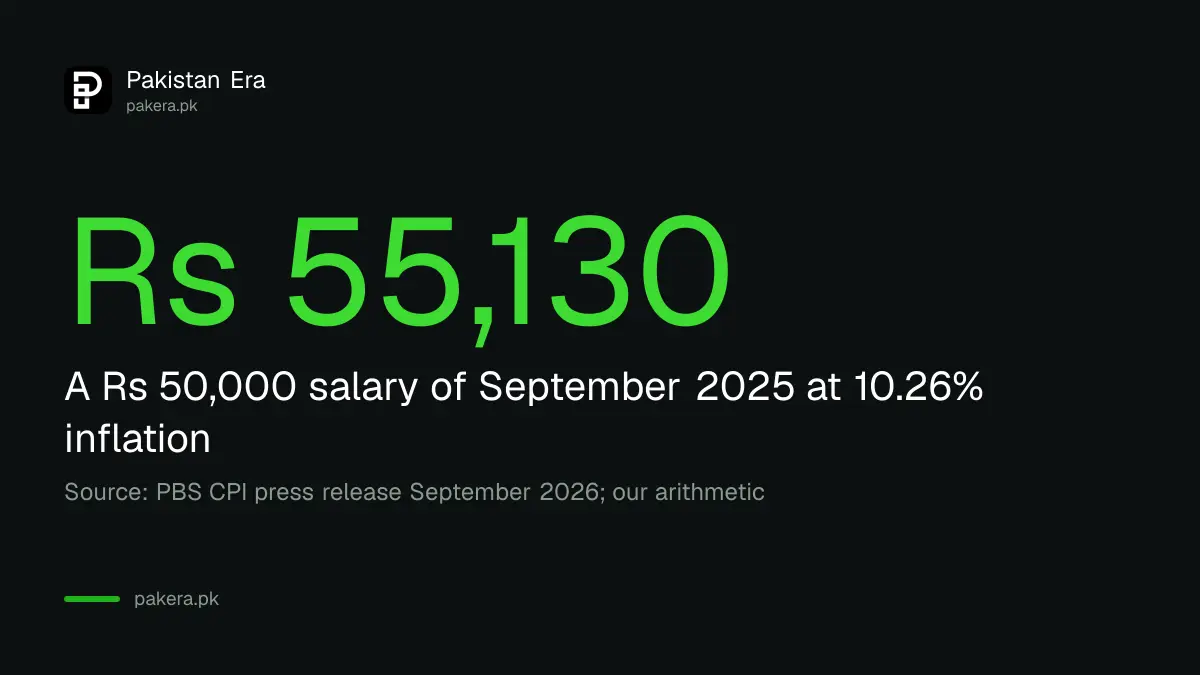
The break-even salary for Rs 30,000 to Rs 150,000
Find your pay in the first column. The second column is the pay you need now. The third is the extra per month. The fourth is what your unchanged pay is worth in September 2025 rupees.
| Pay a year ago | Pay needed now | Extra per month | Worth of unchanged pay |
|---|---|---|---|
| Rs 30,000 | Rs 33,078 | Rs 3,078 | Rs 27,208 |
| Rs 40,000 | Rs 44,104 | Rs 4,104 | Rs 36,278 |
| Rs 50,000 | Rs 55,130 | Rs 5,130 | Rs 45,347 |
| Rs 75,000 | Rs 82,695 | Rs 7,695 | Rs 68,021 |
| Rs 100,000 | Rs 110,260 | Rs 10,260 | Rs 90,694 |
| Rs 150,000 | Rs 165,391 | Rs 15,391 | Rs 136,041 |
Round the figures if you like. The method matters more than the last rupee. A worker on the Punjab minimum of Rs 40,000 would need Rs 44,104 to break even. As of 1 October 2026 we had found no new Punjab rate for 2026-27, which we set out in the note on the Punjab minimum wage.
Urban and rural workers face slightly different rates
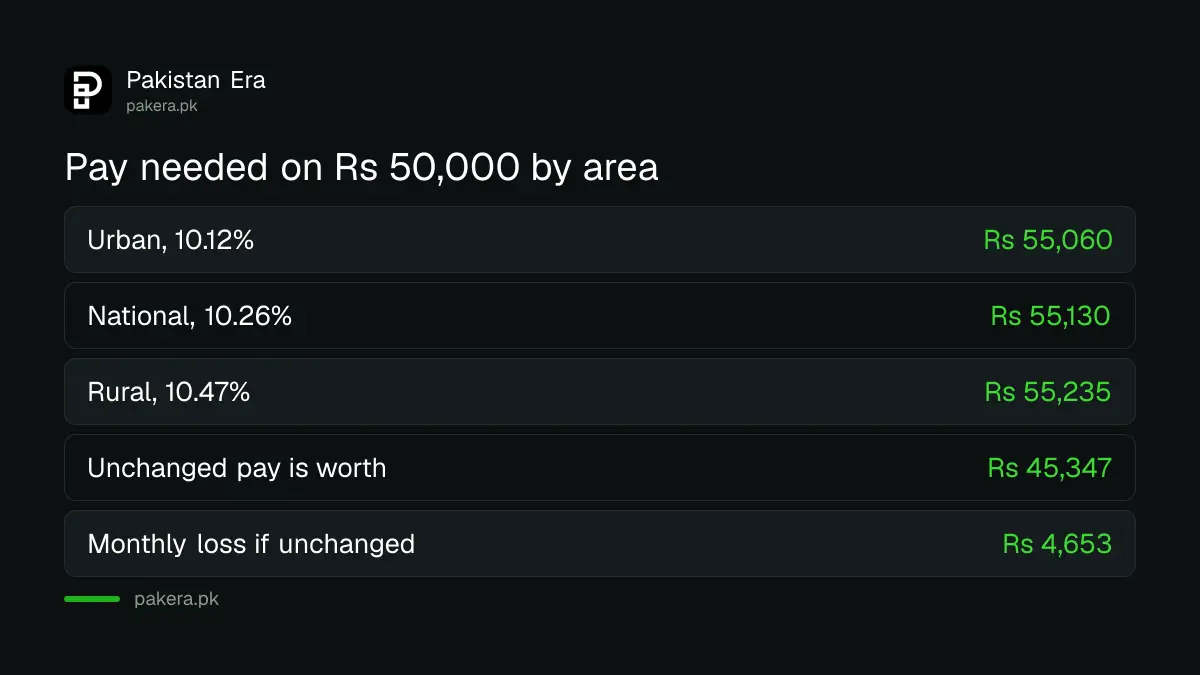
PBS gives a separate rate for cities and villages. Urban prices rose 10.12 per cent and rural prices rose 10.47 per cent over the year. The gap is small, but villages are higher.
- Urban households: multiply your pay by 1.1012. Rs 50,000 becomes Rs 55,060.
- Rural households: multiply by 1.1047. Rs 50,000 becomes Rs 55,235.
- National figure: multiply by 1.1026. Rs 50,000 becomes Rs 55,130.
Use the one that fits where you live. The difference on Rs 50,000 is only Rs 175 between the two.
Your own rate may be higher than 10.26 per cent
The national rate is an average. PBS says flour was 31.71 per cent dearer in towns than a year ago, electricity charges 32.46 per cent and motor fuel 37.73 per cent. A family that spends a lot on these items feels more than 10.26 per cent. A family that buys sugar, chicken and eggs feels less, because those fell by about a fifth.
If you want your own figure, the method in the guide on how to calculate your own inflation rate uses the same PBS data. The four headline measures are explained in Pakistan's four inflation numbers.
The 10.26 per cent is also the rate over one year. The average for July to September 2026 was 10.20 per cent against the same months of last year, according to PBS. Both say the same thing: prices are about a tenth higher than a year ago.
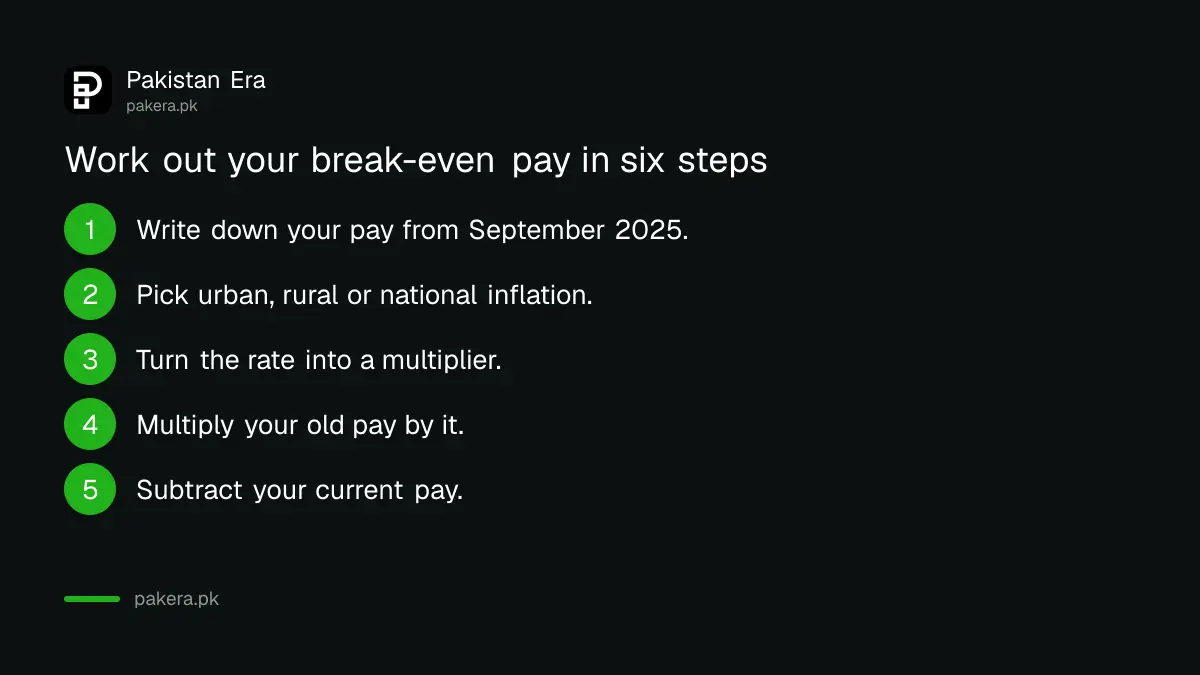
How to work out your own break-even pay
You need your pay from a year ago and a calculator. The steps take two minutes.
- Write down your monthly pay in September 2025.
- Choose your rate: 10.12 for urban, 10.47 for rural, or 10.26 for the national figure.
- Turn the rate into a multiplier. Divide by 100 and add 1. For 10.26 that is 1.1026.
- Multiply your September 2025 pay by the multiplier. This is your break-even pay.
- Subtract your pay now from the break-even pay. A positive answer is the monthly shortfall.
- Take the shortfall to your employer with the PBS release in your hand.
If you have just had a raise, compare it with the multiplier. A 7 per cent raise falls 3.3 points short of 10.26 per cent. The Finance Division set a 7 per cent increase on federal pensions from 1 July 2026, as we covered in the note on the federal pension increase, so pensioners are below break-even by that gap.
Saving some of the loss
You cannot argue prices down, but you can stop savings from losing more. A bank savings account at 10 per cent before tax pays less than 10.26 per cent inflation, and tax comes off the profit. The sums are in the guide on whether your savings beat inflation.
Inflation is not the same every month. It was 11.1 per cent in August and 10.26 per cent in September, so the break-even figure changes with each new PBS release. Run the sum again each month.
Common questions about raises and inflation
How much raise do I need to match inflation in Pakistan?
You need 10.26 per cent, the national rate for September 2026 over September 2025, according to PBS. Multiply your pay from a year ago by 1.1026.
Is the national rate the right one for me?
It is a good start. Urban households can use 10.12 per cent and rural households 10.47 per cent. Your own rate may be higher or lower, depending on what you buy.
What if my raise was smaller than inflation?
Then your pay buys less than a year ago. A 7 per cent raise against 10.26 per cent inflation is a real cut of about 3 per cent.
Does the law require employers to match inflation?
We did not research a legal duty to match inflation for this guide, so we do not claim one. Minimum wages are notified by each province and the capital territory, and raises above the minimum depend on your contract and your employer.
Where do I find the inflation figure?
The PBS press release for each month states the year-on-year rate near the top. The September 2026 release is on the PBS website at pbs.gov.pk.
How we verified this
What we checked, where we read it, and what we could not confirm.
Last checked 14 October 2026. The CPI values, the 10.26, 10.12 and 10.47 per cent rates, and the item changes come from the Pakistan Bureau of Statistics press release on CPI for September 2026. The multipliers, the salary table and the 7 per cent comparison are our arithmetic. Your own inflation rate will differ. For the headline numbers in context, see our note on September's inflation.
About the author

Global Affairs & Political Economy Writer
Muhammad Hatim is a book lover who started writing because he enjoys it. At Pakistan Era he writes about international relations, geopolitics and the global economy, with a particular interest in South Asia and the forces behind current events.