Senate Panel Inspects Malakand Ghee and Steel Mills Over Rs 400 Billion FATA and PATA Tax Exemption Probe, FBR Chairman Summoned
A Senate sub-committee inspected ghee, steel and tea mills in Sakhakot and Dargai on 27 November 2026 over alleged Rs 400 billion FATA PATA exemption misuse.
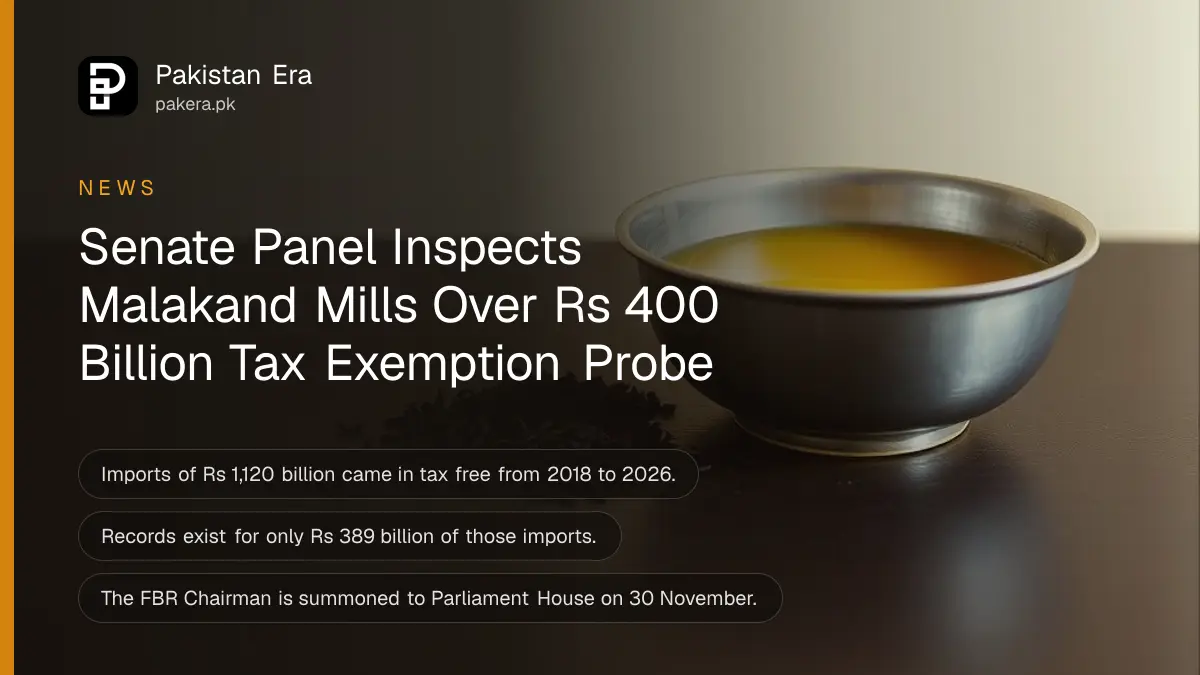
Short answer: A Senate sub-committee made a surprise inspection of ghee mills, steel mills and tea factories in Sakhakot and Dargai, Malakand, on 27 November 2026. It is probing alleged tax evasion of Rs 400 billion under the FATA and PATA tax exemption from 2018 to 2026. Two FBR officials were suspended before the visit, the FIA was asked to put officials on the Exit Control List, and the FBR Chairman has been summoned to Parliament House on Monday 30 November.
The sub-committee belongs to the Senate Standing Committee on Interior and Narcotics Control. Its convener, Senator Saifullah Abro, led the visit with Senators Talha Mahmood and Umar Farooq. Officials of the Federal Investigation Agency (FIA) and the Federal Board of Revenue (FBR) went with them.
The Senate panel inspected mills in Sakhakot and Dargai on 27 November
The Senate sub-committee visited industrial units in Sakhakot and Dargai, in Malakand division of Khyber Pakhtunkhwa, on Friday 27 November 2026. It checked ghee mills, steel mills and tea factories that imported raw material tax free under the FATA and PATA exemption.
FATA and PATA are the former Federally Administered Tribal Areas and Provincially Administered Tribal Areas, now part of Khyber Pakhtunkhwa. Industries there could import raw material without some federal taxes. To claim this, a factory needed a consumption certificate from the FBR showing the goods were used inside those areas.
The concern is simple. Goods may have come in tax free, then been sold in other cities as if normal tax had been paid. The committee says that cost the national treasury a large amount of revenue.
The committee puts the alleged evasion at Rs 400 billion
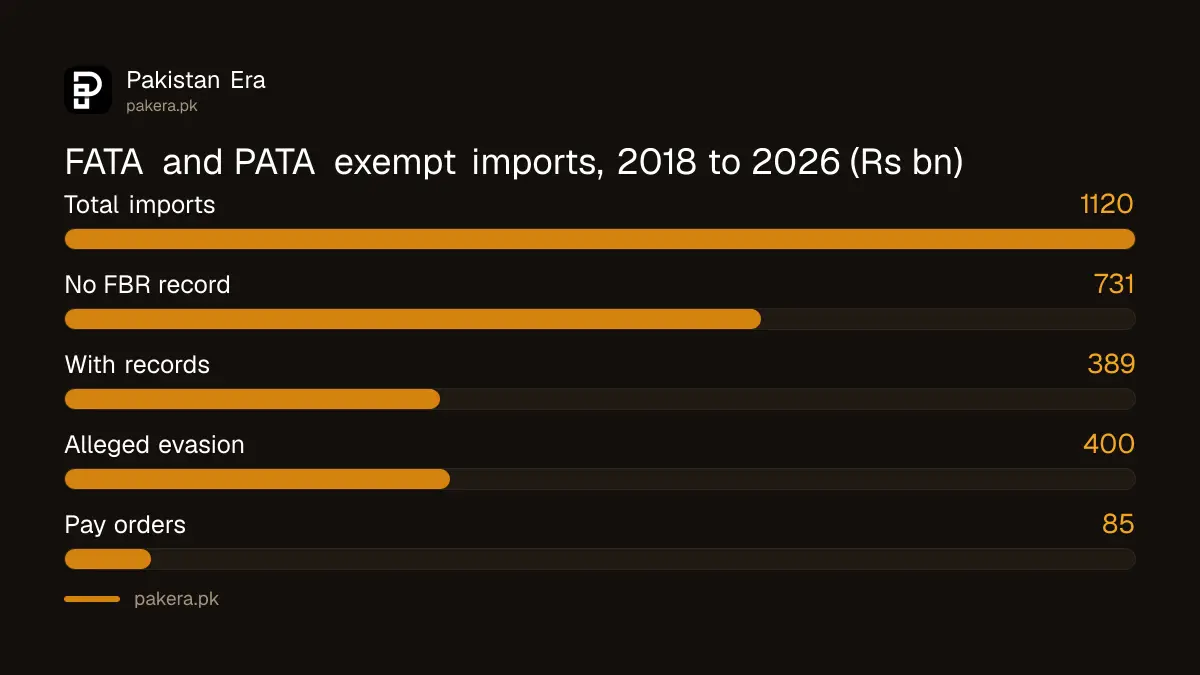
According to the Senate release, imports under the exemption from 2018 to 2026 were worth Rs 1,120 billion. Records exist for only Rs 389 billion of that, and the FBR released pay orders of Rs 85 billion against it. The convener said the FBR has no record for the remaining Rs 731 billion.
| Item, 2018 to 2026 | Amount |
|---|---|
| Raw material imported under the exemption | Rs 1,120 billion |
| Imports with records | Rs 389 billion |
| Pay orders released by the FBR against those records | Rs 85 billion |
| Imports with no FBR record | Rs 731 billion |
| Alleged tax evasion, committee's figure | Rs 400 billion |
These figures match the 10 November briefing, when the same sub-committee was told of an unreconciled gap of Rs 730.797 billion. Our report on the Senate FATA and PATA probe has the sector split from that meeting: steel, textiles, food, and ghee and oil made up most of the gap.
The Rs 400 billion is the committee's estimate of tax evaded. It is an allegation under inquiry, not a court finding or an FBR assessment.
What the senators say they found at the factories
The convener said factories with monthly import quotas of 4,000 to 5,000 tonnes did not have enough stock to fill two trucks. He alleged that a few cartons had been arranged before the visit and machines switched on at the last moment to look busy.
He said the rules, including an FBR notification of 2021, require the FBR to verify a factory's production capacity and the buyer's bank records before it issues a consumption certificate. In his account, those checks were skipped, exemptions went to companies that did not really exist, and the tax-free raw material was sold in other cities.
The committee also said the ghee it saw being made was of very poor quality. That matters to ordinary buyers, because the committee says goods from these units were sold in other cities across Pakistan.
Two FBR officials suspended and the FBR Chairman summoned
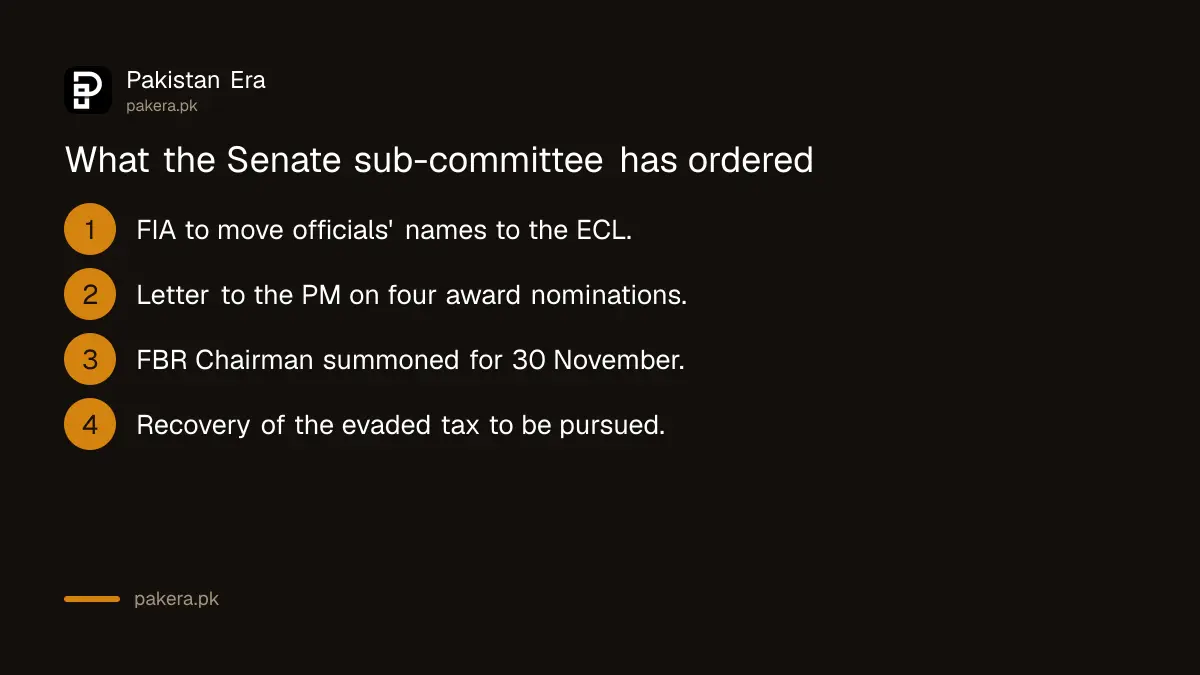
The FBR Chairman suspended two officials before the committee's visit, a commissioner and a deputy director. The convener said that was not enough and that senior officers must also answer. The committee has called the FBR Chairman to Parliament House on Monday 30 November 2026.
Here is what the sub-committee has done or announced so far:
- Asked the FIA to take steps to place the names of officials allegedly involved on the Exit Control List (ECL), the list of people barred from leaving Pakistan.
- Said it will write to the Prime Minister asking him to withdraw Sitara-e-Imtiaz nominations for four senior FBR officials it says are involved.
- Summoned the FBR Chairman to its meeting on Monday 30 November 2026 at Parliament House.
- Said it will pursue recovery of the evaded tax and action against officials and factory owners found responsible.
No official named by the convener has been charged by any court. The allegations remain under inquiry by the committee and the FIA, and the FBR Chairman's reply is due at the Monday meeting.
What the probe means for you
For most readers, the probe is about public money. Tax lost through misused exemptions has to be made up by other taxpayers. But two groups should pay close attention now.
- Ghee and cooking oil buyers: buy brands with a PSQCA or provincial food authority mark and a printed batch number. How to read those marks is set out in checking cooking oil, atta and milk for PSQCA approval.
- Businesses in the former tribal areas: keep full records of every consumption certificate, stock register and buyer payment. The FIA has already sent hundreds of notices. The provincial sales tax rules are set out under the KPRA exemption for ex-FATA and PATA industrial units.
- Traders who bought from these units: keep invoices and bank proof of payment. These are the records the FBR is told to check before issuing certificates.
Common questions
What is the FATA and PATA tax exemption?
It let industries in the former tribal areas, now part of Khyber Pakhtunkhwa, import raw material without some federal taxes. The goods had to be used inside those areas, shown by an FBR consumption certificate.
How much tax is said to have been evaded?
The Senate sub-committee puts it at Rs 400 billion for 2018 to 2026. Of Rs 1,120 billion in imports, records exist for only Rs 389 billion.
Which factories did the Senate committee inspect?
Ghee mills, steel mills and tea factories in Sakhakot and Dargai, in Malakand, on 27 November 2026. The release does not name the companies.
When will the FBR Chairman appear before the committee?
The committee has summoned him to its meeting at Parliament House on Monday 30 November 2026.
Has anyone been charged?
No court charge has been announced. Two FBR officials were suspended, and the committee has asked the FIA to put officials' names on the Exit Control List.
Is ghee from these factories safe to eat?
The committee said the ghee it saw was of poor quality, but no food authority recall has been issued. Buy sealed packs with a PSQCA or food authority mark and a batch number.
How we verified this
What we checked and where we read it.
We checked this report on 29 November 2026 against the Senate of Pakistan press release dated 27 November 2026 on the sub-committee's inspection in Sakhakot and Dargai, published on the Senate press releases page. The 10 November figures are from the Senate release on the sub-committee's earlier meeting. The 2018 to 2026 amounts are those stated by the committee; the FBR had not issued a public statement on them when we checked.
Free on WhatsApp
Get the next change first on WhatsApp
Price changes, new rules and deadlines that affect your money, in a few short posts a day.
Follow Pakera on WhatsAppOther followers cannot see your number.
About the author

Global Affairs & Political Economy Writer
Muhammad Hatim is a book lover who started writing because he enjoys it. At Pakistan Era he writes about international relations, geopolitics and the global economy, with a particular interest in South Asia and the forces behind current events.