KPRA Sales Tax Exemption for Industrial Units in Ex-FATA and PATA: How to Qualify
KPRA exempts eligible industrial units in ex-FATA and PATA from sales tax on services they receive, 1 August 2026 to 30 June 2028. See the 5 conditions.
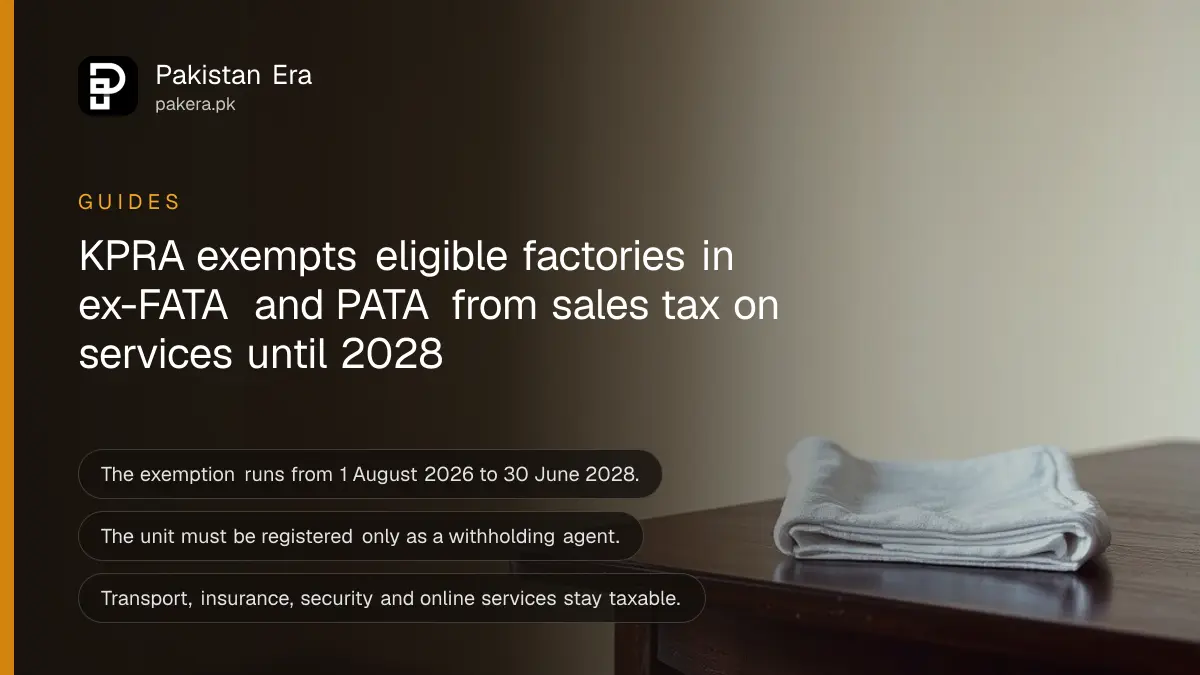
Short answer: A Khyber Pakhtunkhwa Revenue Authority (KPRA) notification exempts eligible industrial units in the former FATA and PATA from sales tax on the services they receive. The unit must sit in those areas, be registered only as a withholding agent and disclose every service in its return or statement. It runs from 1 August 2026 to 30 June 2028.
A marble factory in Mohmand pays a contractor for machine repair. A flour mill in Bajaur pays a local firm for civil work. Each time, the unit would normally deduct provincial sales tax on that service and deposit it with KPRA. For eligible units, a September 2026 notification takes that deduction away.
We opened the notification on the KPRA website on 12 October 2026. It is a scanned Gazette page, and we read all three pages. It is numbered KPRA/Admn/GN/2026/3638, dated 1 September 2026 and printed in the Gazette of 2 September 2026.
The notification exempts services received by eligible industrial units
The Policy Board, with the approval of the provincial government, exempts every eligible industrial undertaking in ex-FATA and PATA from the whole of the sales tax on taxable services it receives. It applies under the Khyber Pakhtunkhwa Sales Tax on Services Act, 2022.
Note the direction of the exemption. It is about services the unit buys, not services the unit sells. A unit that is also a service provider should read our guide on the KPRA exemption for service providers in ex-FATA and PATA, which is a separate notification with different conditions.
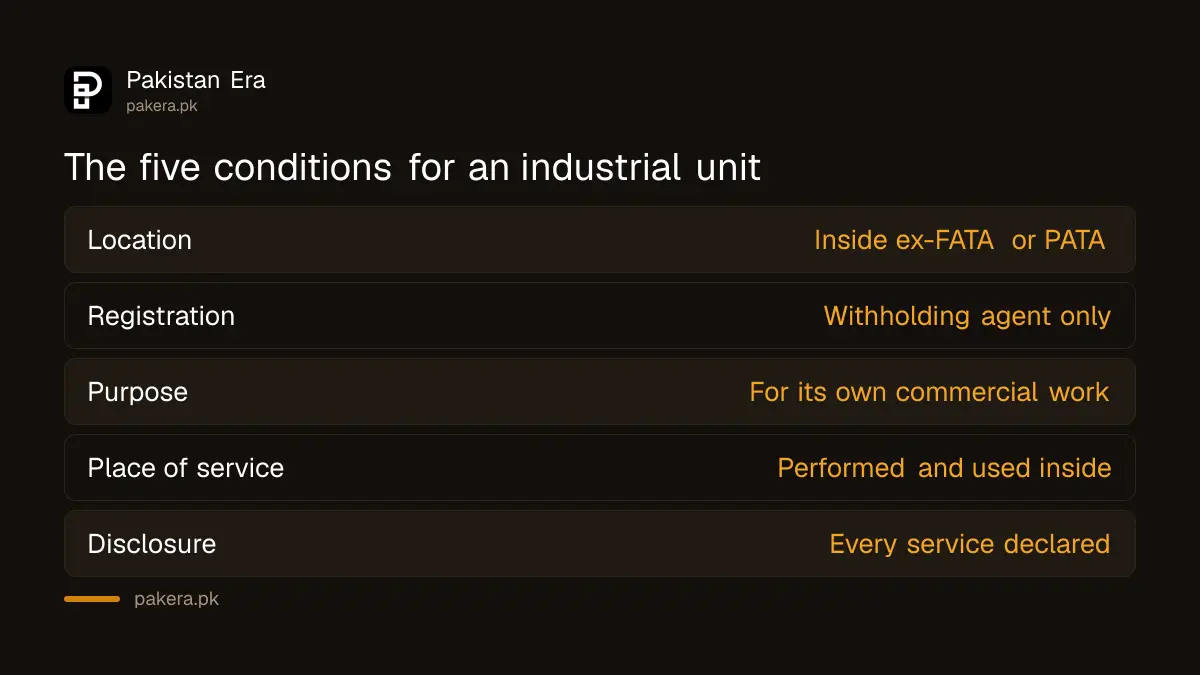
Five conditions must all be met
The conditions cover where the unit is, how it is registered, why it buys the service, where the service is performed and how it reports. All five apply together. A failure on one removes the exemption for the relevant tax period.
| Condition | What the notification says |
|---|---|
| 1. Location | Physically situated and carrying on commercial activities in ex-FATA or PATA |
| 2. Registration | Registered solely as a withholding agent under the 2022 Act and liable to deduct tax as one |
| 3. Purpose | Services are received exclusively for the unit's commercial activities |
| 4. Place of service | Services are physically rendered, performed and consumed inside the area |
| 5. Disclosure | Complete particulars of all taxable services are declared in the return or withholding statement, with records |
Condition 2 is the one most units will check first. It says the unit is registered solely as a withholding agent. A unit that is also registered to charge tax on its own services is not described by that wording.
Only the listed kinds of industrial unit qualify
The notification defines an eligible unit as an independently owned and managed industrial unit in ex-FATA or PATA. It lists manufacturing, mineral processing, agro-based, forestry and wood-based, and engineering and fabrication industries, with named examples.
The named examples are edible oil and ghee, flour, marble, granite, soapstone, chromite, limestone, gemstones, pharmaceuticals, furniture, dairy products, fruits, olives, spices, herbal products, steel re-rolling, and steel or aluminium fabrication and engineering products.
A unit does not qualify if it works as a franchise, branch, subsidiary, division or satellite unit of a person who has another industrial undertaking doing the same or a similar activity in the settled areas of the province or elsewhere in Pakistan. Ownership and management must be independent.
Services from outside the area and online services are not exempt
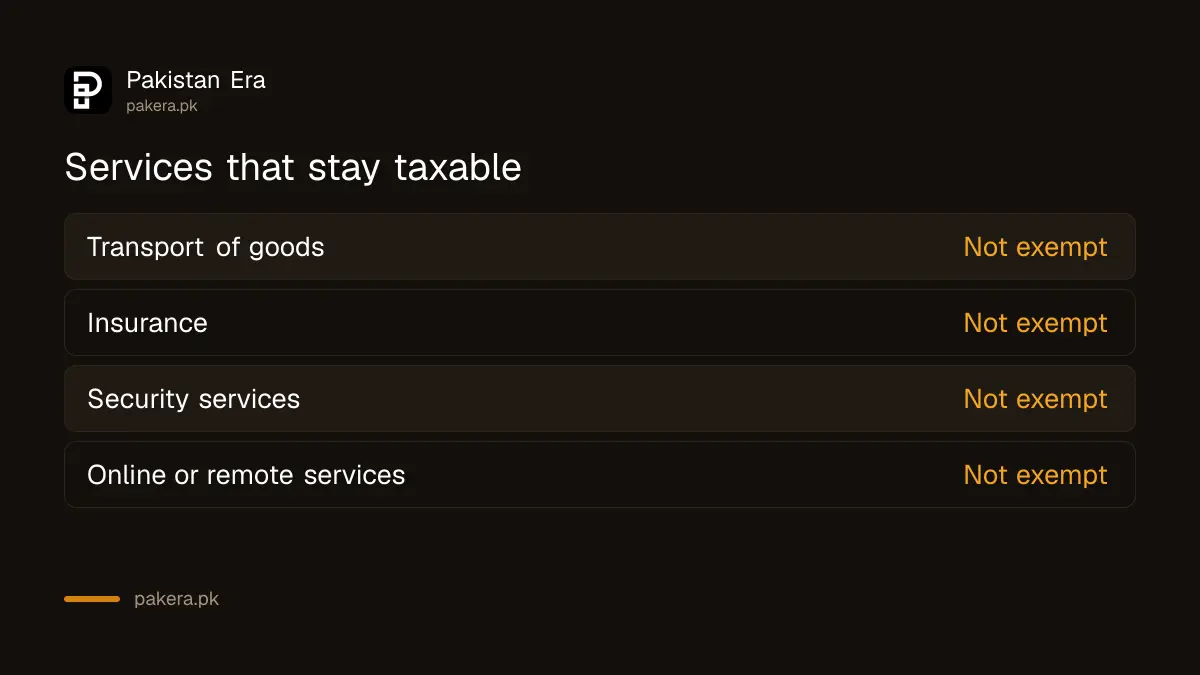
The proviso removes the exemption for services rendered from outside the area. It names transport of goods, insurance and security services, and any service that is not confined to ex-FATA and PATA. It also removes services provided online or by other remote means.
This is the clause most likely to catch a unit out. A cargo company based in Peshawar that carries your goods is outside the area, so the exemption does not reach that bill. The same is true of an online service, even if the unit uses it inside the area.
The text says "notwithstanding that such services are received, consumed or utilized" inside the area. So location of use alone does not rescue an online or remote service.
The exemption runs from 1 August 2026 to 30 June 2028
The notification takes effect from 1 August 2026 and stays in force until 30 June 2028, if not withdrawn earlier. That is almost two years. It also says no unit can claim a refund or adjustment for tax deducted and deposited before the start.
The notification itself takes effect on 1 August 2026, so tax deducted and deposited before that date cannot be claimed back. The Gazette is dated a month later. The text does not say how tax deducted in August or September is treated, so ask KPRA before you assume either way.
How to prepare before the next return
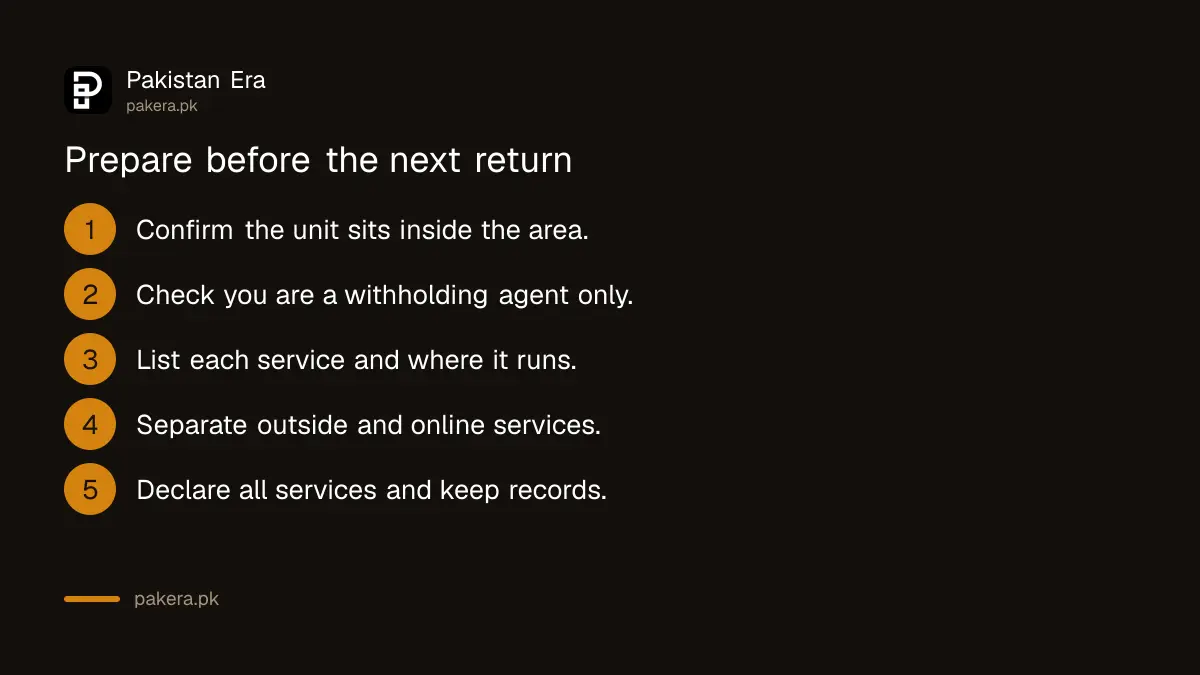
Review your registration, your supplier list and your filing records. The exemption depends on disclosure, so the clean path is to declare every taxable service in the return or statement, even those you no longer deduct tax on.
- Confirm the unit is physically inside ex-FATA or PATA and independently owned.
- Check your KPRA registration type and confirm it is as a withholding agent only.
- List each service you receive and where it is performed.
- Separate services from outside the area, online services, transport, insurance and security.
- Declare all taxable services in your return or withholding statement and keep invoices and contracts.
Our steps for filing a sales tax on services return with KPRA show how the return is laid out. The notification does not give a new form or a claim procedure. It says the unit must disclose the services in its return or statement and keep the records the Authority may prescribe.
Concealment brings the tax back
If KPRA is satisfied that a condition was not met, or that a material fact was concealed, mis-declared or incorrectly reported, the exemption stands withdrawn for the relevant tax period. The tax then becomes recoverable under the Act, and other action may follow.
That is why disclosure is a condition and not a formality. A unit that keeps a full record of every service, its supplier and its place of performance is in the strongest position if KPRA asks.
Common questions
Which units are covered by the KPRA industrial exemption?
Independently owned and managed industrial units in ex-FATA and PATA are covered. They include manufacturing, mineral processing, agro-based, wood-based and engineering units such as flour, marble, ghee and steel re-rolling.
Does the exemption cover services the unit sells?
No. This notification covers taxable services received by the unit. A unit that sells services should check the separate notification for service providers.
Is a unit that also charges tax on its own services covered?
The wording requires registration solely as a withholding agent. A unit with another KPRA registration should ask KPRA in writing whether it is covered.
Is transport of goods exempt?
No. The proviso names transport of goods, insurance and security services as examples of services that are not exempt when rendered from outside the area.
Can a unit claim back tax deducted before the notification?
No. The notification says no refund or adjustment can be claimed for tax deducted and deposited before its commencement.
When does the exemption end?
It ends on 30 June 2028, unless the Government withdraws it earlier.
How we verified this
What we checked, where we read it, and what we could not confirm.
We read KPRA notification KPRA/Admn/GN/2026/3638 on the KPRA notifications page on 12 October 2026. We did not find a KPRA claim form, FAQ or guidance note for this exemption, and we could not confirm how KPRA treats tax deducted in August and September 2026. Check the page for later changes before you act.
About the author

Senior Writer, Public Services and Technology
Shahid joined us in 2024 as an author. He is a senior contributor to Pakistan's leading technology websites. He writes detailed articles, mostly covering his expertise in the latest tech, mobiles, apps, gadgets, and step-by-step guides. His ideology is to help people understand the latest trends and explain complex methods through very easy-to-understand guides.