Check If Your Service Business in Ex-FATA or PATA Is Exempt From KPRA Sales Tax
KPRA exempts qualifying service providers in ex-FATA and PATA from sales tax from 1 August 2026 to 30 June 2027. See the 5 conditions, 14 services and limits.
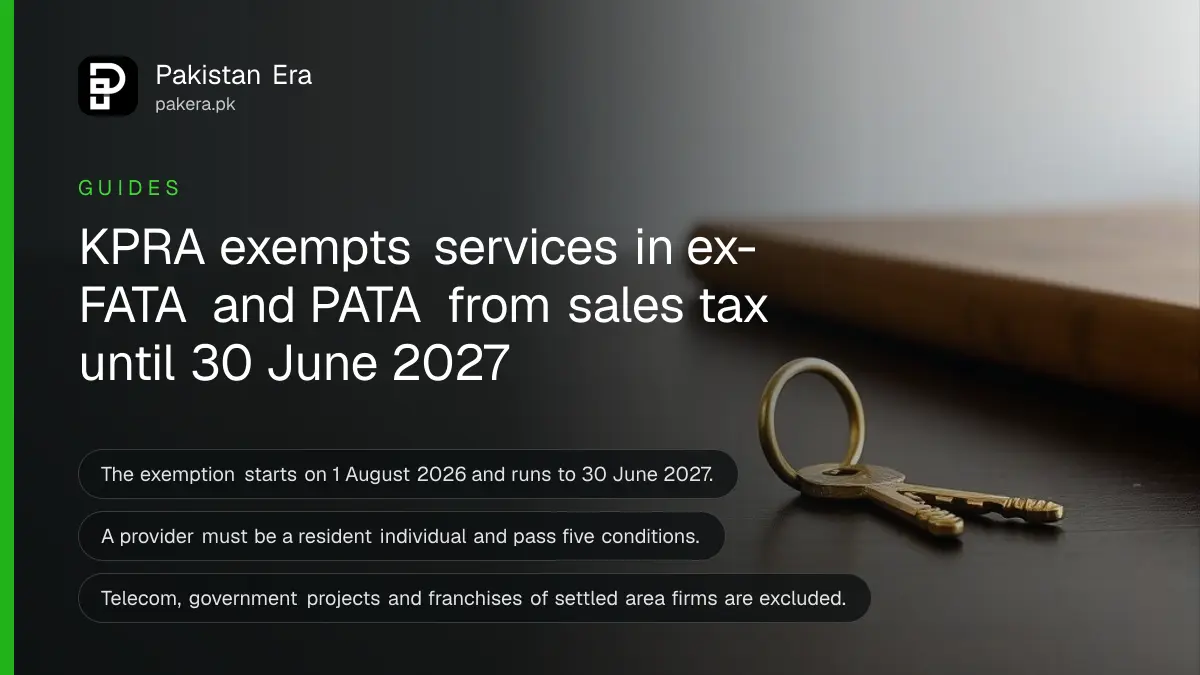
Short answer: The Khyber Pakhtunkhwa Revenue Authority (KPRA) has exempted the whole of sales tax on services for qualifying service providers in the former FATA and PATA. You must be a resident individual, work only inside those areas and pass five conditions. The exemption runs from 1 August 2026 to 30 June 2027 unless withdrawn.
A barber in Khar, a photographer in Mingora and a clinic owner in Miranshah all sell services. A notification in the provincial Gazette now exempts many providers like them from the provincial sales tax on services.
We opened the notification on the KPRA website on 12 October 2026. It is a scanned Gazette page, and we read all three pages. The notification is numbered KPRA/Admn/GN/2026/3637, dated 1 September 2026 and printed in the Gazette of 2 September 2026.
KPRA exempts the whole sales tax on services for qualifying providers
The Policy Board, with the approval of the provincial government, exempts the whole of the sales tax leviable under the Khyber Pakhtunkhwa Sales Tax on Services Act, 2022. It covers services provided in the erstwhile Federally Administered Tribal Areas and Provincially Administered Tribal Areas (ex-FATA and PATA).
The exemption is not automatic for everyone in those areas. The text lists five conditions and fourteen activities. A provider must satisfy the conditions and be engaged in one of the listed activities. Both parts must be true at the same time.
The notification also states a plain rule in its clarification. Every provider who meets the conditions and does a listed activity is entitled to the exemption and is not liable to charge, collect or pay sales tax on those services.
You must pass all five conditions
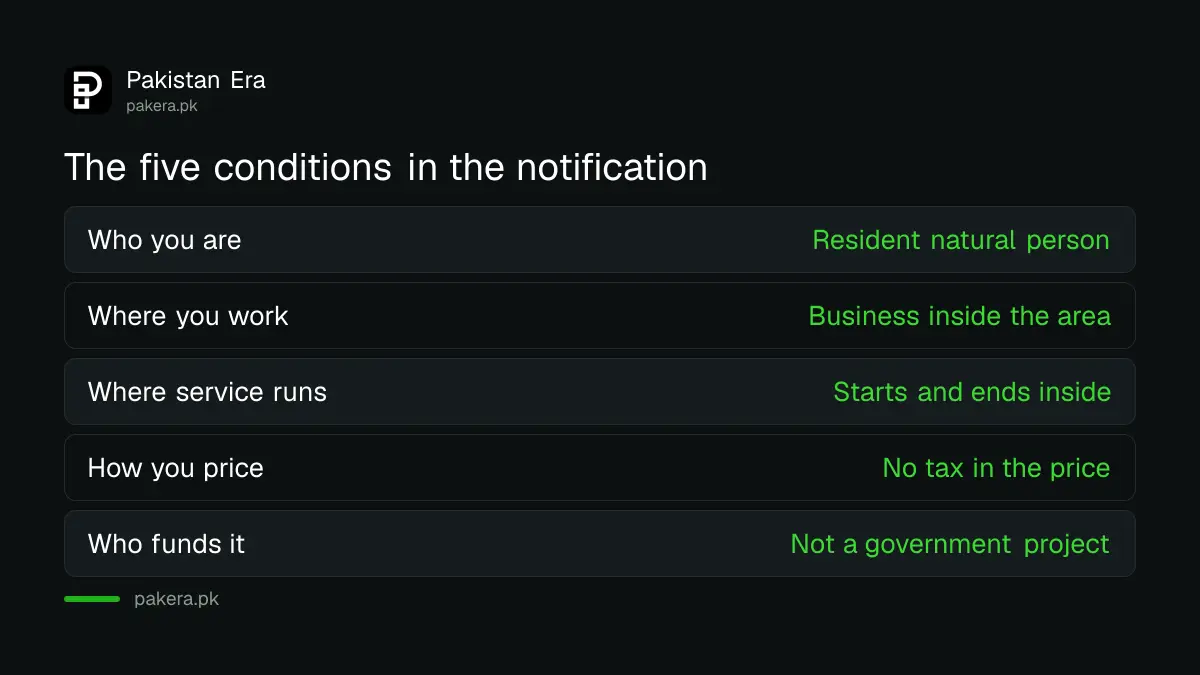
The five conditions are about who you are, where your business sits, where the service starts and ends, how you price it and who pays for it. Fail one and the exemption does not apply to you.
| Condition | What the notification says |
|---|---|
| 1. Who you are | A natural person who is a bona fide resident of the area |
| 2. Where the business is | Established, located and ordinarily carried on within the area |
| 3. Where the service runs | Services exclusively originate and terminate within the area |
| 4. How you price it | No sales tax component is included in the gross value of the service |
| 5. Who funds the work | Not providing services in relation to Government funded projects |
A natural person means an individual, not a company. The text does not extend the exemption to companies or firms. If you run a registered company, read condition 1 again before you assume you are covered.
A bona fide resident has to hold a CNIC with a local address
The notification defines a bona fide resident as a person who ordinarily lives in ex-FATA or PATA, keeps their principal home and principal business there, and holds a valid CNIC showing an address inside those areas.
That last part matters in practice. A resident who works in the area but whose CNIC shows an address in a settled district does not meet the definition as written. Check the address printed on your card before you stop charging tax.
The same definition asks for the principal business to be in the area too. A person with a second shop outside the area has to look at where the principal business sits, and at condition 3.
The exemption covers 14 listed kinds of service
The list is wide. It names hotels, guest houses, restaurants and wedding halls, property rental, construction trades, private hospitals and clinics, local transport, salons, vehicle workshops, repair shops, photography, event management, resident consultants and travel agents.
The notification lists these activities:
- Hotels, guest houses, lodges, restaurants, cafes, tea houses, wedding halls and clubs.
- Rental or leasing of own or leased immovable property, including real estate services.
- Construction and allied services, such as electrical, plumbing, flooring, plastering and painting, except for Government funded projects.
- Services of local private hospitals, doctors, clinics and diagnostic laboratories.
- Intra-city passenger and goods transport.
- Beauty parlours, barber shops and salons.
- Vehicle repair, car washing, laundry and dry cleaning.
- Industrial, mechanical, electrical and electronic repair workshops, including installation and inspection work.
- Electrical, plumbing, welding and fabrication services.
- Photography and videography.
- Event management, exhibitions and conventions.
- Consultancy and professional services by resident practitioners.
- Travel agents, tour operators, property dealers and distribution intermediaries.
- Any other service the Government notifies later.
If your work is not on that list, the exemption does not reach it today.
Telecom, franchises and government projects stay outside
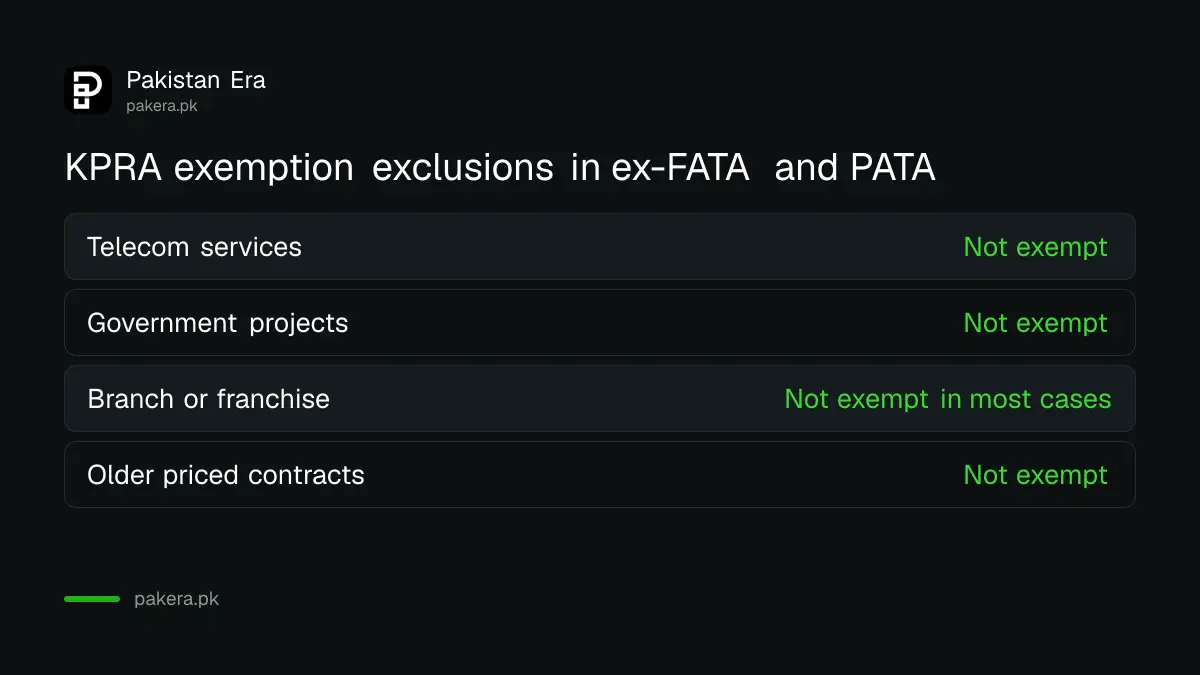
The notification names three exclusions. It does not apply to telecom and allied services or government funded projects, to branches and franchises of businesses that operate in the settled areas, or to contracts priced with the tax included before the notification began.
| Excluded case | Detail from the notification |
|---|---|
| Telecom and allied services | Not exempt |
| Government funded, PSDP or ADP projects | Not exempt, and this includes entities set up for one project |
| Franchise, branch or satellite office | Not exempt if the parent runs a similar business in settled areas, except private hospitals and diagnostic laboratories |
| Older contracts | Not exempt if sales tax was included in the price before the notification began |
Private hospitals and diagnostic laboratories get a carve-back. Even if they are a branch of a larger chain in the settled areas, the exclusion for branches does not apply to them.
The exemption runs from 1 August 2026 to 30 June 2027
The notification takes effect from 1 August 2026 and stays in force until 30 June 2027, if not withdrawn earlier. That is about eleven months. The start date is a month before the Gazette date, so it reaches back to August.
That start date raises a practical question. A provider who charged tax in August may ask what happens to it. The text we read does not say, so ask KPRA directly rather than assume. KPRA's website lists a Peshawar head office phone number, +92 91 9219202, on its pages.
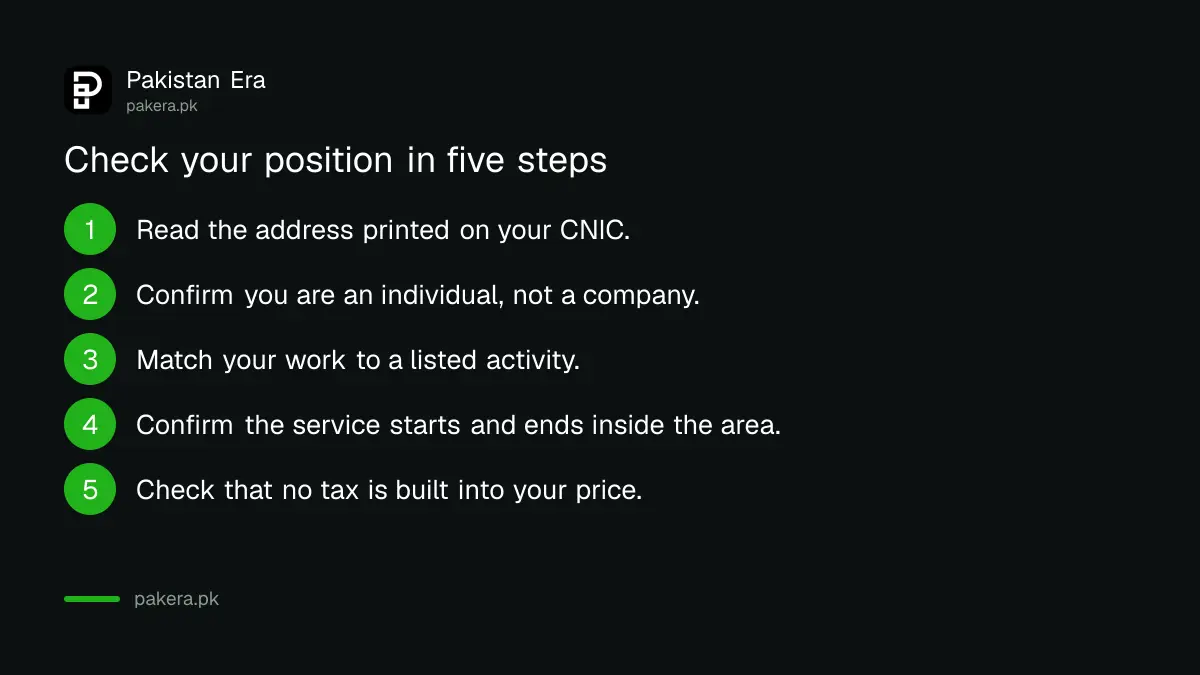
Here is how to check your own position.
- Look at your CNIC and confirm the address is inside ex-FATA or PATA.
- Confirm you are an individual and not a company or a branch.
- Match your work to one of the 14 listed activities.
- Confirm the service starts and ends inside the area and that no government project funds it.
- Read your price lists and contracts to make sure the tax is not already built into the price.
Registration and returns are not explained in the notification
The notification says nothing about whether an exempt provider still registers or files a return. It only says the provider need not charge, collect or pay the tax. We did not find a KPRA instruction on this point and we do not guess.
If you are already registered, the steps for registering for sales tax on services with KPRA show what you hold. The steps for filing a KPRA return show what a null return looks like. Ask KPRA in writing which of the two applies to you before you stop filing.
A separate notification of the same date covers industrial units that receive services. We explain it in the guide on the KPRA exemption for industrial undertakings in ex-FATA and PATA.
Common questions
Who can use the KPRA sales tax exemption in ex-FATA and PATA?
A bona fide resident individual whose business and services are entirely inside those areas can use it. The person must also do one of the 14 listed activities and meet all five conditions.
Does the exemption cover a company?
The conditions say service providers are natural persons. The text does not extend the exemption to companies, so a company should ask KPRA before relying on it.
When does the exemption start and end?
It starts on 1 August 2026 and ends on 30 June 2027, if the Government does not withdraw it earlier.
Are telecom services exempt?
No. The notification excludes telecom and allied services, and it also excludes government funded projects and projects under the PSDP or ADP.
Can I charge sales tax to a customer anyway?
The notification says a qualifying provider is not liable to charge, collect or pay the tax. Condition 4 also requires that no tax component is built into your price.
Where can I read the notification myself?
It is on the notifications page of the KPRA website, listed as the sales tax exemption for service providers in ex-FATA and PATA, dated 2 September 2026.
How we verified this
What we checked, where we read it, and what we could not confirm.
We read the KPRA notification numbered KPRA/Admn/GN/2026/3637 on the KPRA notifications page on 12 October 2026. We did not read any later KPRA clarification, and we could not confirm how KPRA treats tax charged in August 2026. Notifications can be amended or withdrawn, so check the page before you act.
About the author

Senior Writer, Public Services and Technology
Shahid joined us in 2024 as an author. He is a senior contributor to Pakistan's leading technology websites. He writes detailed articles, mostly covering his expertise in the latest tech, mobiles, apps, gadgets, and step-by-step guides. His ideology is to help people understand the latest trends and explain complex methods through very easy-to-understand guides.