Send Animal Samples to a Disease Diagnostic Laboratory in Punjab: 27 District Labs Listed
Punjab has 1 provincial, 8 divisional and 27 district animal laboratories, plus a poultry reference lab in Rawalpindi. See how to send a dung sample and report.
Punjab runs 36 government laboratories to test sick animals: one provincial, 8 divisional and 27 district laboratories, all under the Directorate of Disease Diagnostic, Reporting and Surveillance. Poultry samples go to a separate reference laboratory at the Poultry Research Institute in Rawalpindi.
We read the Livestock and Dairy Development Department's disease diagnostic page, its FAQs and its home page at livestock.punjab.gov.pk on 21 October 2026. The 36 total is our addition of the three figures on the page. The page lists no addresses, fees or turnaround times, so we give none.
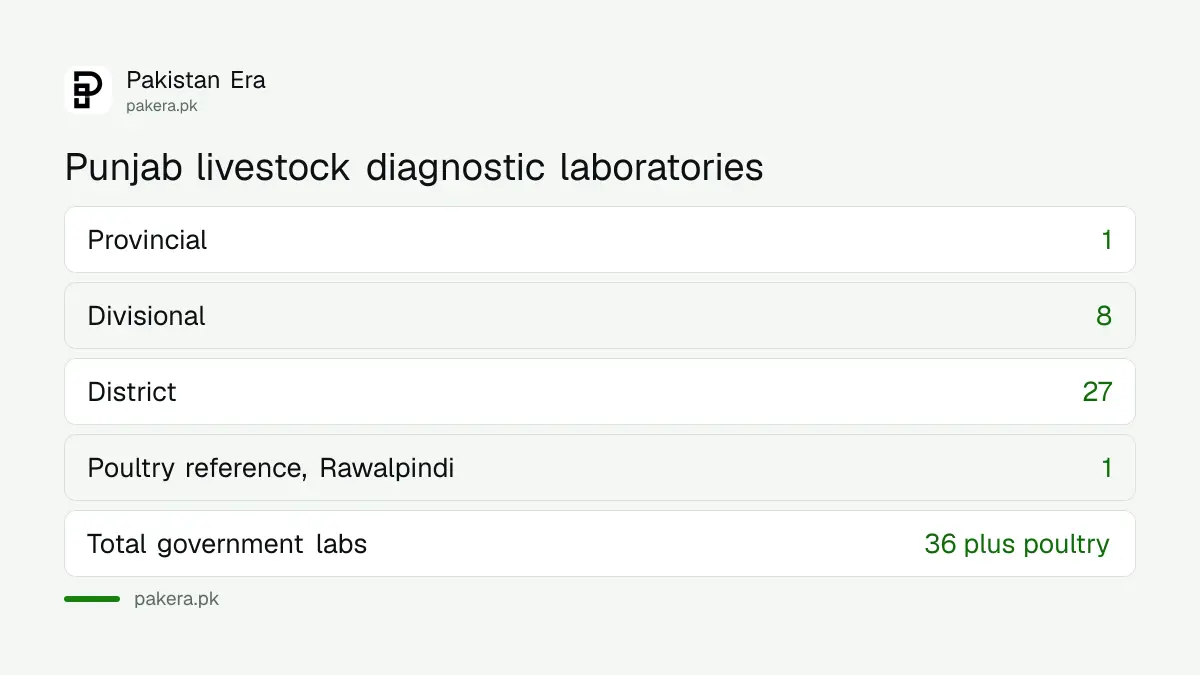
The network has 1 provincial, 8 divisional and 27 district laboratories
The department calls these laboratories the backbone of its work. They test for bacteria, viruses, parasites and fungi, and they track disease outbreaks. A farmer usually deals with the district one first, because it is closest.
| Level | Number |
|---|---|
| Provincial laboratory | 1 |
| Divisional laboratories | 8 |
| District laboratories | 27 |
| Poultry reference laboratory, Rawalpindi | 1 (nine sections) |
The page does not say which laboratory serves which district, so ask the livestock office which one covers you.
The laboratories test, track and report disease
The department lists their jobs: diagnostic tests, identifying the germ, giving results to farmers and vets, monitoring outbreaks, studying risk factors and reporting to provincial and national bodies. They also gather data on antibiotic resistance, which means germs that no longer respond to common medicines.
Records go through software called ADRSinfo, which the department says is for passive disease surveillance and laboratory management. Passive surveillance means the system learns about disease when farmers and vets report it. That makes your report count.
The department also names diseases that pass between animals and people, such as avian influenza, brucellosis and rabies. It says it works with public health authorities on them.
Send a faecal sample before you deworm
On worms, the department's FAQ is clear: send the animal's faecal sample to the diagnostic laboratory to find the internal worms, then use medicine matching the result. It says to deworm every four months.
A fresh sample works better than an old one, in general, but the department gives no handling rules on the page. Ask the laboratory how to collect and carry it. The step-by-step for mastitis and worms is in the guide on preventing mastitis and worms in dairy animals.
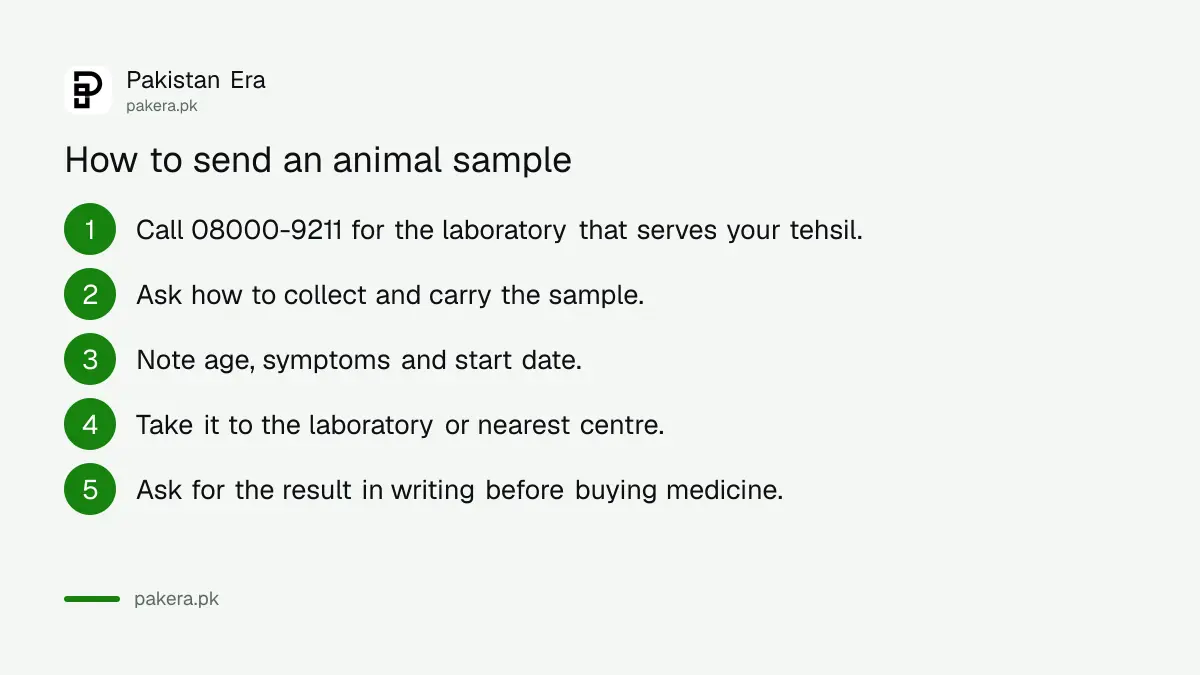
- Call 08000-9211 and ask which laboratory serves your tehsil.
- Ask how to collect and carry the sample.
- Note the animal's age, symptoms and when they began.
- Take the sample to the laboratory or the nearest livestock centre.
- Ask for the result in writing before you buy medicine.
Poultry samples have their own reference laboratory in Rawalpindi
The department says the Disease Diagnostic Section at the Poultry Research Institute, Rawalpindi, is the provincial reference laboratory for poultry diseases and receives samples from all over Punjab. It has nine laboratories, each for a special task.
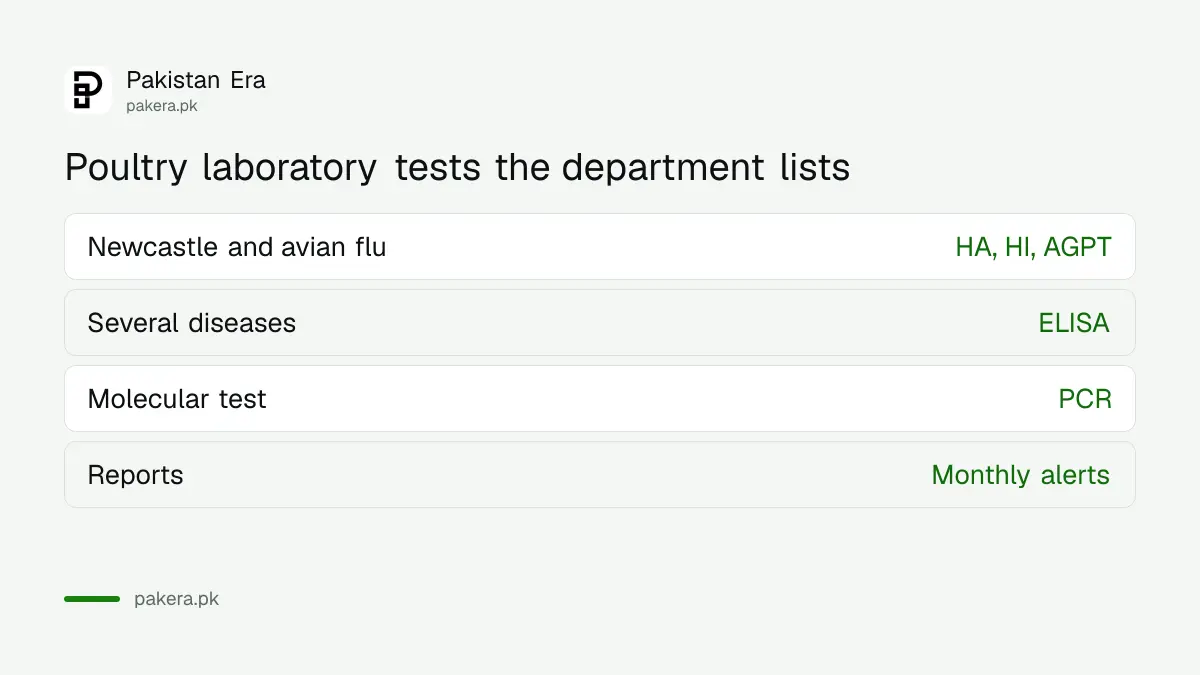
It tests with HA, HI and AGPT methods for Newcastle disease and avian influenza, ELISA for several diseases, and PCR. It also makes its own antigen for Newcastle disease, avian influenza H9, H7 and H5, Salmonella and Mycoplasma. It issues monthly disease reports and alerts for the poultry sector, the page says.
Ask your poultry vet before you send birds. For the farm rules that go with this, the poultry farm distance, space and registration rules are in a separate guide.
Reporting an outbreak helps your own herd
The department says it reports outbreaks to provincial and national animal health bodies and shares information with the World Organisation for Animal Health. It may enforce quarantine during outbreaks. That is why early reports from farmers matter.
Move sick animals away from the herd and call before you sell any of them. Selling a sick animal to a market spreads the disease. The department's page does not give a legal penalty, so we do not state one.
The department says it trains veterinarians, para-veterinary staff and farmers in disease diagnosis, reporting and prevention, and that it seeks accreditation from recognised bodies for its laboratories. We do not know which laboratories hold accreditation now, and the page does not say. It also describes field investigations to find the source of an outbreak, which can mean a team visiting your farm.
If a team does visit, give them honest dates for when animals fell sick, what they ate and any new animals you bought. That history is what lets the laboratory and the field team find the source quickly.
Common questions about animal disease laboratories
How many animal diagnostic laboratories are in Punjab?
The department lists one provincial, 8 divisional and 27 district laboratories.
Is laboratory testing free?
The department lists free diagnostic facilities among its services. Its diagnostic page says the laboratories give cost-effective testing, so ask the laboratory what applies to your sample.
Where do poultry samples go?
To the Disease Diagnostic Section of the Poultry Research Institute, Rawalpindi, the provincial reference laboratory.
Can the test tell me which dewormer to use?
Yes, that is the department's advice: test the faecal sample, then choose medicine matching the worms found.
What is ADRSinfo?
It is the software the department uses for passive disease surveillance and laboratory information.
Who do I call first?
The home page lists the helpline 08000-9211. We did not call it.
How we verified this
What we checked, where we read it, and what we could not confirm.
Last checked 21 October 2026. We read the department's disease diagnostic and surveillance page and its FAQs page. We could not find laboratory addresses, fees, sample handling rules or result times on those pages, and we did not call the helpline or visit a laboratory.
About the author

Senior Writer, Public Services and Technology
Shahid joined us in 2024 as an author. He is a senior contributor to Pakistan's leading technology websites. He writes detailed articles, mostly covering his expertise in the latest tech, mobiles, apps, gadgets, and step-by-step guides. His ideology is to help people understand the latest trends and explain complex methods through very easy-to-understand guides.