Send University Fees Abroad From Pakistan: Up to US$70,000 a Year per Student
SBP rules let banks send up to US$70,000 a year per student for fees and living costs abroad. Tuition goes to the university. See the 5 documents and cash cap.
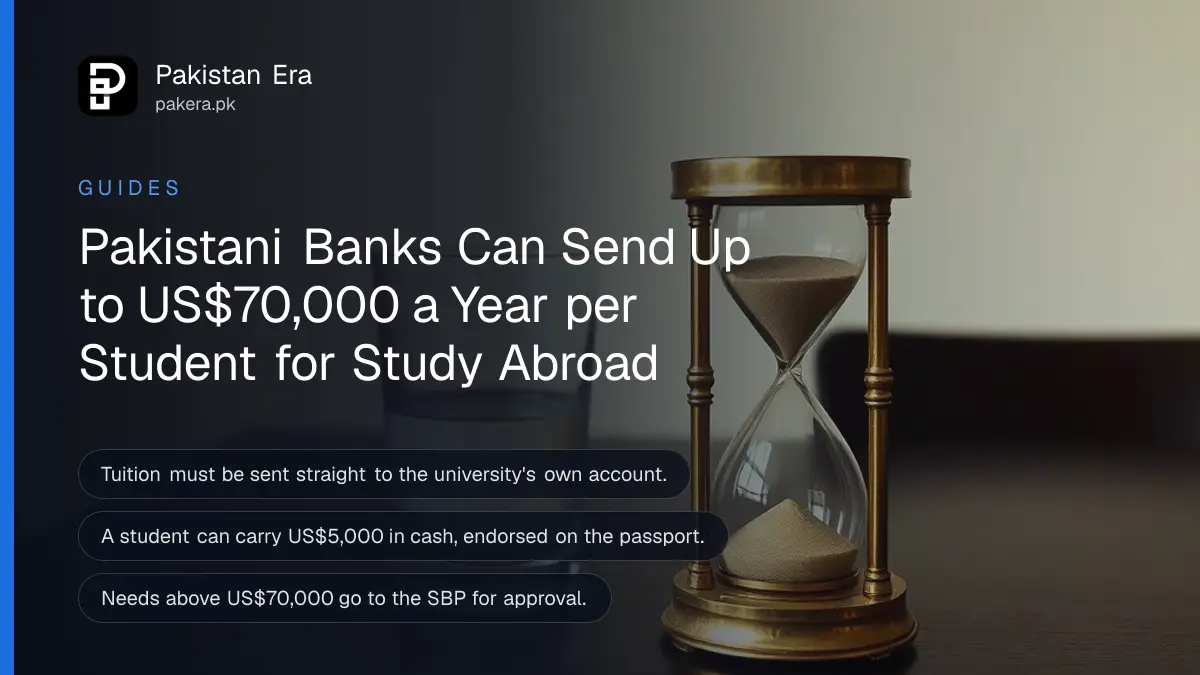
Short answer: a Pakistani bank can send up to US$70,000 a year for each student studying abroad, covering application fees, tuition and living costs. Tuition must go straight to the university's account. The student can also take up to US$5,000 in cash, endorsed on the passport.
That limit is set in chapter 17, paragraph 38, of the State Bank of Pakistan's Foreign Exchange Manual, which we read on the SBP website on 20 October 2026. It applies to study at "accredited and recognized foreign institutions/universities". The limit is per student per calendar year, so two children abroad each have their own US$70,000.
Parents usually meet this rule when the first tuition invoice arrives and the bank asks for a form they have never seen. Knowing the documents and the routing in advance saves a second trip to the branch, and sometimes a missed fee deadline.
Banks can send up to US$70,000 a year for each student
An authorised dealer bank can remit up to US$70,000, or the same value in another currency, per student per calendar year. It covers application or processing charges, tuition fees, living expenses and other dues such as health, insurance, union, sports and library fees.
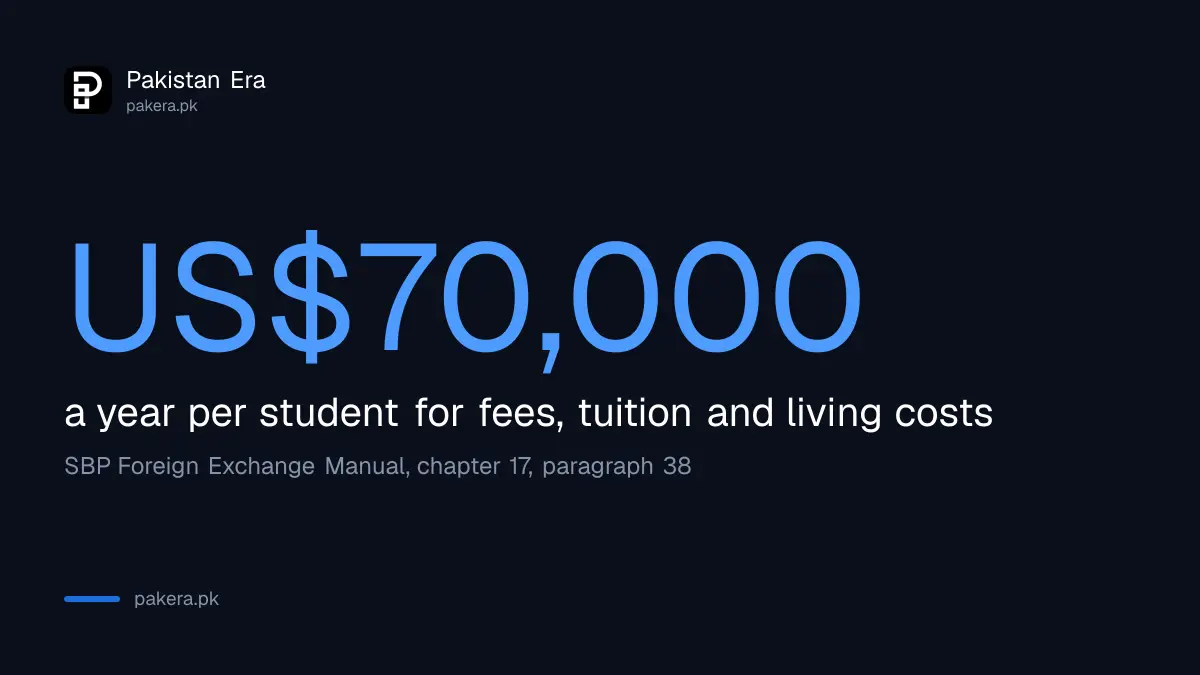
An authorised dealer is a bank licensed by the SBP to deal in foreign exchange. Most large banks are. On the SBP's revaluation rate of Rs 276.90 to the dollar for 19 October 2026, US$70,000 is about Rs 19.4 million, on our arithmetic.
| Item | SBP rule |
|---|---|
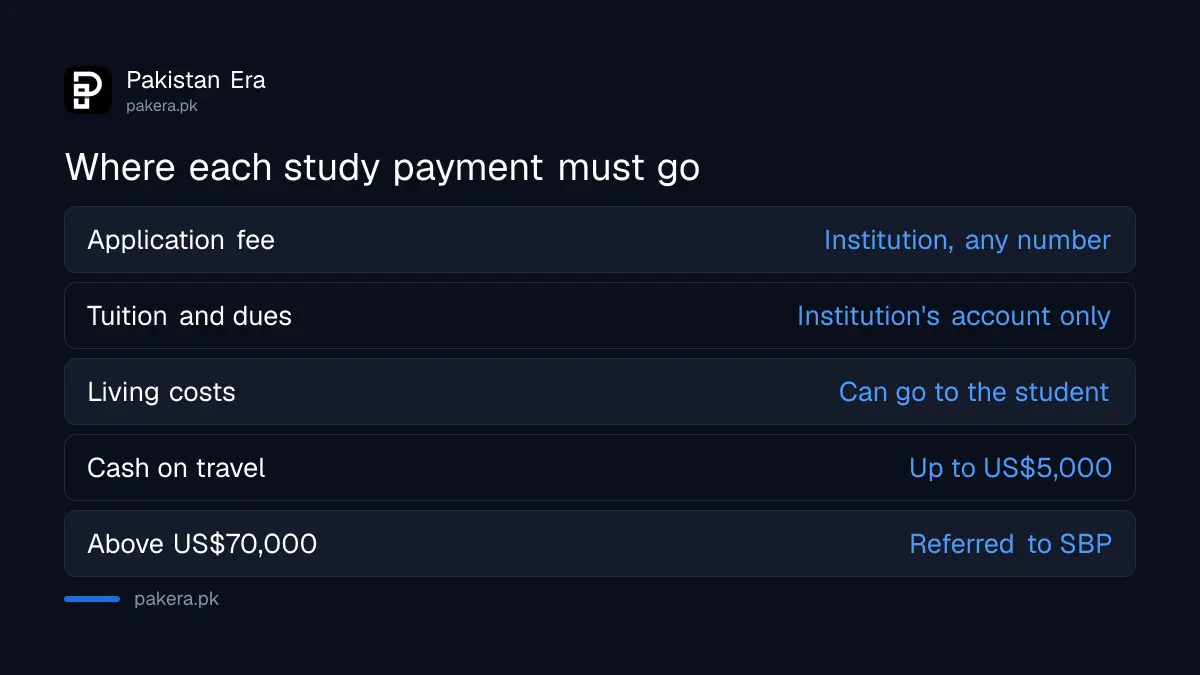
| Annual limit | US$70,000 or equivalent per student per calendar year |
| Application or processing fees | Can be sent before admission, with proof of the amount, to any number of institutions |
| Tuition and other dues to the institution | Sent directly to the institution's account |
| Living expenses | Can be sent to the student |
| Cash for the student | Up to US$5,000, endorsed on the passport |
| Need above the limit | Bank refers the case to the SBP's Foreign Exchange Operations Department |
Application fees can be sent before admission, to any number of universities
You do not need an admission letter to pay an application fee. The bank can send application or processing charges to a foreign institution on documentary proof of the amount. The SBP says there is no limit on how many institutions a student can apply to.
Bring the university's fee page or invoice showing the charge. A student applying to five universities can pay all five this way, each counting toward that year's US$70,000.
Tuition goes straight to the university, living money can go to the student
Dues payable to the foreign institution, including tuition, must be sent directly to its account by SWIFT, telegraphic transfer or demand draft. They cannot be released to the student. Living or other expenses not paid to the institution can be sent to the student.
This split matters for planning. If a university invoices accommodation, that goes to the university. Rent paid to a private landlord counts as living costs and can be sent to the student's own account abroad, within the same yearly limit.
A card payment is the other route families use for fees. It sits under a different limit and carries advance tax, explained in tax on card payments abroad and the US$30,000 card limit.
The bank will ask for five documents
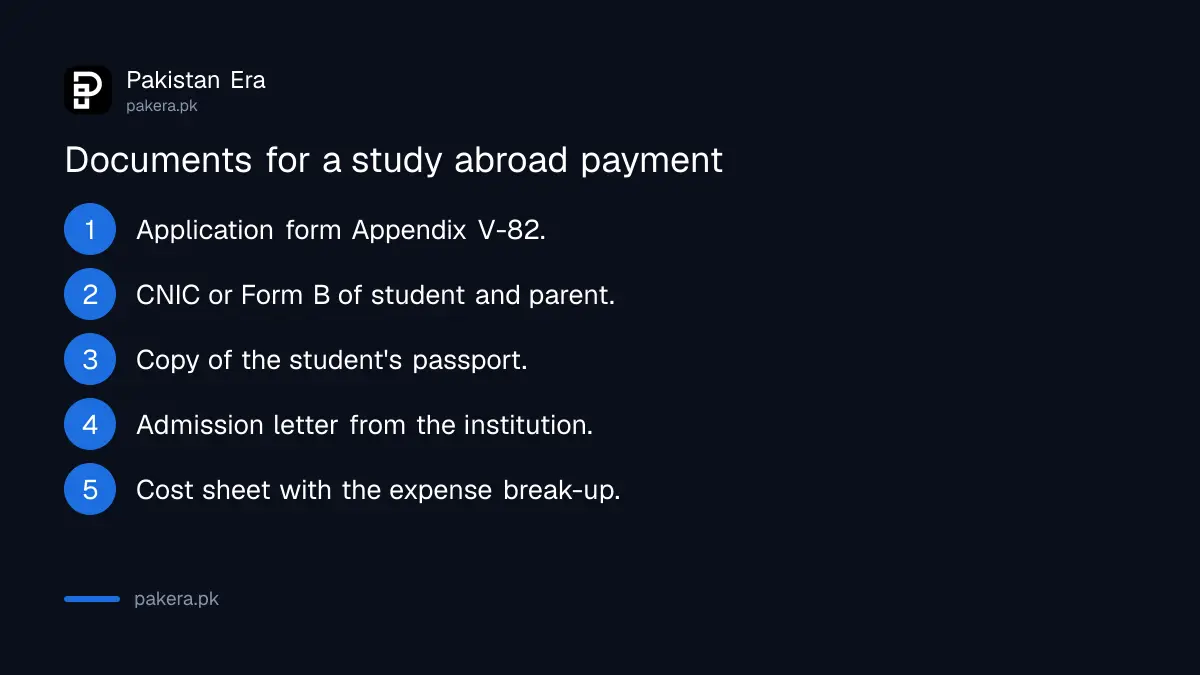
For tuition and living costs, the bank needs the SBP application form, CNIC or Form B copies, the student's passport, the admission letter and the university's cost sheet. The form is Appendix V-82 of the Foreign Exchange Manual.
- Application form Appendix V-82, filled in by the student, parent or guardian.
- Copies of the student's CNIC or Form B, and the parent's or guardian's CNIC.
- A copy of the student's passport.
- The letter of admission from the foreign institution.
- A letter or cost sheet from the institution showing the break-up of expenses.
The cost sheet is the document families most often forget. Visa offices ask for proof of funds too, and the figures should match. For UK applicants, the latest funds rule is in the UK student visa funds increase.
The student can carry US$5,000 in cash, endorsed on the passport
For first expenses on arrival, such as boarding and lodging, the bank can release foreign currency cash worth up to US$5,000 to the student. The bank must record the amount on the student's passport.
Banks are told to keep stocks of major currencies at authorised branches for this. The SBP also requires them to display study abroad foreign exchange information in branches and on their websites, with a list of branches offering the service. If your branch says it cannot help, ask which branch can.
Above US$70,000 the bank must ask the SBP
If a student needs more than US$70,000 in a calendar year, the bank forwards the case, with justification and documents, to the Director of the Foreign Exchange Operations Department at SBP Banking Services Corporation, Karachi. It is not refused automatically.
Expensive medical or engineering programmes can cross the limit once living costs are added. Start this request early, since it needs SBP consideration. The manual also says a bank should not release foreign exchange for two different purposes at the same time, so keep study and travel requests separate.
Common questions
How much money can I send abroad for my child's education?
Up to US$70,000 or equivalent per student per calendar year through an authorised bank, under the SBP Foreign Exchange Manual.
Can the bank send tuition to my child's own account?
No. Tuition and dues payable to the institution must go directly to the institution's account.
Do I need an admission letter to pay an application fee?
No. The bank can send application fees on proof of the amount, to any number of institutions.
How much cash can a student take for studies abroad?
Up to US$5,000 in foreign currency cash from the bank, endorsed on the student's passport.
What if the course costs more than US$70,000 a year?
The bank can refer the case to the SBP's Foreign Exchange Operations Department in Karachi with justification and documents.
How we verified this
What we checked, where we read it, and what we could not confirm.
We read chapter 17, Travel, of the State Bank of Pakistan's Foreign Exchange Manual, paragraphs 37, 38 and 40, on 20 October 2026. Paragraph 38(3) cites EPD Circular Letter No. 14 of 14 September 2018. The dollar rate is the SBP revaluation rate for 19 October 2026. The manual chapter carries no revision date, so we could not confirm whether a later circular changed the US$70,000 limit. We did not send a payment, so bank charges, the exchange rate a bank applies and processing time are not verified.
About the author

Public Services and Education Journalist
Fajr Riaz is a journalist and content writer at Pakistan Era, based in Lahore. She covers the questions people meet in everyday life in Pakistan: how a public service works, what a change in the rules means, and where to find a reliable answer.