Pakistan's USD 30,000 Yearly Card Limit Resets on 1 November: Check What You Have Left
Pakistan caps foreign card spending at USD 30,000 a year per person, across all cards, and the year resets on 1 November. See what counts and how to check it.
Every person in Pakistan can spend up to USD 30,000 a year on debit, credit and virtual cards at foreign merchants and websites. The limit covers all your cards at all banks and wallets together. The year runs from 1 November to 31 October, so the current year ends on 31 October 2026 and a fresh USD 30,000 starts on 1 November.
The rule comes from the State Bank of Pakistan's FE Circular No. 07 of 2022, issued on 8 November 2022. It is not new. But each autumn people who pay for software, ads, courses or flights by card find their foreign payments declined in late October, and most of them never knew a yearly cap existed.
We read the circular on 9 October 2026, along with what HBL and NayaPay tell their customers about it. Here is how the limit works, what counts, and how to work out what you have left before 31 October.
What the USD 30,000 card limit covers
The limit covers card payments that cross the border: online purchases from foreign websites, subscriptions, and card spending or cash withdrawals abroad. It applies to debit, credit and virtual cards, and it is counted per person across the whole banking industry, not per card.
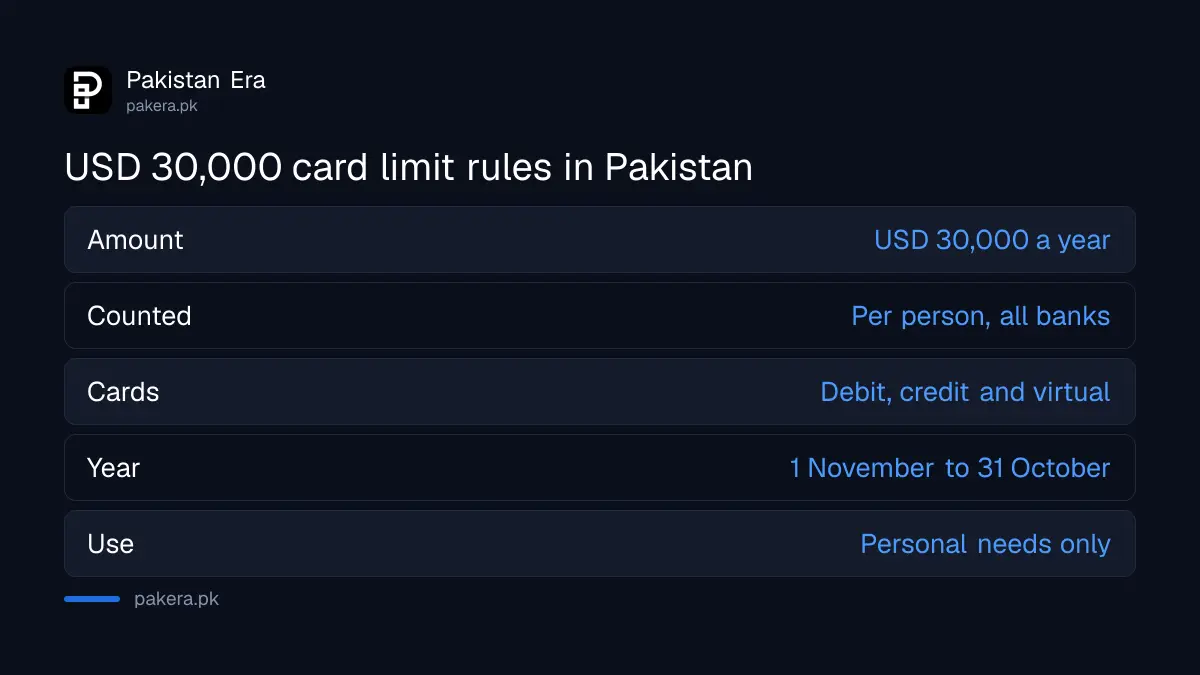
The circular says the limit applies to card-based cross-border transactions, "including virtual cards", and that it is "applicable for an individual across the banking industry". NayaPay's help centre gives a clear example. If you hold three debit cards, one virtual card and one credit card, all five share one USD 30,000 a year.
Watch for prices shown in rupees. HBL says payments to online or international merchants that are settled in foreign currency are foreign transactions, even when the screen shows a rupee amount. Airlines and app stores often work this way.
| Point | What the rule says |
|---|---|
| Amount | USD 30,000 a year, or the equivalent |
| Who it applies to | Each individual, across all banks |
| Which cards | Debit, credit and virtual cards |
| Year | 1 November to 31 October |
| Use | Personal needs only, no commercial payments |
| Source | SBP FE Circular No. 07 of 2022, 8 November 2022 |
The card year resets on 1 November, not 1 January
The circular says the year for this limit starts on 1 November. So the 2025 to 2026 card year closes on 31 October 2026. Anything you spend abroad by card from 1 November 2026 counts toward a new USD 30,000.
This trips people up because another dollar rule uses the calendar year. The cash you carry when you travel is capped at USD 5,000 a visit and USD 30,000 a year, counted from 1 January, as explained in foreign currency limits for travel from Pakistan. The two limits are separate. Cash in your pocket does not use up your card limit, and card spending does not use up your cash limit.
What happens if you cross the limit
Your foreign card payments stop until the new year starts on 1 November. Local use carries on. NayaPay says only international transactions are restricted, and that card privileges return on 1 November.
The circular puts the duty on you first. It says it is "the primary responsibility of a customer" to stay within the limit, and it tells banks to monitor all your cards together. So no bank will warn you in advance as a matter of rule. Some may block the payment that would take you over.
Failed payments can cost you too. NayaPay, for example, allows 5 failed international transactions before it charges a fee to restore card use, and it says repeated failures can lead to a blocked card.
How to check how much of your USD 30,000 is left
No public tracker shows your total across banks. You add it up yourself from each card statement since 1 November 2025, then take the total away from USD 30,000. Ten minutes with your apps is usually enough.
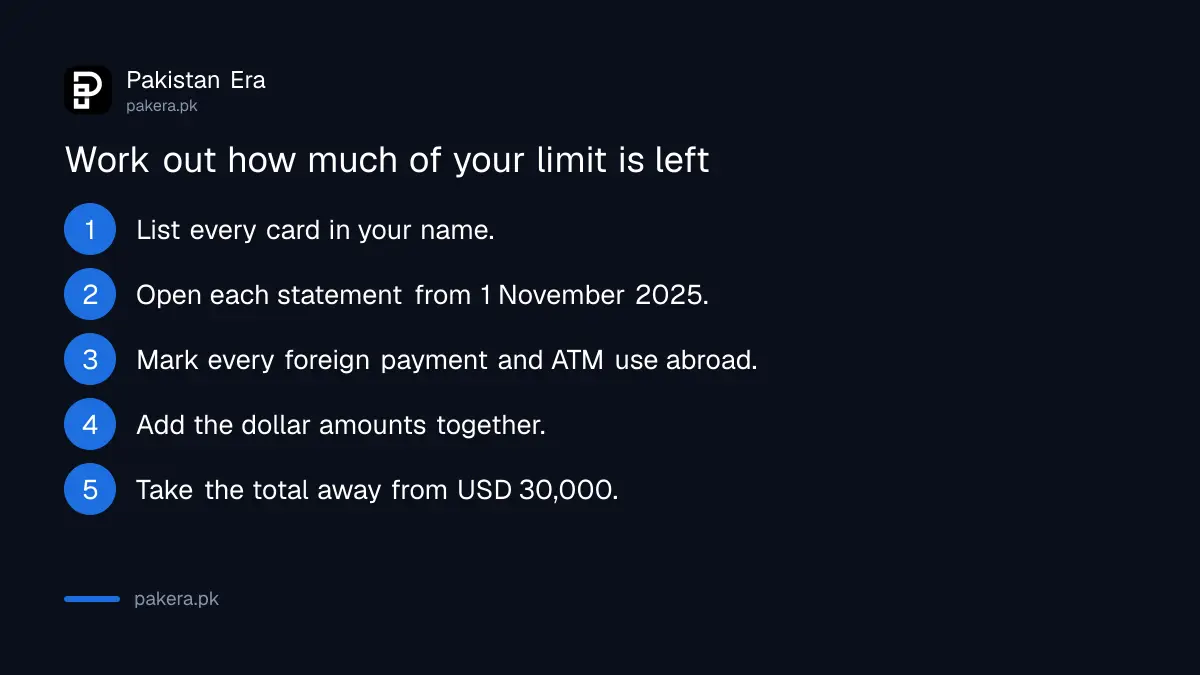
- List every card in your name: bank debit cards, credit cards, wallet cards such as NayaPay or SadaPay, and any virtual cards.
- Open each card's statement in its app, from 1 November 2025 to today.
- Mark every payment to a foreign merchant or website, and every ATM withdrawal abroad. Include rupee-priced charges from foreign sites.
- Add the dollar amounts. Where a statement shows only rupees, ask the bank for the dollar value or use the rate on that statement line.
- Take the total from USD 30,000. If you are close, hold large foreign payments until 1 November or ask your bank what it has recorded.
Your bank only sees its own cards. If you hold cards at three banks, each one sees a part of the picture. That is why the circular makes the total your responsibility.
Personal use only, and the tax on top
Cards in your own name are for personal spending. The circular says cross-border commercial payments through individual cards are not allowed, and that banks may issue corporate cards to business customers instead. Separately, FBR collects advance tax on card payments abroad.
If you run ads or buy software for clients, that is business use. The safer route is a company or corporate card, as set out in paying for Google and Meta ads from Pakistan. Heavy foreign spending on a personal card can also prompt the bank to review your risk profile.
The tax is under section 236Y of the Income Tax Ordinance. FBR's withholding tax rate card, updated as per the Finance Act 2026, lists it at 0.50% for people on the Active Taxpayer List and 1.00% for others. Some bank and wallet fee pages still print older, higher rates, so check the tax line on your own statement.
Card fees are a separate cost again. They vary a lot between providers, from a flat USD 0.25 a payment at NayaPay to 6% at SadaPay. The comparison of virtual dollar cards from Pakistan is worth reading before a big purchase.
Common questions
When does the USD 30,000 card limit reset in Pakistan?
On 1 November each year. The current card year ends on 31 October 2026, and a new USD 30,000 starts on 1 November 2026.
Is the USD 30,000 limit per card or per person?
Per person. All your debit, credit and virtual cards at every bank and wallet share one USD 30,000 a year.
Do online purchases from foreign websites count?
Yes. Online payments to foreign merchants count, including some charges shown in rupees but settled in foreign currency.
What happens if I go over the limit?
Foreign card payments are blocked until 1 November. Local payments and ATM use in Pakistan keep working.
Is this the same as the USD 30,000 cash limit for travel?
No. The travel cash limit counts from 1 January and covers cash you carry. The card limit counts from 1 November and covers card payments.
Can I use my personal card for business payments abroad?
No. The circular says commercial cross-border payments through individual cards are not allowed. Banks can issue corporate cards for business use.
How we verified this
What we checked, where we read it, and what we could not confirm.
Last checked on 9 October 2026, Pakistan time. We read the State Bank's FE Circular No. 07 of 2022 on cross-border card transactions, HBL's page on foreign transactions, NayaPay's help articles on the USD 30,000 limit and failed transactions, and FBR's withholding tax rate card updated as per the Finance Act 2026. We did not test a card at the limit, so what happens at the point of crossing it comes from those pages.
About the author

Technology Journalist & Multimedia Producer
Ahmad Ali is a technology journalist and multimedia producer at Pakistan Era, joining the team in October 2026. He covers consumer technology and digital life for Pakistani readers, combining research with hands-on product testing.