Sindh Says It Has Enough Wheat as Flour Reaches Rs 150 to Rs 160 a Kilo
Sindh's chief minister said on 10 October 2026 there is no wheat shortage and flour costs Rs 150 to 160 a kilo. See how PBS city prices compare and what to do.
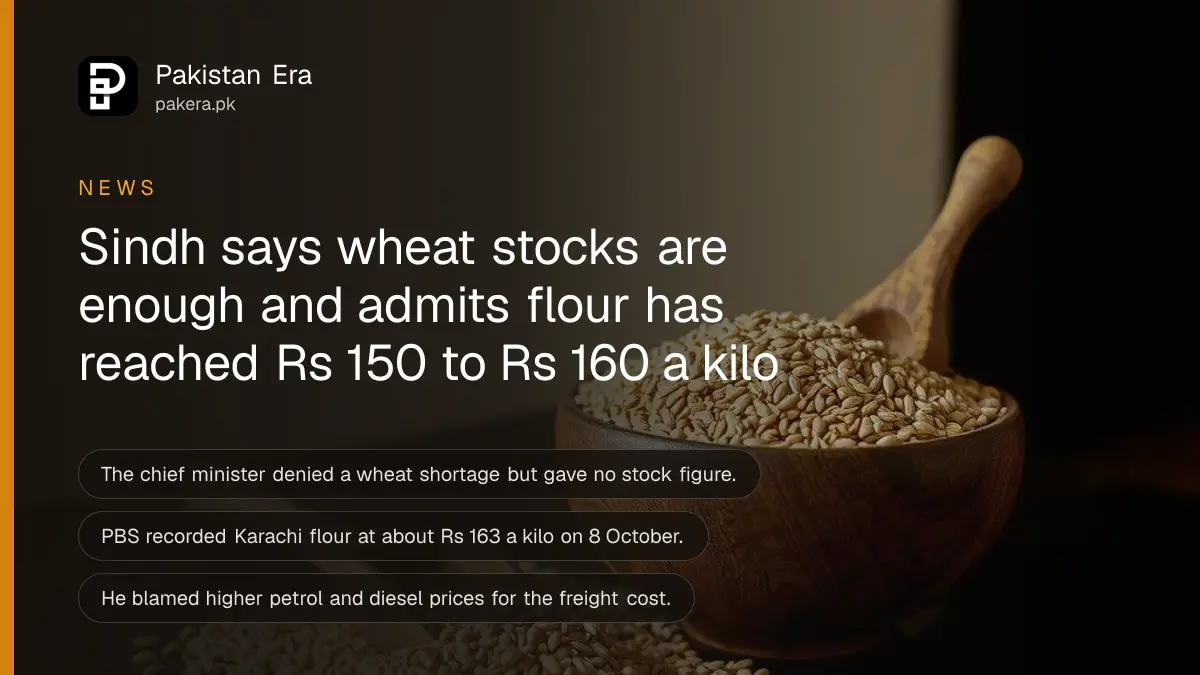
Short answer: Sindh Chief Minister Syed Murad Ali Shah said on Saturday, 10 October 2026, that the province has enough wheat stock to keep supply steady and flour prices stable, and that there is no shortage. He accepted that flour now costs between Rs 150 and Rs 160 a kilo. This is his statement to reporters as reported, not a notification.
He spoke at Sukkur airport before leaving for Khairpur, and later the same evening flew from Karachi for a five-day visit to China. The flour bag at the market is the number that matters to most readers. Nationally it was 32.60% dearer than a year ago in the week to 8 October, according to PBS.
We checked his range against the weekly figures of the Pakistan Bureau of Statistics (PBS) for 8 October. They match. What the statement does not give is a stock figure, a bag price or a date by which prices will fall.
The chief minister says wheat stocks are enough for the province
He rejected the idea that Sindh faces a wheat shortage. He said the province has enough stock to maintain supply and stabilise flour prices, and that his government had worked for two to three months on wheat procurement, including purchases left outstanding from earlier periods.
He did not give the size of the stock in tonnes or bags. He also did not say how many days of provincial demand it covers. Without those numbers, "enough" is a position, not a measurement.
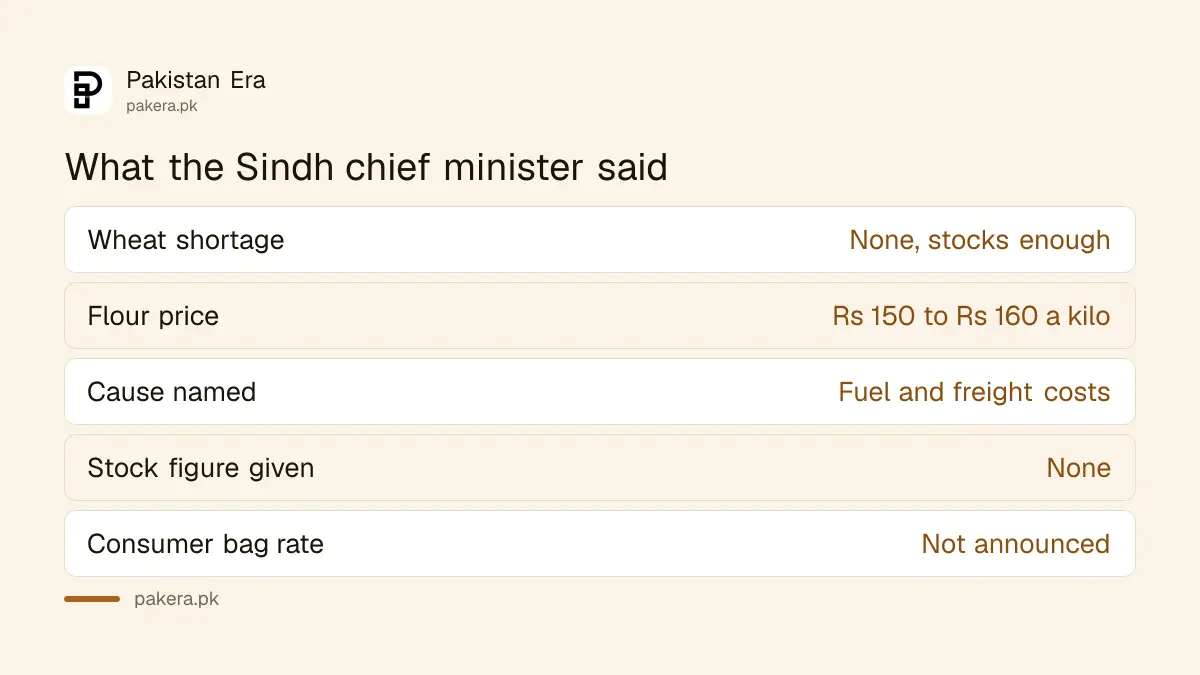
| Point | What he said | Our status |
|---|---|---|
| Wheat shortage | None, stocks are sufficient | Reported, no stock figure given |
| Flour price | Rs 150 to Rs 160 a kilo | Matches PBS city averages |
| Cause | Higher petrol and diesel, so higher freight | Reported |
| Relief for buyers | Steps to keep prices stable, none named | Not specified |
He blames fuel prices and freight for flour at Rs 150 to Rs 160 a kilo
He said flour reached between Rs 150 and Rs 160 a kilo and tied the rise to local factors and international conditions. Higher petrol and diesel prices, he said, raised transport and freight costs, and regional and international conditions affected the market too.
That explanation matches a pattern we have seen in the national numbers. PBS recorded flour as the biggest single mover in the weekly price index for the week ended 8 October, as our report on flour at Rs 2,851 a bag sets out. The grain itself rose Rs 84 per 10 kg that week.
PBS prices for Sindh cities sit inside his range
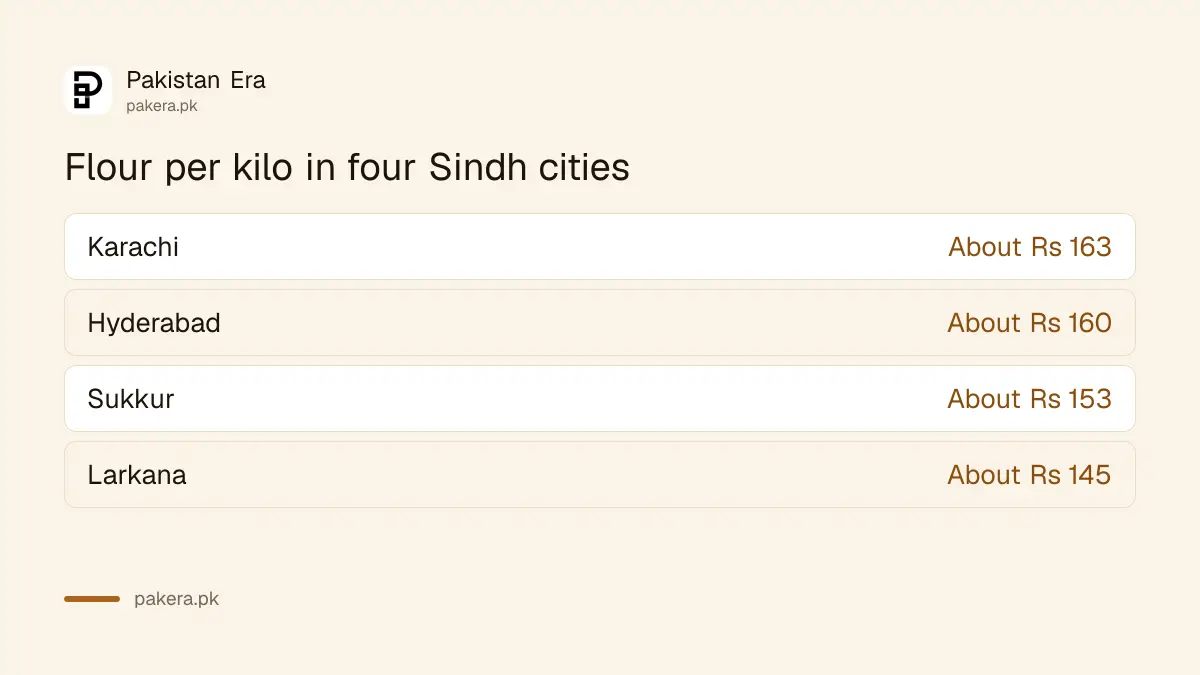
The PBS city table for 8 October gives a 20 kg flour bag price for each Sindh city it tracks. Divide by 20 and the figures are close to what he quoted. The Sindh grain prices, per 10 kg, also rose faster than most other places that week.
| Sindh city | 20 kg flour bag, 8 October | Per kilo, our arithmetic | Wheat per 10 kg |
|---|---|---|---|
| Karachi | Rs 3,256.97 | About Rs 163 | Rs 1,410 |
| Hyderabad | Rs 3,191.63 | About Rs 160 | Rs 1,450 |
| Sukkur | Rs 3,060.00 | About Rs 153 | Rs 1,400 |
| Larkana | Rs 2,900.00 | About Rs 145 | Rs 1,308 |
So Karachi is a little above the top of his range, and Larkana a little below the bottom. Sukkur and Hyderabad sit inside it. Our full table is in the report on wheat at Rs 5,437 a maund.
Punjab named a bag rate, and the Sindh statement did not
On the same day, 10 October, Punjab approved a Rs 10 billion flour subsidy with an official rate for a 10 kg bag made from government wheat. Our report on the Punjab flour subsidy has the figures and the conditions.
The Sindh statement named no consumer bag rate and no new subsidy for flour buyers. It said only that steps would be taken to keep prices stable. We have not found a notification from the Sindh Food Department that sets a rate. We checked its home page on 12 October and did not search its full notification list.
The national price committee had already told provinces on 8 October to watch flour supply and hoarding. Provincial and district administrations carry out that order, and it is the first thing to watch for in Sindh next.
Farmers have their own package, separate from the shop price
The Sindh cabinet approved an extra Rs 14.9 billion on 17 September for wheat growers with up to 25 acres. It also doubled the bonus for selling wheat to the government to Rs 2,000 per 40 kg. We explained it in our report on the Sindh wheat subsidy for farmers.
That package supports growers. It does not lower the price at your local shop. If the government buys more wheat for its own stocks, it may help supply later, but the chief minister did not link the two.
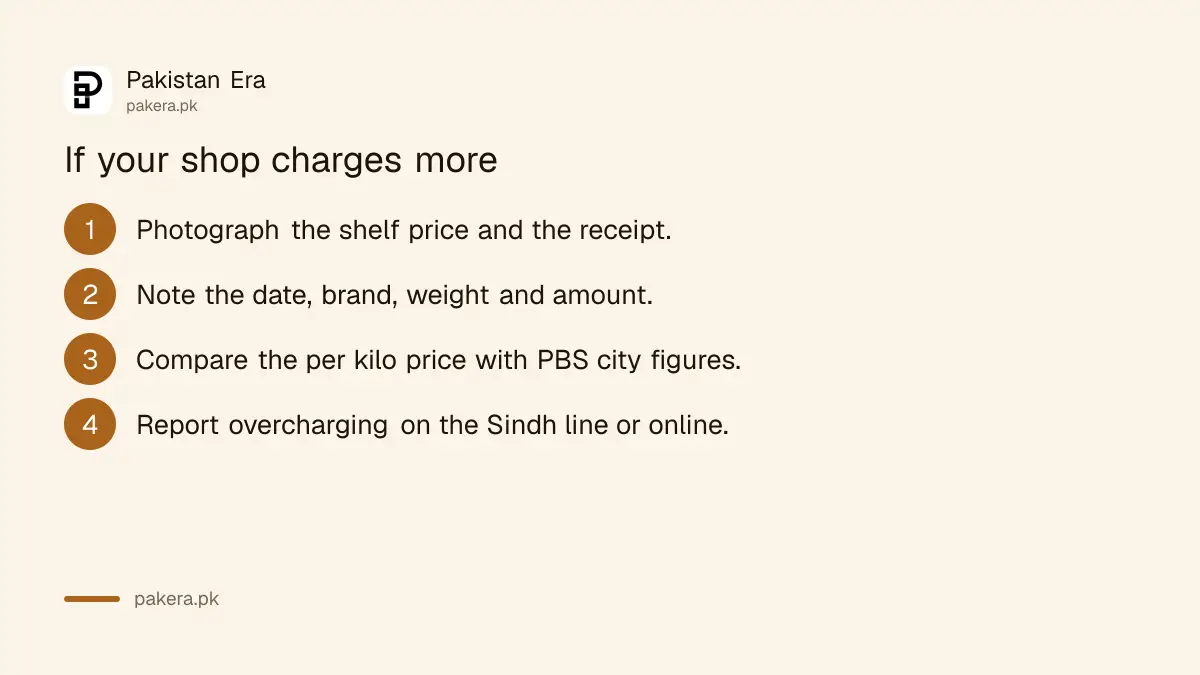
What you can do if your shop charges more
Keep the receipt, and compare the price per kilo with the PBS city figures above. A price well above them in your area is a reason to ask for a receipt and to complain.
- Photograph the shelf price and the receipt, with the shop name visible.
- Note the date, the brand, the weight and the amount charged.
- Compare the per kilo price with the PBS figure for your city.
- Report it. Our guide to reporting overcharging in Karachi and Sindh gives the line and the online route.
Common questions
Is there a wheat shortage in Sindh?
The chief minister said no, and said stocks are sufficient. He gave no stock figure, so we cannot verify it.
How much does flour cost in Sindh now?
He said Rs 150 to Rs 160 a kilo. PBS city averages for 8 October put Karachi at about Rs 163 and Sukkur at about Rs 153.
Did Sindh announce a flour subsidy for consumers?
Not in this statement. Sindh's recent subsidy package is for wheat growers, not for flour buyers.
Why is flour dearer?
He blamed higher petrol and diesel prices raising freight, plus regional and international conditions. National wheat prices also rose sharply in the week to 8 October.
Did he say when prices will fall?
No. He said the government would take steps to keep prices stable. No date or measure was named.
Where was the statement made?
He spoke to reporters at Sukkur airport on Saturday, before travelling to Khairpur, according to press reports.
How we verified this
What we checked, where we read it, and what we could not confirm.
The chief minister's remarks are from press reports of his comments on 10 October 2026, so they are marked as reported. We took the PBS weekly price tables for 8 October from our own earlier reports. We checked the Sindh Food Department home page for a rate notification on 12 October and found none.
- Pakistan Bureau of Statistics, weekly Sensitive Price Indicator: pbs.gov.pk
- Food Department, Government of Sindh: food.sindh.gov.pk
About the author

Tax, Bills and Technology Writer
Ali Akhtar is a young and curious voice here at Pakistan Era. He is currently pursuing his A-Levels and has a growing interest in Pakistan’s changing industrial landscape and educational trends. Ali likes to write in a way that helps him explain and explore the world around him. His writing reflects the perspective of the new generation navigating the evolving trends of Pakistan where technology, youth innovation, and shifting opportunities are reshaping the country’s future.