Spurious, Substandard, Adulterated or Counterfeit Medicine in Pakistan: What DRAP's Alert Words Mean
DRAP alerts use 5 words from the Drugs Act 1976: spurious, substandard, adulterated, counterfeit and misbranded. See what each means and what to do next.
Short answer: In a DRAP alert, a spurious medicine is fake: it lacks its active ingredient or did not come from the maker on the label. Substandard means a genuine product that failed its specification. Adulterated means contaminated or mixed with something else. Counterfeit means packaging copied to deceive. All five words come from the Drugs Act, 1976.
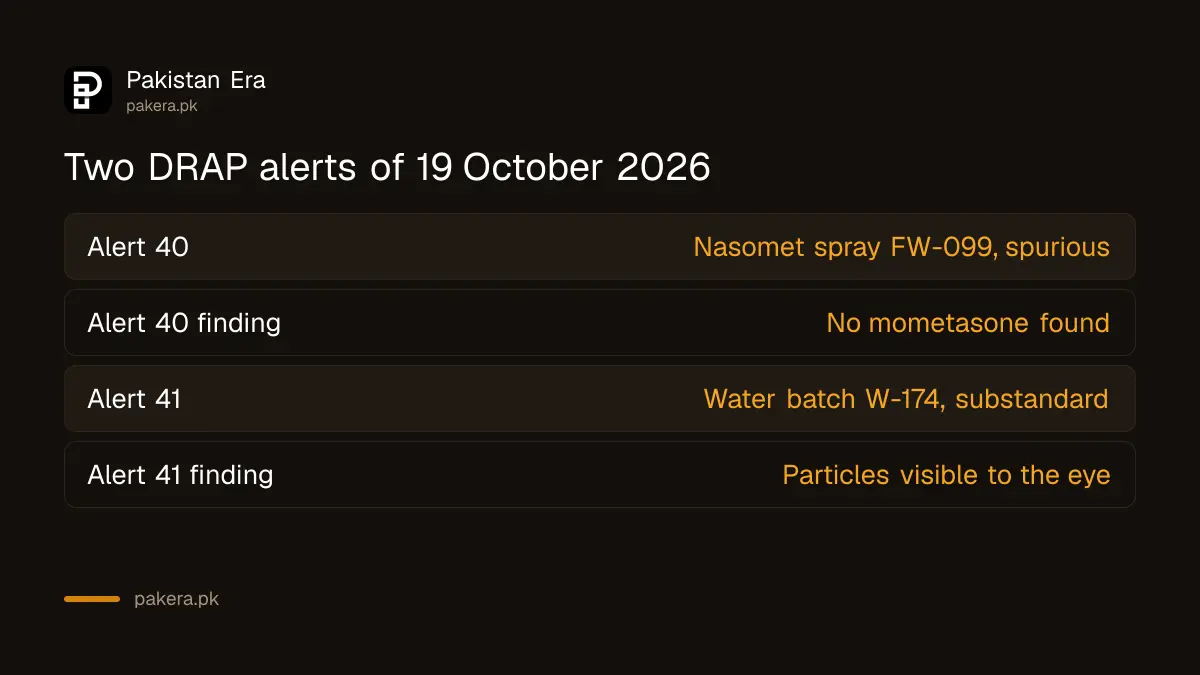
Two alerts from the Drug Regulatory Authority of Pakistan (DRAP) on 19 October 2026 show why the words matter. One called a nasal spray spurious. The other called a batch of water for injection substandard and adulterated. The advice to patients was the same, stop using it, but the problem behind each was different.
We read the definitions in the copy of the Drugs Act, 1976 that DRAP publishes on its website, and both alerts, on 20 October 2026. Here is what each word means and what it tells you to do.
Five legal words describe what went wrong with a medicine
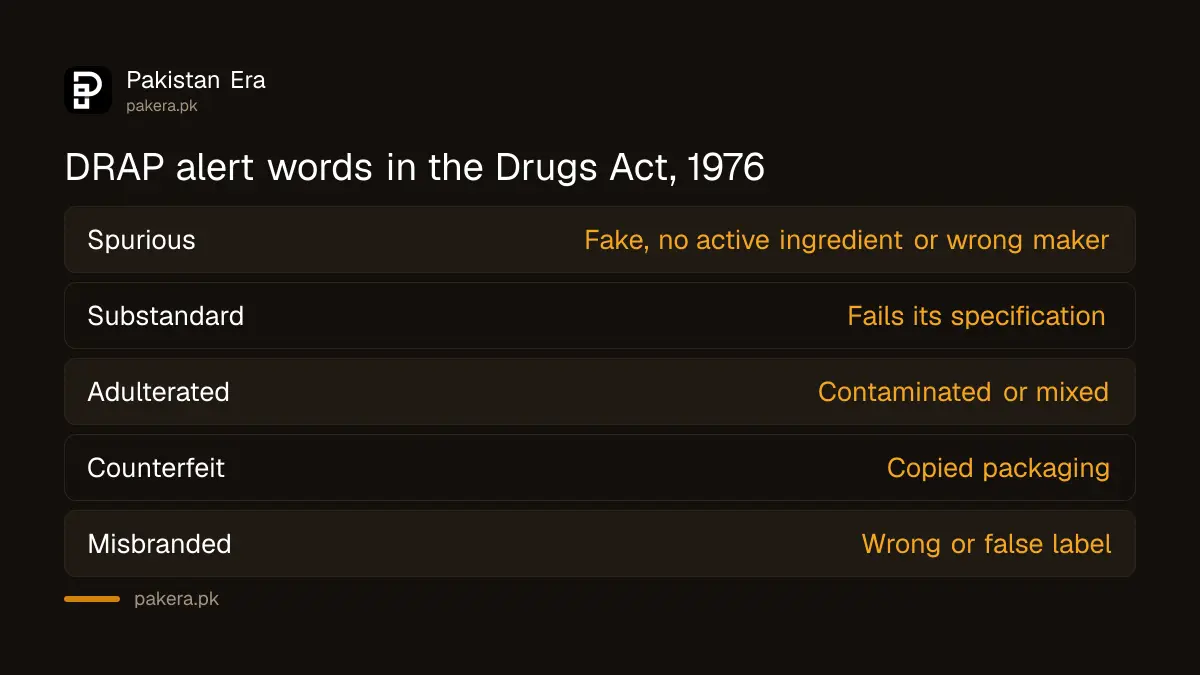
The Drugs Act, 1976 defines spurious, substandard, adulterated, counterfeit and misbranded drugs. Section 23 bans making, importing or selling any of them. DRAP alerts borrow these legal words, so a reader who knows them can tell at once whether a product is fake or a genuine batch that failed.
| Word in the alert | What the Drugs Act says, in plain words | Is the maker real? |
|---|---|---|
| Spurious | Has none of the active ingredient, or is not from the maker named, or is another drug sold under this name, or names a maker who does not exist | No, or the maker did not make it |
| Substandard | Does not meet its specification | Usually yes |
| Adulterated | Dirty, contaminated, made in unclean conditions, or mixed with something that lowers its quality | Usually yes |
| Counterfeit | Label or packing imitates another maker's, made to deceive | No |
| Misbranded | Not labelled as the rules require, or the label makes a false claim | Can be either |
DRAP often writes "spurious/falsified" together. Falsified is the international term for the same idea. The Act itself uses spurious.
Spurious means fake, even when the box looks real
The Act calls a drug spurious if it has none of its active ingredient, or claims a maker that did not make it, or is sold under one name while being another drug. A label naming a maker who does not exist also counts. A spurious product can look exactly like the real one.
DRAP's alert 40 of 19 October is a clear example. A lab in Karachi found no mometasone furoate in Nasomet nasal spray batch FW-099, and the company named on the label said the bottle was not theirs. That covers two parts of the definition at once. The full story is in our report on the fake Nasomet nasal spray.
The practical meaning for you: the real maker cannot vouch for anything in that pack. Stop using it and report it, even if you have used the brand for years.
Substandard and adulterated usually mean a real batch that failed
A substandard drug, in the Act's words, is one "not of specifications". It can be a genuine product from a licensed maker that failed a lab test, for example on strength or purity. Adulterated covers dirt, foreign matter, unclean manufacture, or a substance mixed in that lowers quality.
DRAP's alert 41, also of 19 October, used both words for water for injection batch W-174, packed with Exoran and Exit injections. The lab found particles visible to the eye. The maker is a licensed Karachi company, and the problem is with specific batches, not the brand. That recall is in our report on the W-174 water for injection recall.
For a substandard batch, the batch number is everything. Other batches of the same brand may be fine. For a spurious product, the batch number helps, but the main question is whether the pack is genuine at all.
Read the batch number, then the word, then the advice
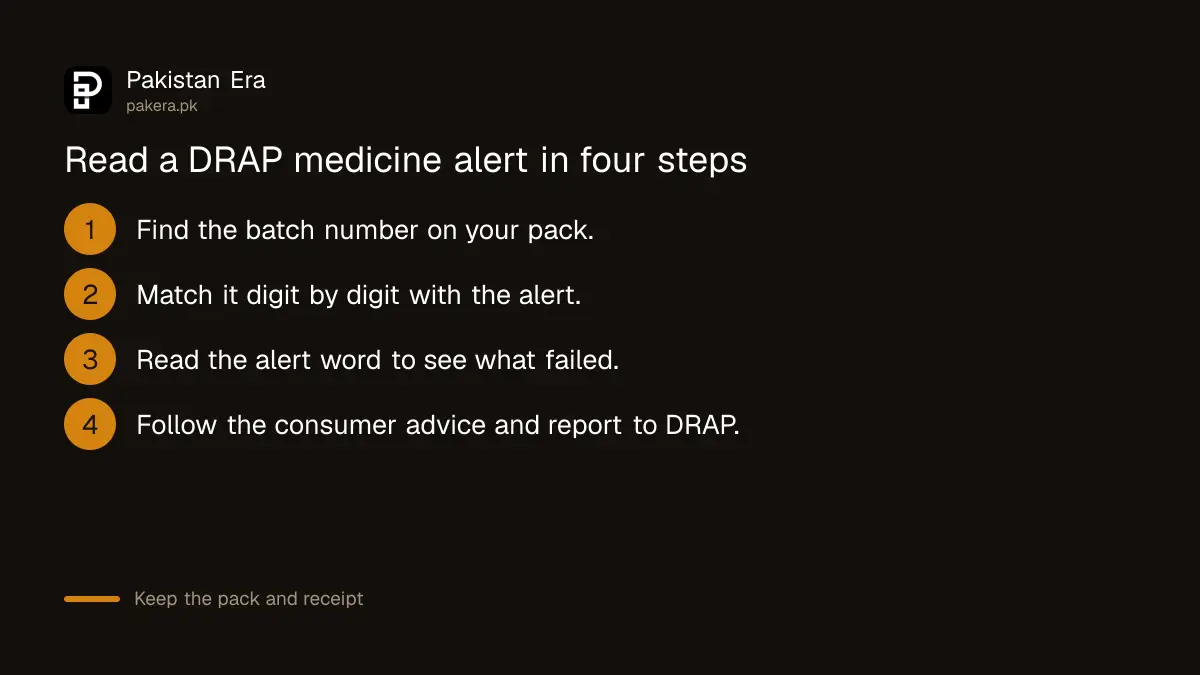
Every DRAP alert names products by batch number. Find the batch on your pack first. If it matches, read the word in the alert to understand the problem. Then follow the advice section for consumers, which usually says stop using it, see your doctor and report.
- Find the batch number on your box and on the strip, bottle or ampoule. The Act defines it as the number that lets a batch's production history be traced.
- Compare it with every batch listed in the alert, digit by digit.
- Read the alert's heading: spurious, substandard, adulterated or counterfeit.
- Read the "Advice for consumers" part. Do what it says, usually stop use and contact your doctor.
- Keep the pack and receipt. They help DRAP trace where it came from.
- Report the product, and any side effect, to DRAP.
Our step-by-step page on checking whether a batch has been recalled shows where DRAP's alert list sits on its website.
Selling any of these is banned under section 23
Section 23 of the Drugs Act bans exporting, importing, making for sale or selling any spurious, counterfeit, misbranded, adulterated or substandard drug. It also bans expired and unregistered drugs, and selling medicine on streets, in parks or on public transport.
That last point is useful. A medicine sold from a roadside stall or a bus is outside the law, whatever its label says. Buy from a licensed pharmacy, and if you suspect a fake, the steps are in our page on reporting counterfeit medicine to DRAP.
Common questions
What does spurious medicine mean in Pakistan?
A fake medicine. Under the Drugs Act, 1976 it lacks its active ingredient, or did not come from the maker named, or is a different drug sold under that name.
What is the difference between spurious and substandard medicine?
Spurious is fake. Substandard is usually a genuine product that failed its specification, such as strength or purity, in a lab test.
Is falsified the same as spurious?
Yes, in practice. DRAP alerts often write "spurious/falsified". Falsified is the international term, and the Drugs Act uses spurious.
If one batch is substandard, is the whole brand bad?
No. A substandard alert names specific batches. Other batches are not covered unless DRAP lists them.
What does adulterated mean in a DRAP alert?
The drug is dirty, contaminated, made in unclean conditions, or has something mixed in that lowers its quality.
Where can I read the Drugs Act, 1976?
DRAP publishes a copy on its website, dra.gov.pk. The definitions are in section 3 and the bans in section 23.
How we verified this
What we checked, where we read it, and what we could not confirm.
We read the Drugs Act, 1976 copy on dra.gov.pk, uploaded in October 2022, and DRAP's alert 40 and alert 41, on 20 October 2026. Penalties may have changed since that copy was uploaded, and we could not confirm the current amounts, so we have not quoted any.
About the author

Public Services and Education Journalist
Fajr Riaz is a journalist and content writer at Pakistan Era, based in Lahore. She covers the questions people meet in everyday life in Pakistan: how a public service works, what a change in the rules means, and where to find a reliable answer.