US Fed Raises Rate to 3.75 to 4 Percent: What It Means for Pakistan
The US Fed raised its rate to 3.75 to 4 percent on 16 September 2026. See what it means for the dollar, remittances, loans and SBP, and the next date to watch.
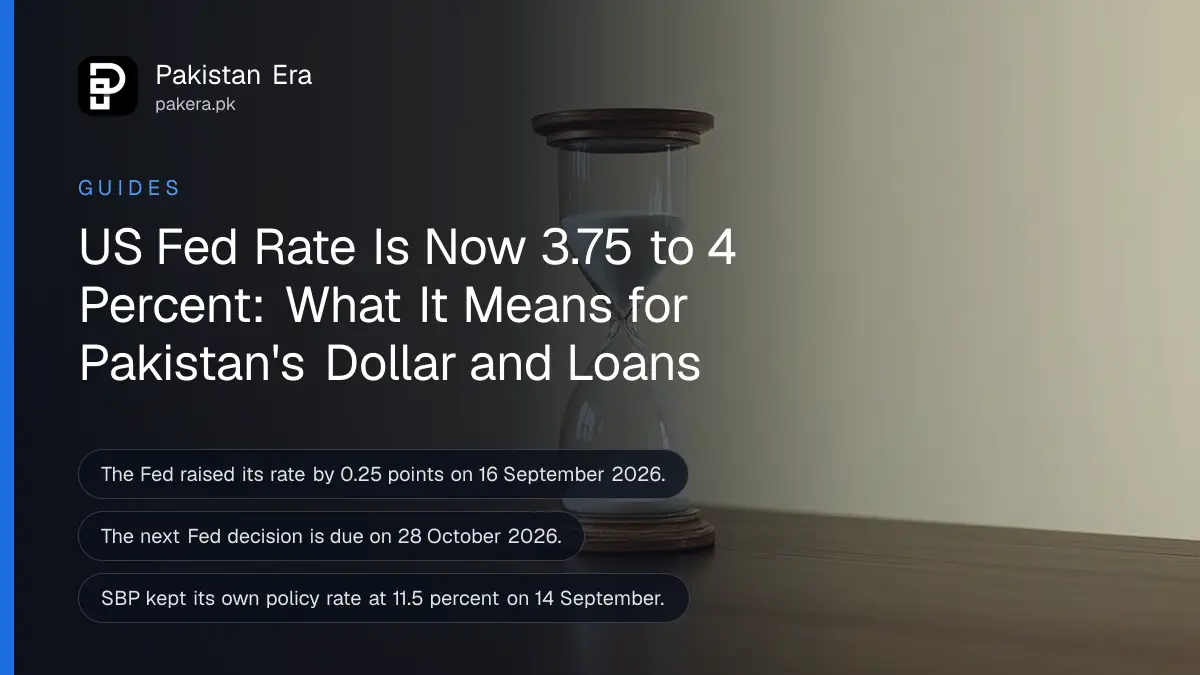
The US Federal Reserve raised its policy rate by 0.25 points to a range of 3.75 to 4 percent on 16 September 2026, and it meets again on 27 and 28 October. For Pakistan the effect is indirect: a stronger dollar and costlier foreign loans, not a change in your bank rate.
The Fed is the central bank of the United States. Its rate sets the price of dollar money worldwide. We read the Fed's own statement and calendar, and the Finance Division's September 2026 economic update, on 21 October 2026.
The Fed raised its rate by 0.25 points on 16 September
The Federal Open Market Committee voted 12 to 0 to lift the target range to 3.75 to 4 percent. Its statement says inflation "remains elevated" and that the raise will support a timelier return to 2 percent. The Finance Division calls it the first increase since 2023.
The statement also says economic activity is growing at a solid pace and that uncertainty is high, partly because of geopolitical developments. Those are the Fed's words, and we add no reading of our own on why it moved.
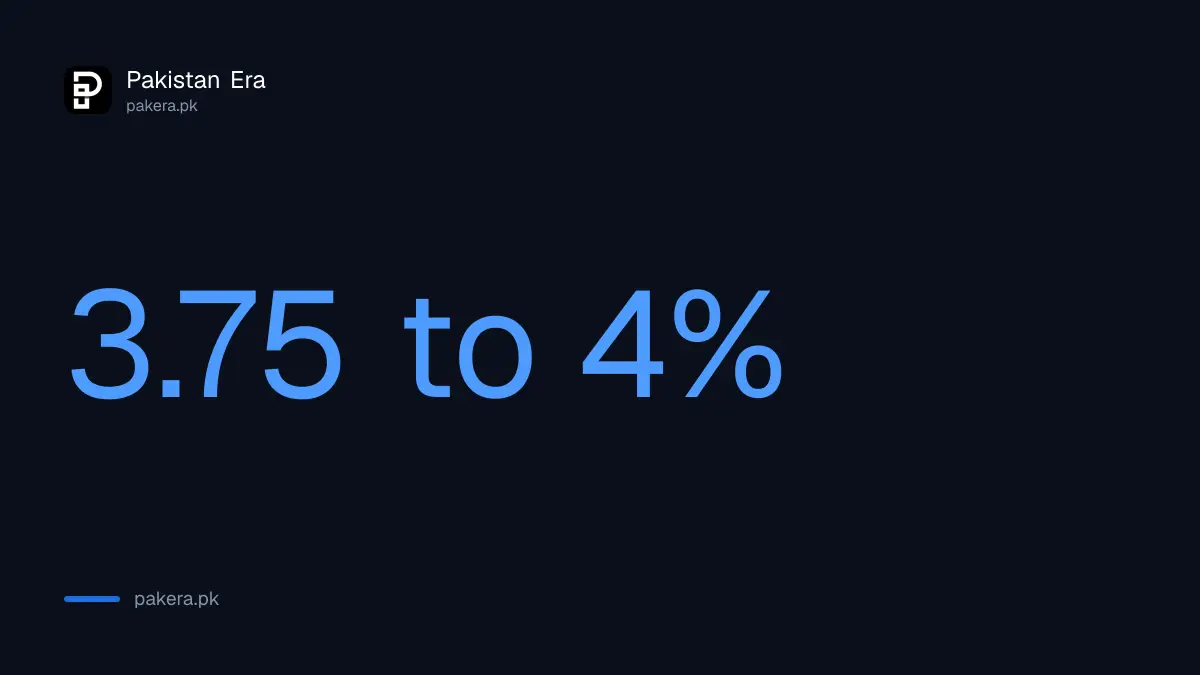
Pakistan's policy rate is still 7.5 points above the Fed's
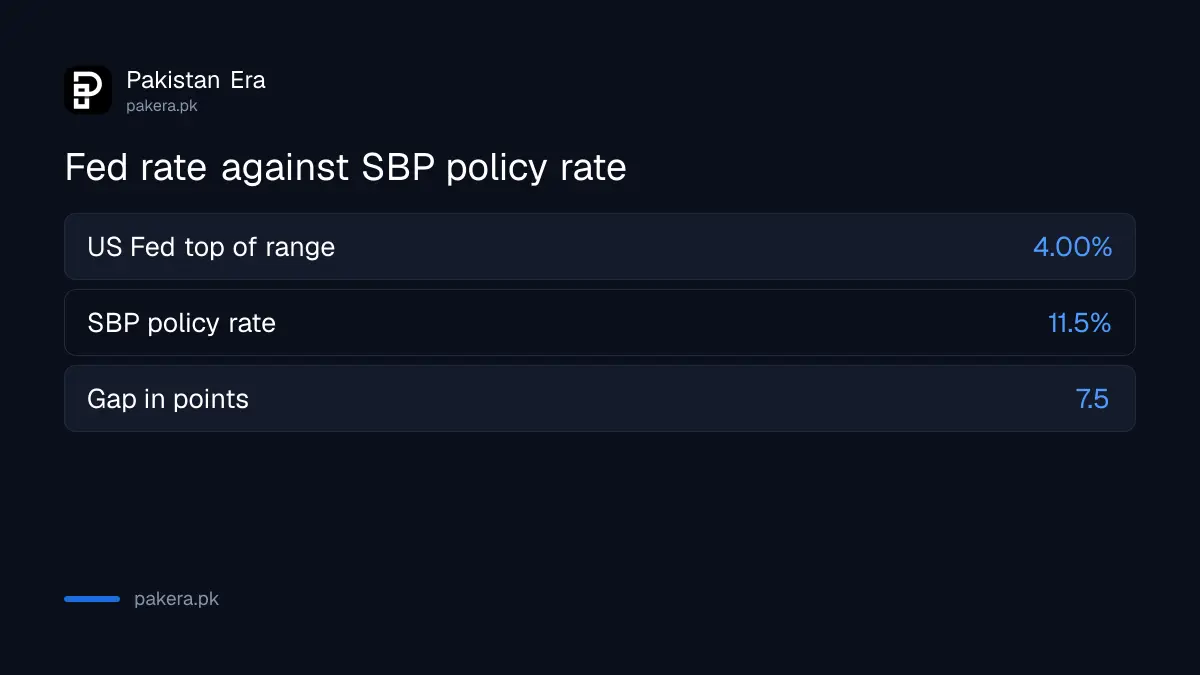
The State Bank of Pakistan kept its policy rate at 11.5 percent on 14 September, two days before the Fed. The gap to the Fed's top rate of 4 percent is 7.5 points, our arithmetic. A wide gap is part of what keeps Pakistani rupee savings attractive.
| Item | Figure | Date | Source |
|---|---|---|---|
| US Fed target range | 3.75 to 4 percent | 16 September 2026 | Federal Reserve |
| SBP policy rate | 11.5 percent | 14 September 2026 | Finance Division update |
| Rupee per US dollar | 277.1 | 29 September 2026 | SBP, via Finance Division |
| SBP liquid reserves | US$ 21.39 billion | 18 September 2026 | SBP, via Finance Division |
Three of ten SBP members wanted a higher rate that day. Our report on the SBP minutes and the three votes to raise has the detail.
A higher US rate usually means a stronger dollar and costlier loans abroad
The Finance Division says higher US rates point to a stronger dollar and costlier financing for emerging markets. That matters when Pakistan borrows abroad. It also raises the cost of any dollar loan that carries a floating rate.
Pakistan sold US$ 3.0 billion of Eurobonds in September, according to the same update. Those bonds pay fixed coupons, so this raise does not change what they cost. The coupons and dates are in our list of Pakistan's Eurobonds. A new borrowing would be priced at the new, higher level.
Remittance senders and importers feel it through the dollar
If the dollar gets stronger, a worker abroad can send fewer dollars for the same rupee need. An importer pays more rupees for each dollar. No official source gives a number for this link, so we do not forecast one.
What we can say is where things stood. The rupee was 277.1 to the dollar on 29 September, against 281.4 a year earlier. Remittances were running well above last year, as our September remittances report shows. The Finance Division says reserve buffers built over the past year are the main protection.
The Fed move does not change your rupee loan or savings rate
Your rupee bank loan and your savings profit follow the SBP policy rate and your bank's own pricing, not the Fed. The Fed rate matters only when money crosses the border: dollar loans, foreign investors choosing between markets, and the dollar's value against the rupee.
Foreign investors are one example. When US rates rise, some investors move money back to the United States. The Finance Division says portfolio investment returned to a net inflow in July and August 2026 at US$ 67.7 million, so that did not happen in the data we read, but the risk is why the update stresses the reserve buffers.
SBP's own decision is separate. The central bank meets on its own calendar, and our page on the SBP policy rate and interest rate corridor explains how its rate reaches bank loans and deposits.
Check these four things before the next decision on 28 October
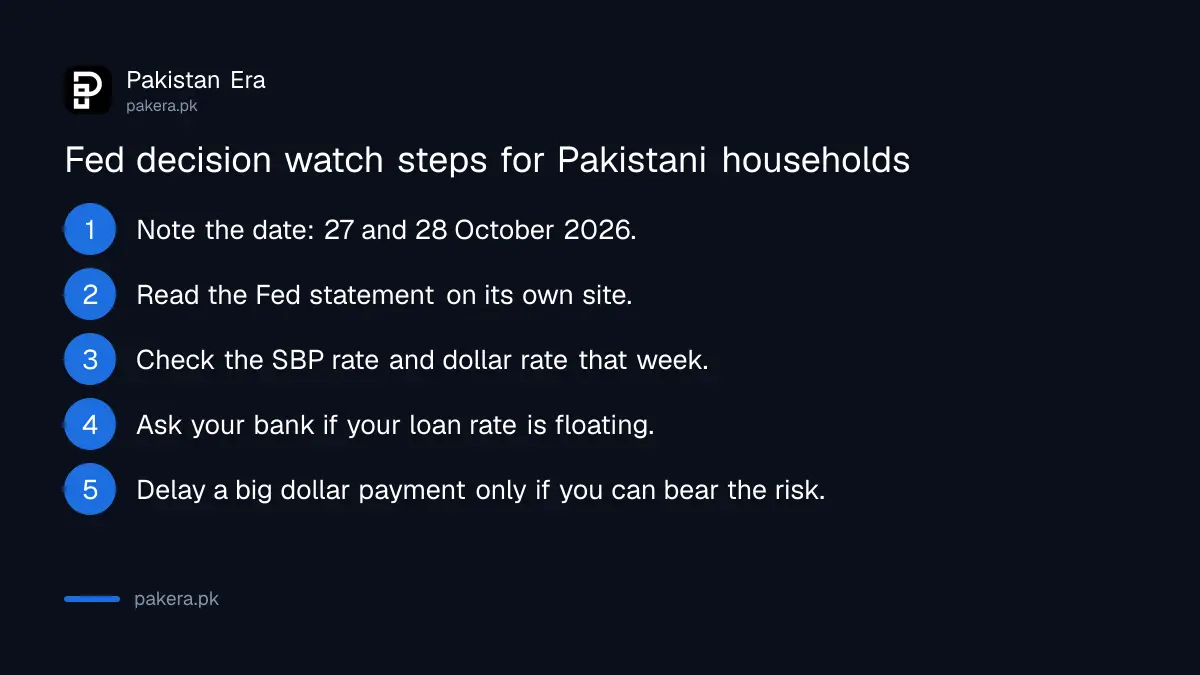
The Fed meets on 27 and 28 October, then 8 and 9 December. The decision comes out on the second day. We cannot tell you the outcome. Here is what a household or small business can check in advance.
- Look at your loan agreement and see whether the rate is fixed or floating.
- Note the interbank dollar rate on the day before the decision, so you can compare after.
- Ask your exchange company or bank for its customer rate, and compare it with the SBP rate.
- If you must pay in dollars soon, do not wait for a better rate unless you can afford a worse one.
Forward dollar rates also reflect rate differences, and our page on how to check SBP forward dollar rates shows where to read them.
Common questions
Did the Fed raise rates in September 2026?
Yes. On 16 September 2026 it raised the target range by 0.25 points to 3.75 to 4 percent, by a 12 to 0 vote.
When is the next Fed meeting?
The next meeting is on 27 and 28 October 2026, and the one after is on 8 and 9 December, according to the Fed's calendar.
Does the Fed rate change my bank loan in Pakistan?
Not directly. Rupee loans follow SBP's policy rate, which was 11.5 percent on 14 September. Only dollar loans with floating rates follow US rates.
Will the dollar get more expensive in rupees?
Nobody can say for sure. The Finance Division expects a stronger dollar globally, but the rupee was 277.1 on 29 September, stronger than a year earlier.
Does this hurt remittances to Pakistan?
No official figure links the two. Remittances were up 14.0 percent in July to September, per SBP's 9 October release.
How we verified this
What we checked, where we read it, and what we could not confirm.
On 21 October 2026 we read the Federal Reserve statement of 16 September 2026, the Fed meeting calendar and the Finance Division's September 2026 Monthly Economic Update and Outlook. We could not verify how far the Fed move changes the rupee, because no official source quantifies it. The 28 October decision has not happened yet.
About the author

Global Affairs & Political Economy Writer
Muhammad Hatim is a book lover who started writing because he enjoys it. At Pakistan Era he writes about international relations, geopolitics and the global economy, with a particular interest in South Asia and the forces behind current events.