How to Check the SBP Policy Rate, Rate Corridor and Overnight Repo Rate in Pakistan
SBP's policy rate is 11.50% with a 10.50% floor and 12.50% ceiling, and the overnight repo rate was 11.56%. See where to check each one and the next meeting.
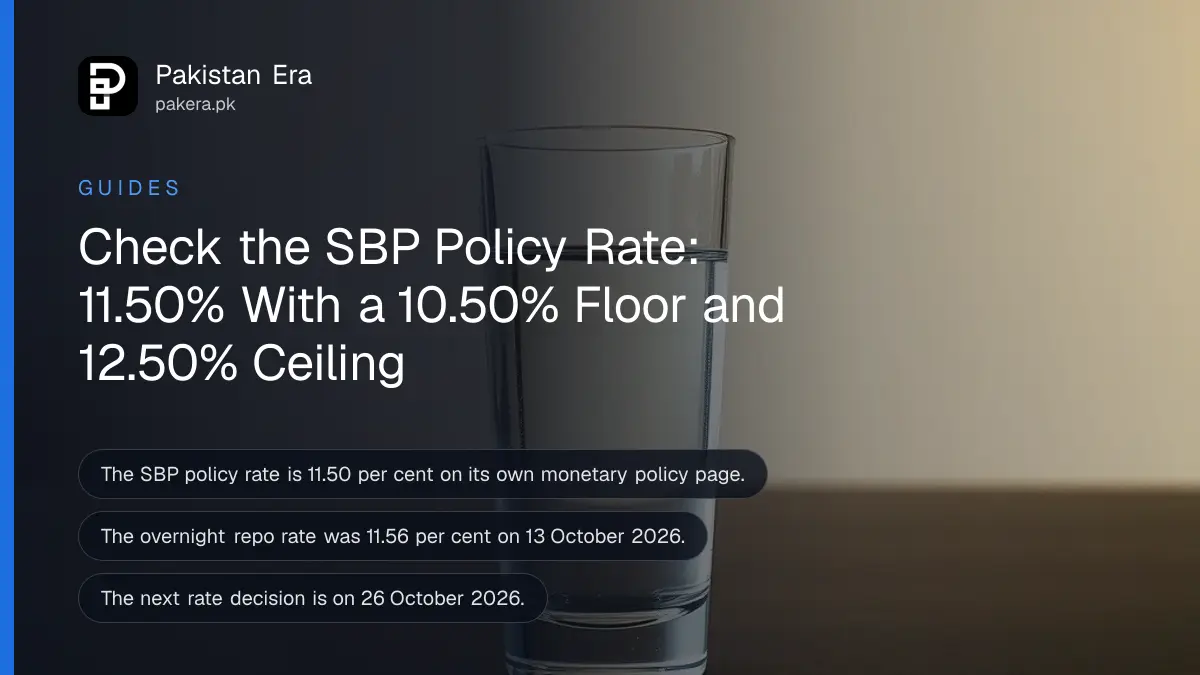
Short answer: The State Bank of Pakistan (SBP) policy rate is 11.50 per cent on its monetary policy page, which we opened on 15 October 2026. The corridor around it runs from a floor of 10.50 per cent to a ceiling of 12.50 per cent. The next rate decision is on 26 October 2026.
If you have a bank loan, a savings account or a treasury bill, one number sits behind your rate. It is the SBP policy rate. You do not need a news report to find it. SBP prints it at the top of its own page, along with the two rates on either side of it.
The policy rate is 11.50 per cent and sits in a 10.50 to 12.50 corridor
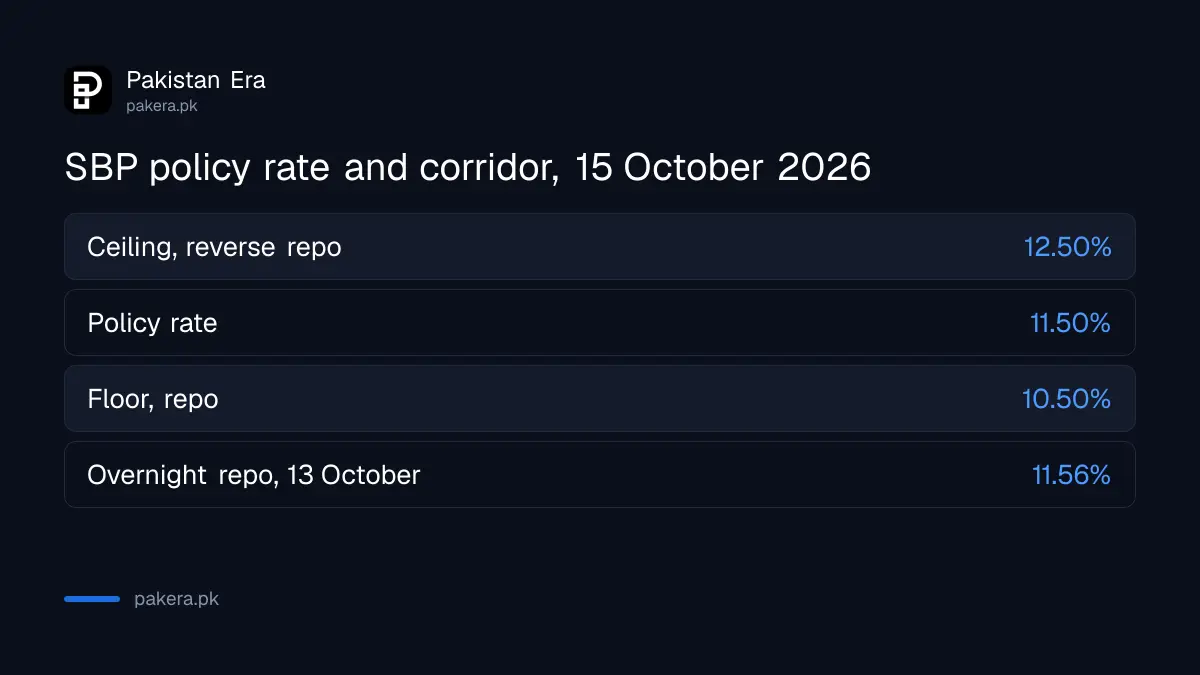
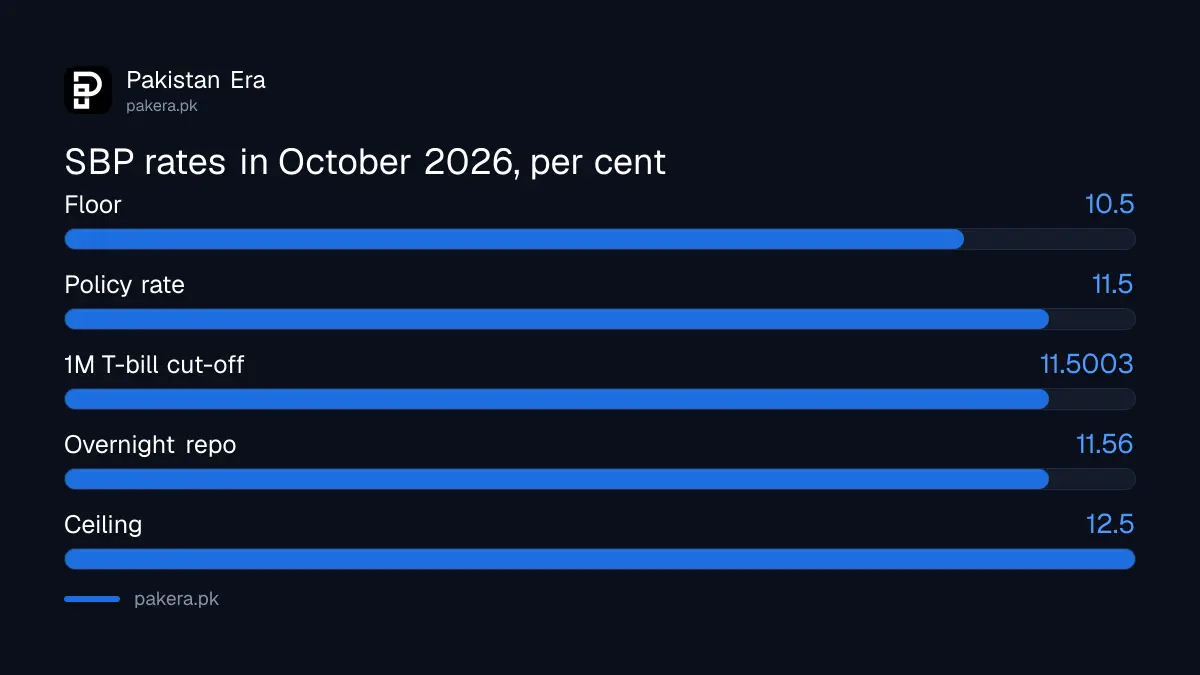
SBP's monetary policy page lists three rates: the policy rate at 11.50 per cent, the overnight reverse repo rate, called the ceiling, at 12.50 per cent, and the overnight repo rate, called the floor, at 10.50 per cent. The ceiling and floor are one percentage point either side.
| Rate | What it is | Value on 15 October 2026 |
|---|---|---|
| Policy rate | SBP's target for the overnight market rate | 11.50% |
| Ceiling (reverse repo) | The most banks pay when they borrow from SBP overnight | 12.50% |
| Floor (repo) | The least banks earn when they lend to SBP overnight | 10.50% |
The wording of the middle column is ours. SBP says the policy rate is set within an interest rate corridor, and that it aims to keep the overnight market rate close to the policy rate. Banks that are short of cash borrow at or below the ceiling. Banks with spare cash earn at least the floor.
The overnight repo rate was 11.56 per cent on 13 October
The policy rate is a target. The rate banks actually trade at is the weighted average overnight repo rate, which SBP publishes each day. Its latest report, as on 13 October 2026, shows 11.56 per cent, which is 6 basis points above the policy rate and well inside the corridor.
A basis point is one hundredth of a percentage point. A gap of 6 basis points tells you the market is close to SBP's target. A rate pushing against the 12.50 ceiling would mean banks are short of cash. Our report on the SBP cash injection of 9 October shows one way SBP manages that.
The one-month T-bill cut-off from SBP's 14 October auction was 11.5003 per cent, almost the same as the policy rate. The result is in our T-bill auction report.
Where to read each rate on SBP's own site
Three pages on sbp.org.pk give you everything. The monetary policy page shows the policy rate, ceiling and floor. The Economic Data page lists the daily overnight repo rate report. A third file there holds the history of the corridor.
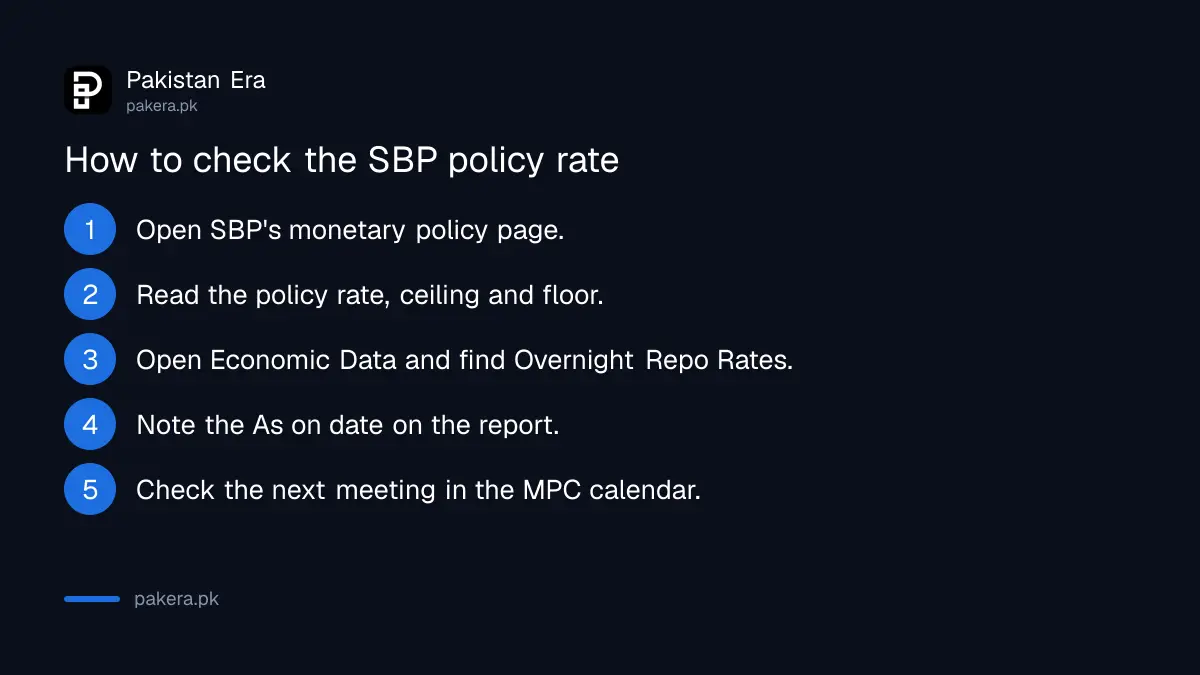
- Open SBP's monetary policy page and read the three rates under "SBP Policy Rate".
- Open SBP's Economic Data page and find "Overnight Repo Rates" to read the latest daily report.
- Note the "As on" date on that report. It is usually a day or two old.
- On the same Economic Data page, open "Interests Rate Corridor of SBP- History" to see when the rates last changed.
- Look at the calendar of Monetary Policy Committee meetings on the monetary policy page to see the next decision date.
The next decision is on 26 October and the minutes follow on 20 November
SBP's advance calendar for the 2026-27 year lists the next Monetary Policy Committee meeting on 26 October 2026. The statement comes the same day, the analyst briefing on 27 October and the minutes on 20 November. After that the dates are 14 December, 25 January and 8 March.
| Meeting date | Statement | Minutes published |
|---|---|---|
| 26 October 2026 | 26 October 2026 | 20 November 2026 |
| 14 December 2026 | 14 December 2026 | 8 January 2027 |
| 25 January 2027 | 25 January 2027 | 19 February 2027 |
| 8 March 2027 | 8 March 2027 | 2 April 2027 |
SBP adds that a new date will be announced if something unforeseen happens on a meeting day. We explain what to watch in the next SBP rate meeting report.
What the policy rate does to your loan and savings
The policy rate moves short-term rates first. SBP says those changes then pass on to longer rates such as KIBOR, the benchmark banks use to price loans to businesses and households. A loan priced at KIBOR plus a margin will follow, though not on the day of the decision.
SBP also warns that the full effect on inflation can take 6 to 8 quarters, or one to two years. So a rate decision is not a quick fix for prices. For the loan side, see how the SBP rate affects loan instalments, and for today's benchmark see the KIBOR rate.
Common questions about the SBP policy rate
What is the SBP policy rate today?
The policy rate is 11.50 per cent on SBP's monetary policy page, which we opened on 15 October 2026.
What are the ceiling and floor rates?
The ceiling, the overnight reverse repo rate, is 12.50 per cent. The floor, the overnight repo rate, is 10.50 per cent.
What is the overnight repo rate?
It is the volume-weighted average of all overnight money market repo deals. SBP's latest report, as on 13 October 2026, shows 11.56 per cent.
When is the next SBP rate decision?
The next Monetary Policy Committee meeting is on 26 October 2026, per SBP's calendar. The statement comes out the same day.
Does a rate cut lower my loan instalment straight away?
Not always. SBP says rate changes pass on to KIBOR and then to lending rates. Your bank's reset date and loan terms decide when your instalment changes.
Where do I see the minutes of the meeting?
SBP publishes minutes in the fourth week after each meeting. For the 26 October meeting, the calendar says 20 November 2026.
How we verified this
What we checked, where we read it, and what we could not confirm.
Last checked 15 October 2026. The policy rate, ceiling, floor, meeting calendar and the notes on how SBP works come from SBP's monetary policy page, which we opened on 15 October 2026. The 11.56 per cent figure comes from SBP's daily overnight repo rate report as on 13 October 2026, listed on its Economic Data page. The T-bill figure comes from SBP's 14 October auction result. The 6 basis point gap and the plain-language column in the first table are our own. SBP can change dates, so check the page before you plan around them.
About the author

Global Affairs & Political Economy Writer
Muhammad Hatim is a book lover who started writing because he enjoys it. At Pakistan Era he writes about international relations, geopolitics and the global economy, with a particular interest in South Asia and the forces behind current events.