Vehicle Smoke, CO and Noise Limits in Punjab: Pass the EPA Test at 40% Smoke, 6% CO and 85 dB
Punjab's vehicle limits: smoke 40 percent or Ringelmann 2, carbon monoxide 6 percent at idle, noise 85 dB at 7.5 metres. How each test works and how to check.
Short answer: A vehicle on Punjab's roads fails the legal test if its smoke is darker than 40 per cent, or 2 on the Ringelmann scale, when the engine is revved. Carbon monoxide at idle must stay under 6 per cent, and noise under 85 decibels measured 7.5 metres away.
Those three limits come from the Punjab Environmental Quality Standards for Motor Vehicle Exhaust and Noise, notified in August 2016. They are what an EPA or traffic officer checks your car, bus, rickshaw or motorcycle against in every smog season crackdown.
Below are the limits in full, how each test is done, and how to check your own vehicle before an officer does.
Three limits apply to every vehicle already on the road
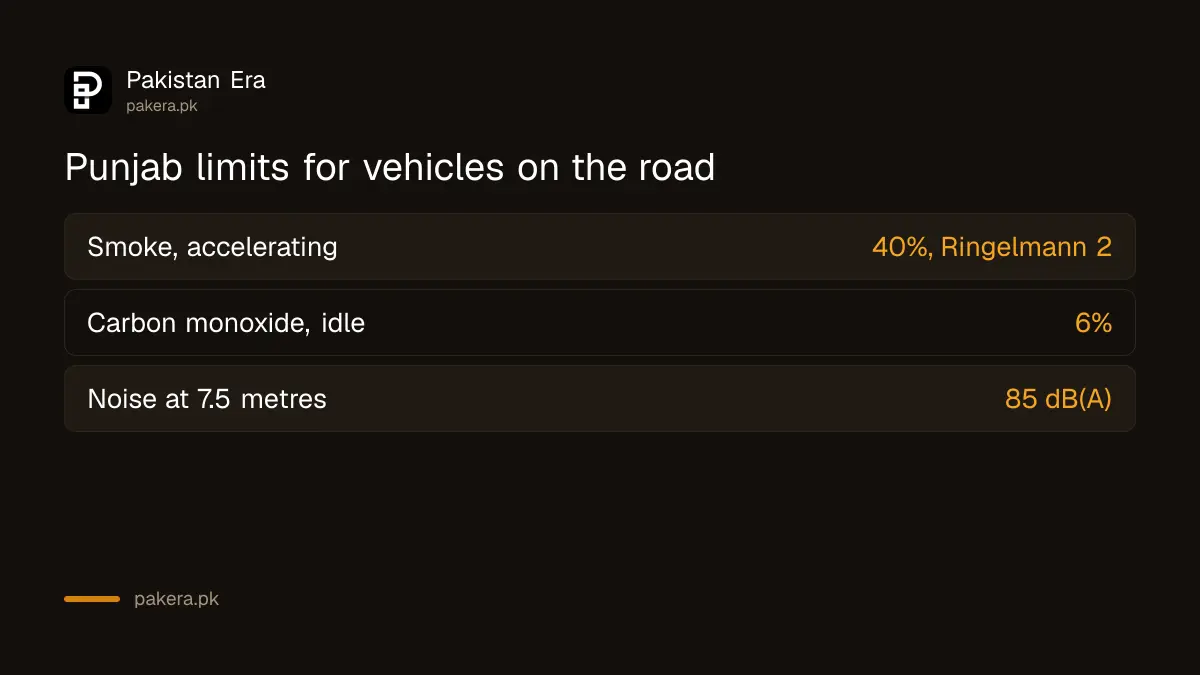
For in-use vehicles, Punjab's standard sets three limits: smoke at 40 per cent or 2 on the Ringelmann scale while accelerating, carbon monoxide at 6 per cent at idle, and noise at 85 dB(A). All three took effect immediately in 2016.
| Test | Legal limit | How it is measured |
|---|---|---|
| Smoke | 40 per cent, or 2 on the Ringelmann scale | Exhaust compared with a Ringelmann chart from 6 metres or more, engine accelerating |
| Carbon monoxide | 6 per cent | Gas analyser in the exhaust, engine idling |
| Noise | 85 dB(A) | Sound meter 7.5 metres from the vehicle |
The Ringelmann scale is a card of grey shades, from 0 for clear to 5 for black. An officer holds it up and matches your exhaust to a shade. Shade 2 means 40 per cent dark. Anything darker fails.
How each roadside test works
The smoke test is done by eye with the chart. The officer stands at least 6 metres from the exhaust and asks the driver to press the accelerator. Puffs of dark grey or black smoke under load are what usually fail.
The carbon monoxide test needs a gas analyser. A probe goes into the tailpipe while the engine idles, and the machine shows the share of CO in the gas. A badly tuned petrol engine or a choked air filter can push this over 6 per cent.
The noise test uses a sound meter 7.5 metres away. Pressure horns and broken or altered silencers are the usual reasons for failing. What happens after a failed test, including the direction slip, the seven day repair window and the daily penalty, is set out in the EPA smoke direction slip rules.
Check your own vehicle before the smog season stops you
You can spot most failures yourself in five minutes. Do these checks on a cold start and again after a short drive, in daylight, with a second person watching the exhaust.
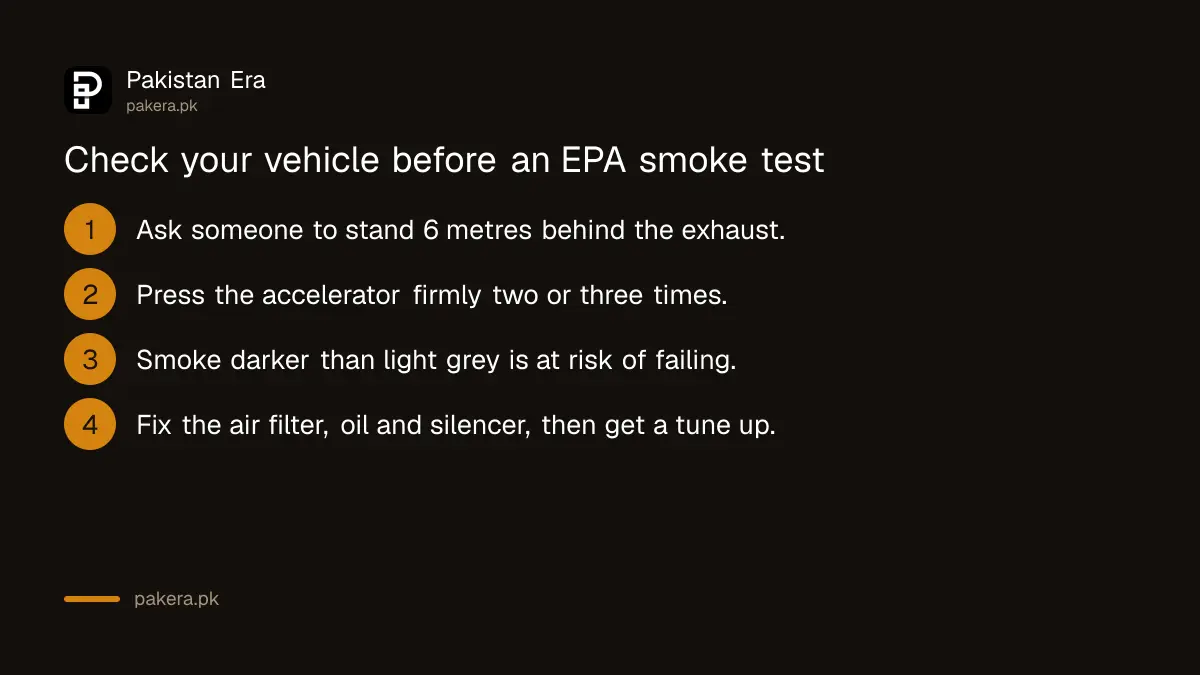
- Start the engine and ask someone to stand 6 metres behind the vehicle.
- Press the accelerator firmly two or three times. If the smoke is darker than light grey, the vehicle is at risk of failing.
- Listen to the exhaust at idle. A blowing or rattling sound points to a damaged silencer.
- Check the air filter and the engine oil level. A dirty filter or old oil can raise smoke and carbon monoxide.
- Get a tune up and an emission test at a certified workshop or lab if anything looks wrong.
Labs certified by Punjab EPA are listed in the EPA Punjab certified lab list. Use one of those if you need a written result.
New vehicles must meet Pak-II emission standards
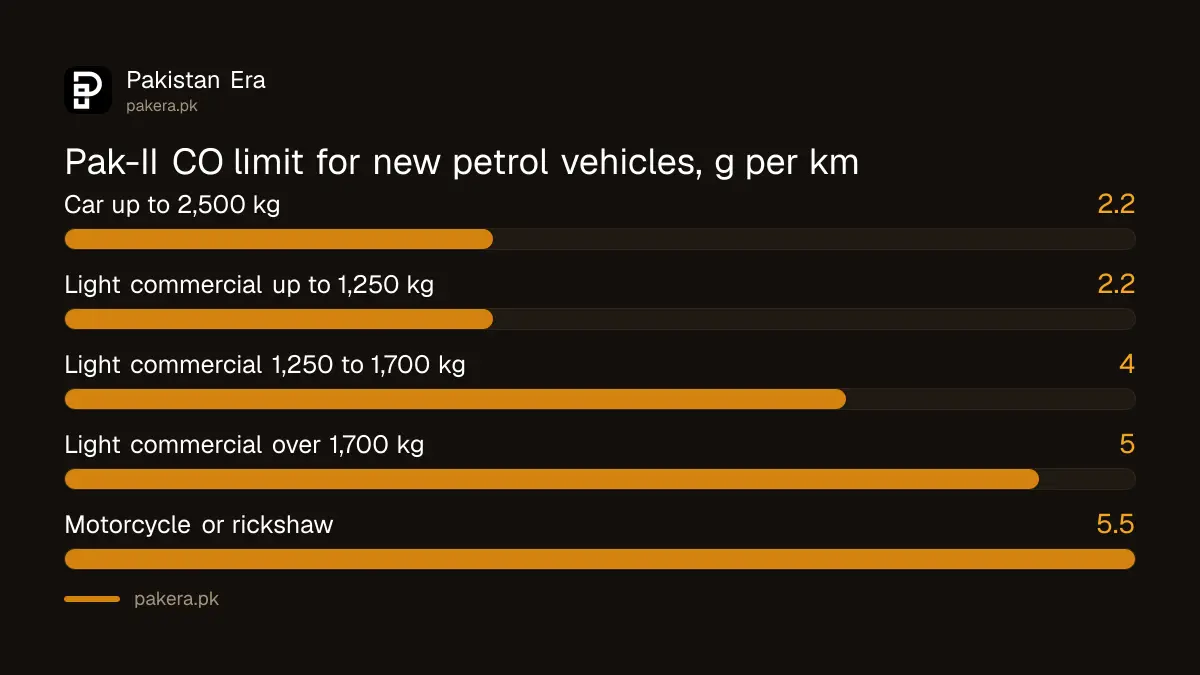
The same notification sets Pak-II limits for new vehicles, measured in grams per kilometre on a test cycle. They apply to imported and locally made vehicles, not to roadside checks. Petrol vehicles have applied them since 1 July 2009 and diesel vehicles since 1 July 2012.
| New vehicle | Carbon monoxide | Hydrocarbons plus NOx |
|---|---|---|
| Petrol car up to 2,500 kg | 2.20 g/km | 0.5 g/km |
| Petrol motorcycle or rickshaw under 150cc | 5.5 g/km | 1.5 g/km |
| Petrol motorcycle or rickshaw over 150cc | 5.5 g/km | 1.3 g/km |
| Diesel car up to 2,500 kg, indirect injection | 1.0 g/km | 0.7 g/km |
| Diesel car up to 2,500 kg, direct injection | 1.0 g/km | 0.9 g/km |
Diesel cars also have a particulate limit: 0.08 grams per kilometre for indirect injection and 0.10 for direct injection. Heavy diesel trucks and buses are tested per kilowatt hour instead, with a carbon monoxide limit of 4.0 and a particulate limit of 0.15. New vehicles of every type must also stay under 85 dB(A).
Where the smoke limit matters most in winter
Heavy vehicles, old buses, loader rickshaws and tractor trolleys are the usual targets of winter checks. Punjab EPA's pre-smog plan for 2026 named smoky heavy vehicles among its targets, as covered in the 32 actions in the pre-smog plan.
If you see a vehicle pouring black smoke, you can report it on the Green Punjab app or call Punjab EPA's helpline, 1373. Note the vehicle number, place and time.
Common questions
What is the smoke limit for vehicles in Punjab?
40 per cent, or 2 on the Ringelmann scale, checked while the engine accelerates, from at least 6 metres away.
What is the carbon monoxide limit for an old car?
6 per cent at idle, measured with a gas analyser in the exhaust.
What is the noise limit for vehicles in Punjab?
85 dB(A), measured with a sound meter 7.5 metres from the vehicle. It applies to old and new vehicles.
Do the Pak-II limits apply at a roadside check?
No. Pak-II limits are for new vehicles on a test cycle. Roadside checks use the smoke, carbon monoxide and noise limits.
Which law sets these limits?
The Punjab Environmental Quality Standards for Motor Vehicle Exhaust and Noise, notified under the Punjab Environmental Protection Act, 1997, in August 2016.
How we verified this
What we checked and where we read it.
We read the Punjab Environmental Quality Standards for Motor Vehicle Exhaust and Noise, Notification No. SO(G)/EPD/7-26/2013 dated 5 August 2016, in the Punjab Gazette (Extraordinary) of 15 August 2016, pages 1202 to 1205, on 15 November 2026. The PDF is linked as "Motor Vehicle Exhaust and Noise" from the Environment Protection Department's standards page. The self check steps are general vehicle care, not part of the notification. The Ringelmann shade description is the standard meaning of the scale. Helpline 1373 is from epd.punjab.gov.pk.
About the author

Global Affairs & Political Economy Writer
Muhammad Hatim is a book lover who started writing because he enjoys it. At Pakistan Era he writes about international relations, geopolitics and the global economy, with a particular interest in South Asia and the forces behind current events.