Weak Mobile Signal at Home in Pakistan: Legal Fixes, the Booster Ban and How to Complain
Fix weak mobile signal or dropped calls at home in Pakistan. Try free Wi-Fi calling and phone checks, avoid illegal boosters and complain to your network.
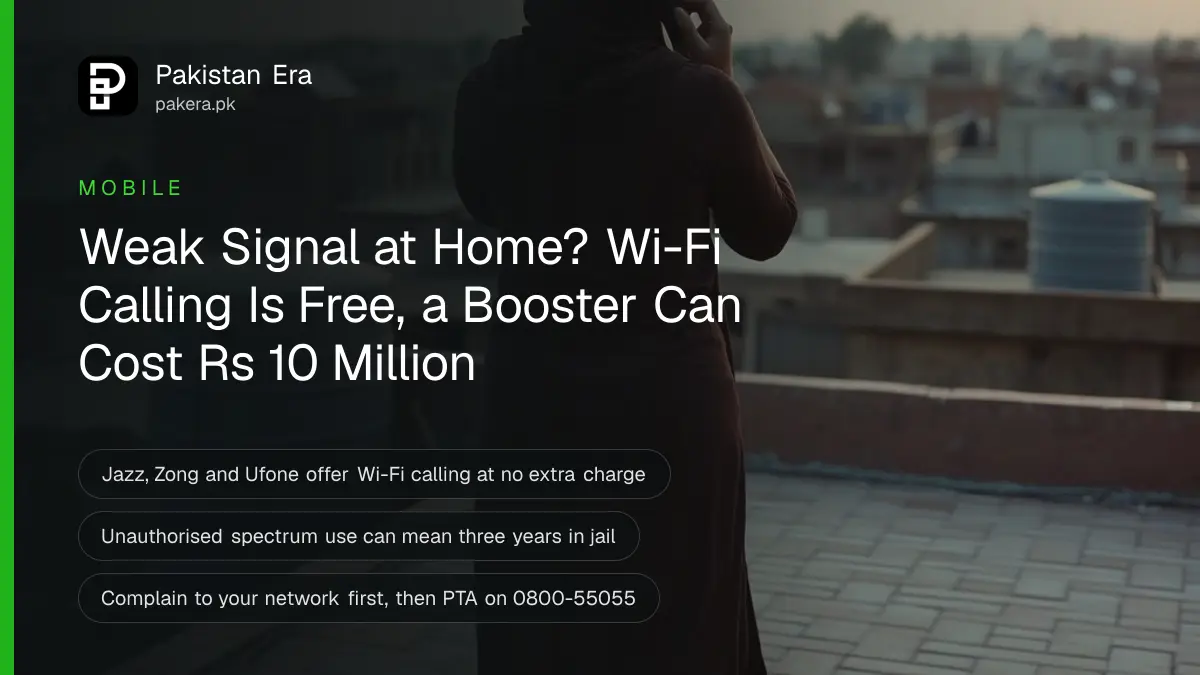
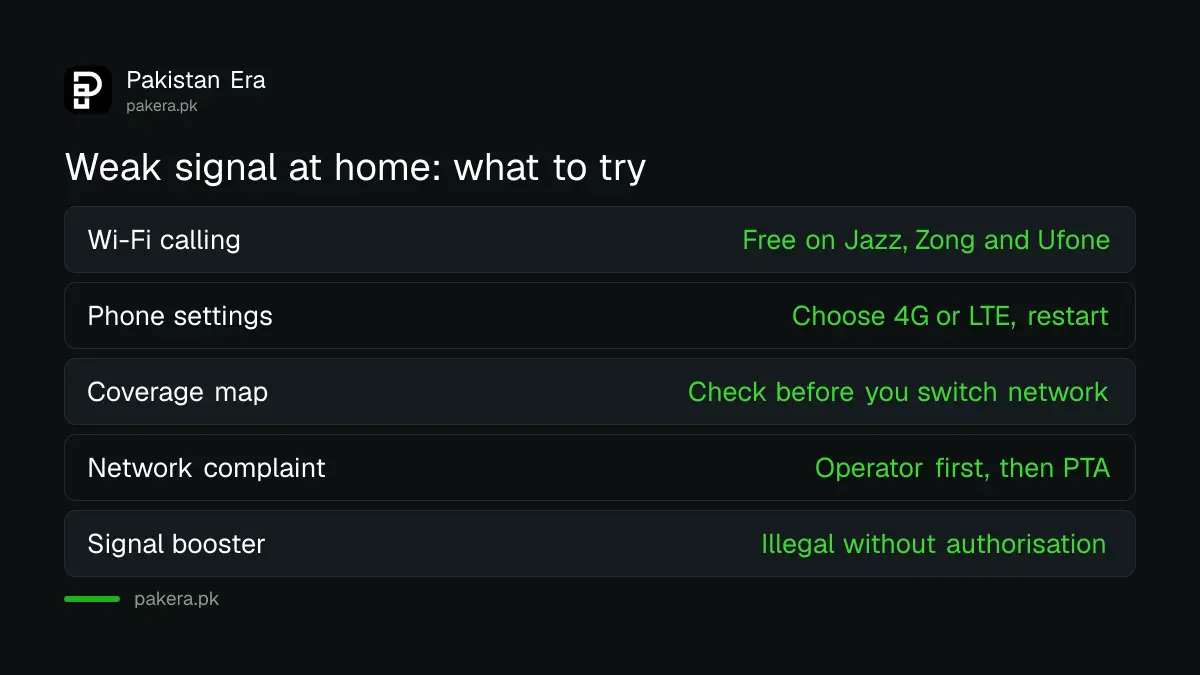
No signal or dropped calls at home in Pakistan? Turn on Wi-Fi calling, which Jazz, Zong and Ufone offer at no extra charge, check your network's coverage map, and file a network complaint with your operator. Do not buy a signal booster: using radio spectrum without permission is an offence under section 31 of Pakistan's telecom law, with up to three years in jail or a Rs 10 million fine.
Most families know the spot. Calls work by the gate or on the roof and die in the back room. Some people put up with it for years. Others buy a cheap booster from a market stall, which can make the network worse for the whole street and puts them on the wrong side of the law. We read the operators' own pages, PTA's latest city survey and the telecom law itself on 9 October 2026 to set out what actually works.
Wi-Fi calling fixes most indoor signal problems
If your home has Wi-Fi, your phone can make normal calls over it on your own number. Jazz, Zong and Ufone offer Wi-Fi calling at no extra charge. On Ufone, dial *9921# first, then switch Wi-Fi Calling on in your phone's settings.
Wi-Fi calling is not a WhatsApp call. The person you call needs nothing special, and it reaches any mobile or landline. It works best with a steady home connection, so the router's position matters. The steps to turn on Wi-Fi calling on Jazz, Zong and Ufone cover each phone brand.
VoLTE helps too. Jazz says that without VoLTE, a phone on 4G drops back to 2G or 3G for a voice call. With VoLTE, the call stays on 4G. In a house with weak 2G but usable 4G, that can be the difference between a call that connects and one that does not.
And if you have no home internet at all, these fixes do not help. Go to the next sections.
Quick checks on your phone before you complain
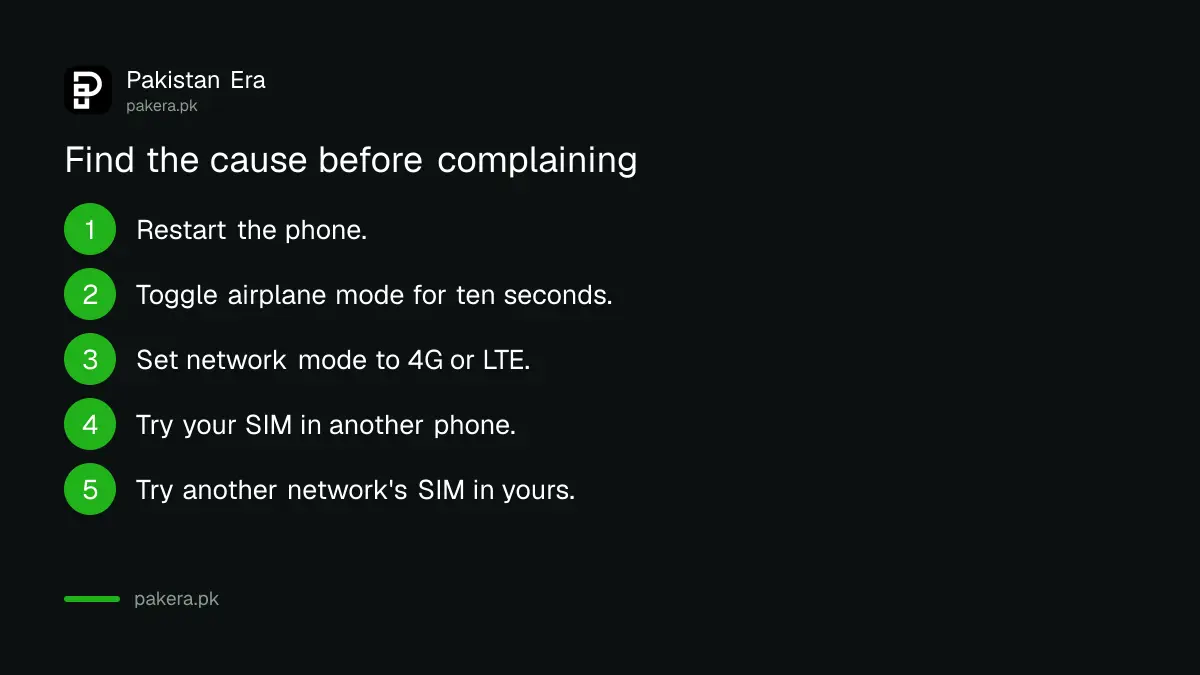
Rule out the phone before blaming the tower. Restart it, switch airplane mode on and off, set the network mode to 4G or LTE, and try the SIM in another phone. If the other phone works in the same room, the problem is your handset.
- Restart the phone. It forces a fresh search for the nearest tower.
- Turn airplane mode on for ten seconds, then off.
- In mobile network settings, choose 4G, LTE or 5G, not 2G only.
- On a dual SIM phone, move the main SIM to the first slot and test again.
- Put your SIM in a family member's phone in the same room. If it works there, your phone is the problem.
- Try a different network's SIM in your phone. If that works, your network is the problem.
A very old SIM can be worth asking about too. Networks offer SIM upgrades at their centres, and Zong advertises a 5G SIM upgrade offer on its site. Whether a new SIM for 5G helps depends on your phone and your area.
Building materials matter as well. Thick brick walls, basements, metal roofs and tinted glass all weaken signal. Standing near a window often adds a bar.
Check the coverage map and PTA's test for your area
Each network publishes a coverage map, and PTA tests all four networks in major cities every quarter. If your network shows no 4G for your area, or failed PTA's coverage test in your city, a different network may simply work better where you live.
| Where to check | What it shows |
|---|---|
| Ufone LTE/4G and 3G coverage map, on Ufone's self care site | Ufone 4G and 3G areas |
| Zong 5G coverage map, on Zong's website | Zong 5G areas |
| PTA's quarterly QoS survey | Measured 4G coverage and speed for each network in 11 cities |
| A friend's SIM on another network | The real signal in your own rooms |
In PTA's April to June 2026 test, Telenor's 4G signal missed PTA's 90% target in 6 of 11 cities, including Lahore and Islamabad. Jazz, Zong and Ufone passed in all 11. The full numbers for your city are in PTA's 2026 test of the best mobile network by city.
If another network is clearly better at home, you can move your number to it. The steps to change SIM network in Pakistan keep your number the same.
Signal boosters are illegal, and they hurt your neighbours
Unlicensed mobile boosters and repeaters use radio spectrum that only licensed operators may use. Section 31 of the Pakistan Telecommunication (Re-organization) Act, 1996 makes unauthorised use of radio spectrum an offence, punishable with up to three years in prison, a fine of up to Rs 10 million, or both.
We read section 31 in the Act's text on the Pakistan Code, the Ministry of Law's official site. Sub-section (1)(n) covers "unauthorized use of radio frequency spectrum where authorization from the Board is required". The same section also covers anyone who aids or abets the offence, which reaches sellers.
PTA runs a public warning titled "Unauthorized Use of Signal Boosters" on its website. Its site would not load for us on 9 October 2026, so we could not quote that page. PTA has said in the past that boosters interfere with networks and cause dropped calls for other users, as reported.
That last point is the practical one. A booster that seems to help you can make calls worse for the people around you.
Complain to your operator, then to PTA
File a network complaint with your operator first and keep the reference number. Ufone has an online network complaint form, Jazz takes complaints in its SIMOSA app, and Zong takes them on 310 and its online complaint portal. If nothing changes, go to PTA on 0800-55055.
| Network | Where to file a signal complaint |
|---|---|
| Jazz | SIMOSA app: Support, Submit a complaint. Or call 111 |
| Zong | Call 310, or the online complaint form on Zong's complaints page |
| Ufone | Network Complaint form on Ufone's self care site, or call 333 |
| Telenor | Telenor's helpline; its website refused our requests |
| PTA | complaint.pta.gov.pk or 0800-55055, with your operator's reference number |
Give details. Ufone's form asks for the exact problem location, the date the problem started, how often it happens and the signal strength you see. Note those before you call any network. "No signal in my house" gets less action than "No 4G inside House 12, Street 4, since 1 September, every evening".
Jazz says its SIMOSA app sends the complaint ID by SMS. If your operator does not fix it, the steps to complain about your mobile network to PTA explain how PTA handles it. For slow data rather than no signal, use the steps to complain to PTA about slow internet.
Common questions
Are mobile signal boosters legal in Pakistan?
Not without authorisation. Unauthorised use of radio spectrum is an offence under section 31 of the Pakistan Telecommunication (Re-organization) Act, 1996, with up to three years in prison or a Rs 10 million fine.
How can I improve mobile signal at home for free?
Turn on Wi-Fi calling, which Jazz, Zong and Ufone offer at no extra charge, and switch your phone to 4G or LTE mode. Standing near a window also helps.
Does Wi-Fi calling cost extra?
No. Jazz, Zong and Ufone offer the feature at no extra charge. You need a working Wi-Fi connection and a supported phone.
How do I complain about no signal in my area?
Complain to your operator first and keep the reference number. Ufone has an online Network Complaint form, Jazz uses SIMOSA, and Zong uses 310. Then go to PTA on 0800-55055 if nothing changes.
Which network has the best coverage in my city?
PTA's April to June 2026 survey found Jazz, Zong and Ufone met the 4G coverage target in all 11 cities tested. Telenor missed it in 6. Your own rooms can still differ, so test a SIM first.
Should I switch network if signal is bad at home?
Only after testing. Borrow a SIM on another network and try it in the rooms you use. If it is clearly better, you can move your number without changing it.
How we verified this
What we checked, where we read it, and what we could not confirm.
Last checked on 9 October 2026. Sources: section 31 of the Pakistan Telecommunication (Re-organization) Act, 1996, read in the Act's PDF on the Pakistan Code; Ufone's Network Complaint form and coverage map; Jazz's VoLTE page and FAQs; Zong's complaints page; and PTA's Q2 2026 QoS city survey. PTA's signal booster page did not load for us, so nothing on this page is quoted from it.
About the author

Technology Journalist & Multimedia Producer
Ahmad Ali is a technology journalist and multimedia producer at Pakistan Era, joining the team in October 2026. He covers consumer technology and digital life for Pakistani readers, combining research with hands-on product testing.