13-20-65 Arms Ordinance in Pakistan: Punishment for an Unlicensed Pistol, Bail and Confiscation
13-20-65 means sections 13 and 20 of the Arms Ordinance 1965: up to 7 years for an unlicensed weapon, 3 years minimum for heavy arms. Bail and seizure rules.
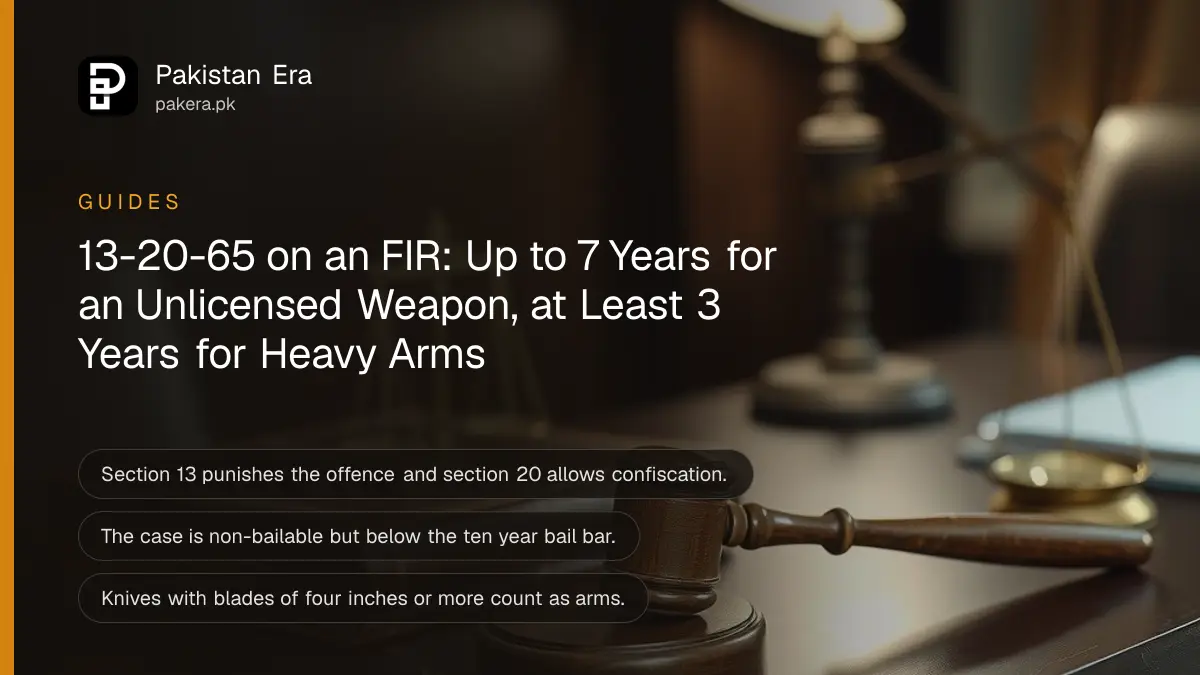
"13-20-65" on an FIR means section 13 (punishment) and section 20 (confiscation) of the Pakistan Arms Ordinance of 1965, and under the federal text an unlicensed pistol can bring up to 7 years in jail, a fine, or both. For automatic weapons, rifles of .303 bore or more, grenades and bombs, the minimum is 3 years. The offence is non-bailable on paper, but it sits below the ten year line where courts usually refuse bail. The full penalty list, the bail position and what happens to the weapon and the car are below.
We read the [Pakistan] Arms Ordinance 1965, marked "Updated till 23.9.2021", on Pakistan Code on 1 November 2026, with the Second Schedule of the Code of Criminal Procedure (CrPC).
The three numbers stand for two sections and a year
"13" is section 13, which lists the offences and their punishment. "20" is section 20, which lets the court confiscate the weapon and any vehicle used to carry it. "65" is the year of the Ordinance, 1965. Together they mean an unlicensed weapon case.
Police write it as 13/20/65 or 13-20-65 A.O. The offence most FIRs rely on is section 13(e): having arms or ammunition without a licence, in breach of section 9. Section 13(d), going armed without a licence in breach of section 8, is the other common one.
Section 13 carries up to 7 years, with a 3 year minimum for heavy weapons
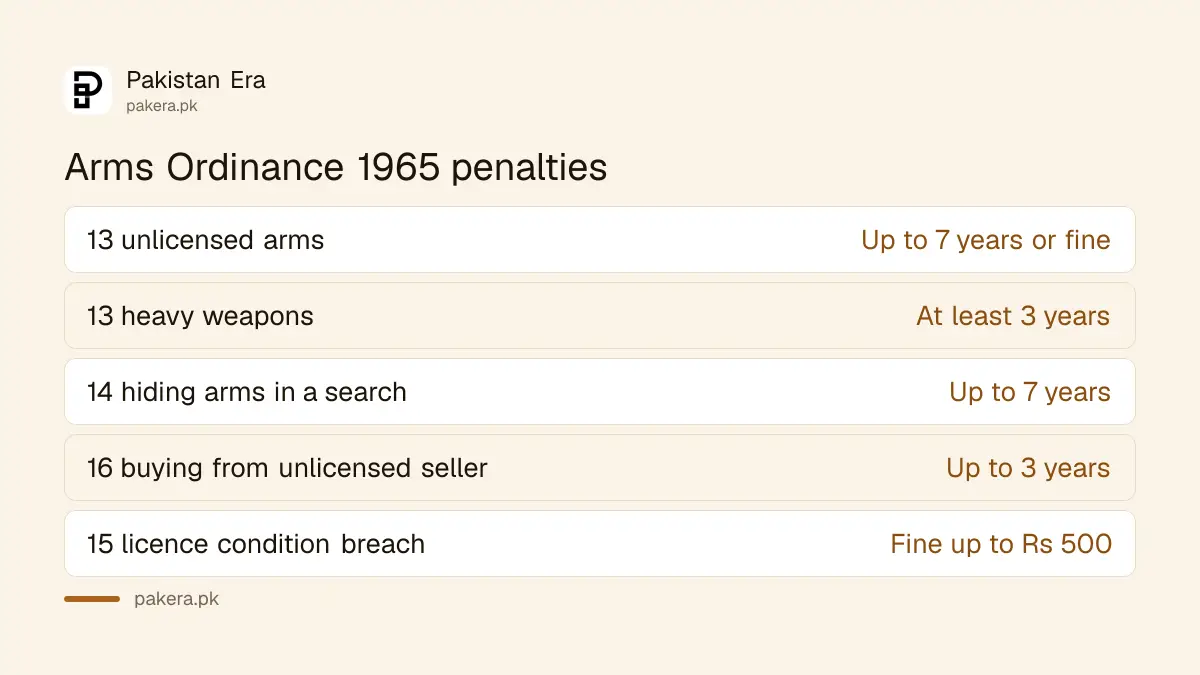
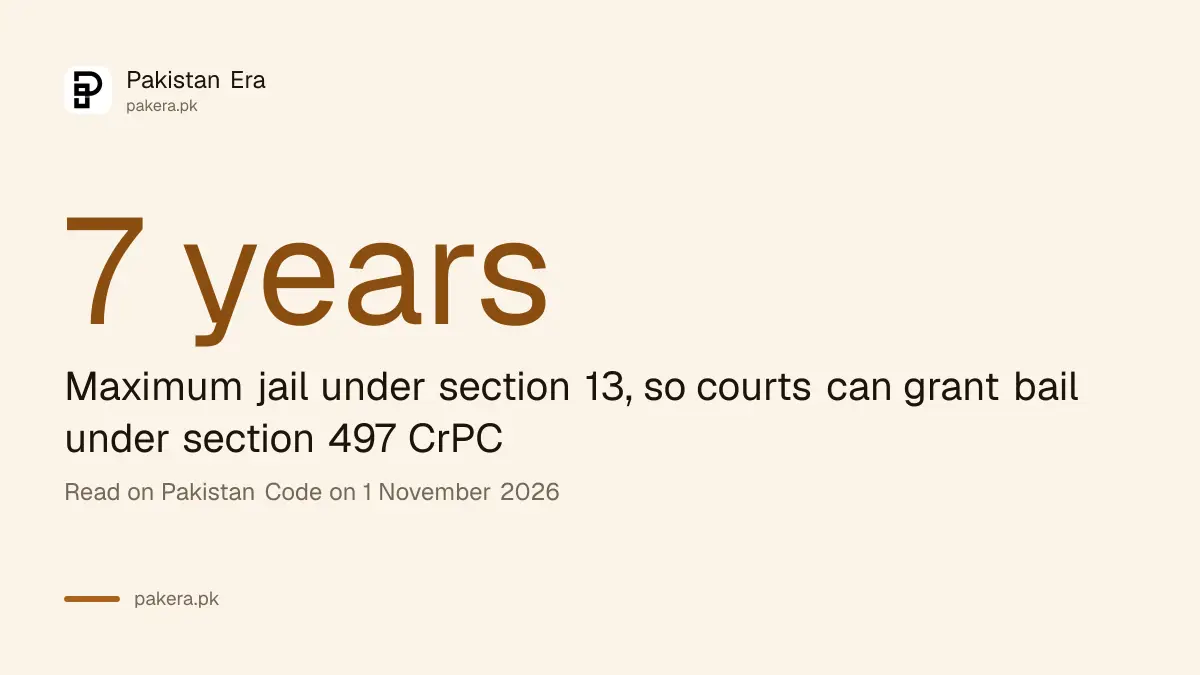
Every offence in section 13 is punishable with up to seven years, or a fine, or both. The minimum is three years where the offence involves a cannon, grenade, bomb or rocket, an automatic weapon, a .303 bore rifle or above, a .410 bore musket or above, or a large-bore pistol.
| Section | Offence | Punishment |
|---|---|---|
| 13(e) | Possessing arms or ammunition without a licence | Up to 7 years, or fine, or both |
| 13(d) | Going armed without a licence | Up to 7 years, or fine, or both |
| 13(a) | Selling or repairing arms without a licence | Up to 7 years, or fine, or both |
| 13(i) | Carrying or displaying arms against an order under section 11-B | Up to 7 years, or fine, or both |
| 13, proviso | Any of the above with heavy or automatic weapons | At least 3 years |
| 14 | Hiding arms during a search | Up to 7 years; at least 2 for heavy weapons |
| 16 | Knowingly buying from an unlicensed seller | Up to 3 years; at least 1 for heavy weapons |
| 15 | Breaking a licence condition | Fine up to Rs 500 |
| 19 | Refusing to produce arms when required | Up to 1 month, or fine up to Rs 200 |
The large-bore pistol line in the published text reads ".441 bore or over". A common .30 bore or 9mm pistol is not named in that list, so for it the general rule of up to seven years applies, with no minimum in the federal text.
Bail is a court decision, and usually granted below ten years
The CrPC Second Schedule treats any offence under another law that carries three to seven years as cognizable, non-bailable and not compoundable. So police can arrest without a warrant, and a magistrate must decide bail. A compromise does not end the case.
Section 497 of the CrPC bars bail only where the offence carries death, life or ten years. Section 13 tops out at seven, so it is below that bar, and courts commonly grant bail. Section 14-A sends cases to a First Class Magistrate, except those involving the heavy weapons, which go higher.
How a bail application and surety work is set out in getting bail in Pakistan. If the FIR also names a PPC section, such as 324 for firing at someone, that section decides the bail position, not the arms charge.
Section 20 lets the court take the weapon and the car
On conviction, section 20 allows the court to confiscate the weapon, its ammunition, and any vehicle, package or container used to carry or hide it. That is why "20" sits in the middle of the label. Confiscation is at the court's discretion, not automatic.
For a family whose car was seized with the weapon, the vehicle can sometimes be released on superdari (custody pending trial). The process is explained in getting seized property back from court.
Knives, swords and air pistols count as arms too
Section 2 of the Ordinance defines "arms" widely. Besides firearms of every kind, it includes air pistols, bayonets, swords, daggers, knives with blades of four inches or more and flick-knives of any blade length. Kitchen knives and tools used in good faith for work are excluded.
So walking around with a large dagger or a flick-knife, without a licence, can be charged under section 13(d). Bows and arrows, spears and knuckle-dusters are on the list as well.
Licence holders should keep the papers on them
Most 13-20-65 cases begin at a checkpoint or during a search. A valid licence, carried with the weapon and used within its conditions, is the defence. A licence that has lapsed, or a weapon carried outside the licence's area, is where trouble starts.
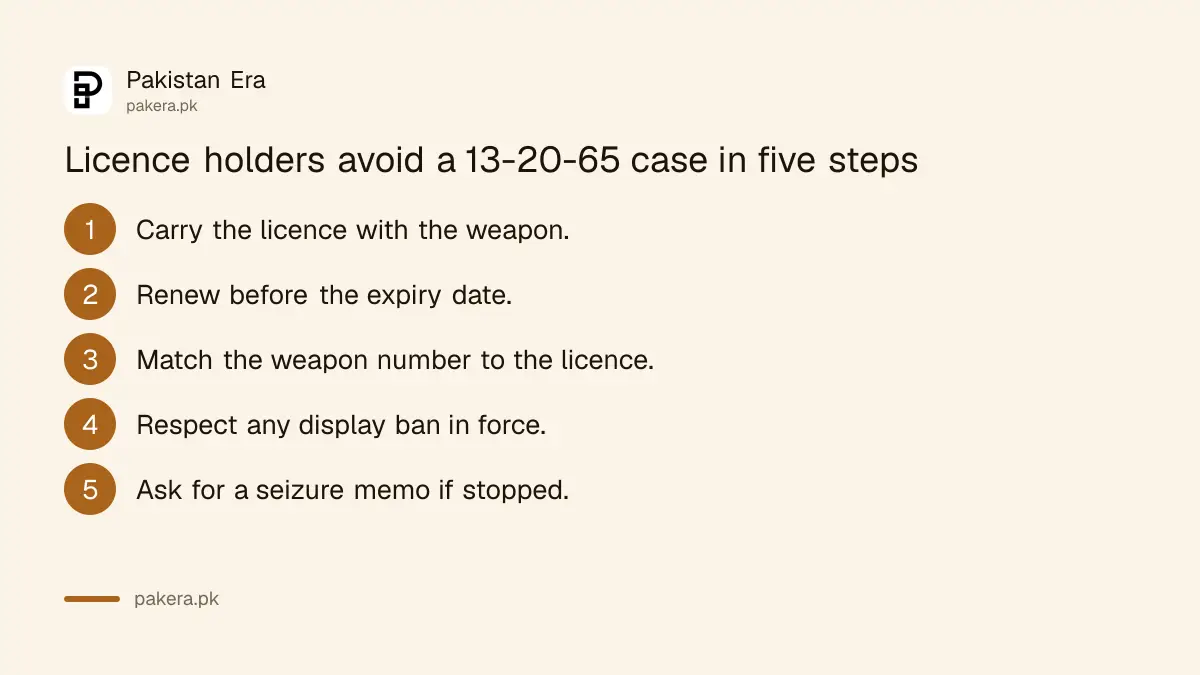
- Carry the original licence, or its digital copy where your province issues one, with the weapon.
- Renew before the expiry date and keep the receipt.
- Check that the weapon number matches the licence.
- Do not display arms where a section 11-B order or a section 144 order bans it.
- If stopped, show the licence and ask for a seizure memo if anything is taken.
Renewal rules for the capital are in renewing an Islamabad arms licence, and the position on new licences in Sindh and Khyber Pakhtunkhwa is in arms licences in Sindh and KP.
Provincial laws can set different punishments
This page reads the federal Ordinance, which applies in Islamabad and is the text behind the "13-20-65" label. Arms licensing is a provincial subject, and provinces have their own rules or Acts. Sindh, for example, licenses arms under its own Sindh Arms Rules 2018.
Where a province has passed its own Act, its sections and punishments may differ from the table above. We did not read the provincial texts, so check the law named on your FIR with a lawyer. Other common FIR sections are in the PPC sections list.
Common questions
What does 13-20-65 mean in an FIR?
Sections 13 and 20 of the Arms Ordinance 1965: section 13 punishes the unlicensed weapon offence and section 20 allows confiscation of the weapon and vehicle.
What is the punishment for an illegal pistol in Pakistan?
Under the federal Ordinance, up to seven years, or a fine, or both. For automatic weapons, .303 rifles and above, and the large-bore pistols named in the law, the minimum is three years.
Is 13-20-65 bailable?
It is non-bailable under the CrPC schedule, which means a magistrate decides. Because it carries less than ten years, courts commonly grant bail.
Can a 13-20-65 case be settled by compromise?
No. It is an offence against the state, and the CrPC schedule marks such offences not compoundable.
Is carrying a knife illegal in Pakistan?
A knife with a blade of four inches or more, or any flick-knife, counts as arms under the Ordinance. Kitchen knives and tools used for work are excluded.
How we verified this
What we checked, where we read it, and what we could not confirm.
We read sections 2 to 20 of the [Pakistan] Arms Ordinance 1965, updated to 23 September 2021, and the "offences against other laws" rows and section 497 of the CrPC on pakistancode.gov.pk on 1 November 2026. Provincial arms Acts and any later amendments were not read. This page is a reference, not legal advice.
About the author

Global Affairs & Political Economy Writer
Muhammad Hatim is a book lover who started writing because he enjoys it. At Pakistan Era he writes about international relations, geopolitics and the global economy, with a particular interest in South Asia and the forces behind current events.