379 and 380 PPC in Pakistan: Theft Punishment, Bail and What Victims Should Do
379 PPC theft carries up to 3 years in Pakistan, 380 home theft and 381A vehicle theft up to 7. All are non-bailable and not compoundable. What victims do next.
Short answer: Under the Pakistan Penal Code (PPC), theft under Section 379 carries up to 3 years, or a fine, or both. Theft from a house, shop, tent or storeroom under Section 380 carries up to 7 years and a fine. Theft of a car, motorcycle or tractor under Section 381A carries up to 7 years and a fine up to the vehicle's value. All three are cognizable, not bailable and not compoundable under the Code of Criminal Procedure (CrPC).
Theft is the offence most Pakistanis meet first, as victims. A phone snatched from a pocket, a motorcycle gone from outside the mosque, a shop broken into overnight. Which section the FIR uses decides the punishment and the court. This page sets out each one, the bail and compromise position, and what victims should do.
What counts as theft under Section 378
Section 378 PPC defines theft as moving any movable property out of another person's possession, without that person's consent, with the intention of taking it dishonestly. The property only has to be moved to complete the offence. It does not have to leave the area.
Three things decide a theft case:
- Movable property: money, phones, jewellery, vehicles, livestock, goods. Land is not movable, so a land grab is not theft.
- Possession of another: the property was in someone else's possession, even if that person is not the owner.
- No consent and dishonest intent: it was taken without consent, meaning to cause wrongful gain or loss.
If the owner handed the property over and the other person later kept it, that is usually criminal breach of trust under Section 406, not theft. If the owner was tricked into handing it over, that points to cheating under Section 420.
The theft sections and their punishments
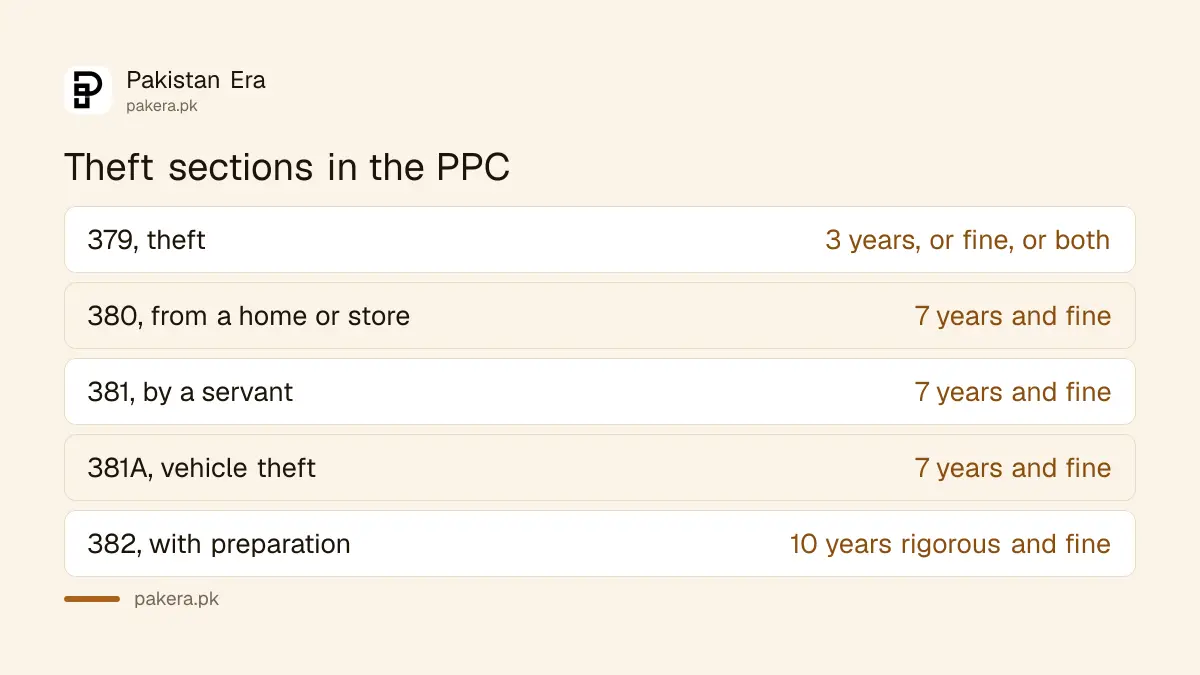
The PPC grades theft by where it happens, who commits it and what is taken. Section 379 is the basic offence, and the sections after it raise the maximum for theft from a dwelling, by a servant, of a vehicle, or with preparation for violence.
| Section | Offence | Maximum punishment | Trial court in the CrPC schedule |
|---|---|---|---|
| 379 | Theft | 3 years, or fine, or both | Any Judicial Magistrate |
| 380 | Theft in a building, tent or vessel used as a dwelling or to store property | 7 years and fine | Any Judicial Magistrate |
| 381 | Theft by a clerk or servant of the employer's property | 7 years and fine | Court of Session or Magistrate of the first or second class |
| 381A | Theft of a car or other motor vehicle, including motorcycle, scooter and tractor | 7 years and fine up to the vehicle's value | Court of Session or Magistrate of the first class |
| 382 | Theft after preparing to cause death, hurt or restraint | 10 years rigorous and fine | Court of Session or Magistrate of the first class |
Section 381A also says theft of an electric motor of a tube well or a transformer falls within it. That brings farm motor thefts up to the same 7-year level as a vehicle theft.
Snatching with force or threats is a more serious offence than theft, and robbery and dacoity have their own sections. The full list is in PPC sections and punishments.
Theft is cognizable and not bailable
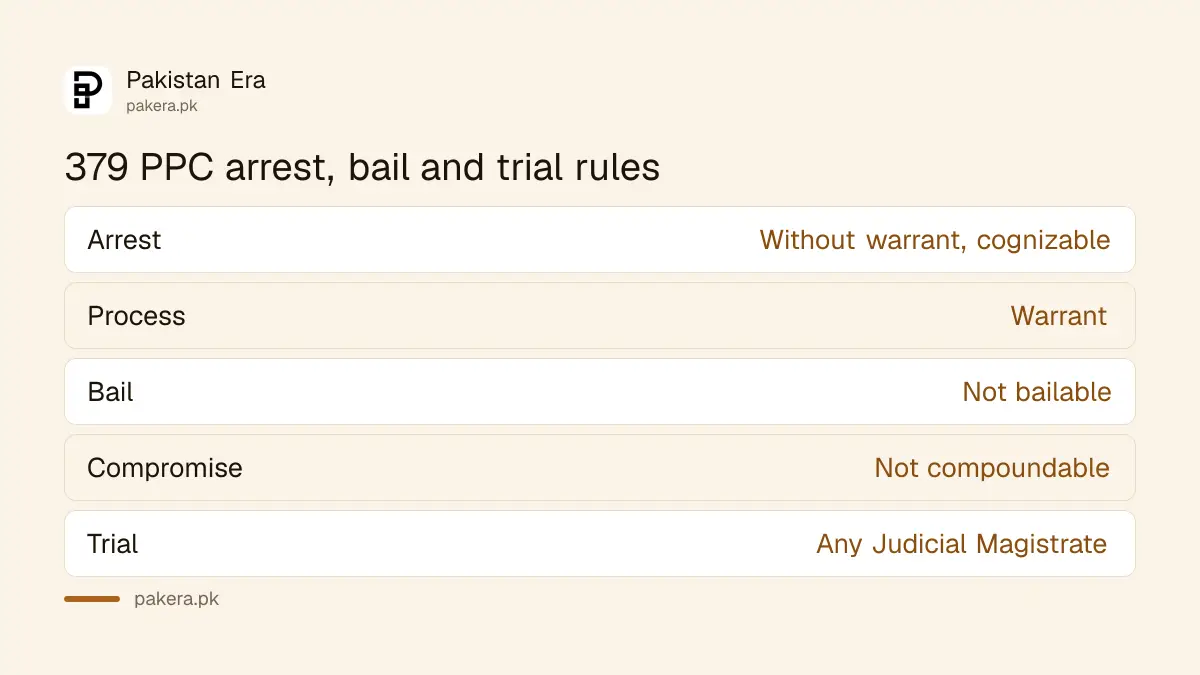
The CrPC's second schedule says police may arrest without a warrant for Sections 379, 380, 381, 381A and 382, a warrant issues in the first instance, and each is not bailable. Police must register an FIR when a theft is reported.
"Not bailable" means the accused must apply, and the court decides on the facts. The value taken, the evidence and the accused's record all go before the court. The rules are set out in bailable and non-bailable offences.
Receiving stolen goods is a separate offence
Section 411 PPC punishes anyone who dishonestly receives or keeps stolen property, knowing or having reason to believe it is stolen. It carries up to 3 years, or a fine, or both, and is also cognizable and not bailable. Buying a cheap phone with no box and no receipt can bring a 411 charge.
Theft cases cannot be settled by compromise
None of the theft sections, 379 to 382, appear in the compounding tables of Section 345 of the CrPC. Section 345(7) bars compounding outside those tables. So returning the stolen goods, or a compromise between families, does not close the case by itself.
The schedule marks each theft section "Not compoundable". The case runs on the evidence, and the court decides. A complainant can still tell the court what was recovered.
What to do if something is stolen
Report the theft at the police station with jurisdiction over the place where it happened, and ask for a copy of the FIR. List each item with its serial number, IMEI or registration number. Then take the steps specific to phones and vehicles.
- Report it. Go to the police station for the place of theft, or call 15 if it is happening now.
- Describe the property. Make, model, colour, serial numbers, IMEI for phones, chassis and engine number for vehicles.
- Get the FIR number. You need it for insurance, PTA blocking and any later claim.
- Block a stolen phone. Use the PTA's process, explained in blocking a lost or stolen phone.
- Report a stolen vehicle. Follow the steps in reporting a stolen car, including the excise and insurance notices.
- Claim recovered property. If police recover it, apply to the court for its return, set out in getting seized property back.
If the police station will not register the FIR, give your application in writing and keep a copy. You can then complain to senior police officers or apply to the Sessions Judge as Justice of the Peace under Section 22-A CrPC.
Common questions
What is the punishment for 379 PPC?
Up to 3 years of imprisonment of either description, or a fine, or both.
Is 379 PPC bailable?
No. The CrPC schedule lists it as not bailable, so the court decides bail on the facts.
What is the difference between 379 and 380 PPC?
Section 380 is theft from a building, tent or vessel used as a home or to store property. It carries up to 7 years and a fine, against 3 years for 379.
Is theft compoundable in Pakistan?
No. Sections 379 to 382 are not in the Section 345 CrPC tables, and the schedule marks each "Not compoundable".
What is the punishment for motorcycle theft?
Section 381A covers cars and other motor vehicles, including motorcycles, scooters and tractors. It carries up to 7 years and a fine up to the vehicle's value.
Is buying a stolen phone a crime?
Yes, if you knew or had reason to believe it was stolen. Section 411 carries up to 3 years, or a fine, or both.
How we verified this
What we checked and where we read it.
Sections 378 to 382 and 411 are from the Pakistan Penal Code PDF, and the second schedule rows and the Section 345 tables are from the Code of Criminal Procedure PDF, both on the Ministry of Law's Pakistan Code website. Section 381A was inserted by Act I of 1996, and its tube well and transformer Explanation was added later. This page explains the law and is not legal advice.
Last checked 15 November 2026.
About the author

Global Affairs & Political Economy Writer
Muhammad Hatim is a book lover who started writing because he enjoys it. At Pakistan Era he writes about international relations, geopolitics and the global economy, with a particular interest in South Asia and the forces behind current events.