Pakistan Marks Access to Information Day: Federal Offices Must Answer in 10 Working Days
On Access to Information Day, how to ask a federal office for records under the 2017 Act: 10 working days to answer, no reason needed and a free appeal to PIC.
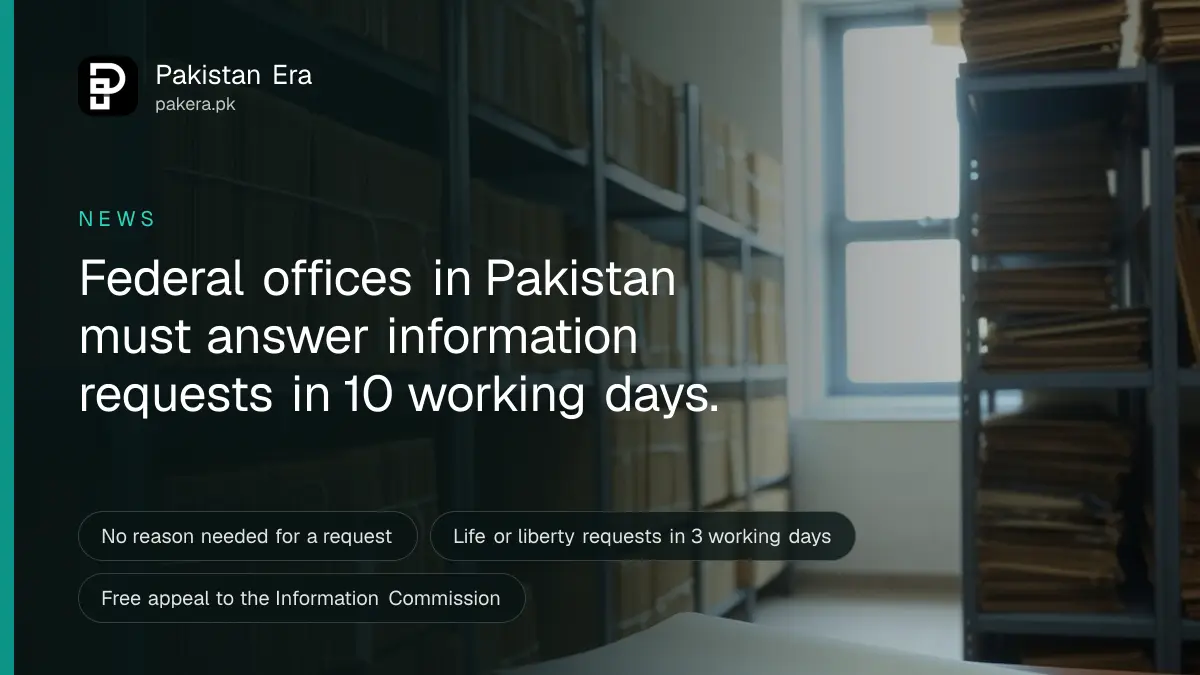
Any Pakistani citizen can ask a federal government office for its records, and the office must answer within 10 working days. That is the rule under the Right of Access to Information Act 2017, and it is worth knowing today, 28 September, which the world marks as the International Day for Universal Access to Information.
Update, 11 October 2026: If a federal office refuses, you can appeal to the Pakistan Information Commission.
Prime Minister Shehbaz Sharif issued a message for the day through the Press Information Department. He said access to information is a basic right under Article 19-A of the Constitution, and that the Pakistan Information Commission handles complaints when citizens are refused. We read his message, the 2017 Act as printed in the Gazette of Pakistan, and the 2019 Rules on the Commission's own website.
The Prime Minister's message for 28 September
The Prime Minister's message says Pakistan is committed to citizens' right to information and to fighting false information. It says government records are being digitised for public access, and that the Pakistan Information Commission is the forum for citizens' complaints.
This year's theme, as the message gives it, is "Upholding Information Integrity in the Digital Age". The message ties it to the spread of false news on social media. Its answer is more official information released on time, not less.
A message is not a new law. Nothing changed today. What the day does is remind people of a right that already exists and that few people use.
Federal offices must answer within 10 working days
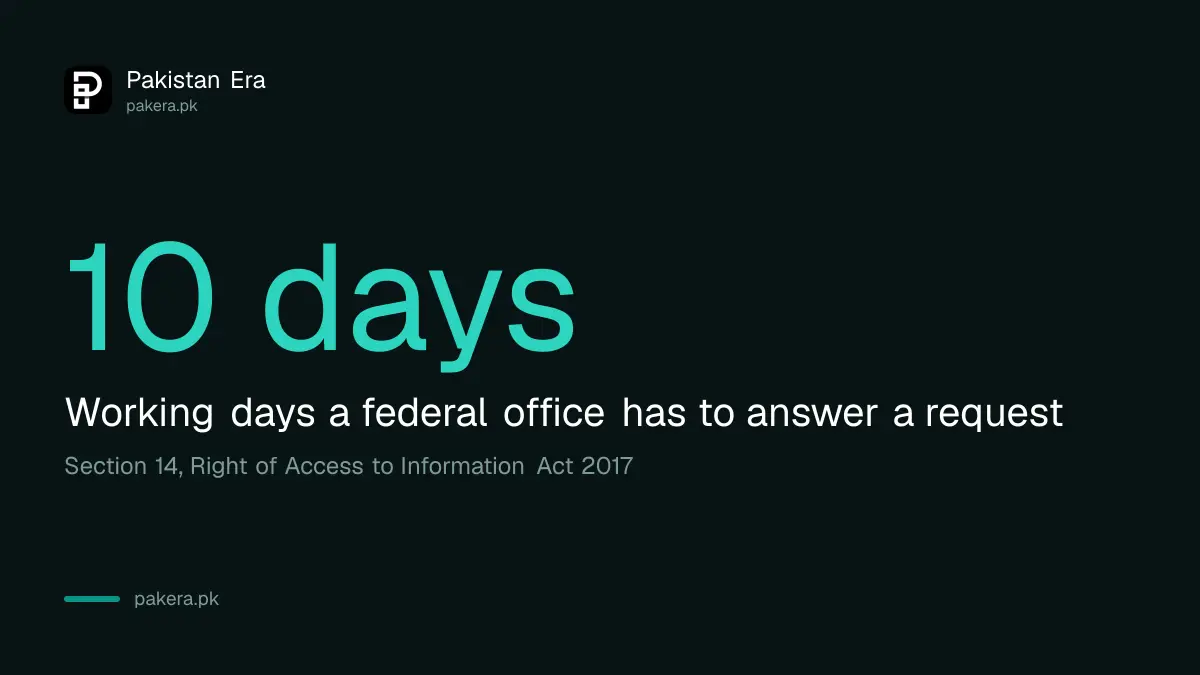
Under section 14 of the Act, a federal public body must answer a request within 10 working days. It can take 10 more working days if it has to search many records or consult other offices. Information needed to protect someone's life or liberty must be given within 3 working days.
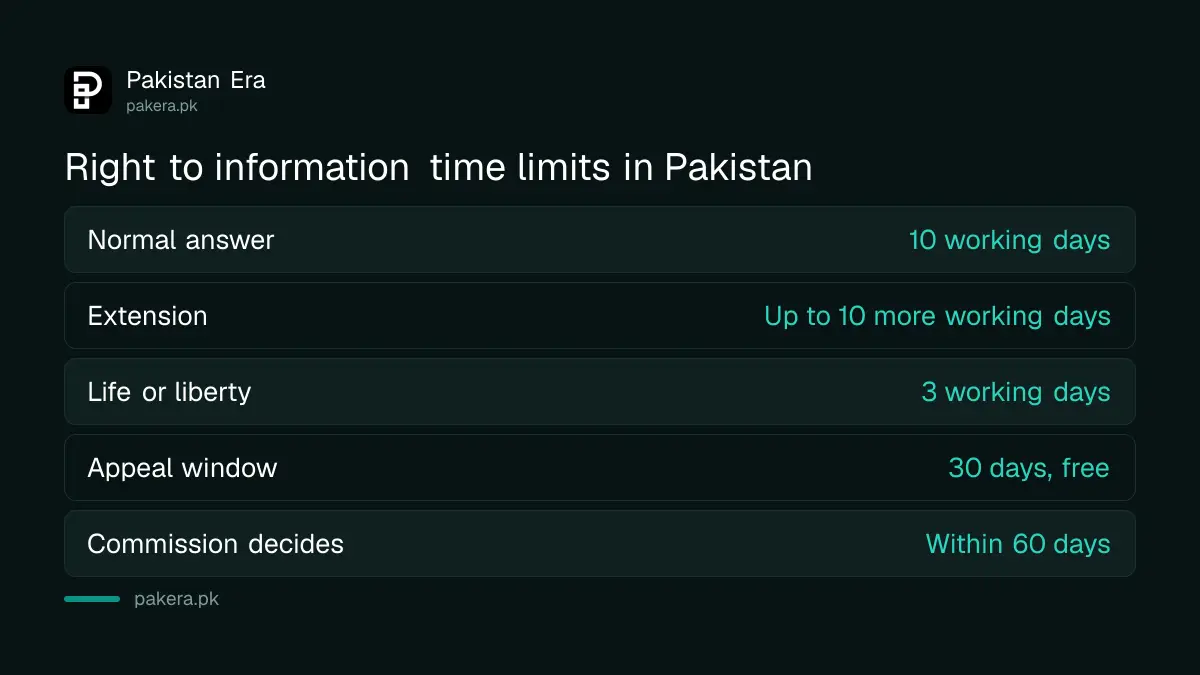
| Rule | What the law says | Where |
|---|---|---|
| Normal answer | Within 10 working days | Section 14(1) |
| Extension | Up to 10 more working days | Section 14(2) |
| Life or liberty | Within 3 working days | Section 14(3) |
| Office does not hold it | Must tell you within 10 working days | Section 12 |
| Reasons for asking | Never required | Section 11(5) |
| Appeal | To the Information Commission within 30 days, free | Section 17 |
| Commission decision | Within 60 days | Section 17(3) |
You never have to say why you want the information. Section 11(5) is plain about that. An office that asks you for a reason is asking for something the law does not allow.
How to send a request to a federal office
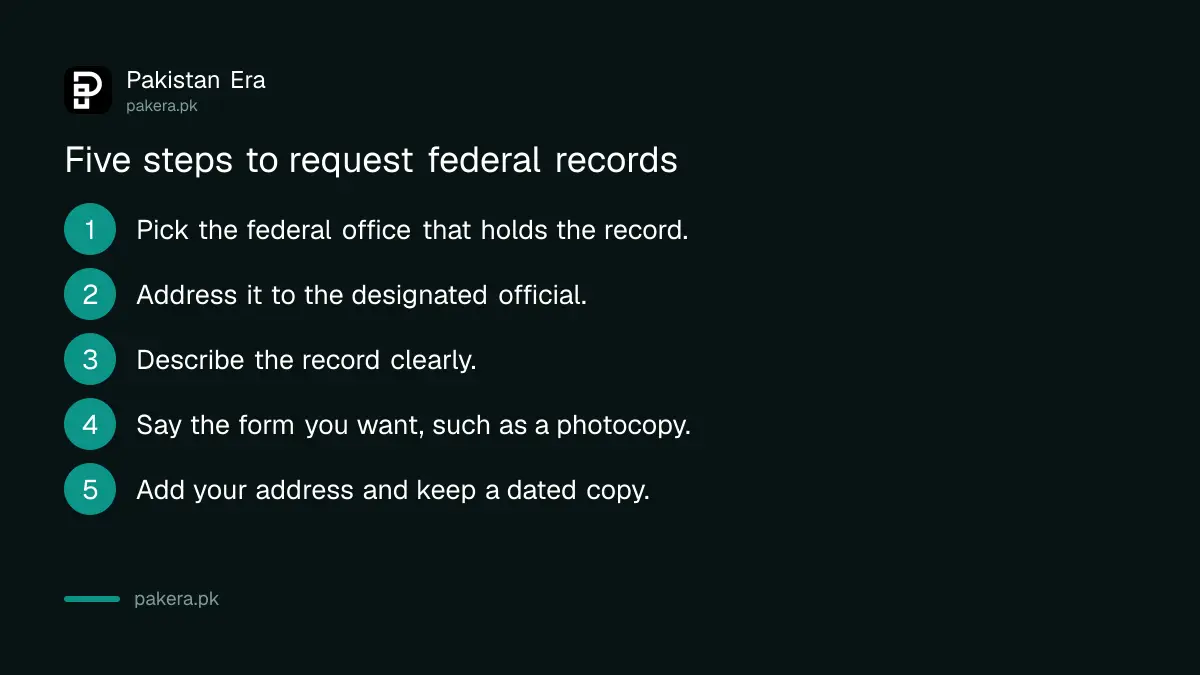
Write a request on plain paper, or by email, fax or online where the office accepts it, and address it to the office's designated official. Describe the record, say what form you want it in, and give your address and phone number. Nothing else is needed.
- Pick the federal office that holds the record, such as a ministry, division or federal department.
- Address it to the designated official. Under section 9 this is an officer of BPS-19 or above. If none is named, send it to the head of the office.
- Describe the record clearly enough for the office to find it.
- Say whether you want a photocopy, CD, video or audio clip, as Rule 4 allows.
- Add your full address and phone number or email, and keep a copy with the date you sent it.
The office must give you a written acknowledgement. If the information is refused, the refusal must name the exact exemption used and tell you about your right to appeal.
The office can charge a fee, but only for the cost of copying and sending the record, under section 15. Rule 5 says no cost can be charged for information about a person's life or liberty.
Appeal to the Pakistan Information Commission for free
If the office refuses, gives part of the record, or does not answer in time, appeal to the Pakistan Information Commission within 30 days. The appeal is free, can be on plain paper, and the Commission must decide it within 60 days.
Under Rule 8 you must certify that you have not taken the same matter to another forum or court. Send the facts, your contact details and any evidence, such as your copy of the request. In the appeal, the office has to prove it followed the law, not you.
The Commission lists its appeals line as 051-9261014 and its email as appeals@rti.gov.pk on its website, rti.gov.pk. Its recent orders show what an appeal can do. In March 2026 it says electricity companies began uploading live load shedding information after its orders, and it declared the Human Rights Commission of Pakistan a public body under the Act.
What an information request cannot do
An information request gets you records. It does not fix a wrong bill, a delayed pension or a bad decision. For that, a complaint is the right tool. The Wafaqi Mohtasib handles complaints about federal offices, and the Pakistan Citizen's Portal sends complaints to the office concerned.
The two can work together. A record you get through a request can be the evidence your complaint needs. Some records are also exempt under section 16 of the Act, and only chosen parts of some files are released, as with the plan to publish selected parts of federal officers' asset declarations.
This Act covers federal public bodies. A provincial department is outside it, so check the province's own arrangements before you write to one.
Common questions
How long does a federal office have to answer an information request?
Ten working days, which can be extended by up to 10 more. Information about a person's life or liberty must be given within 3 working days.
Do I have to give a reason for my request?
No. Section 11(5) of the Right of Access to Information Act 2017 says an applicant can never be asked for reasons.
Is there a fee for an information request?
Only the cost of copying and sending the record, under section 15. No cost can be charged for information about life or liberty.
What can I do if the office does not reply?
Appeal to the Pakistan Information Commission within 30 days. The appeal is free and must be decided within 60 days.
Who can make a request?
Any citizen of Pakistan, under section 11. The 2019 Rules also let someone act on a citizen's behalf.
When is International Day for Universal Access to Information?
28 September each year. The Prime Minister issued a message for the 2026 day, released for publication on 28 September.
How we verified this
What we checked, where we read it, and what we could not confirm.
Last checked on 28 September 2026. The Prime Minister's message, its theme and its points on Article 19-A, digitising records and the Commission are from PID press release No. 298 of 27 September 2026, embargoed until 28 September, on the Press Information Department website. The time limits, fees, designated officials, the no-reasons rule and the appeal are from the Right of Access to Information Act 2017 as printed in the Gazette of Pakistan of 16 October 2017, and the plain paper, form of record, life and liberty and appeal rules are from the Right of Access to Information Rules 2019. We read both documents on the Pakistan Information Commission's website, which also gives its phone number, email and the March 2026 orders.
About the author

Tax, Bills and Technology Writer
Ali Akhtar is a young and curious voice here at Pakistan Era. He is currently pursuing his A-Levels and has a growing interest in Pakistan’s changing industrial landscape and educational trends. Ali likes to write in a way that helps him explain and explore the world around him. His writing reflects the perspective of the new generation navigating the evolving trends of Pakistan where technology, youth innovation, and shifting opportunities are reshaping the country’s future.