Admit a Relative for Psychiatric Treatment in Islamabad: Mental Health Ordinance Rules
Islamabad's Mental Health Ordinance allows detention only on doctors' advice: 28 days to assess, 6 months to treat. See who applies and how to appeal.
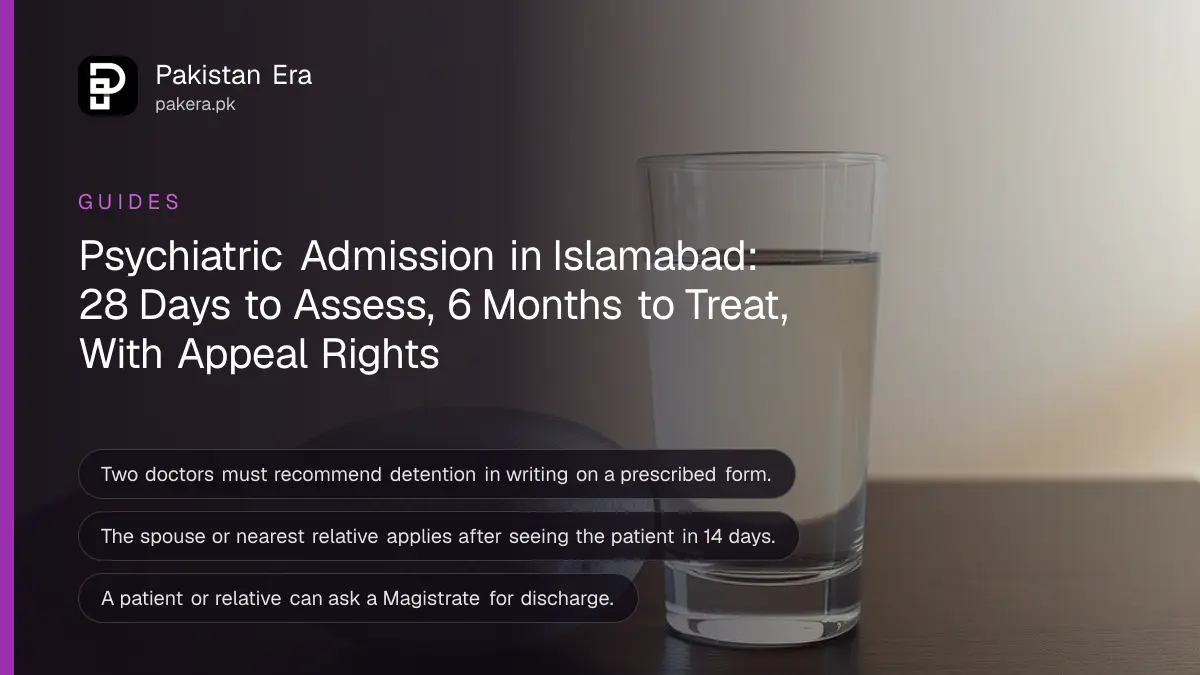
In Islamabad, a relative can be admitted to a psychiatric facility against their will only on written recommendations from doctors, under the Mental Health Ordinance, 2001, and only for set periods: 28 days for assessment, six months for treatment, 72 hours for an urgent case and 24 hours for emergency holding. The person, or the family, can appeal or ask a Magistrate for discharge.
Most psychiatric care is voluntary, and the Ordinance says so first. Section 8 lets anyone who seeks help, or is brought by a relative, be examined by a psychiatrist, who decides on outpatient care or admission. We read the full Ordinance on the Pakistan Code, the federal law website, on 20 October 2026. It is federal law, so it applies in the Islamabad Capital Territory.
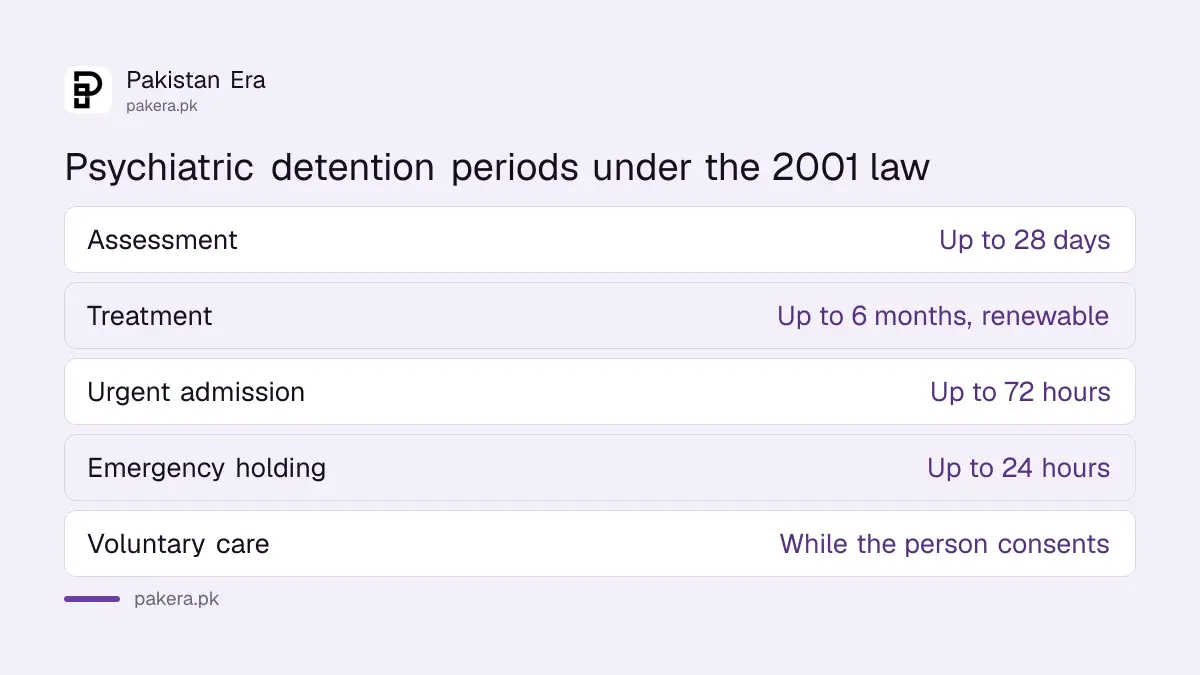
The Ordinance allows four types of detention, each with a time limit
Section 9 sets four types of detention. Admission for assessment lasts up to 28 days. Admission for treatment lasts up to six months and can be renewed. Urgent admission lasts up to 72 hours. Emergency holding of a patient already in hospital lasts up to 24 hours.
| Type | Section | Longest period | Who must recommend |
|---|---|---|---|
| Voluntary care | 8 | As long as the person consents | Psychiatrist or nominated medical officer examines |
| Assessment | 10 | 28 days | Two doctors, one a psychiatrist where available |
| Treatment | 11 | 6 months, renewable | Two medical officers, one an approved psychiatrist |
| Urgent admission | 12 | 72 hours | One approved psychiatrist or nominated medical officer |
| Emergency holding | 13 | 24 hours | A medical officer, for a patient already admitted |
A treatment order can be renewed for another six months, then for one year at a time. Each renewal is a fresh decision, not an automatic one. A patient admitted for treatment is no longer held under any earlier assessment order.
Doctors, not families, decide whether a person can be held
An application for assessment must show three things in writing: a mental disorder that warrants detention, a need to protect the person's health or safety or other people, and that community or voluntary care is not possible. Two doctors must sign recommendations on a prescribed form.
For treatment, the two medical officers must also explain why other ways of helping the person are not suitable. So a family cannot simply drop a relative at a hospital and leave. The doctors have to record their reasons, and the psychiatrist can discharge the person at any time.
A person who attempts suicide must be assessed by an approved psychiatrist under section 49. If a mental disorder is found, the person is treated under the Ordinance. We read this as a duty to assess and treat, not to punish.
Only a spouse or the nearest relative should apply
Section 15 says the husband or wife presents the application. If there is none, or they cannot act, the nearest relative does. Anyone else must explain in writing why the spouse or nearest relative did not apply, and how they are connected to the patient.
The applicant must be an adult and must have personally seen the patient within 14 days before applying. The application must be signed and verified. Once complete, it allows the applicant to take the patient to the facility within 14 days of the last medical examination, or within 24 hours for an urgent application.
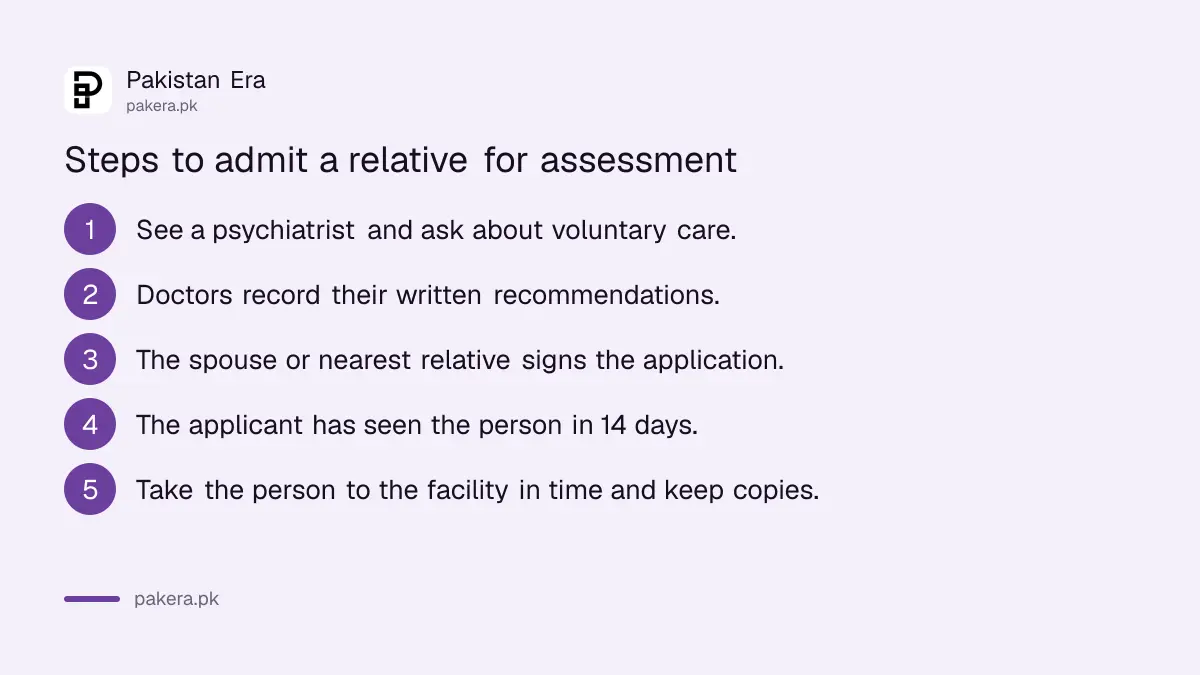
- Take the person to a psychiatrist first and ask whether voluntary treatment is possible.
- If not, ask the doctors to record their recommendations on the prescribed form.
- The spouse, or the nearest relative, signs and verifies the application.
- Make sure you have seen the person yourself in the last 14 days.
- Take the person to the facility within the time the application allows, and keep copies.
Patients and families can appeal or ask for discharge
After an assessment order, the patient, a relative or a guardian may file one appeal to a Court of Protection within 14 days. After a treatment order, one appeal is allowed in each period of detention. A Magistrate can also order discharge after an inquiry.
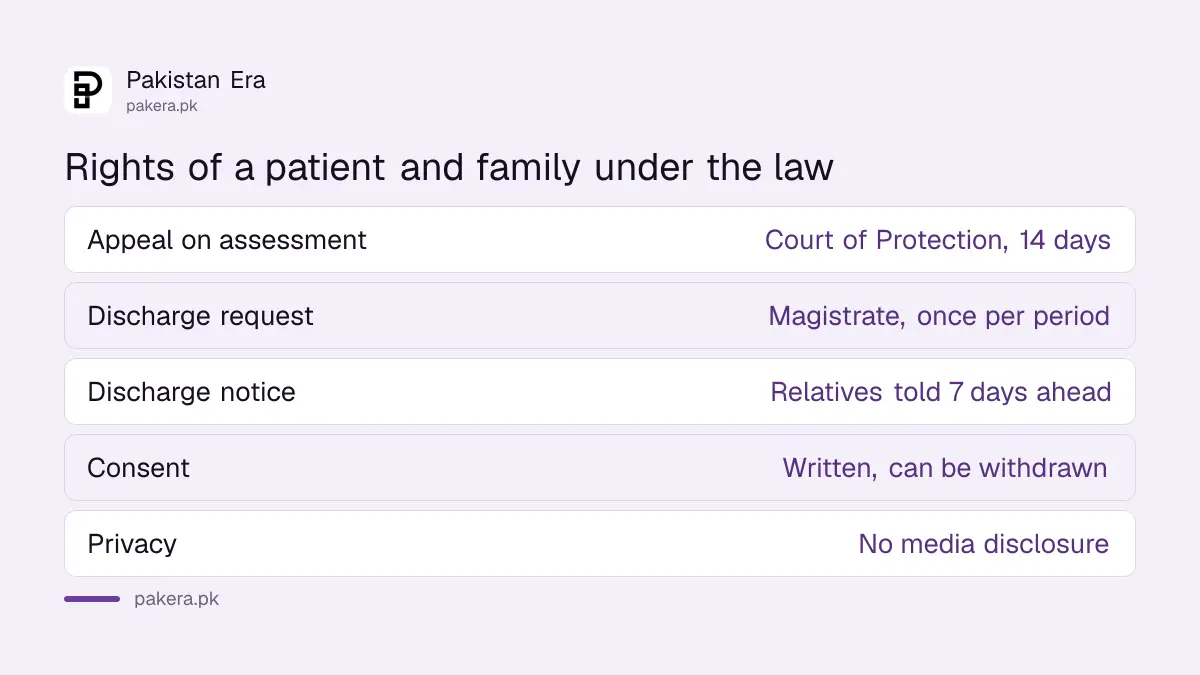
Under section 22, a patient who feels recovered can apply to the Magistrate for discharge. Under section 25, relatives of a patient admitted for assessment or treatment can apply to the Magistrate where the facility is. Only one such application is allowed in each period of detention.
The hospital must try to tell relatives at least seven days before a patient is discharged. If a patient becomes seriously ill or dies, the nearest relatives must be told. A person found not to have a mental disorder must be discharged at once.
The Ordinance protects consent and privacy
Section 51 requires written informed consent before any investigation or treatment, from the patient, or for a minor from a relative or guardian. Consent can be withdrawn in writing. Section 14 allows emergency treatment without written consent only to save life or prevent serious harm.
Section 50 bars publicising a patient or revealing their identity through the press or media, unless the person chooses to. That matters for families too: sharing a relative's condition online can breach this protection.
Most families start by seeing a psychiatrist at a government hospital, and you can confirm a doctor's licence by checking PMDC registration. The federal government's plans for services sit in the national mental health policy. If someone is in immediate danger, call the numbers on the emergency helpline list.
Common questions
Can a family admit someone to a psychiatric hospital without consent?
Only through the Ordinance's process. Doctors must recommend it in writing, and the stay is limited to 28 days for assessment or six months for treatment.
How long can a person be held for assessment?
Up to 28 days from the date of the application, under sections 9 and 10. Longer stays need a separate treatment order.
Who can apply for admission?
The husband or wife, or if there is none, the nearest relative. The applicant must be an adult who saw the patient in the last 14 days.
Can a patient ask to leave?
Yes. A patient who feels recovered can apply to a Magistrate for discharge, and the psychiatrist in charge can discharge at any time.
Does this law apply in my province?
It applies in Islamabad. Provinces now have their own mental health laws, such as the Balochistan Mental Health Act, 2019. Check your provincial law before acting.
Is attempted suicide punished under this law?
No. Section 49 says a person who attempts suicide must be assessed by an approved psychiatrist and, if found unwell, treated under the Ordinance.
How we verified this
What we checked, where we read it, and what we could not confirm.
Last checked 20 October 2026. We read the full Mental Health Ordinance, 2001 on the Pakistan Code, focusing on sections 8 to 26 and 49 to 51. We confirmed on the Balochistan Code that a Balochistan Mental Health Act, 2019 is listed. The Punjab and Sindh law websites did not load for us that day, so we could not compare their laws. We could not find the prescribed application forms online. This page explains the law and is not legal or medical advice.
About the author

Public Services and Education Journalist
Fajr Riaz is a journalist and content writer at Pakistan Era, based in Lahore. She covers the questions people meet in everyday life in Pakistan: how a public service works, what a change in the rules means, and where to find a reliable answer.