Pakistan's National Mental Health Policy 2026-2035 and Where to Get Free Help
Pakistan launched its National Mental Health Policy 2026-2035 for 32.4 million people in need. See what it promises and the free helplines you can call today.
Pakistan has launched a National Mental Health Policy for 2026 to 2035. The aim is to reach about 32.4 million people who need mental health care, mostly through primary health care, schools and communities. If you need help today, the policy does not change where you go: call 1122 in an emergency, or Umang's helpline on 0311-7786264.
The federal health ministry launched the policy at Pakistan's Global Mental Health Summit in Islamabad, held on 1 and 2 October 2026. It worked with the World Health Organization (WHO), UNICEF and the Global Institute of Human Development at Shifa Tameer-e-Millat University. WHO's release on the launch is dated 5 October 2026.
The gap it has to close is huge. WHO estimates only about 5 per cent of people in Pakistan can reach mental health services. That leaves a treatment gap of about 95 per cent.
Free mental health help in Pakistan starts with these numbers
If someone is in danger now, call 1122 for an ambulance, 112 from a mobile, or 15 for the police. WHO lists Umang's helpline, 0311-7786264, as the suicide crisis contact for Pakistan. Government psychiatry wards also see patients free or at low cost.
| Where | Contact | What we found |
|---|---|---|
| Ambulance | 1122, or 112 from a mobile | Listed by WHO for Pakistan |
| Police | 15 | Listed by WHO for Pakistan |
| Umang helpline | 0311-7786264 | WHO's suicide crisis contact for Pakistan |
| Punjab Institute of Mental Health, Lahore | 042-99203776-7 | Emergency open round the clock, medicines free |
We did not call these numbers. We read them on the WHO Eastern Mediterranean page and the Punjab Institute of Mental Health's own site on 6 October 2026. Hospital by hospital details for Lahore, Karachi, Islamabad and Quetta are in how to see a psychiatrist at a government hospital.
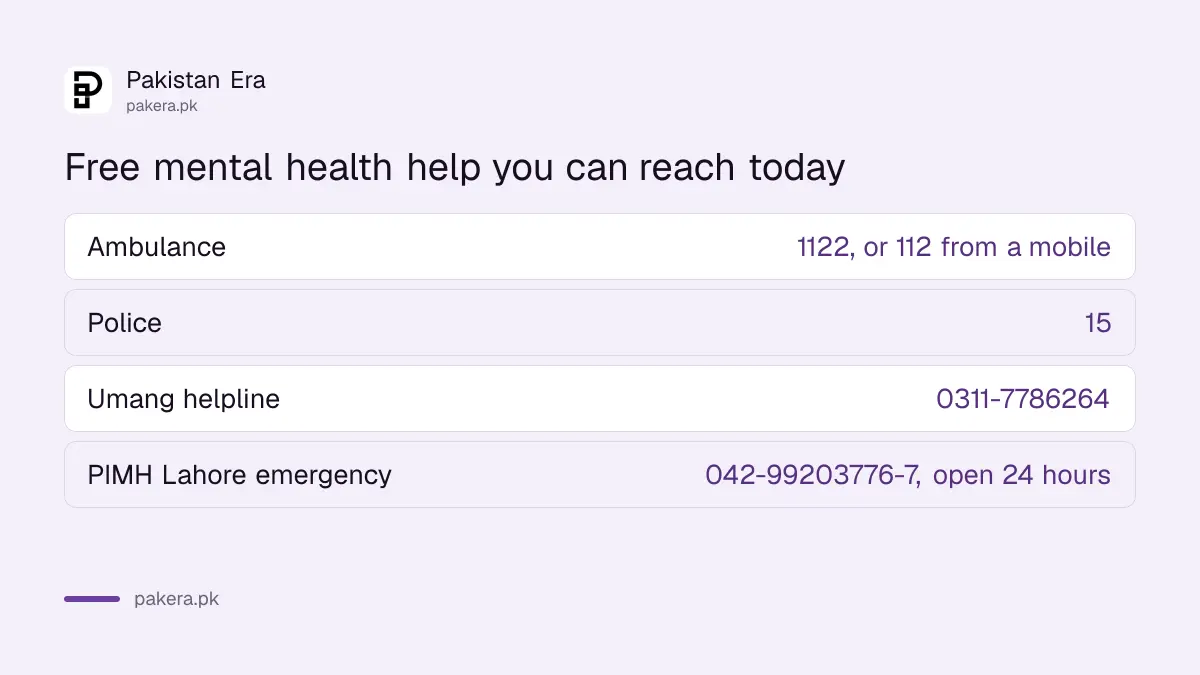
Save these on your phone now, before you need them. A full list of emergency helpline numbers is worth keeping too.
The policy targets 32.4 million people and a 95 per cent gap
WHO estimates about 32.4 million people in Pakistan need mental health care. Pakistan has about 0.19 psychiatrists per 100,000 people. High-income countries average 7 per 100,000, which is more than 35 times as many.
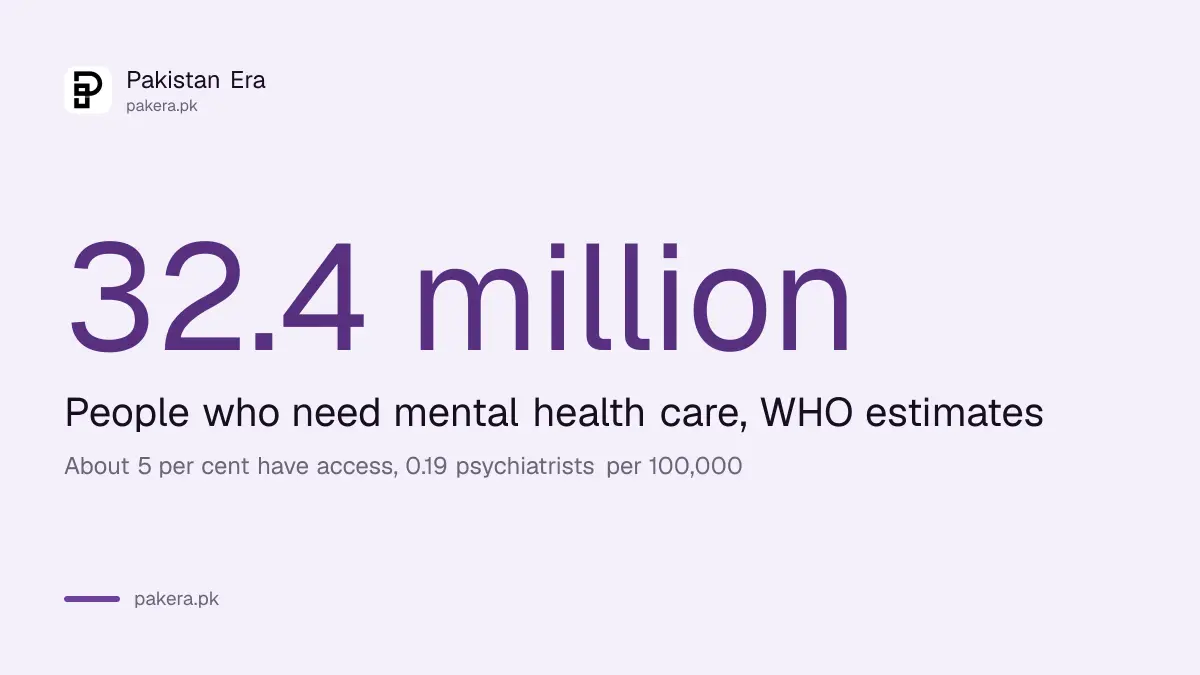
Put simply, there are not enough specialists, and there never will be soon. That is why the policy leans on other people to do the first part of the work: general doctors, health workers, teachers and families.
The policy promises care through schools, clinics and communities
The policy's main promise is to bring care closer to families. Ministers said it will be put into practice in schools, primary health care and communities, so people get support early. Children and young people are a stated focus, with more weight on prevention and early identification.
Here is what was said at the launch, as WHO reported it:
- Federal Health Minister Syed Mustafa Kamal called mental health "an emergency in Pakistan" and a national security and economic issue.
- Minister of State Dr Malik Mukhtar Ahmad Bharath said the ministry will work with provincial governments to put the policy into practice in schools, primary health care and communities.
- UNICEF's Pernille Ironside said children and adolescents must be at the centre, with focus on prevention, early identification and care.
- WHO's Dr Tedros Adhanom Ghebreyesus said every dollar spent on depression and anxiety returns four dollars in better health and productivity.
That is the direction. It is not yet a list of services you can ask for.
Provinces will decide what actually changes on the ground
Health is a provincial subject in Pakistan. So the federal policy sets the direction, and each province has to turn it into hospitals, staff and budgets. The Minister of State said as much: the ministry will work "with provincial governments" to translate it into action.
We could not find the full policy text on the health ministry's website on 6 October 2026. No targets, timelines or budget figures have been published yet that we could read. Until they are, treat any claim about new free services under the policy as unconfirmed.
- Watch for the full policy document from the Ministry of National Health Services, Regulations and Coordination.
- Watch for provincial plans from the Punjab, Sindh, Khyber Pakhtunkhwa and Balochistan health departments.
- Watch for the National Hub of Excellence for Mental Health. The ministry has invited bids from institutions to host it.
Medical colleges must already screen students every year
One rule is already in force for medical students. A Pakistan Medical and Dental Council (PM&DC) directive of 29 April 2026 tells every medical and dental college to screen students for mental health at admission and once a year after that.
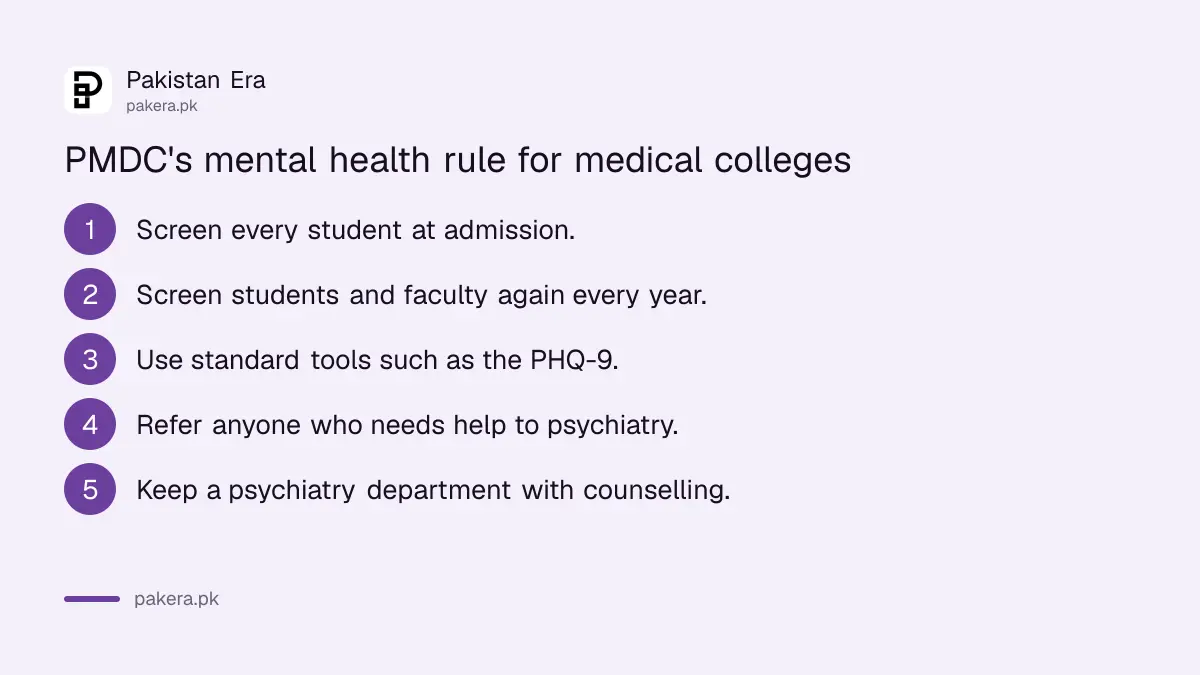
The directive names standard tools such as the PHQ-9, a nine-question depression check. Students who need more help must be referred to the college's psychiatry department. Every college must keep a working psychiatry department with a counselling section, and PM&DC says the duty to prevent psychological harm sits with the institution. If your college has none, that is a gap PM&DC can be told about.
For anyone checking that a doctor treating them is licensed, the PMDC doctor register takes two minutes.
Common questions
When was Pakistan's National Mental Health Policy launched?
At the Global Mental Health Summit in Islamabad on 1 and 2 October 2026. WHO's release on the launch is dated 5 October 2026.
Which years does the policy cover?
2026 to 2035. It is a ten-year federal policy, led by the Ministry of National Health Services, Regulations and Coordination.
Is there a free mental health helpline in Pakistan?
Yes. WHO lists Umang's helpline, 0311-7786264, as Pakistan's suicide crisis contact. In an emergency, call 1122 or 15.
Does the new policy give me free treatment now?
Not directly. No new service or budget has been published yet. Government psychiatry wards already treat patients free or at low cost.
How many people need mental health care in Pakistan?
About 32.4 million, WHO estimates. Only about 5 per cent of people can reach mental health services.
How we verified this
What we checked, where we read it, and what we could not confirm.
Last checked on 6 October 2026. The launch details, figures and quotes come from WHO's release on the policy launch, dated 5 October 2026. Crisis numbers come from WHO's suicide crisis contacts page. The Lahore hospital details come from the Punjab Institute of Mental Health's emergency and contact pages. The medical college rule comes from PM&DC's directive of 29 April 2026 on pmdc.pk. The hub invitation is on the health ministry's home page. We did not call any number. Nothing here is medical advice.
About the author
Public Services and Education Journalist
Fajr Riaz is a journalist and content writer at Pakistan Era, based in Lahore. She covers the questions people meet in everyday life in Pakistan: how a public service works, what a change in the rules means, and where to find a reliable answer.