Advance Tax on Wedding and Function Bills in Pakistan: 10% for Filers, 20% for Non-Filers Under Section 236CB
Section 236CB: halls, hotels and lawns in Pakistan collect 10% advance tax on wedding and function bills, 20% for non-filers. How to pay less and claim it back.
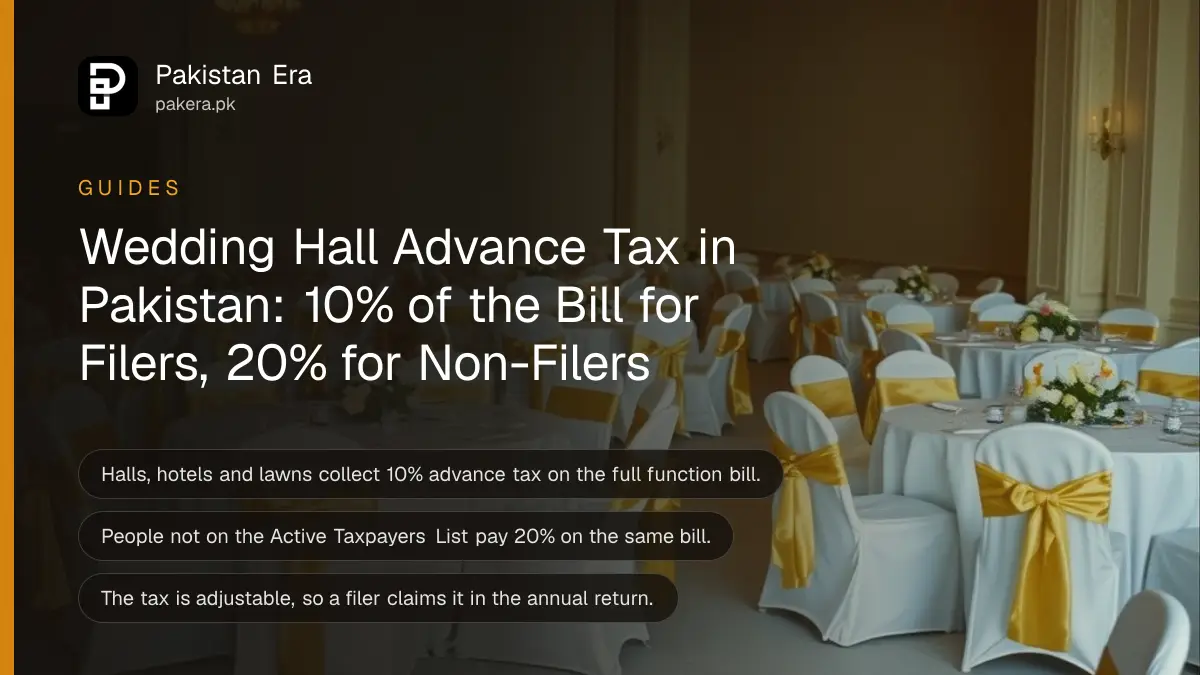
A marriage hall, marquee, hotel, restaurant, lawn or club in Pakistan must collect 10% advance income tax on the total bill for a wedding or any other function, under section 236CB of the Income Tax Ordinance. A person not on FBR's Active Taxpayers List pays double, 20%. The tax is adjustable, so a filer can claim it back against their income tax in the annual return.
Many families see this line on the hall bill and take it for sales tax. It is not. It is federal income tax collected in advance, and it sits on top of any provincial sales tax on the same booking. We read section 236CB, the rate in the First Schedule and the non-filer rule in the Tenth Schedule of the Ordinance as amended up to the Finance Act 2026.
The hall collects 10% on the full function bill
Section 236CB makes the owner, lease-holder, operator or manager of the venue collect advance tax on the total bill from the person who arranges or holds the function. Division XI of Part IV of the First Schedule sets the rate at 10%.
The venues named are marriage halls, marquees, hotels, restaurants, commercial lawns, clubs, community places and "any other place used for such purpose". So a farmhouse booked commercially for a mehndi falls in the same rule as a city hall.
| Bill for the function | Filer on the ATL (10%) | Not on the ATL (20%) |
|---|---|---|
| Rs 300,000 | Rs 30,000 | Rs 60,000 |
| Rs 500,000 | Rs 50,000 | Rs 100,000 |
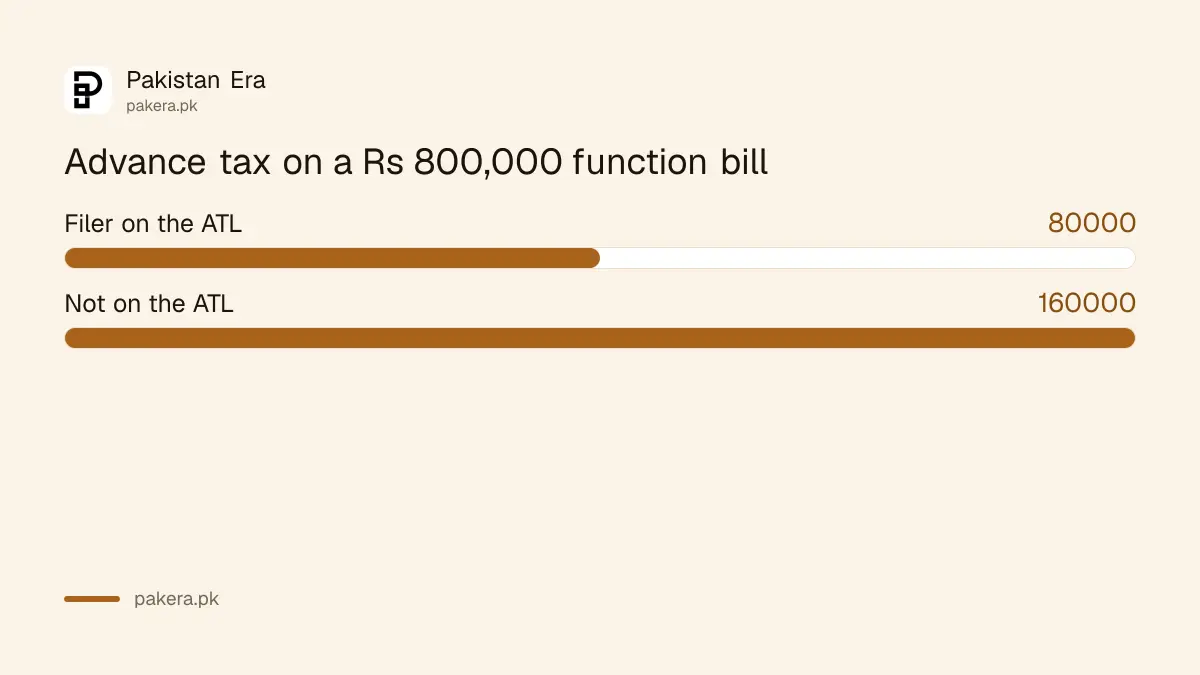
| Rs 800,000 | Rs 80,000 | Rs 160,000 |
| Rs 1,500,000 | Rs 150,000 | Rs 300,000 |
Catering by an outside company is taxed too
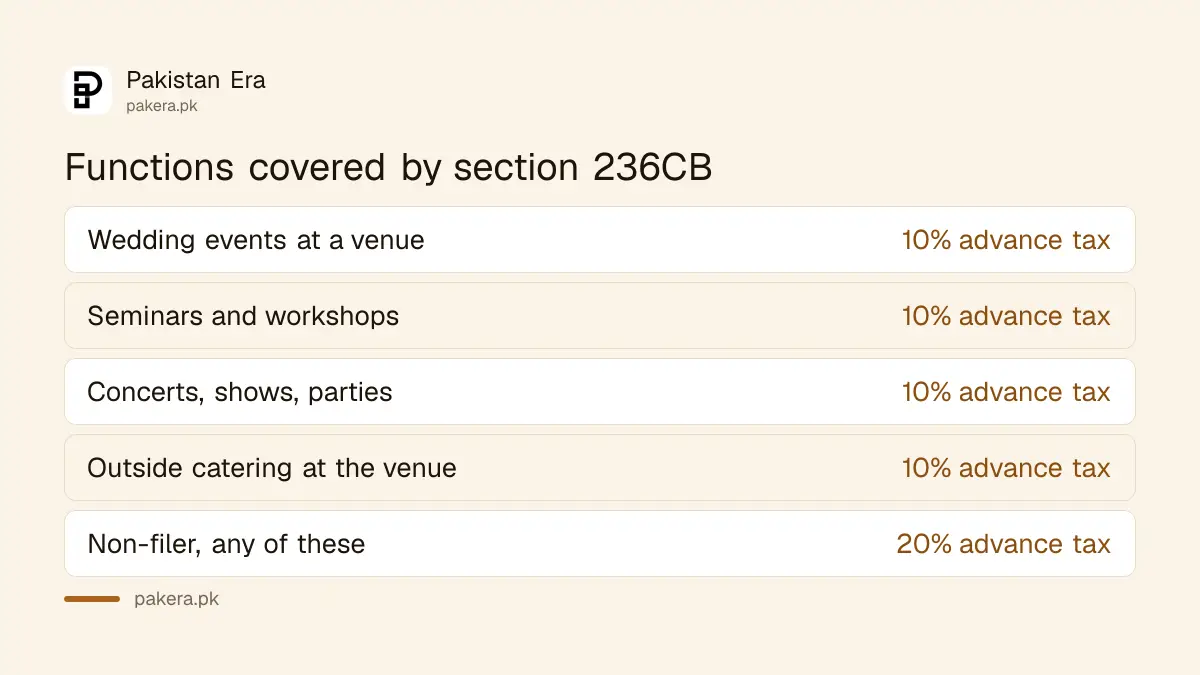
Subsection (2) covers food, services or facilities provided by someone other than the venue. The venue must also collect 10% advance tax on the payment for that food or service, from the person holding the function. Bringing in your own caterer does not move the catering bill outside the tax.
In practice, ask the hall to show both amounts on its receipt: the tax on its own bill and the tax on the outside catering or decor. You need both figures to claim the credit.
Weddings are not the only functions covered
The section defines a function to include any wedding related event, a seminar, a workshop, a session, an exhibition, a concert, a show, a party or any other gathering. A company dinner at a hotel or a training workshop in a banquet hall is covered.
- Wedding events: mehndi, barat, nikah and walima held at a venue.
- Business events: seminars, workshops, sessions and exhibitions.
- Entertainment: concerts, shows and parties.
- Any other gathering held at a hall, hotel, restaurant, lawn, club or community place.
A function held at home with no venue bill is outside the section, because there is no prescribed person to collect it. Provincial sales tax on the hall and caterer is a different law, set by each province.
Non-filers pay 20%, so get on the ATL first
Rule 1 of the Tenth Schedule raises every withholding and collection rate by 100% for a person not on the Active Taxpayers List. That turns 10% into 20%. On an Rs 800,000 wedding, the difference is Rs 80,000, and a non-filer cannot claim the extra back without filing.
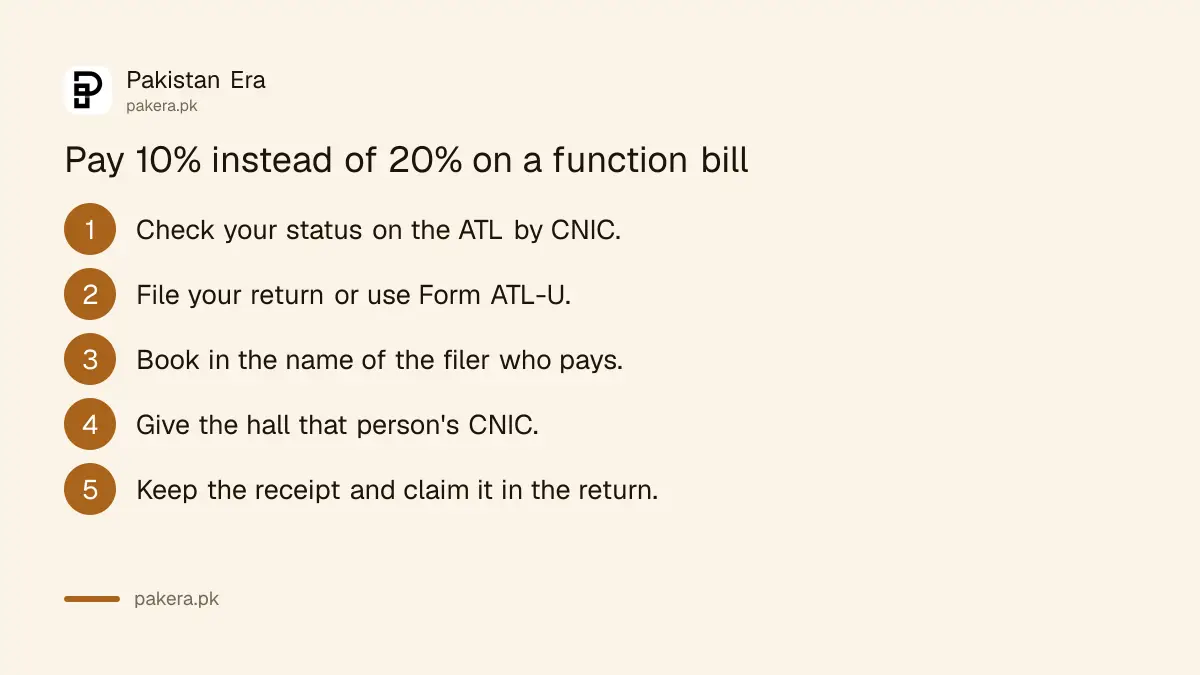
- Check your status on the Active Taxpayers List by CNIC before you book.
- If you are not on it, file your return for the latest tax year. Late filers can use Form ATL-U to join the ATL under the new rules.
- If a family member on the ATL is the one arranging and paying for the function, book the hall in that person's name.
- Give the hall that person's CNIC so the 10% is collected against it.
- Keep the receipt that shows the tax collected.
Rule 2 of the same schedule covers a person who was not required to file a return at all. The venue can notify the Commissioner with that person's details and the reason, and the Commissioner decides within 30 days.
Claim the 10% back in your tax return
Subsection (3) says the tax collected under section 236CB is adjustable. A filer enters it as advance tax paid in the return for the tax year of the function, and it reduces the income tax payable. If it is more than the tax due, it can form part of a refund claim.
The credit only works if the hall actually deposits the tax against your CNIC. Under the Finance Act 2026, a taxpayer gets credit only for tax actually deposited, so check that the amount appears against you before you file. Where it is more than your liability, follow the steps to claim an income tax refund.
Common questions
What is section 236CB tax on a wedding hall bill?
It is 10% advance income tax that the hall, hotel or lawn collects on the total function bill, under section 236CB of the Income Tax Ordinance 2001.
How much is the function tax for a non-filer?
20%. The Tenth Schedule raises the rate by 100% for anyone not on the Active Taxpayers List.
Is the 236CB tax refundable?
It is adjustable. A filer claims it as advance tax in the return, and any excess over the tax due can be part of a refund claim.
Does 236CB apply to a seminar or company dinner?
Yes. A function includes seminars, workshops, sessions, exhibitions, concerts, shows, parties and any other gathering at a covered venue.
Is the 10% charged on outside catering?
Yes. Where food or services come from another person, the venue must also collect advance tax on that payment from the organiser.
Is 236CB the same as sales tax on the hall?
No. 236CB is federal income tax collected in advance. Sales tax on the hall and caterer is a separate provincial tax.
How we verified this
What we checked and where we read it.
Last checked 15 November 2026. Section 236CB, Division XI of Part IV of the First Schedule (rate 10%) and rules 1 and 2 of the Tenth Schedule come from the Income Tax Ordinance 2001 as amended up to the Finance Act 2026, published by FBR. The footnote records that section 236CB was inserted by the Finance (Supplementary) Act 2023, dated 23 February 2023. Worked examples are our own arithmetic.
About the author

Tax, Bills and Technology Writer
Ali Akhtar is a young and curious voice here at Pakistan Era. He is currently pursuing his A-Levels and has a growing interest in Pakistan’s changing industrial landscape and educational trends. Ali likes to write in a way that helps him explain and explore the world around him. His writing reflects the perspective of the new generation navigating the evolving trends of Pakistan where technology, youth innovation, and shifting opportunities are reshaping the country’s future.