Claim Only the Withholding Tax FBR Can See: Excess Credit Now Carries a Penalty in Pakistan
From 1 July 2026 FBR fines you the excess if you claim more withholding tax credit than was deposited. See the rule, blank return papers and readable accounts.
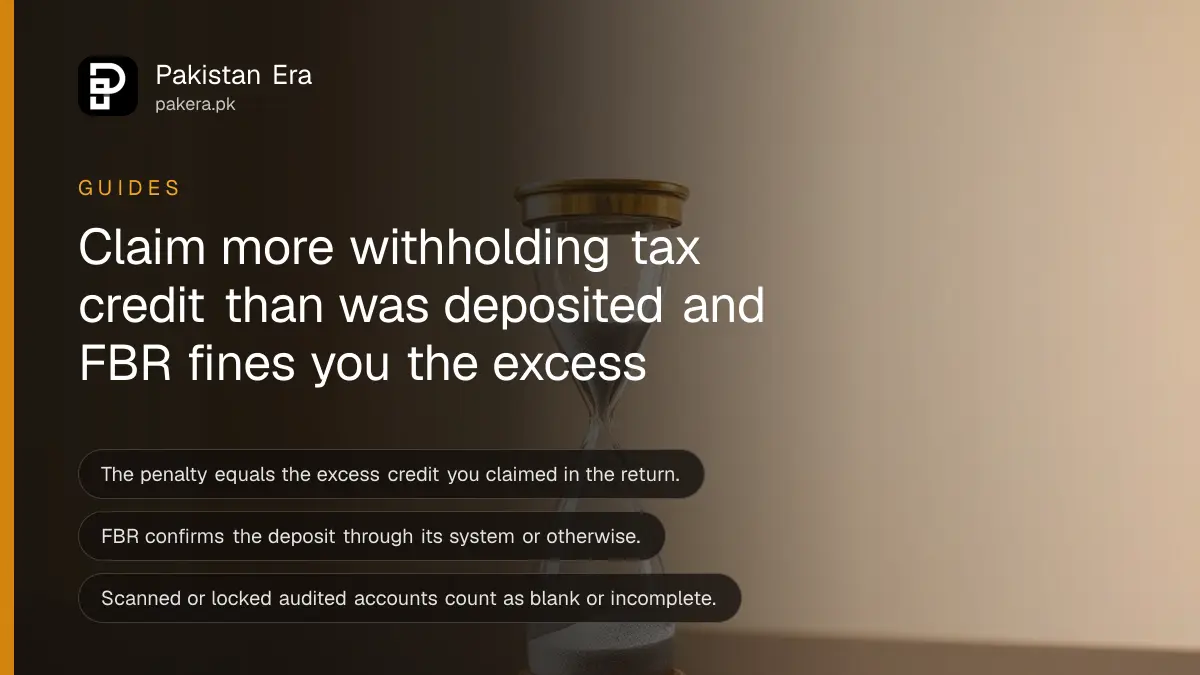
Short answer: From 1 July 2026, if you claim credit in your return for tax withheld at source and the amount is higher than what the withholding agent verifiably deducted and deposited, the penalty equals the excess credit you claimed. The Finance Act 2026 adds this as entry 36 of the section 182 penalty table. Claim only what your records and FBR's system confirm.
When a client, bank or employer deducts tax before paying you, you may claim that tax as a credit in your own return. Some people have claimed more than was deposited. The Finance Act 2026 now attaches a penalty to that.
We read the Act on FBR's own download site on 13 October 2026. This page covers the new credit penalty, a wider penalty for blank or unreadable return papers, and the new rule on how company accounts are filed.
Entry 36 fines an excess credit by the same amount
Entry 36 applies where a person claims credit for tax withheld at source under any provision of the Ordinance, in excess of the amount verifiably deducted and deposited by the withholding agent. The Act says this is confirmed through the Board's computerised system or otherwise.
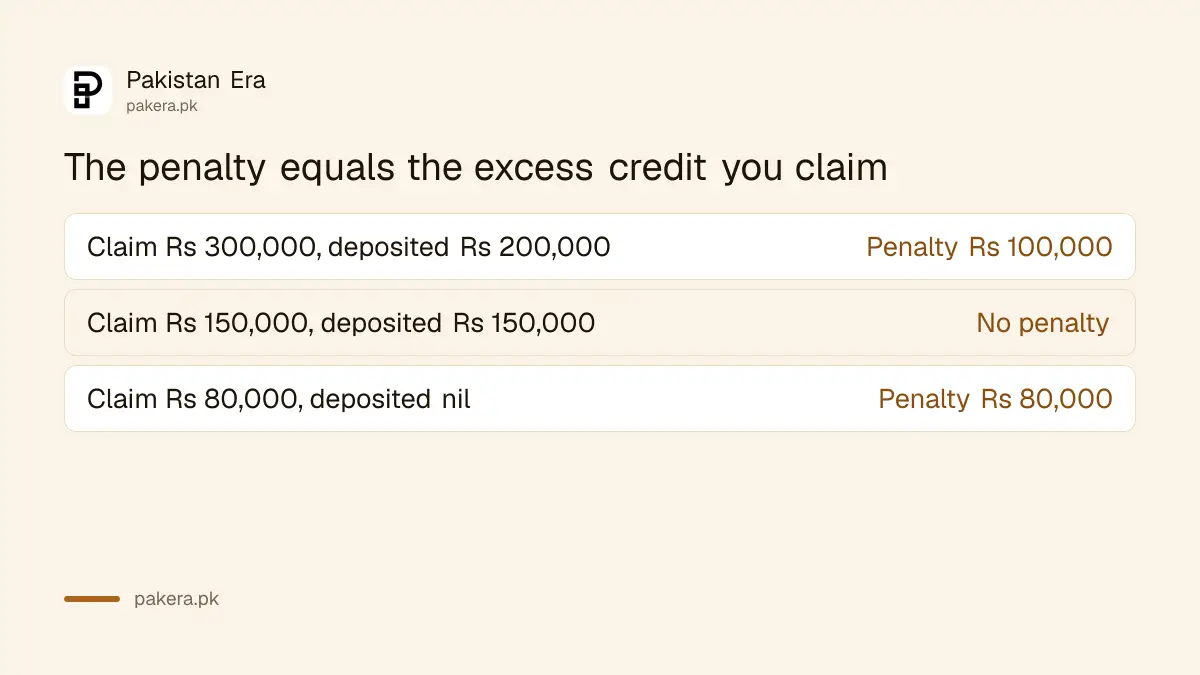
The penalty equals the amount of the excess credit claimed. If you claim Rs 300,000 of credit and only Rs 200,000 was deposited, the excess is Rs 100,000 and so is the penalty. The entry refers to section 168 in the fourth column.
| You claim | Deposited and confirmed | Excess credit | Penalty under entry 36 |
|---|---|---|---|
| Rs 300,000 | Rs 200,000 | Rs 100,000 | Rs 100,000 |
| Rs 150,000 | Rs 150,000 | Nil | Nil |
| Rs 80,000 | Rs 0 | Rs 80,000 | Rs 80,000 |
These figures are our own worked examples of the rule. They are not from FBR.
The risk is a payer who deducts but does not deposit
You may have a certificate or a payment slip that shows tax deducted. If the payer never deposited it, FBR's system will not show it. The Act measures what was verifiably deposited, so a certificate alone may not protect you.
The Act does not say what happens when the payer is at fault. It also does not say whether you can show proof by other means. It says the confirmation is by the computerised system or otherwise. Ask your payer for the deposit details before you file.
Our guide to why your client pays less than the invoice explains the deduction itself. A payer who fails to deduct faces its own penalty, as we explain in the penalty for not deducting withholding tax.
Blank or unreadable papers count as a failed return
Entry 35 penalises a failure to state the particulars in the return form, or filing blank or incomplete annexures. The July 2025 text applied it to a company and an association of persons, with a penalty of Rs 500,000 or 10% of the tax chargeable, whichever is higher.
The Act changes the words in column (2) from company to person, including a company. It also adds an explanation. Audited financial statements filed as image files, scanned documents or password protected files that the tax officer cannot open or read are deemed to be blank or incomplete.
We read no change to the penalty amount. Check the wording of column (3) in the current table, since the Act's amendment touches column (2).
Returns go on IRIS and company accounts must be readable
The Act replaces section 114(2A). A return must be filed electronically on IRIS as the Board prescribes, and the Board may make rules on verification and digital signatures. For companies, from tax year 2026 onwards, the financial statements with the return must be in an electronically readable file format.
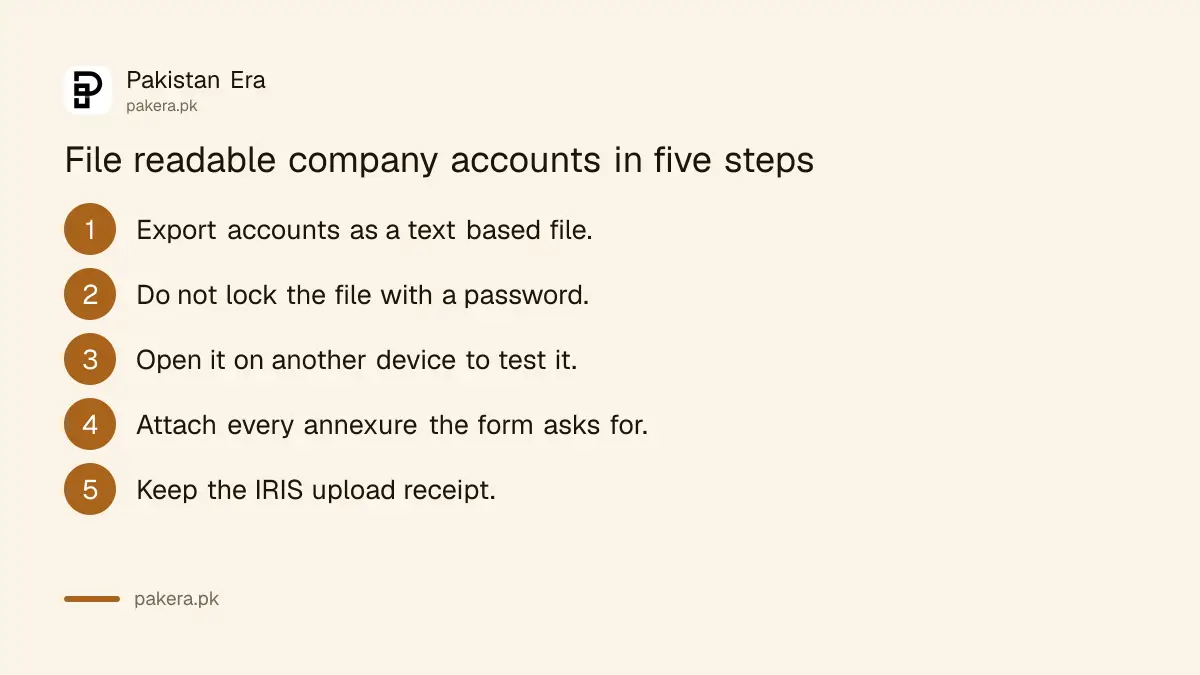
- Export the audited accounts as a text based file, not a photo or a scan.
- Do not lock the file with a password.
- Open the file on another device to confirm it can be read.
- Attach all annexures the return form asks for, with no blank pages.
- Keep the upload receipt from IRIS.
If you need to confirm that a return went through, see how to check your tax return was filed on IRIS. If you find a mistake after filing, you can revise your income tax return.
Common questions
What is the penalty for claiming too much withholding tax credit?
It equals the amount of the excess credit claimed, under entry 36 of the section 182 table added by the Finance Act 2026.
How does FBR check the credit?
The Act says it is confirmed through the Board's computerised system or otherwise.
What if my client deducted tax but did not deposit it?
The entry measures what was verifiably deposited. The Act does not say how a payer's failure is treated, so ask the payer for deposit proof before you file.
Are scanned audited accounts accepted?
The Act deems image files, scans and password protected files that cannot be read to be blank or incomplete.
Does the readable file rule apply to individuals?
The rule on financial statements applies to companies for tax year 2026 and onwards. Entry 35 now speaks of any person.
Where do I file the return?
The Act requires electronic filing on IRIS as prescribed by the Board.
How we verified this
What we checked, where we read it, and what we could not confirm.
Last checked on 13 October 2026, Pakistan time. We read sections 114(2A) and 182 as amended by the Finance Act 2026 and the Ordinance as amended up to 31 July 2025, both on FBR's download site. We found no FBR circular on how entry 36 will be applied, so the process for proving a deposit is unconfirmed.
About the author

Senior Writer, Public Services and Technology
Shahid joined us in 2024 as an author. He is a senior contributor to Pakistan's leading technology websites. He writes detailed articles, mostly covering his expertise in the latest tech, mobiles, apps, gadgets, and step-by-step guides. His ideology is to help people understand the latest trends and explain complex methods through very easy-to-understand guides.