Apply for a Commercial Gas Connection From SNGPL: Documents and 6 Steps
SNGPL commercial gas connections now run on RLNG. See the documents, the six steps from survey to meter and why you must pay only through a bank. Read first.
Short answer: To get a commercial gas connection from SNGPL, file the application form at a regional office or online, with your CNIC, property papers, a recent electricity bill and an active taxpayer record. New commercial connections are on imported RLNG gas. Only stand-alone roti tandoors can still get local gas.
A shop owner who plans a bakery or a restaurant kitchen needs to know one fact before anything else. The gas will not come at the old cheap rate. SNGPL's own page says new commercial connections are being processed on the RLNG tariff. That changes your costing, so read it first.
We read SNGPL's Procedure for Commercial Gas Connection page on 11 October 2026. It shows an update date of 7 October 2026. The company has not printed amounts on that page, so every fee below is "to be told on your demand notice", not a number we can quote.
New commercial connections run on RLNG gas
RLNG means re-gasified liquefied natural gas, which is imported gas and costs more than local gas. SNGPL says new commercial gas connections are processed on the RLNG tariff. Stand-alone roti tandoors that meet its conditions are the exception and get local system gas.
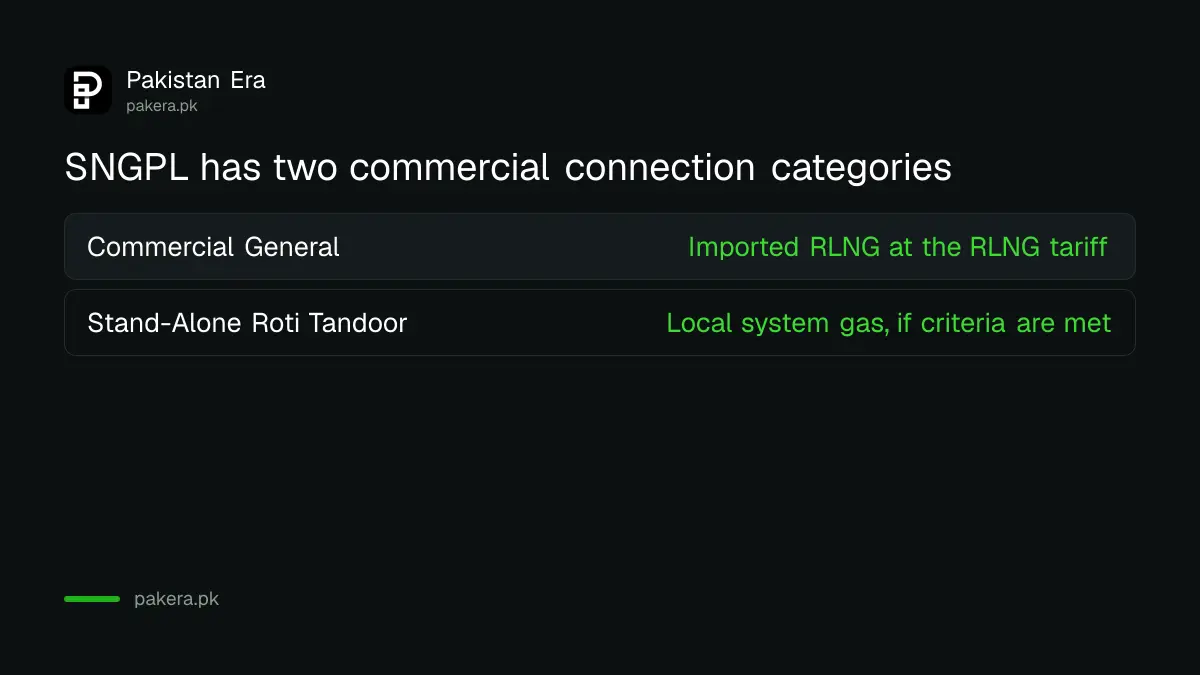
The application form offers two categories. The first is Commercial General (RLNG). The second is Stand-Alone Roti Tandoor, which SNGPL calls Special Commercial on system gas. To qualify for the second one you must be an exclusive roti tandoor business and meet SNGPL's other parameters.
If you run a restaurant that also bakes naan, you are in the general RLNG category. Do not apply as a roti tandoor to get the cheaper gas. SNGPL sets pre-requisite criteria for that category, and a false claim puts the connection at risk.
| Category | Gas type | Who qualifies |
|---|---|---|
| Commercial General | Imported RLNG | Shops, restaurants, offices and other businesses |
| Stand-Alone Roti Tandoor | Local system gas | An exclusive roti tandoor business meeting SNGPL's criteria |
The documents you need before you apply
SNGPL asks for the signed application form, a copy of your electricity bill, a copy of a neighbour's gas bill, your NTN certificate showing active taxpayer or filer status, property papers, your CNIC and, for a rented shop, the landlord's NOC and rental agreement.
The page lists the full set. Gather these before you go to the office:
- Application form, signed.
- Signed copy of an electricity bill for the premises.
- Copy of a neighbouring gas bill.
- NTN certificate or proof you are an active taxpayer or filer. SNGPL marks this mandatory.
- Property documents, such as PT-1 or the registry.
- CNIC copy of the applicant.
- Letterhead, if you have one.
- NOC of the landlord, and the rental agreement, if the premises are rented.
- For a sole proprietor, an affidavit on Rs 100 non-judicial stamp paper. SNGPL gives a specimen with the form.
- For a company, the memorandum and articles with a letter naming the signatory.
The NTN requirement is the one that stops applications. If you are not on the active taxpayer list, fix that first. Our explanation of commercial electricity rates for shops is a useful companion when you price the whole premises.
The six steps from application to meter
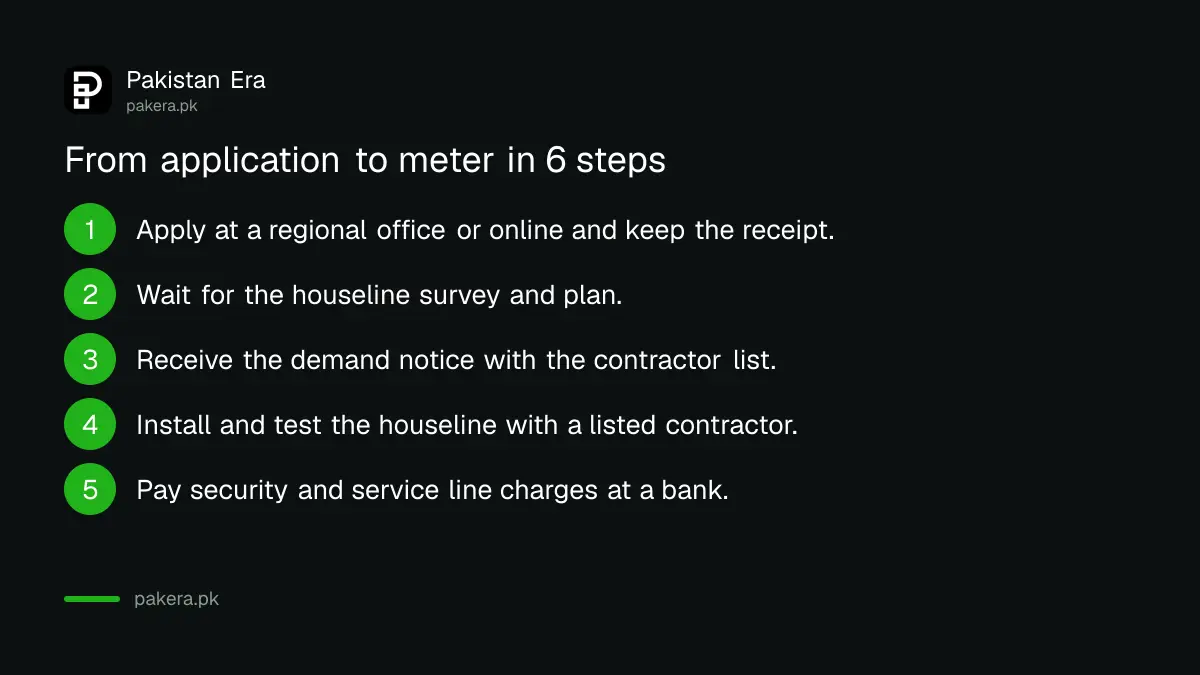
SNGPL lists the steps in order: apply, houseline survey, demand notice, houseline installation, payment of security and service line charges, then the service line and meter. Connections are given on a first come, first served basis once every step is complete.
- Submit the application at the nearest regional office, sub office or customer services centre, or online. Keep the acknowledgement receipt. You will need it for every query.
- Wait for the houseline survey. A company representative visits on a turn or merit basis, checks feasibility and assesses the load. A houseline plan is drawn at that visit.
- Receive the demand notice or proposal letter. It comes with the houseline plan and a list of SNGPL's registered houseline contractors for your region.
- Install the houseline at your own cost and risk, using a contractor from that list, who tests it and issues a certificate.
- Sign the RLNG supply contract, take it with the plan, certificate, CNIC and property papers to the office, get the challan, and deposit the security and service line charges at the designated bank or online channel.
- SNGPL installs the service line and the meter.
The security amount is set from estimated consumption and working hours. Service line charges depend on the length of pipe and the materials used. That is why SNGPL cannot print one price for everyone.
Pay only through the bank and ignore agents
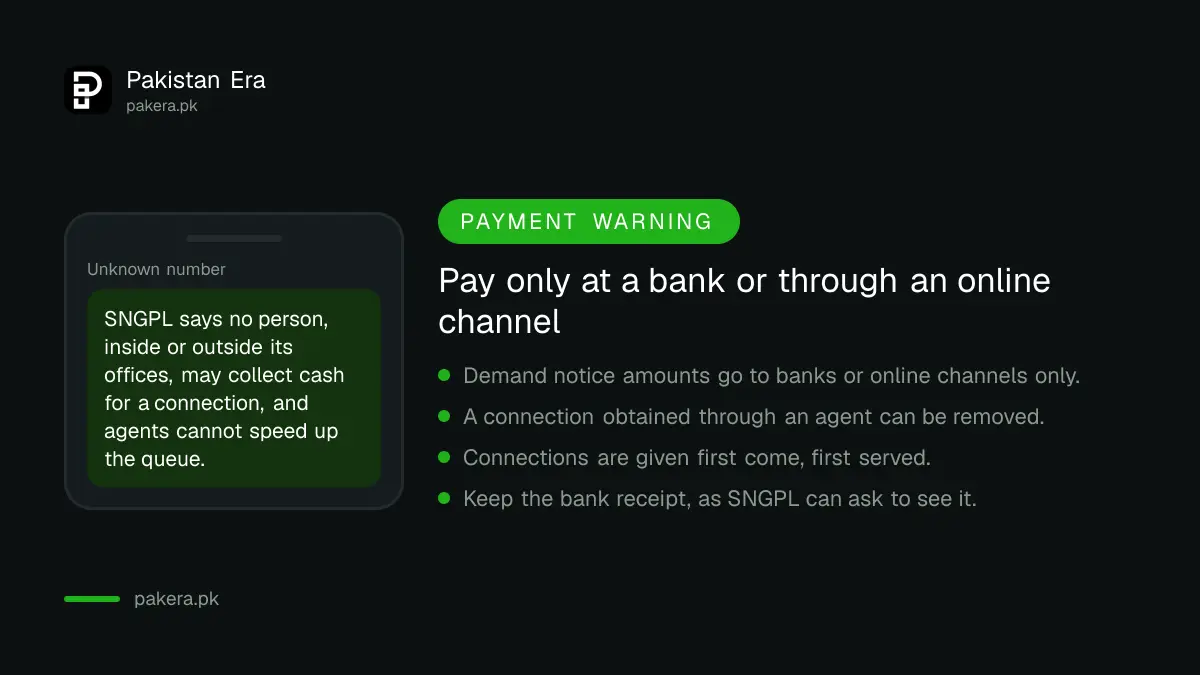
SNGPL says demand notice amounts are paid only at banks or through online channels. No person inside or outside its offices is authorised to collect cash, and it warns that paying an agent to speed things up is a waste and legally actionable.
The warning on the page goes further. A connection obtained through a tout can be removed, and SNGPL says it lodges FIRs in such cases. Keep the bank receipt in a safe place, because SNGPL can ask to see it at any time.
A tout may offer to "arrange" the houseline survey or jump the queue. Say no. If a staff member asks for cash, note the name and report it through the company's complaint channel. The steps for filing are in the SNGPL and SSGC gas complaint guide.
After the meter: first bill and running costs
SNGPL's page includes a First Bill section and an Application Status tracker. Once connected, your bills follow the commercial category, and the RLNG price is notified by OGRA every month, so expect the rate to move.
Plan for that. A fixed monthly cost is not guaranteed on RLNG. If your margin is thin, work out your gas use per day first. Domestic and commercial bills also differ in how they treat a stuck meter or low use, as explained in the four SNGPL bill types.
A home that wants a connection should read how to get a new gas connection from SNGPL or SSGC instead, because domestic rules and queues differ.
Common questions
Can I get a commercial gas connection on local gas?
Only a stand-alone roti tandoor can. SNGPL says other new commercial connections are processed on imported RLNG at the RLNG tariff.
Is an NTN compulsory for a commercial connection?
Yes. SNGPL marks the NTN certificate or active taxpayer or filer proof as mandatory on its document list.
How much is the security deposit?
SNGPL's page does not print an amount. The demand notice sets security from estimated consumption and working hours, and service line charges from pipe length and materials.
Can I apply online?
Yes. SNGPL says it introduced online submission of commercial applications through its website, and the form is also at regional offices and customer services centres.
Can I pay a contractor to speed things up?
No. SNGPL says connections go on a first come, first served basis, and a connection obtained through an agent can be removed.
How we verified this
What we checked, where we read it, and what we could not confirm.
Last checked on Sunday 11 October 2026. We read the SNGPL Procedure for Commercial Gas Connection page, which shows an update date of 7 October 2026. We did not submit an application, so we cannot describe the online form screens. SNGPL does not print fees on the page, so none are quoted here.
About the author

Global Affairs & Political Economy Writer
Muhammad Hatim is a book lover who started writing because he enjoys it. At Pakistan Era he writes about international relations, geopolitics and the global economy, with a particular interest in South Asia and the forces behind current events.