Why Your SNGPL Gas Bill Is Estimated, Minimum or Stuck Meter, and How to Fix It
SNGPL issues four gas bill types: normal, estimated, minimum and stuck meter. See what each means, what it is based on and how to challenge a wrong bill.
Short answer: SNGPL issues four kinds of gas bill: normal, estimated, minimum and stuck meter. An estimated bill means nobody could read your meter. A minimum bill means you used little or no gas. A stuck meter bill means the meter stopped recording. Each one has its own fix.
You open the envelope and the bill looks wrong. The number is high, or it is the same as last month, or you were away for weeks and still owe money. Before you call anyone, find out which of the four bill types you were given. The answer decides what you do next.
We read the Types of Bill page on the Sui Northern Gas Pipelines Limited (SNGPL) website on 11 October 2026. This guide follows that page. It is for SNGPL customers in northern Pakistan. SSGC customers in Sindh and Balochistan are billed by a different company, so check its pages for them.
SNGPL bills fall into four types
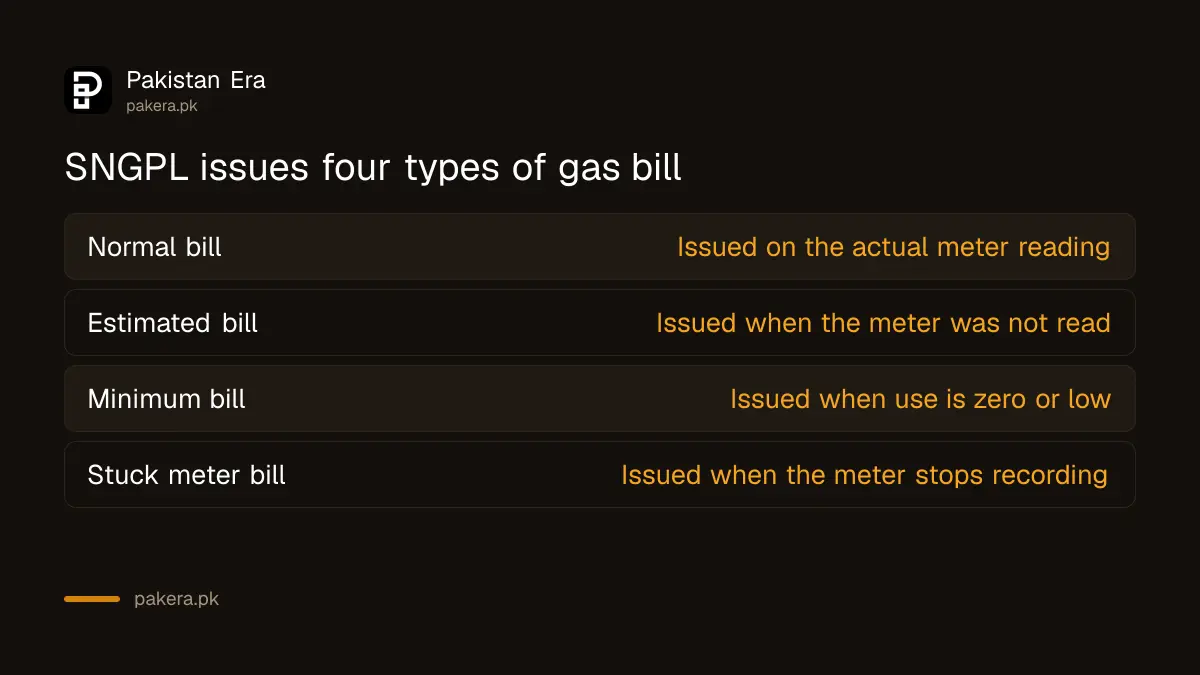
SNGPL says every gas bill is one of four types: normal, estimated (also called provisional), minimum, or sticky or stopped meter. The type depends on whether the meter was read, whether you used gas, and whether the meter works.
| Bill type | When SNGPL issues it | What it is based on |
|---|---|---|
| Normal | The meter was read | The actual reading, at OGRA rates |
| Estimated (provisional) | The meter could not be read | Same period last year, the last bill, or the local trend |
| Minimum | Use was zero or below the set limit | The minimum charge for your category |
| Sticky or stopped meter | The meter is not recording gas | An average of past use |
An estimated bill means the meter was not read
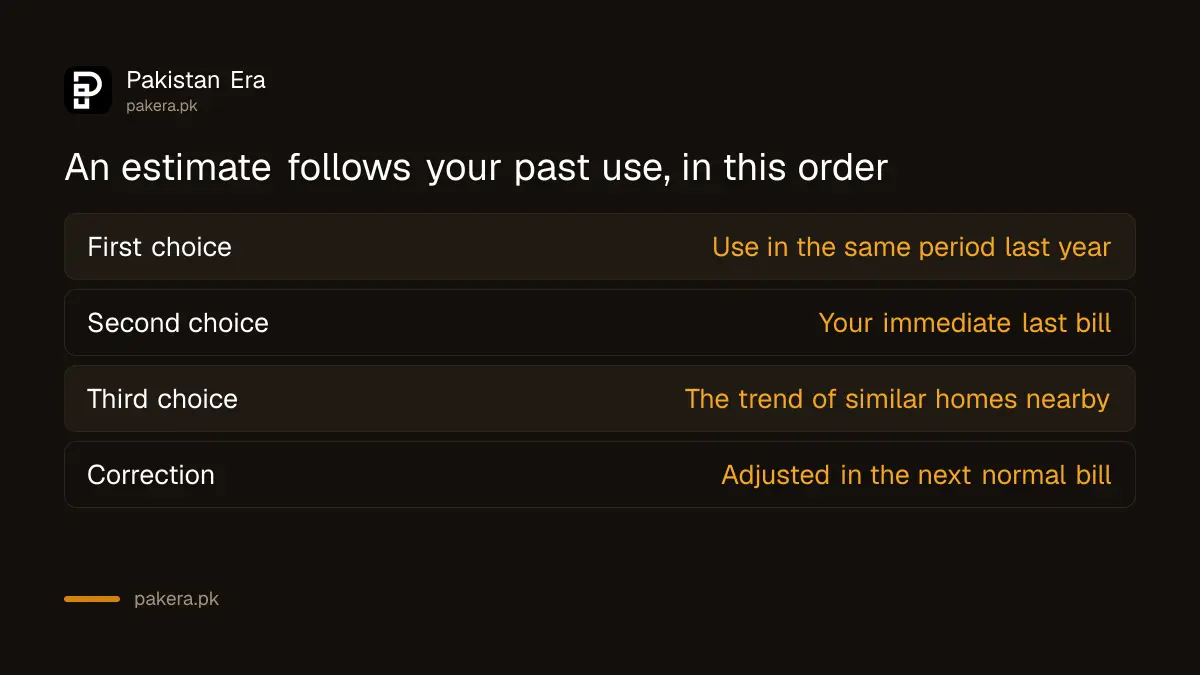
SNGPL issues an estimated bill when its meter reader cannot record the actual reading. It is based on your use in the same period last year, your last bill, or the trend of similar homes nearby. The next normal bill corrects it.
The reasons SNGPL lists are plain and mostly about access. The meter glass is dirty or misty. There is water inside the meter, or rain water around it. The meter is covered in dust or bushes. It is fixed too high, or it sits in a place the reader cannot reach. The meter is locked inside the premises, or the reader could not find the house.
Many of these are things you can fix. Clean the glass. Cut back the plants. Move whatever blocks the meter box. If the meter is inside a locked gate, leave a way for the reader to see it. Fixing access is the cheapest cure for repeat estimated bills.
An estimate can be too high. If your use last winter was heavy and you were away this winter, the estimate follows last year, not your life. SNGPL says an estimated bill is adjusted in the next normal bill once an actual reading is available. Pay what you can and keep the receipt, then check the adjustment line on the following bill.
A minimum bill is a charge for zero or low use
A minimum bill is issued when your use is nil or below the prescribed limit. SNGPL says the charge follows rates notified by OGRA, the Oil and Gas Regulatory Authority, and excludes meter rent and sales tax. You pay it even if you burned no gas.
This is the bill people find most unfair, because the house was empty. It is not a mistake. It is a standing charge for having a connection. The only way to avoid it is to have the connection formally disconnected, which brings its own steps and a later reconnection process, explained in how to restore a gas connection with SNGPL or SSGC.
One warning on figures. The SNGPL page prints a domestic minimum charge of Rs 172.58 a month, and the section shows "Updated: 17-11-2020". We would not rely on that number. OGRA's gas price notification of July 2025 is the current rule, and it is a scanned document that we could not read line by line. For the fixed charges now in force, see the winter gas slab rates.
A stuck meter bill is an average, not your real use
When a meter is sticky or stopped, SNGPL bills a domestic customer on seasonal average use, either the summer or the winter average. For commercial and industrial customers it uses the average of the previous two months or the following two months, whichever is higher.
The commercial rule comes from the Gas Sales Agreement, according to SNGPL's page. That "whichever is higher" wording matters for a shop owner. A meter that stopped in a quiet month can still be billed at a busy month's level.
A stuck meter is a fault in SNGPL's equipment as far as most customers can tell. Report it in writing the day you notice it. The steps for getting it tested and replaced are in how to complain about a gas meter.
How to challenge a bill you think is wrong
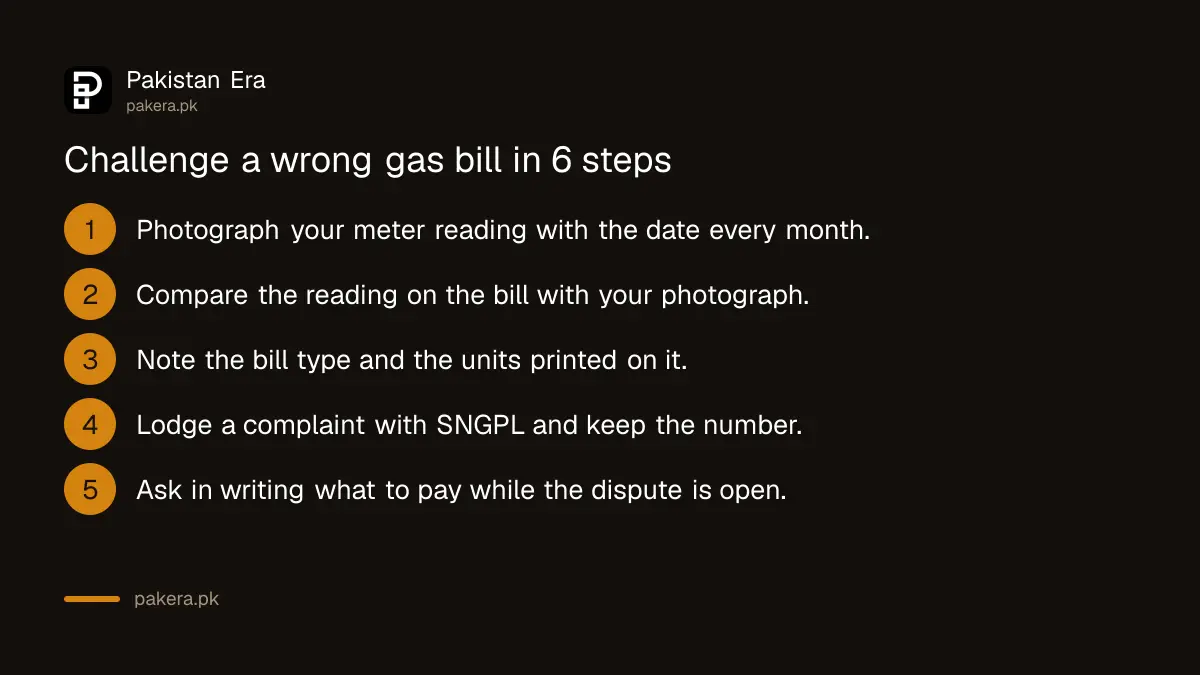
Lodge a complaint with SNGPL first, through the 1199 helpline or the Lodge Complaint form on its website. Ask for a meter check and a corrected bill. If the company does not resolve it, you can take the complaint to OGRA.
- Photograph your meter reading with the date visible, every month, before the reader comes.
- Compare the reading on the bill with your photograph.
- Note the bill type and the consumption units printed on it.
- Lodge a complaint with SNGPL and keep the complaint number.
- Ask SNGPL in writing what you should pay while the dispute is open, and keep every receipt.
- If SNGPL does not fix it, write to OGRA's Registrar with your papers.
OGRA's Consumer Affairs page says its designated officers decide such complaints and that decisions are typically reached within 90 days. Officers sit in Islamabad, Karachi, Quetta, Lahore, Multan and Peshawar. The full complaint process, with the portal and helpline, is laid out in the SNGPL and SSGC gas complaint guide.
Know how a normal bill is worked out
A normal bill uses the actual meter reading and OGRA's notified rates. For domestic users the rate depends on a slab, and for commercial users SNGPL says a pressure factor is applied to correct the volume of gas consumed.
The page says industrial and bulk customers also get temperature and super compressibility factors applied. Those corrections are for large meters and do not touch a home bill. If you want to estimate your own bill before it arrives, SNGPL offers a Bill Estimator, and a separate guide on the SNGPL email bill, SMS alert and estimator shows how to use it.
Common questions
Why is my SNGPL gas bill the same every month?
A repeated amount usually means an estimated or minimum bill. SNGPL issues an estimate when the meter cannot be read, and a minimum charge when your use is zero or low. Check the units on the bill against your meter.
Will an estimated bill be corrected?
Yes. SNGPL says an estimated bill is adjusted in the next normal bill when an actual reading is available. Check that the next bill shows the adjustment before you pay it.
Do I pay a minimum bill if I was away?
Yes, while the connection is live. The minimum bill is a charge for the connection, not for gas used. Only a formal disconnection stops it.
What is a stuck meter bill based on?
For homes, SNGPL uses a seasonal average, summer or winter. For commercial and industrial users it uses the higher of the previous two or following two months, as per the Gas Sales Agreement.
Where do I complain about a wrong gas bill?
Call SNGPL on 1199 or use the Lodge Complaint form on its website. If it is not resolved, file a complaint with OGRA's Registrar, which forwards it to a designated officer.
How we verified this
What we checked, where we read it, and what we could not confirm.
Last checked on Sunday 11 October 2026. We read the Types of Bill page on the SNGPL website and the Consumer Affairs page on ogra.org.pk. We did not test a bill or a meter ourselves. The minimum charge figures on SNGPL's page are dated 2020, so we have not repeated them as current.
About the author

Global Affairs & Political Economy Writer
Muhammad Hatim is a book lover who started writing because he enjoys it. At Pakistan Era he writes about international relations, geopolitics and the global economy, with a particular interest in South Asia and the forces behind current events.