Apply for the HEC Research Awards 2026-27: Up to Rs 1 Million, Deadline 31 October
HEC invites applications for its Research Awards 2026-27 until 31 October 2026. See the three prizes, who is eligible and the five documents you must upload.
Short answer: HEC is taking applications for its Research Awards 2026-27 until 31 October 2026. Best Researcher and Best Young Researcher each pay Rs 500,000. Best Publication pays Rs 1,000,000. You apply online at research.hec.gov.pk with a two-page CV, three endorsement letters, your publications and a short video.
The three awards are separate, and a book or article that won before cannot win again. Pick the one category that fits you, because HEC lets a person who qualifies for both researcher awards apply for only one of them.
We read the HEC Research Awards pages on 12 October 2026: the introduction, the eligibility criteria and the how-to-apply page. HEC's own call for applications is a separate PDF that we have not reproduced here, so check it for the exact forms.
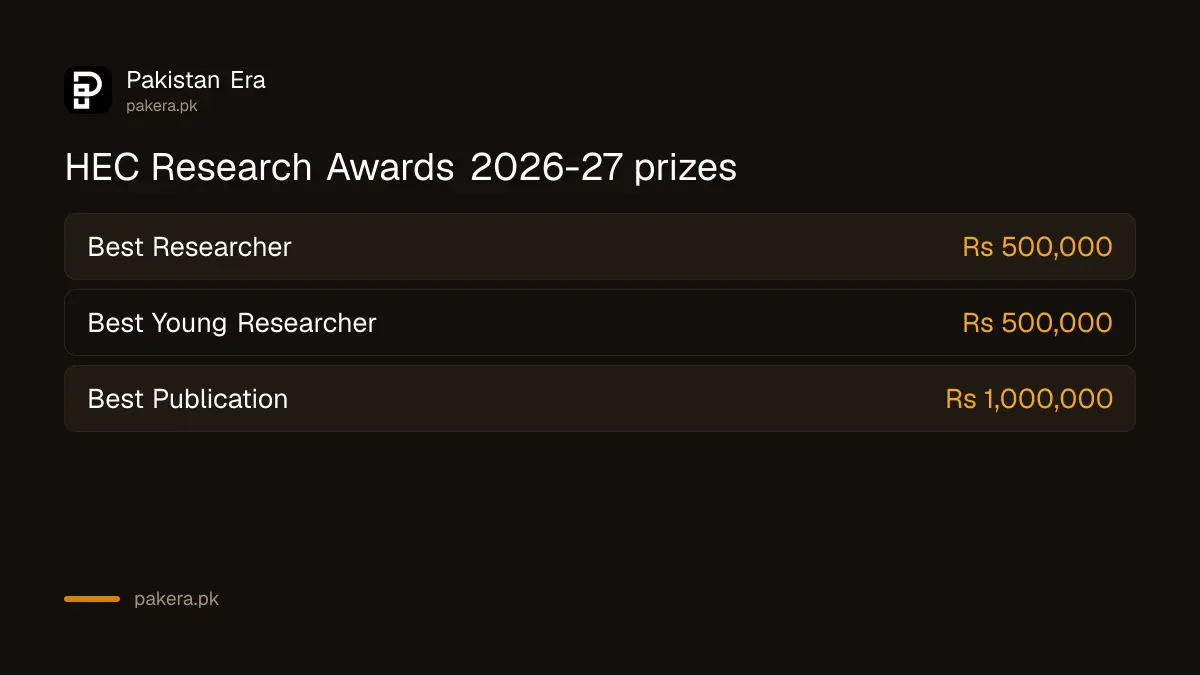
HEC offers three awards worth Rs 500,000 to Rs 1,000,000
The Research Awards recognise research excellence and work with a real impact on people. Each award carries a certificate and a cash prize. The prizes are given in three subject areas, so a social scientist does not compete with an engineer.
| Award | Prize | Who it is for |
|---|---|---|
| Best Researcher | Rs 500,000 | A researcher judged to have made the highest quality contribution over time |
| Best Young Researcher | Rs 500,000 | An early-career researcher under 40 with promise |
| Best Publication | Rs 1,000,000 | A book or journal article likely to have the greatest impact |
The three subject areas are social sciences, arts and humanities, law, education, management and public policy; physical sciences, engineering, technology, computer science, statistics and mathematics; and life, biological and health sciences, pharmacy, agriculture and veterinary sciences.
Your age, residence and record decide which award you can enter
HEC sets general conditions for everyone and extra conditions for each award. Read both before you spend time on the file. A missed condition ends the application.
For every applicant, HEC says you must never have been blacklisted by HEC, and you must not have received the same award earlier. None of your publications may be plagiarised under the HEC plagiarism policy.
| Award | Extra conditions on HEC's page |
|---|---|
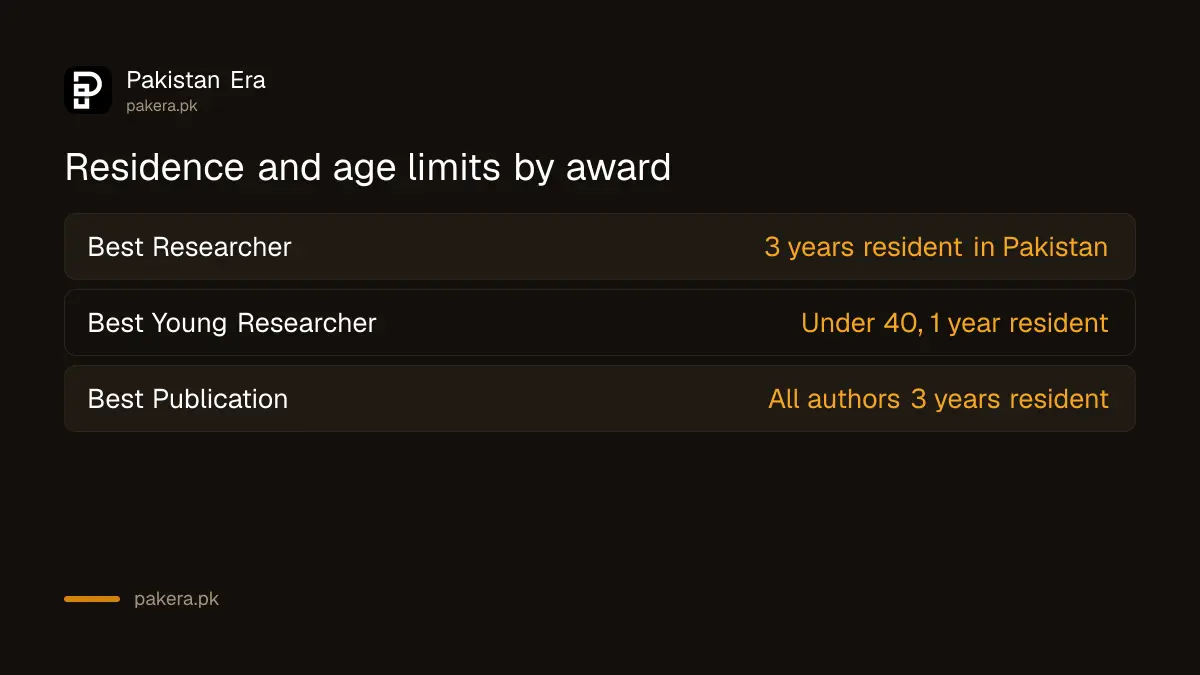
| Best Researcher | Resident of Pakistan for at least three years at the closing date |
| Best Young Researcher | Under 40 at the closing date and resident of Pakistan for at least one year |
| Best Publication | Book or journal article, published within three years before the closing date, no more than three authors, all authors resident in Pakistan for at least three years |
An article entered for Best Publication must be in an HEC-recognised W-category journal and must have at least 100 citations. A book must come from a recognised academic press. A publication that was submitted before in the same category cannot be sent again.
Five documents make up a complete application
All applications go through HEC's online portal, research.hec.gov.pk. You fill every section of the form and upload the mandatory documents in PDF. Incomplete or late applications are not considered.
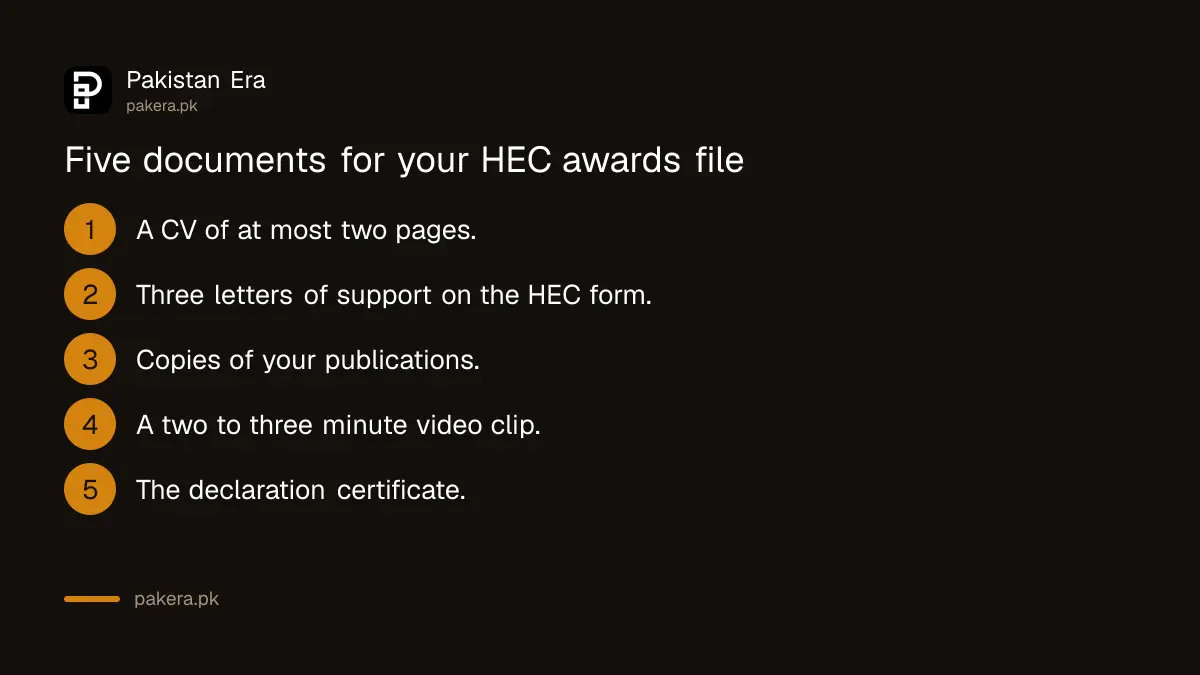
- A curriculum vitae of at most two pages, listing personal details, education and jobs, research projects, publications, patents, honours and service.
- Three letters of support from three endorsers, on the prescribed endorsement form.
- Copies of the publications that support what you claim, such as articles, books and patents.
- A video clip of two to three minutes that shows the lasting impact of your research.
- A declaration certificate.
Start the endorsement letters first because they depend on other people
Three endorsers on a prescribed form is the slowest part. Ask early and send each endorser your CV and the two or three publications that matter most. A letter that names a specific result is stronger than a general one.
The video is the part most applicants leave to the last night. Two to three minutes is short. Say what the research found, who it helped or could help, and why it will last. Do not read your CV.
Keep the PDFs clear and small enough to upload. Test the portal login now, not on 31 October, so that you find any account problem while there is still time.
Other HEC research money is open or closing at the same time
The awards reward past work. HEC also funds new work and research visits. If you are building a case for future years, look at the call for the NRPU research grant outline due 30 October, which pays for a new project.
Researchers who want to work with a U.S. lab can look at the IRSIP scholarship for research visits. A wider list of what closes this month is in the roundup of HEC scholarships closing in October.
Common questions
What is the deadline for the HEC Research Awards 2026-27?
31 October 2026. HEC's page says the call is live now and gives that date for submission.
How much does each award pay?
Best Researcher and Best Young Researcher pay Rs 500,000 each. Best Publication pays Rs 1,000,000.
Can I apply for both Best Researcher and Best Young Researcher?
No. HEC says an applicant who is eligible for both can apply for only one of them.
Do I need to live in Pakistan?
Yes. Best Researcher needs three years of residence at the closing date. Best Young Researcher needs one year. Best Publication needs all authors to have three years.
Is there an application fee?
HEC's pages that we read do not mention a fee. Check the call for applications PDF before you submit.
Where do I submit the application?
Only online, at the HEC research portal, research.hec.gov.pk. Paper applications are not part of the process on HEC's page.
How we verified this
What we checked, where we read it, and what we could not confirm.
We read the HEC Research Awards introduction page, its eligibility criteria and its how-to-apply page on 12 October 2026. The application itself is made at the HEC research portal. The advertisement and guidance PDFs were linked from HEC's page and not reproduced here. Confirm every date with HEC before you submit.
About the author

Global Affairs & Political Economy Writer
Muhammad Hatim is a book lover who started writing because he enjoys it. At Pakistan Era he writes about international relations, geopolitics and the global economy, with a particular interest in South Asia and the forces behind current events.