Apply for an HEC NRPU Research Grant 2026-27: Outline Due 30 October, No Fee
HEC's NRPU 2026-27 call takes outlines until 30 October 2026, and the Rs 5,000 fee is waived. See the domains, who can lead a proposal and how to apply.
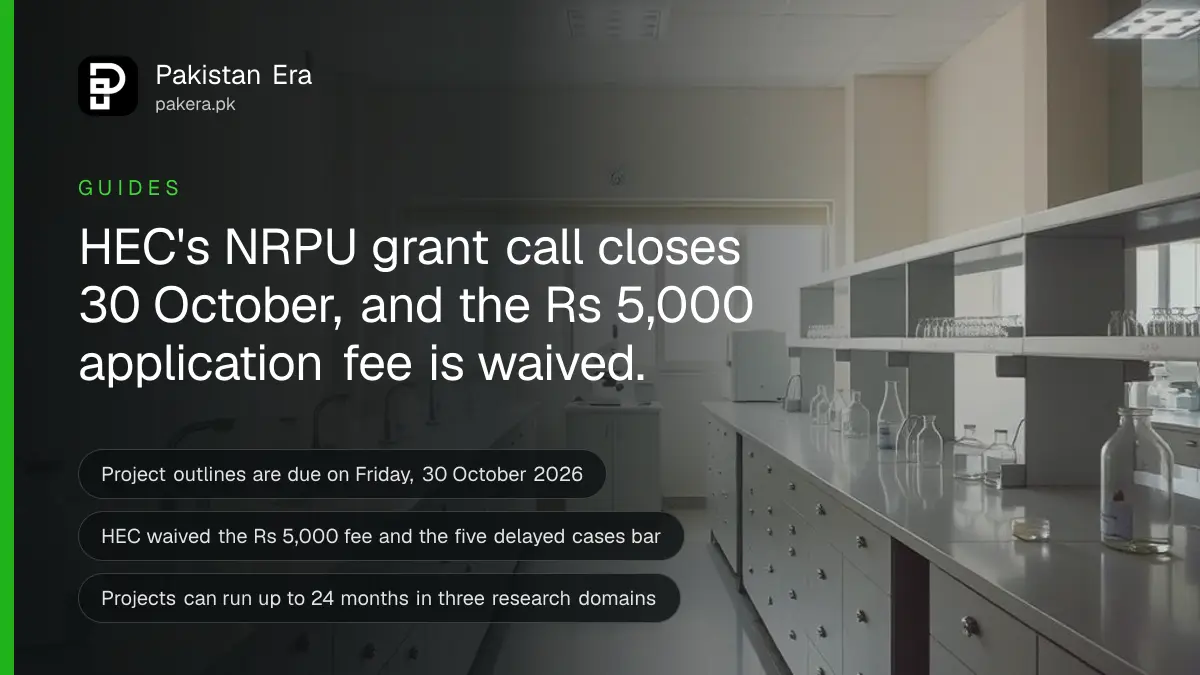
HEC's National Research Program for Universities (NRPU) is taking project outlines for 2026-27 until Friday, 30 October 2026. A later notice from HEC removed the Rs 5,000 application fee and lifted the ban on universities with more than five delayed NRPU cases.
NRPU is HEC's main competitive research grant. You apply as a faculty member, through your university, in two stages. This is a call for researchers, not students.
We read HEC's NRPU pages, the advertisement, the corrigendum and the updated FAQ sheet on hec.gov.pk on 7 October 2026. Here is what to do before 30 October.
The first-stage outline is due on Friday, 30 October 2026
The call asks for a short project outline, not a full proposal. You submit it on the HEC online portal. HEC's advertisement gives the deadline as Friday, 30 October 2026. It does not give a closing time, so submit at least a day early.
HEC's FAQ sheet says "Monday, October 30, 2026". That day is a Friday in 2026, and the advertisement says Friday, so we use Friday. If you are unsure, email the NRPU office before you plan around the weekend.
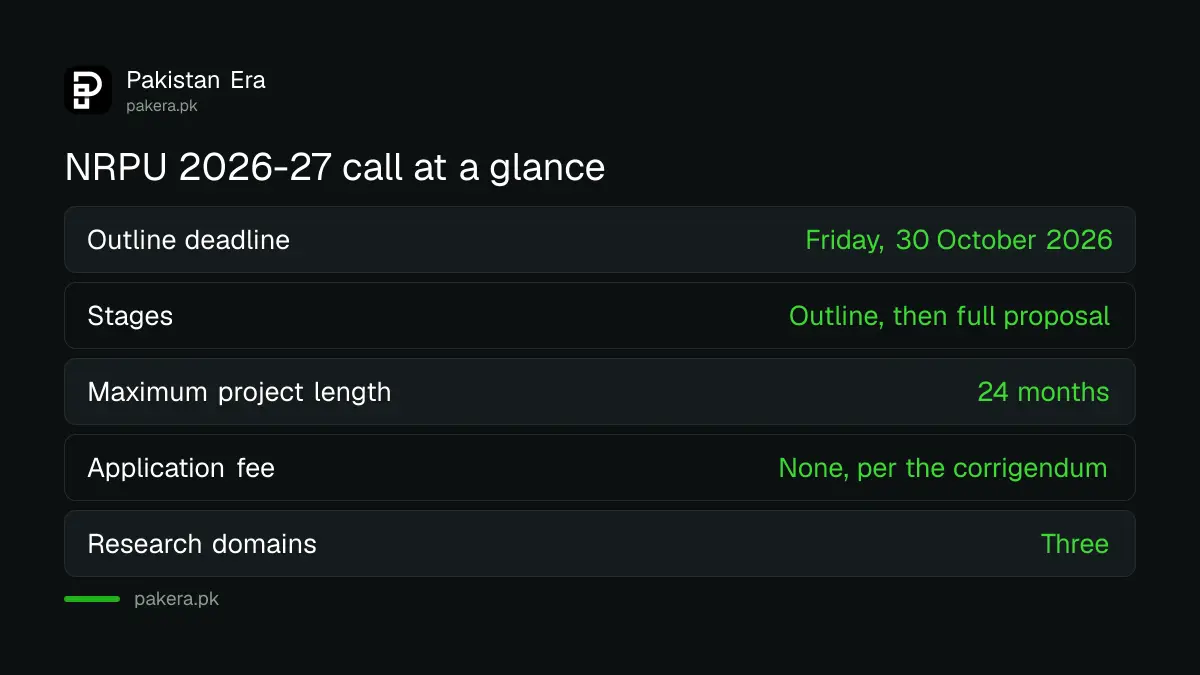
| Item | What HEC says |
|---|---|
| Call published | 6 September 2026, per the corrigendum |
| Outline deadline | Friday, 30 October 2026 |
| Stages | Two: outline first, full proposal if shortlisted |
| Maximum project length | 24 months |
| Application fee | None, after the corrigendum |
| Where to submit | HEC online portal for NRPU |
The application fee is gone and the delayed cases rule is relaxed
HEC's corrigendum says no application fee will be charged under this call. The original advertisement asked for Rs 5,000 through 1LINK or 1-Bill. If you saw that figure on an older notice, ignore it.
The same corrigendum relaxes one more rule. The original call barred universities with more than five delayed or unsettled NRPU cases. Now all universities can apply, as long as they meet every other condition. HEC says all other terms stay unchanged.
That second change helps researchers at universities that were shut out. It does not help a researcher whose own earlier project ran late. HEC's eligibility page still says a lead researcher with significant delays in an earlier project, more than two years beyond the timeline, is ineligible.
Pick one of three research domains
The call has three eligible domains: Social, Behavioral, Economic and Human Sciences; Natural and Emerging Sciences; and Product, Process and Technology Development. Choose the one that matches your project before you write anything.
- Social, Behavioral, Economic and Human Sciences is an open call for basic research.
- Natural and Emerging Sciences has thematic areas tied to national priorities and new technologies.
- Product, Process and Technology Development has problem-oriented themes, and industry collaboration is mandatory.
HEC says funding is meant for high quality, innovative, interdisciplinary and solution-oriented research that matters to Pakistan's economy, industry and society. A proposal that fits the domain but misses that national relevance is the one most likely to be weak.
Who can lead a proposal as Principal Investigator
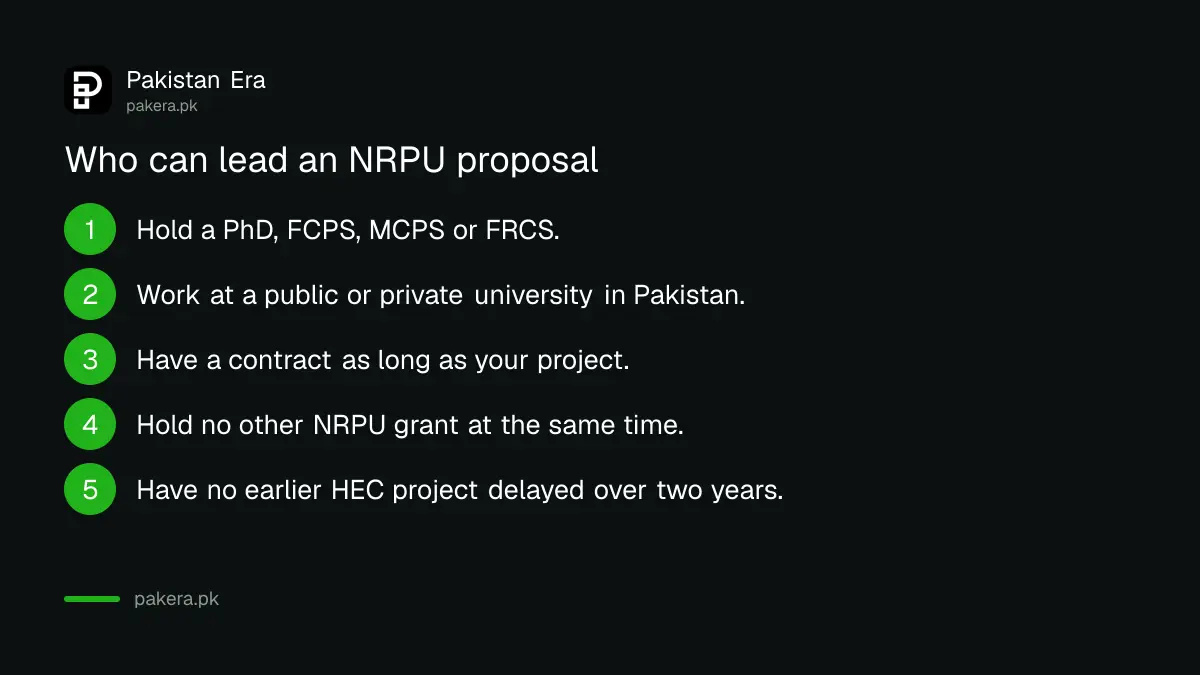
The Principal Investigator (PI), who leads the project, must be a faculty member with a PhD or an FCPS, MCPS or FRCS, working at a public or private higher education institution in Pakistan. The contract must run at least as long as the project.
- You hold a PhD, FCPS, MCPS or FRCS.
- You work at the institution on a regular or contract basis, and the contract is not shorter than your project.
- You hold no other NRPU grant. A PI can hold only one NRPU grant at a time.
- Your earlier HEC projects were not delayed by more than two years beyond the plan.
- Your university is eligible. After the corrigendum, the five delayed cases limit no longer applies.
The grant goes to the host institution of the lead researcher and is run through its ORIC, the university's research office. Teams can include faculty from several departments or universities, and HEC prefers collaboration with industry. Private companies in a team get no money from the grant.
MS, MPhil and PhD students can work on the project, according to HEC's FAQ sheet. Early-career researchers are encouraged to apply if they meet the criteria. A faculty member on more than one NRPU project gets an honorarium for only one.
How the two stages work and how to submit your outline
HEC reviews outlines blind, using a panel of subject experts. Shortlisted researchers are then asked to send a detailed proposal on the same portal. The full proposals get a second expert review, and HEC's competent authority approves the awards.
- Choose your domain and check the eligibility page on the NRPU section of hec.gov.pk.
- Agree your team, and add an industry partner if you chose Product, Process and Technology Development.
- Write the outline: the problem, objectives, method, expected outcomes and national relevance.
- Check similarity and AI content. HEC's FAQ sheet says a 19 per cent similarity index and a 25 per cent AI content threshold are acceptable.
- Get your university's research office ready to support you.
- Submit the outline on the HEC online portal before 30 October 2026.
HEC says a strong proposal shows originality, scientific merit, national relevance, clear objectives, a workable method and a plan to build capacity. Pakistani researchers are also encouraged to submit joint proposals with partners abroad, in countries such as Saudi Arabia, Türkiye, China, the USA, the UK, Japan, Australia and South Korea.
If you are a PhD student rather than a faculty member, other HEC calls fit better. The Quaid-e-Azam Memorial Fellowship also closes on 30 October, and our list of HEC scholarships closing in October shows the rest of the month's deadlines.
Common questions
What is the NRPU deadline for 2026-27?
The project outline deadline is Friday, 30 October 2026. HEC's advertisement and its FAQ sheet both give the date, though the sheet wrongly calls it a Monday.
Is there an application fee for NRPU 2026-27?
No. HEC's corrigendum exempts the Rs 5,000 fee that the original advertisement asked for, so no fee is charged under the current call.
How long can an NRPU project run?
The maximum duration is 24 months, according to the advertisement and the FAQ sheet.
Can a private university researcher apply?
Yes. HEC's eligibility page says the PI can work at a public or private higher education institution in Pakistan, if they meet the degree and contract conditions.
Is industry collaboration compulsory?
Only for the Product, Process and Technology Development domain, where HEC's FAQ sheet makes it mandatory. For other domains HEC says it is preferred.
How much money does an NRPU grant give?
We could not find a funding amount in the advertisement, the corrigendum or the FAQ sheet. The NRPU policy and guidelines on HEC's downloads page are the place to look.
Who do I contact at HEC about NRPU?
The advertisement lists the NRPU Directorate at H-9, Islamabad, phone 051-90401904 and 051-90401924, and the emails hquddus@hec.gov.pk and smbatool@hec.gov.pk.
How we verified this
What we checked, where we read it, and what we could not confirm.
We last checked on 7 October 2026. The deadline, domains, duration and contact details come from HEC's NRPU 2026-27 call advertisement. The fee and delayed cases changes come from HEC's corrigendum. The eligibility points come from the NRPU eligibility page, and the similarity and honorarium points from the FAQ sheet updated on 29 September 2026. All are on hec.gov.pk. We did not open the application portal, and we could not find the grant size or the date of the corrigendum.
About the author

Public Services and Education Journalist
Fajr Riaz is a journalist and content writer at Pakistan Era, based in Lahore. She covers the questions people meet in everyday life in Pakistan: how a public service works, what a change in the rules means, and where to find a reliable answer.