How to Get Permission for a Rally or Protest in Islamabad Under the 2024 Act
Islamabad's Peaceful Assembly Act 2024 needs written permission 7 days ahead for any gathering over 15 people. See the application, appeal route and penalties.
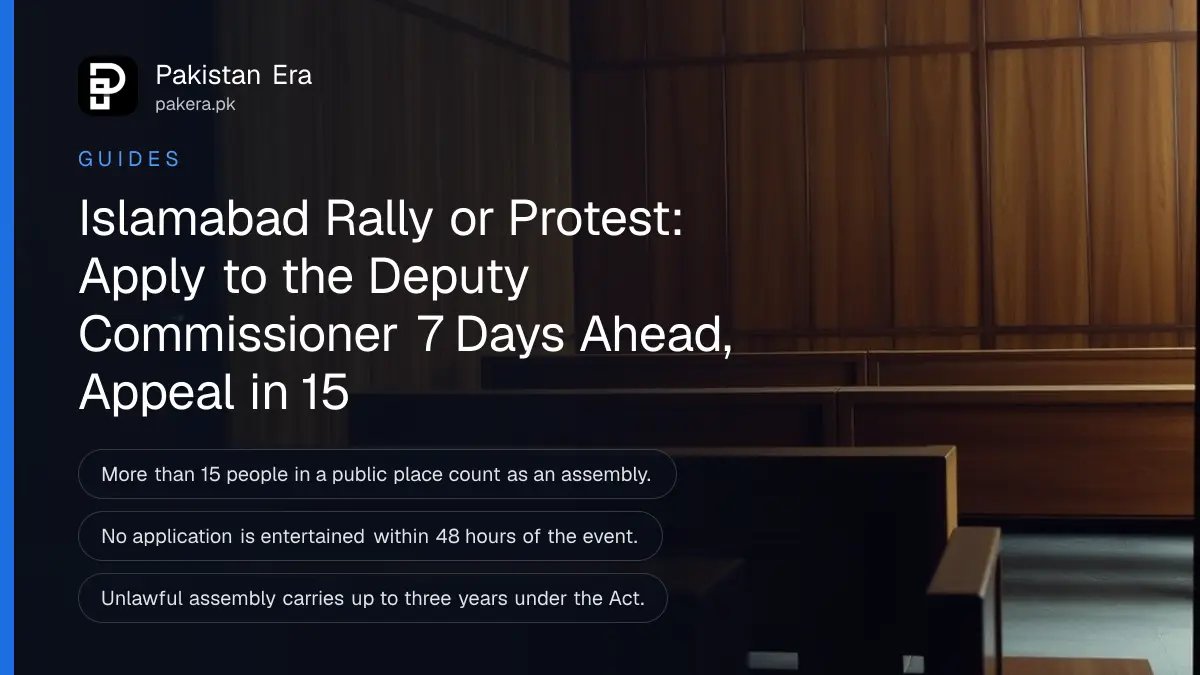
To hold a rally, procession or sit-in of more than 15 people in Islamabad, the organiser must apply in writing to the Deputy Commissioner at least 7 days before the date. An application filed less than 48 hours before is not entertained. Assembling without permission is not allowed, and the Act sets jail of up to three years for membership of an unlawful assembly.
This is the Peaceful Assembly and Public Order Act, 2024 (Act No. XIX of 2024), dated 6 September 2024. It extends to the Islamabad Capital Territory only. We read its text on the Pakistan Code portal on 22 October 2026. We did not check later amendments, court challenges or notifications, so confirm the current position with a lawyer or the district administration before you plan an event.
Any gathering of more than 15 people in a public place is an assembly
Section 2 defines an assembly as a public, religious or political gathering, rally, sit-in or concourse of more than fifteen persons on a public road or any other public place open to the air. Private indoor events are not described in the definition.
The person who calls the gathering, or the head of the rally, is the Event Coordinator. The Act puts the duty and the risk on that person. The District Magistrate is the Deputy Commissioner of ICT.
The application is due 7 days before and must include these details
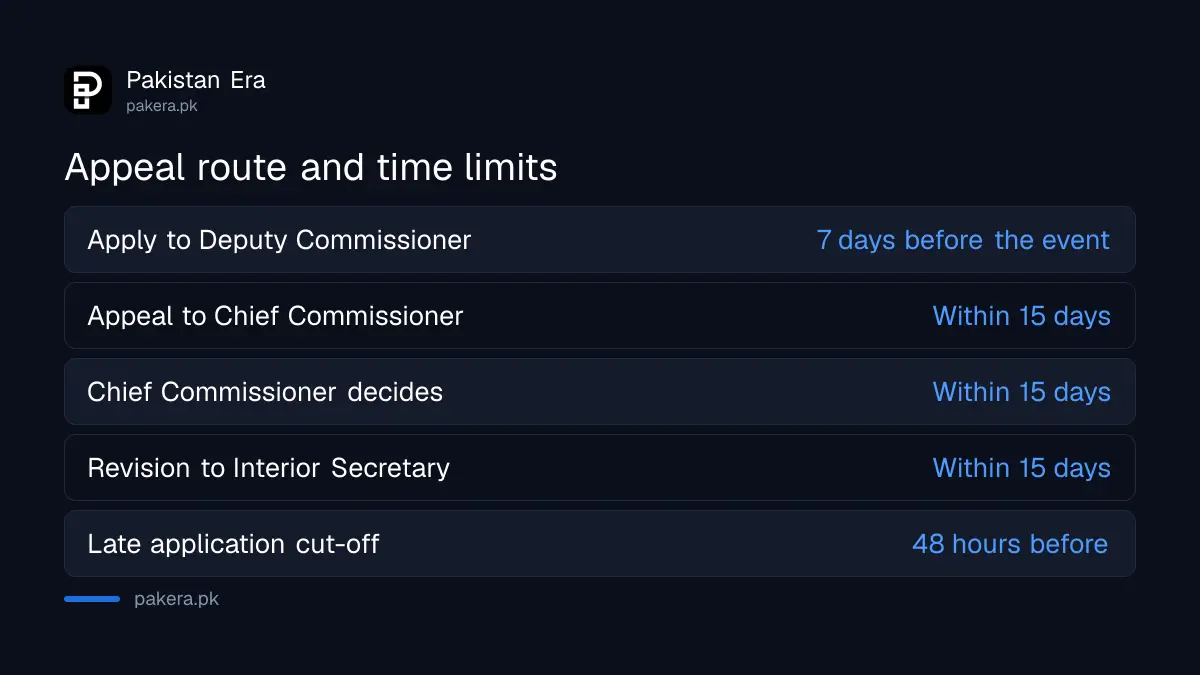
Section 3 requires a signed written application to the District Magistrate not later than seven days before the intended date. A late application can be declined unless there are justifiable grounds. No application is entertained if filed less than 48 hours before the start.
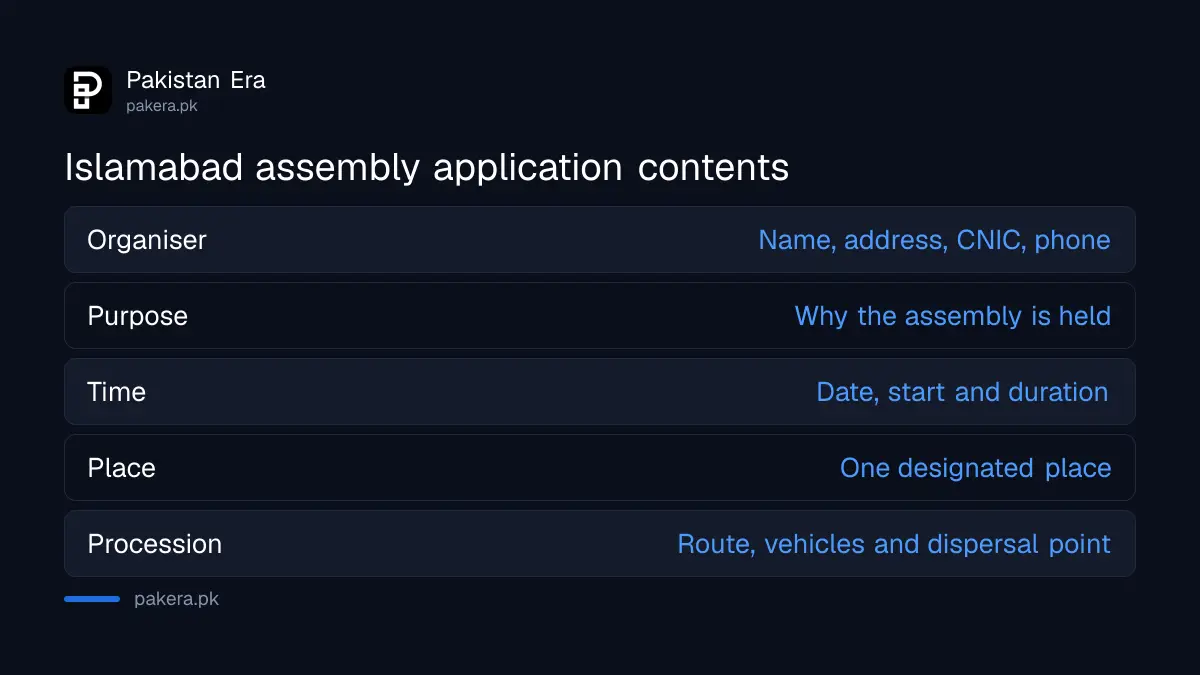
| Item in the application | Detail required |
|---|---|
| Event Coordinator | Name, address, CNIC copy, programme details, telephone |
| Organisation | Name of organisation, or a statement that the party head runs it |
| Purpose | Why the assembly is held |
| Time | Date, start time and duration |
| Place | One of the designated places |
| Numbers | Expected number of participants |
| Procession | Full route, assembly and dispersal points, transport, number and type of vehicles |
Permission is only for the designated area, and the Deputy Commissioner can refuse in writing
Section 4 tells the Deputy Commissioner to examine the law and order situation and to get security clearance reports before granting permission. He may not permit an assembly outside the designated area, which means Moza Sangjani or any other area the Government notifies. He can take a surety bond from the organiser.
He may refuse with reasons recorded in writing. No assembly may take place without prior permission. The Government can also declare a Red Zone or High Security Zone by Gazette notification, where all assemblies are prohibited. Section 144 orders are a separate power. Recent bans are tracked in the page on Section 144 in Islamabad, Karachi and Balochistan.
A ban can be imposed on four grounds and challenged within 15 days
Section 5 allows a ban if the assembly threatens national security or public safety, if law enforcement reports a substantial risk of violence, if it disrupts daily life or the freedom of business, or if another assembly is already under way. The ban must be in writing with reasons.
A person or organisation affected by a ban can file a revision before the Chief Commissioner within 15 days of the order. Keep the written order, because you need it to challenge it.
Refusal can be appealed to the Chief Commissioner, then the Interior Secretary
Under section 6, the Event Coordinator can appeal in writing to the Chief Commissioner within 15 days. The Chief Commissioner must decide within 15 days, or within an extended period that cannot exceed 15 more days. If he does not, the appeal is deemed granted.
A revision then lies to the Secretary of the Ministry of Interior within 15 days of the order. He too must decide within 15 days, extendable by up to 15, and a revision not decided in time is deemed granted. High Court remedies under the Constitution exist separately, but are outside this Act and were not examined.
- Choose a designated place and write the application with every detail above.
- Sign it and give it to the Deputy Commissioner at least seven days before.
- Ask for the decision in writing.
- If refused or banned, appeal to the Chief Commissioner within 15 days.
- If still refused, file a revision with the Interior Secretary within 15 days.
- Do not gather before permission is granted.
The penalty is up to three years, and dispersal can be by force
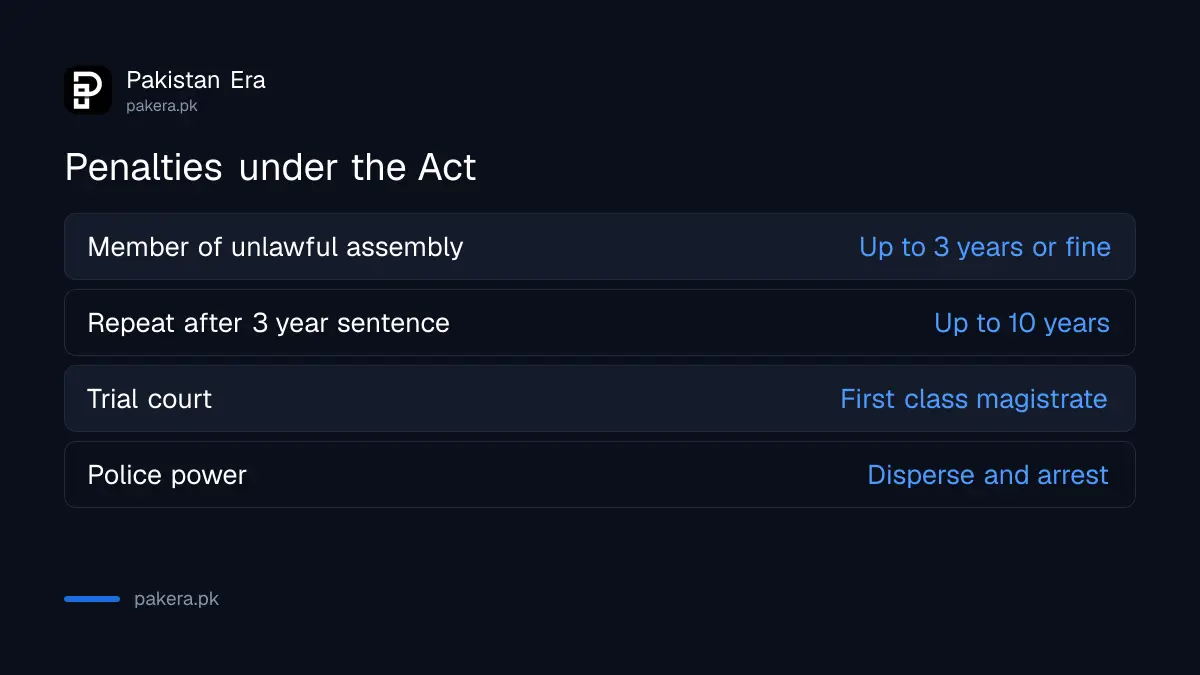
Section 7 lets a police station officer, on the Deputy Commissioner's instruction, command an assembly likely to disturb the peace to disperse. If it does not, the officer may disperse it by force and arrest members. Section 8 punishes membership of an unlawful assembly with up to three years, a fine, or both.
A repeat offender with an earlier sentence of three years or more can get up to ten years. A first class magistrate tries the offence. For what to do after an arrest, see the page on police remand limits.
Common questions
Does this Act apply in Lahore or Karachi?
No. Section 1 limits it to the Islamabad Capital Territory. Other provinces use their own orders and laws.
How many people make an assembly?
More than fifteen persons in a public place that is wholly or partly open to the air.
Who gives permission?
The District Magistrate, who is the Deputy Commissioner of ICT, after security clearance reports.
What is the designated area?
The Act names Moza Sangjani, or any other area the Federal Government specifies by Gazette notification. We did not check for newer notifications.
What happens if permission is refused?
Appeal to the Chief Commissioner within 15 days. A further revision lies to the Interior Secretary within 15 days.
Can the police stop a peaceful meeting without a ban?
The Act lets police disperse an assembly on the Deputy Commissioner's instruction if it is likely to disturb public peace. It does not state a separate test for peaceful ones.
How we verified this
What we checked, where we read it, and what we could not confirm.
Last checked 22 October 2026. We read the Peaceful Assembly and Public Order Act, 2024 on the Pakistan Code portal, in the copy dated 3 October 2024 on that portal. We did not find or read rules under section 10, later amendments, a current designated-area notification, or any court ruling on the Act. This page describes the text of the law and takes no side on its merits. It is general information, not legal advice.
About the author

Senior Writer, Public Services and Technology
Shahid joined us in 2024 as an author. He is a senior contributor to Pakistan's leading technology websites. He writes detailed articles, mostly covering his expertise in the latest tech, mobiles, apps, gadgets, and step-by-step guides. His ideology is to help people understand the latest trends and explain complex methods through very easy-to-understand guides.