How to Ask the Provincial Government to Suspend or Remit a Sentence in Pakistan
Section 401 lets the Provincial Government suspend or remit a sentence, with conditions, and ask the trial judge for an opinion. See what it bars and the steps.
Under section 401 of the Code of Criminal Procedure, the Provincial Government can suspend or remit all or part of a sentence, with or without conditions, and it can ask the trial judge for an opinion before deciding. It cannot do this for sentences under the karo kari and similar offences in Chapter XVI of the Penal Code.
Families of prisoners often ask who can cut a sentence short. Courts hear appeals, but section 401 gives a separate power to the executive. We read sections 401, 402, 402A and 402B of the Code of Criminal Procedure, 1898, on 21 October 2026. For the court route, see the guide to appealing a criminal conviction.
Section 401 lets the Provincial Government suspend or remit a sentence
The Provincial Government may at any time, without conditions or on conditions the person sentenced accepts, suspend the execution of a sentence or remit the whole or any part of the punishment. Remission means the punishment is cancelled. Suspension means it is put on hold.
The Code names the Provincial Government, not a department, a form or a fee. We could not verify which office takes the application in each province today, so ask the prison superintendent or the Home Department. In Punjab, the Code's own footnote also points to a separate Good Conduct Prisoners Probational Release Act, 1926.
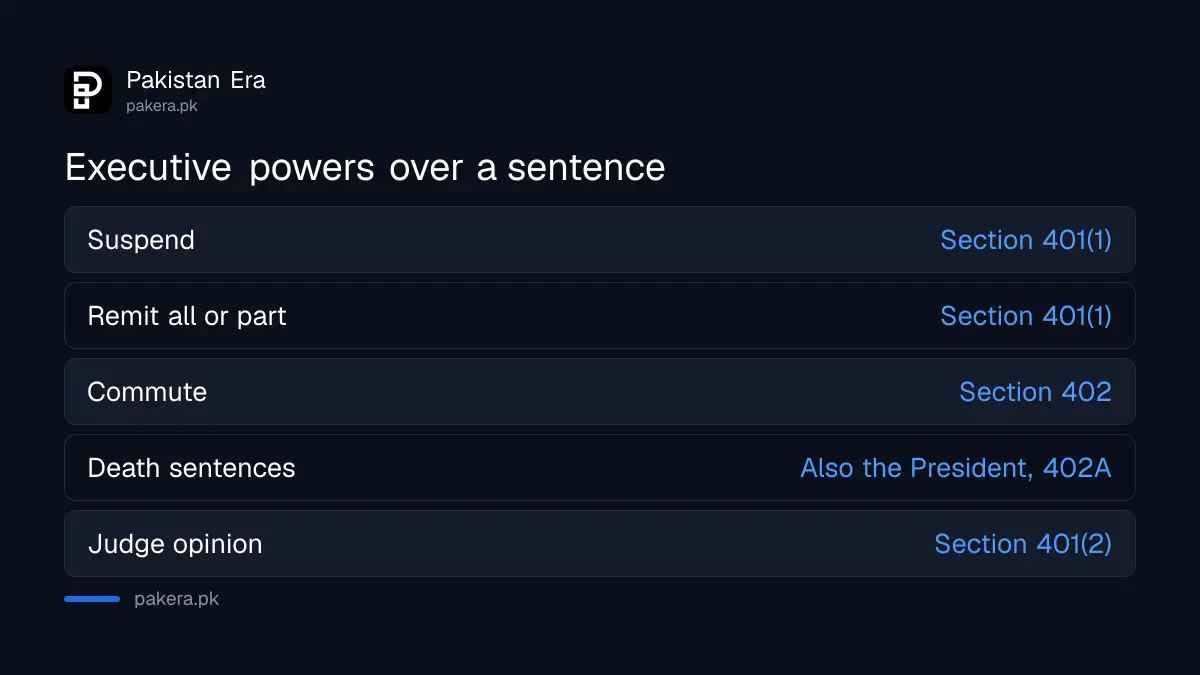
| Power | Section | Who uses it |
|---|---|---|
| Suspend a sentence | 401(1) | Provincial Government |
| Remit all or part of a sentence | 401(1) | Provincial Government |
| Commute a sentence to a lesser one | 402 | Provincial Government, without consent |
| Death sentences | 402A | Provincial Government, and also the President |
| Ask the trial judge's opinion | 401(2) | Provincial Government |
The government may ask the trial judge for an opinion and the record
Section 401(2) says that when an application is made, the Provincial Government may require the presiding judge of the court that convicted or confirmed to state his opinion on whether it should be granted, with reasons, and to send a certified copy of the trial record.
Your application therefore travels with the trial record. Make it clear and short. State the case number, the court, the sentence, how much you have served, and why you ask. Add papers such as a medical report, if illness is the reason.
A condition can bring the sentence back
Section 401(3) says that if a condition of suspension or remission is, in the Provincial Government's opinion, not fulfilled, it may cancel it. The person, if at large, may then be arrested by any police officer without a warrant and remanded to serve the rest of the sentence.
Section 401(4) allows a condition to be one the person must fulfil or one independent of his will. Read any conditions closely before you accept them. Section 401(4A) says these rules also apply to any order by a criminal court that restricts liberty or imposes a liability on property.
Some sentences cannot be remitted
The proviso to section 401(1) bars the Provincial Government from suspending or remitting any sentence under Chapter XVI of the Penal Code if the offence was committed in the name of, or on the pretext of, karo kari, siyah kari or similar customs.
Section 402 separately lets the Provincial Government commute a sentence, without the person's consent, to a lighter one in a listed order, from death down to a fine. Section 402A adds the President for death sentences, and section 402B restricts some cases to prior approval of the President.
- Get a certified copy of the judgment and the jail warrant.
- Ask the prison office for your sentence record and time served.
- Write a short application to the Provincial Government through the jail.
- Attach medical or family papers if they are the reason.
- Ask a lawyer to check the offence is not one the proviso bars.
- Keep a receipt, and follow up in writing.

Jail remission earned by conduct or study is a separate route
Section 401 is a power of the executive on application. Remission earned inside prison, through exams or good conduct, follows jail rules. We cover one such scheme in earning remission in Punjab jails.
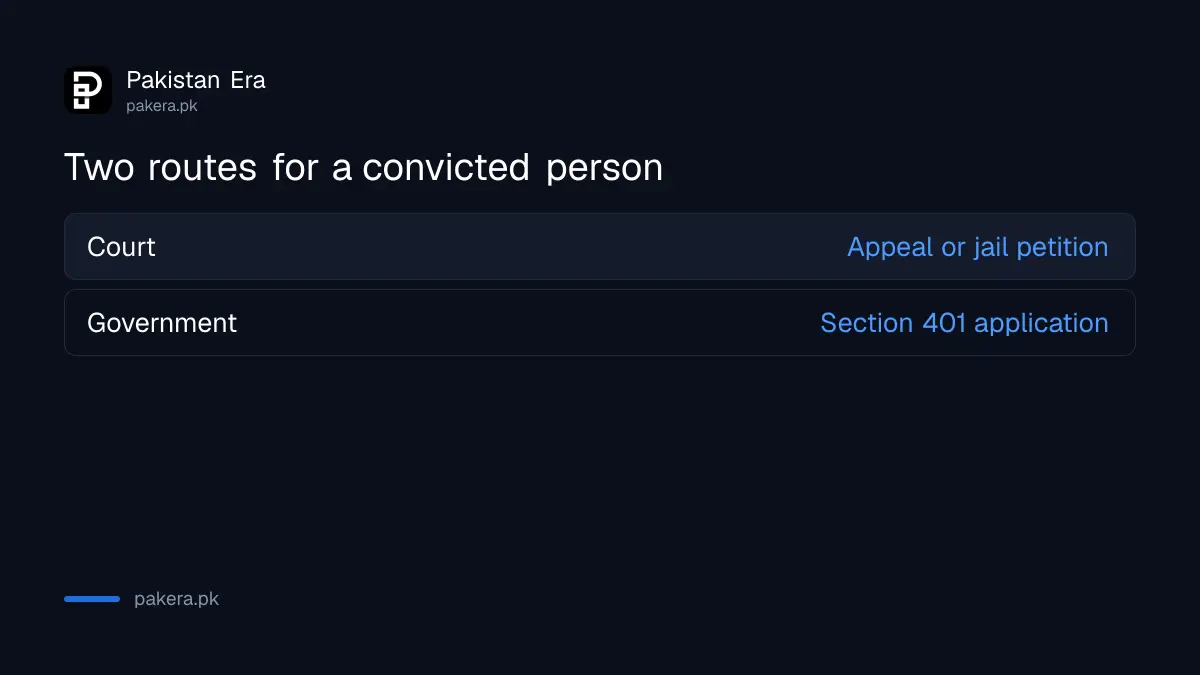
A convicted person can also challenge the case in court. If the Supreme Court is the next step, the guide on a jail petition to the Supreme Court explains it. The two routes are independent, and one does not stop the other.
Common questions
Who decides a section 401 application?
The Provincial Government. The Code names no department, so confirm the office with the jail superintendent.
Is there a form or fee?
The Code names none. We could not check current provincial rules.
Is suspension the same as release?
Suspension puts the execution of the sentence on hold, with conditions if set. Remission cancels part or all of the punishment.
Can this be used for a death sentence?
Sections 402 and 402A allow commutation, and the President can also exercise the powers in a death case. Ask a lawyer about the current process.
What if I break a condition?
The government may cancel the order under section 401(3), and police may arrest you without a warrant to serve the rest.
How we verified this
What we checked, where we read it, and what we could not confirm.
Last checked 21 October 2026. We read sections 401, 402, 402A and 402B of the Code of Criminal Procedure, 1898, in the Pakistan Code PDF marked as last amended on 16 February 2017, from a copy saved earlier this week. The Pakistan Code portal did not open for us on the day, so later amendments are unchecked. We did not read provincial jail rules, forms or the full text of the Punjab 1926 Act.
About the author

Global Affairs & Political Economy Writer
Muhammad Hatim is a book lover who started writing because he enjoys it. At Pakistan Era he writes about international relations, geopolitics and the global economy, with a particular interest in South Asia and the forces behind current events.