How to Earn Remission in a Punjab Jail by Passing Exams: Up to 10 Months for One Test
Convicted prisoners in Punjab jails can earn remission by passing exams. See months off for Matric, Quran and Hafiz courses by sentence length and marks.
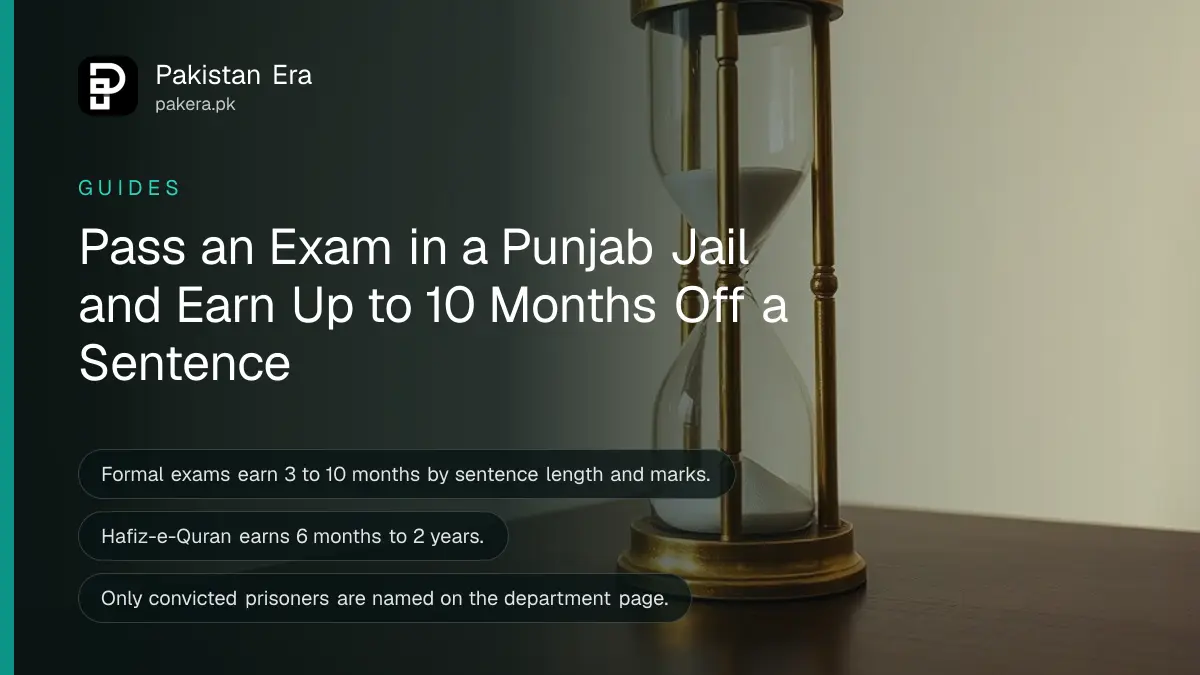
A convicted prisoner in a Punjab jail can earn a shorter sentence by passing an exam inside the jail. A prisoner serving more than 10 years who scores above 60 per cent in a formal exam earns 10 months off. A Hafiz-e-Quran course earns up to 2 years. Punjab Prisons publishes the full table under rule 215 of the Pakistan Prisons Rules 1978.
The rule is called education remission. Remission means a part of the sentence is cancelled, so the prisoner is released earlier. Families often ask about it after a conviction, because it is one of the few things a prisoner can do for himself or herself. This guide reads the department's own table and says where the table has a gap.
Education remission applies to convicted prisoners only
Every convicted prisoner in a Punjab jail may sit exams inside the jail and earn remission. Punjab Prisons lists three kinds of exam: formal education, oriental languages and religious education. The legal basis is rule 215 of the Pakistan Prisons Rules 1978.
Formal education covers Matric, F.A., B.A. and M.A. Oriental languages include Urdu, Punjabi and Arabic. Religious education covers Hafiz-e-Quran, Nazra Quran, Taleem-ul-Quran courses and Tarjama-ul-Quran. Under-trial prisoners, whose cases are still in court, are not named on the page. The page speaks of "convicted prisoners", so we read the rule as applying to them only. Ask the jail's education officer about your own case.
The formal exam table depends on sentence length and marks
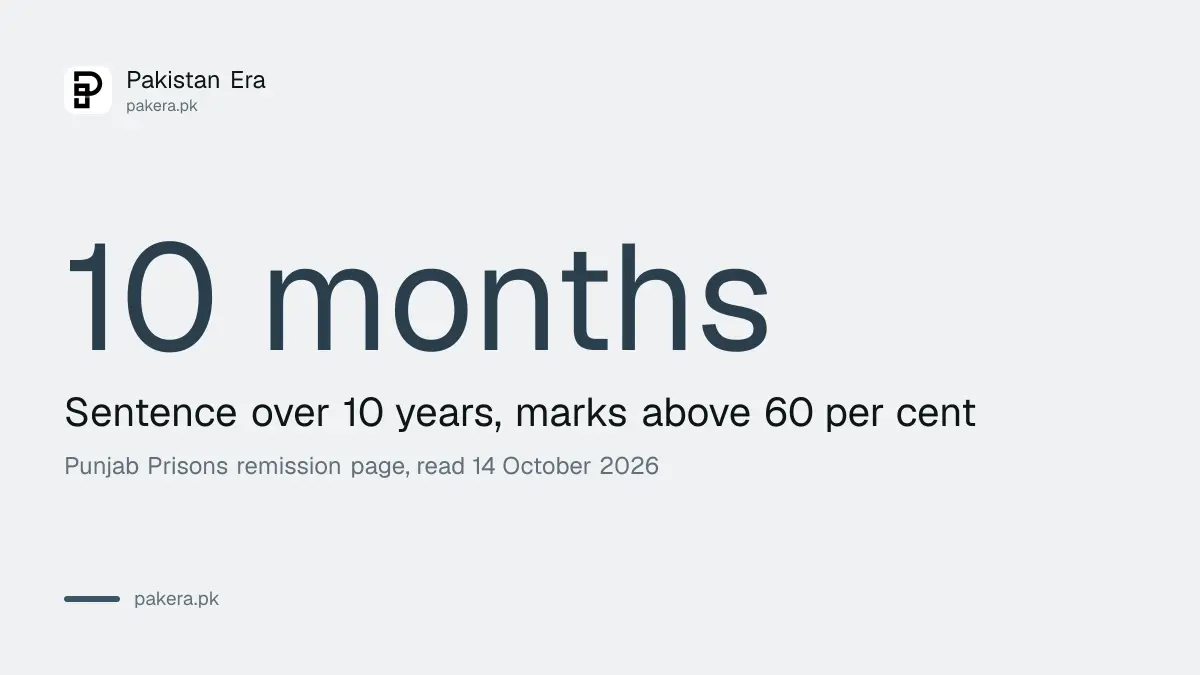
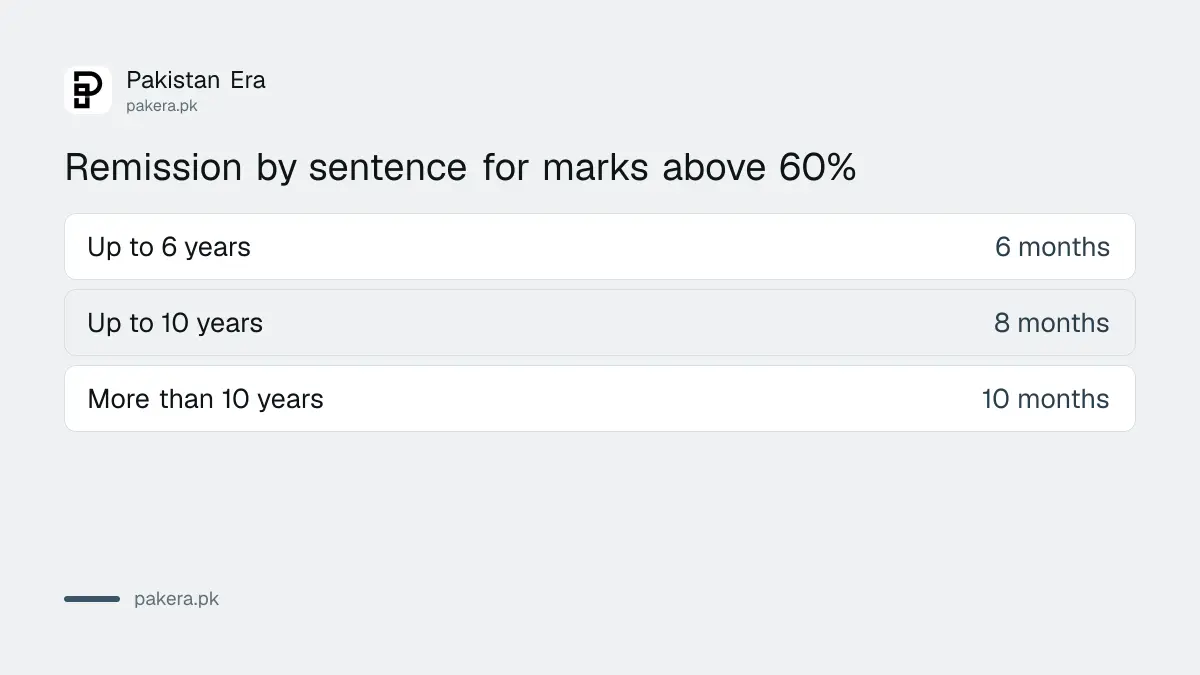
For formal and oriental exams, the months of remission depend on two things: how long the sentence is and what percentage of marks the prisoner scores. A longer sentence and higher marks earn more. Punjab Prisons gives three mark bands: up to 40 per cent, 41 to 60 per cent and above 60 per cent.
| Sentence | Up to 40% marks | 41 to 60% marks | Above 60% marks |
|---|---|---|---|
| Up to 6 years | 3 months | 4 and a half months | 6 months |
| Up to 10 years | 4 months | 6 months | 8 months |
| More than 10 years | 5 months | 7 and a half months | 10 months |
Punjab Prisons also lists a row for sentences up to 2 years. On the page we read, that row shows only two figures, 3 months and 4 months, and a repeated heading. We cannot tell which mark bands they belong to, so we left the row out. Do not rely on it until the department fixes the page. The department also says no more than two remissions can be earned in oriental language exams.
Religious courses earn fixed remission
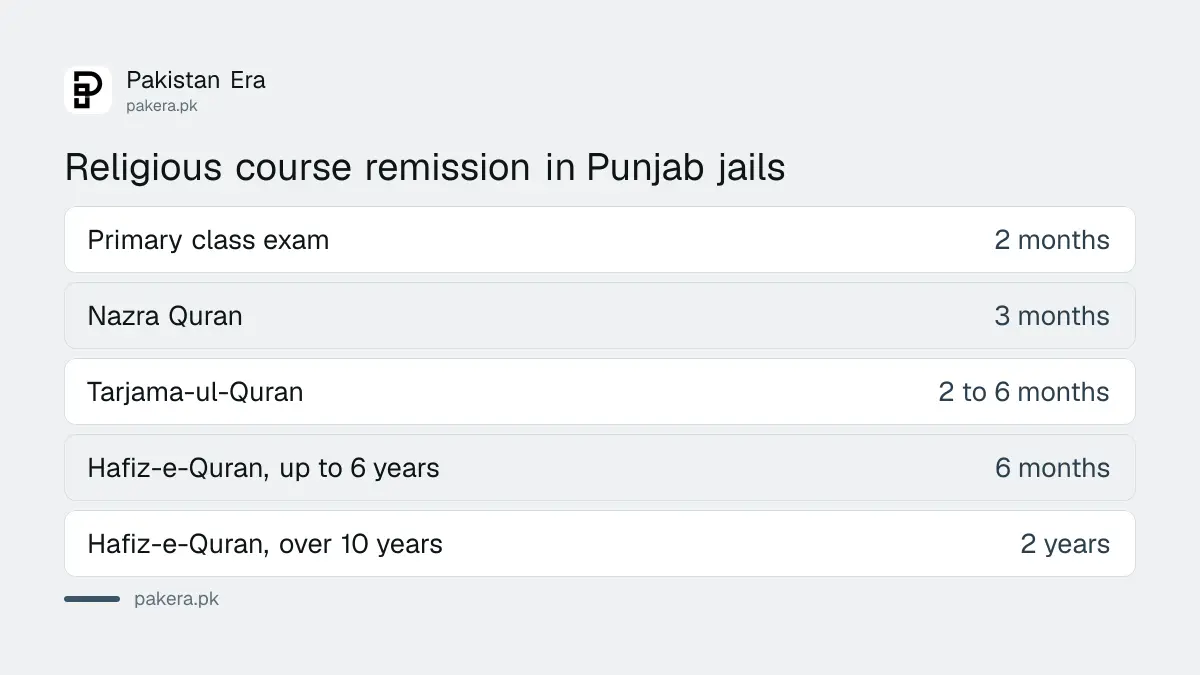
Quran courses earn a fixed number of months, not a mark band. Qualifying in primary classes run by the District Education Officer earns 2 months, and a Nazra Quran course earns 3 months. Hafiz-e-Quran earns the most, from 6 months to 2 years.
Taleem-ul-Quran courses are taken in order. The page lists five courses that earn 15 days, 15 days, 30 days, 60 days and 60 days. Tarjama-ul-Quran earns 2, 3, 4 or 6 months, depending on whether the sentence is up to 2 years, up to 6, up to 10 or more than 10. Hafiz-e-Quran earns 6 months for sentences up to 3 and up to 6 years, 12 months for up to 10 years, and 2 years above that.
- Ask the jail's education section which exams are held and when.
- Register for the exam inside the jail.
- Study with the jail's education programme or on your own.
- Sit the exam within the jail premises.
- Ask the jail record office to add the remission once the result comes.
The department page does not describe the registration steps above. We wrote them from the rule that exams are held inside the jail, so confirm each with the jail. The remission itself is the department's published figure.
Other remissions exist beyond the exam table
The same page links to remission for minority prisoners in Hindu, Christian and Sikh religious education, and to technical education courses. Punjab Prisons also lists remissions on special occasions. For 2025 it reports 183 prisoners released and 1,606 who benefited on Pakistan Day and Eid-ul-Fitr.
Those occasion figures show the scale of the scheme. They are not a promise for any one prisoner. A family that wants to understand the next step in a case can read how to file a jail petition in the Supreme Court, and the visit rules in the guide to booking a jail visit in Punjab. For legal help, see free legal aid in Punjab.
Common questions about remission in Punjab jails
Can an under-trial prisoner earn remission?
The page speaks only of convicted prisoners. A prisoner whose trial is still running should ask the jail and a lawyer, because the page does not name under-trial prisoners.
How many months can one exam earn?
For a formal exam, the most is 10 months, for a sentence over 10 years and marks above 60 per cent. Hafiz-e-Quran can earn up to 2 years.
Where is the exam held?
Inside the jail. Punjab Prisons says convicted prisoners may appear in these exams within the jail premises under rule 215.
Does failing the exam cost anything?
The page does not mention a penalty. It lists only what passing earns. Ask the jail what happens on a fail.
Is remission the same as parole or a pardon?
No. Remission shortens the sentence under the prison rules. The page does not cover parole or pardon, so ask a lawyer about those.
How we verified this
What we checked, where we read it, and what we could not confirm.
Last checked 14 October 2026. Every number comes from the Entitlement of Education Remission and Remission on Special Occasions pages at prisons.punjab.gov.pk. The 2-year row of the formal table is unclear on that page. The registration steps in the list are our reading of the rule, not a published procedure. We did not speak to the department.
About the author

Tax, Bills and Technology Writer
Ali Akhtar is a young and curious voice here at Pakistan Era. He is currently pursuing his A-Levels and has a growing interest in Pakistan’s changing industrial landscape and educational trends. Ali likes to write in a way that helps him explain and explore the world around him. His writing reflects the perspective of the new generation navigating the evolving trends of Pakistan where technology, youth innovation, and shifting opportunities are reshaping the country’s future.