Arsh Amount in Pakistan 2026-27: Compensation for Each Injury, From Rs 967,620 for a Tooth to Rs 19.35 Million
Arsh amounts in Pakistan for 2026-27, worked out from the Rs 19,352,390 diyat: eye, hand, finger, tooth and head wounds, plus daman and the 5 year payment rule.
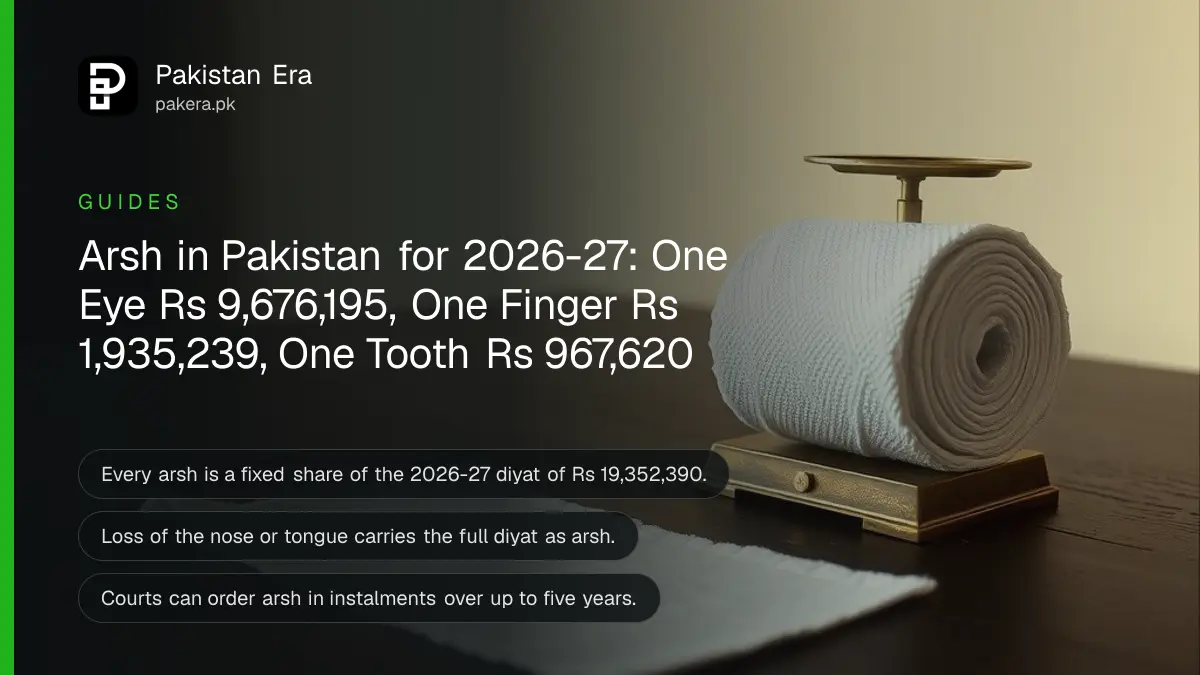
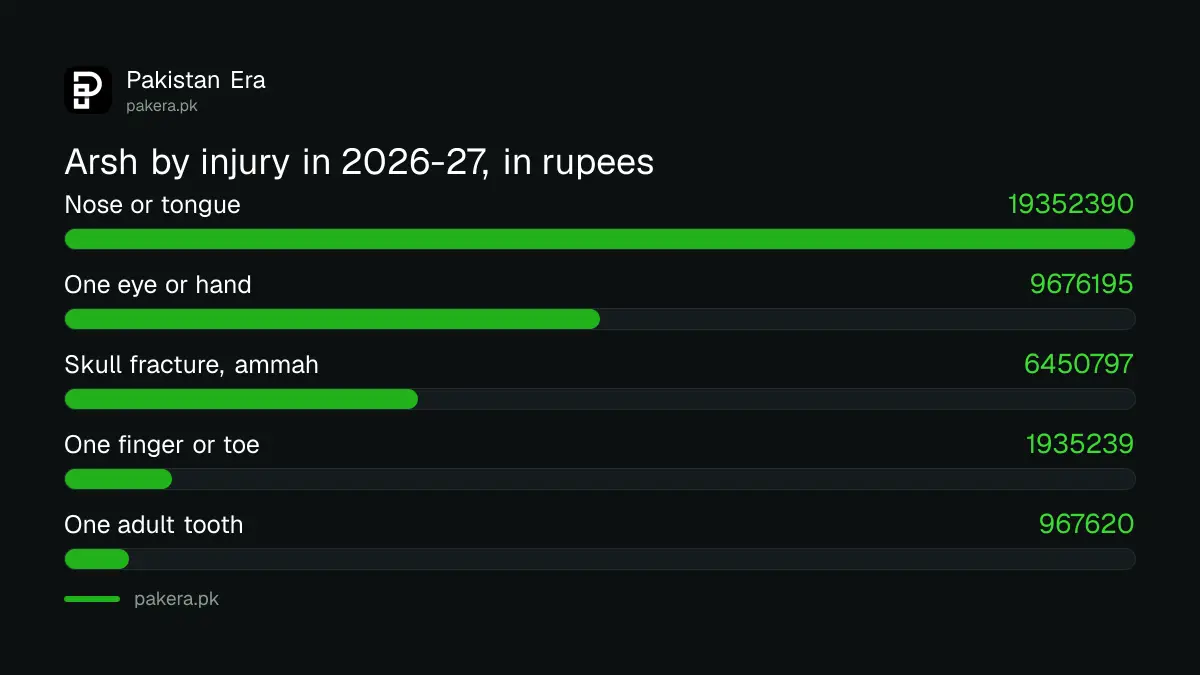
Arsh is the fixed compensation an offender pays a victim for an injury in Pakistan, set as a share of diyat. With diyat at Rs 19,352,390 for 2026-27, the arsh for one adult tooth is about Rs 967,620, one finger Rs 1,935,239, one eye Rs 9,676,195, and the nose or tongue the full Rs 19,352,390.
The fractions are written into sections 337-A to 337-V of the Pakistan Penal Code. The rupee value moves every year because diyat is tied to the price of 30,630 grams of silver. This year it almost doubled, so every arsh figure doubled too. The table below turns each fraction into rupees.
Arsh for 2026-27 is a fixed share of Rs 19,352,390
The Finance Division notified Rs 19,352,390 as the value of diyat for 2026-27 on 27 July 2026. Each arsh in the Penal Code is a fraction of that diyat. So the arsh for an injury caused in this financial year is that fraction of Rs 19,352,390.
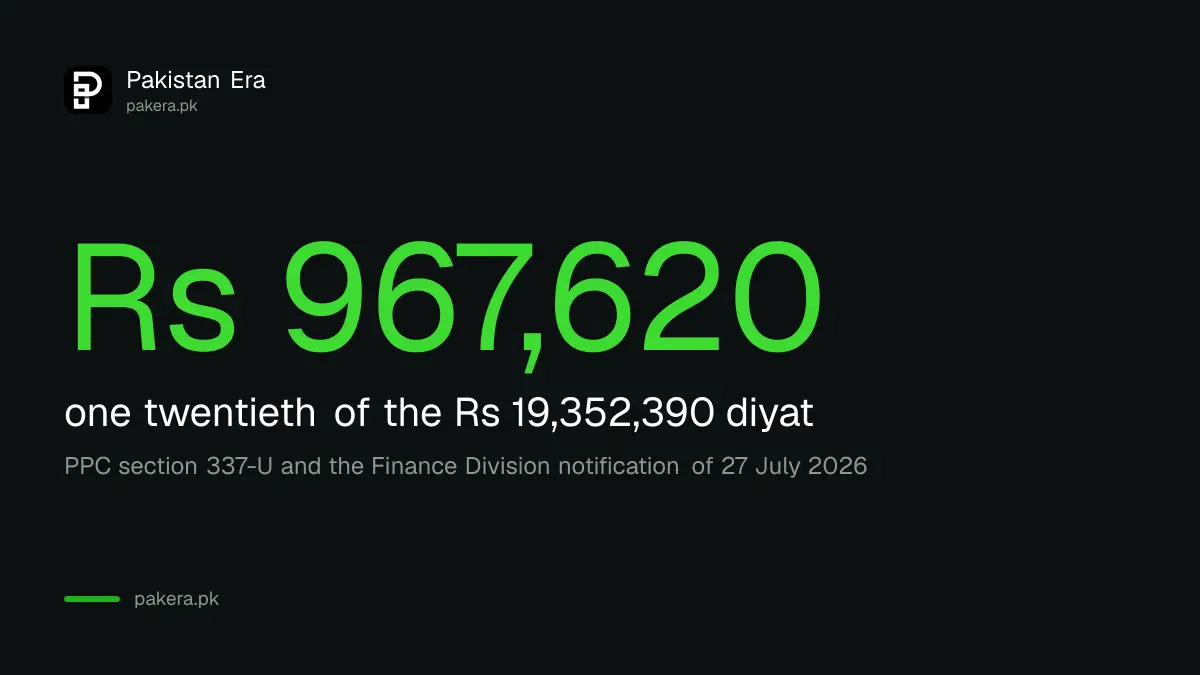
Diyat itself is fixed under section 323 and paid for a death, as set out for road deaths in the 320 PPC accident death case. Arsh is different from diyat in one way. Diyat is paid for a death, to the heirs. Arsh is paid for an injury, to the victim, or to the heirs if the victim later dies.
The arsh table for organs, fingers and teeth
Loss of an organ is called itlaf-i-udw. The arsh depends on how many of that organ a body has. A single organ, such as the nose or tongue, carries full diyat. One of a pair, such as one eye or one hand, carries half. Fingers and teeth have their own smaller shares.
| Injury | PPC section | Share of diyat | Arsh in 2026-27 |
|---|---|---|---|
| Nose or tongue (single organ) | 337-Q | Full | Rs 19,352,390 |
| Both eyes, both hands or both feet | 337-R | Full | Rs 19,352,390 |
| One eye, one hand, one foot, one lip | 337-R | One half | Rs 9,676,195 |
| One eyelid (one of four) | 337-S | One quarter | Rs 4,838,098 |
| Three eyelids | 337-S | Three quarters | Rs 14,514,293 |
| One finger or toe | 337-T | One tenth | Rs 1,935,239 |
| One joint of a finger | 337-T | One thirteenth | Rs 1,488,645 |
| One joint of a thumb | 337-T | One twentieth | Rs 967,620 |
| One adult tooth | 337-U | One twentieth | Rs 967,620 |
| Twenty or more teeth | 337-U | Full | Rs 19,352,390 |
Two rules change these figures. If the victim already had only one eye or one hand, the arsh for losing it is full diyat, not half. And the impaired part of a tooth outside the gum counts as the loss of the tooth. A milk tooth is different: it carries daman, not arsh, unless the injury stops the new tooth from growing.
Head and face wounds carry arsh from 5 per cent to one half
A wound on the head or face that does not destroy an organ is called shajjah. Section 337-A sets six grades. The lightest grade carries daman. The other five carry arsh from 5 per cent of diyat to one half, plus a possible jail term as ta'zir, which is the punishment the court adds.
| Head or face wound | Arsh share | Arsh in 2026-27 | Jail term, up to |
|---|---|---|---|
| Khafifah: no bone exposed | Daman, set by court | Set by court | 2 years |
| Mudihah: bone exposed, no fracture | 5 per cent | Rs 967,620 | 5 years |
| Hashimah: bone fractured | 10 per cent | Rs 1,935,239 | 10 years |
| Munaqqilah: bone fractured and dislocated | 15 per cent | Rs 2,902,859 | 10 years |
| Ammah: skull fracture touching brain membrane | One third | Rs 6,450,797 | 10 years |
| Damighah: skull fracture rupturing the membrane | One half | Rs 9,676,195 | 14 years |
A body wound that reaches the cavity of the chest or stomach is jaifah under section 337-D. It carries arsh of one third of diyat, Rs 6,450,797 this year, and up to ten years. Other body wounds, called ghayr-jaifah, carry daman under section 337-F. The 337 PPC hurt sections explain each grade, bail and compromise.
Daman is set by the court where no fixed arsh exists
Daman is the compensation for hurts that have no fixed arsh, such as a cut that bleeds or a broken arm bone. Section 337-Y tells the court to look at three things: treatment costs, any loss of function of an organ, and the pain and anguish the victim suffered.
So for daman there is no table. Keep every hospital bill, pharmacy receipt and medical report from the first day. These papers are what the court relies on to set the amount. A report from the authorised medical officer also decides which grade of injury applies, so ask for a copy of it.
The same arsh and daman rules apply to injuries in road accidents under section 337-G, with up to five years in jail on top. Hurt caused by a rash act other than driving falls under section 337-H, with up to three years. Hurt by pure mistake under section 337-I carries arsh or daman alone.
Arsh can be paid in instalments over five years
Section 337-X lets the court order arsh as a lump sum or in instalments over five years from the final judgment. Daman follows the same five year rule under section 337-Y. The money goes to the victim, or to the victim's heirs by inheritance shares if the victim dies.
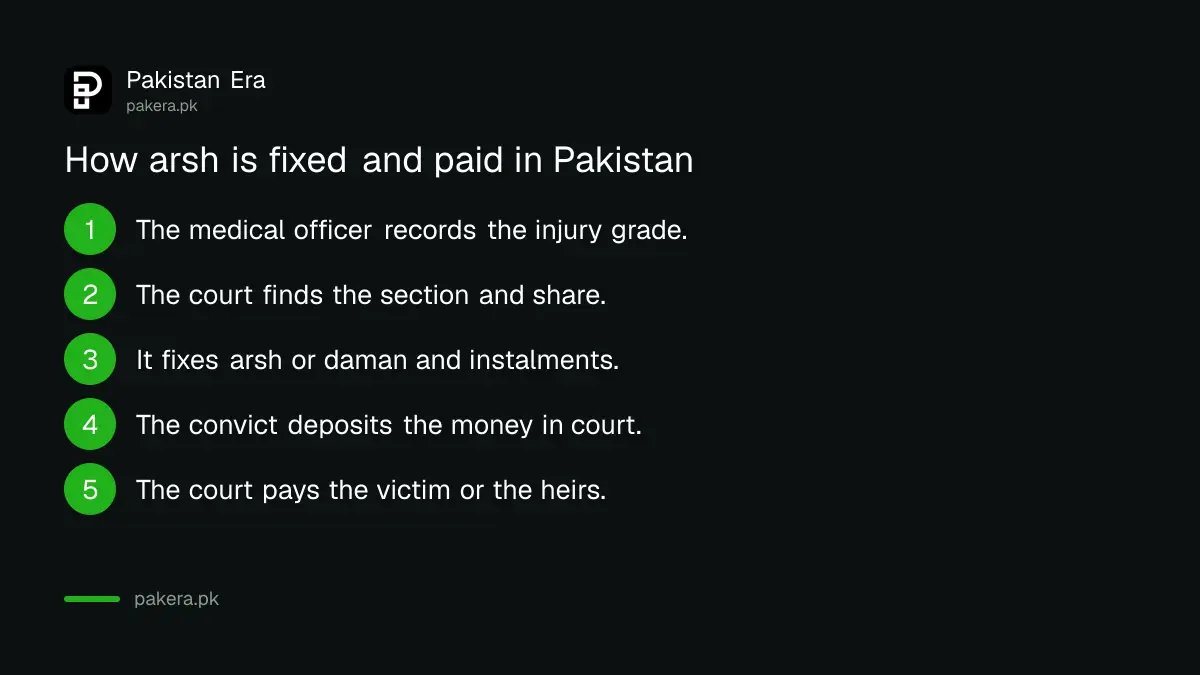
- The medical officer examines the injury and records its grade.
- The court finds which section applies and the share of diyat.
- The court fixes arsh or daman, and a lump sum or instalments.
- The convict deposits the money in court as it falls due.
- The court pays it to the victim, or to the heirs.
If the convict does not pay in time, the court can keep the convict in jail as if under simple imprisonment until the arsh is paid. It can instead release the convict on bail against security or a surety equal to the arsh, or on parole under the rules. If the convict dies, unpaid arsh is recovered from the estate.
Where one attack causes several injuries, section 337-W says arsh is due for each injury separately. But if an organ is lost, arsh is paid for the organ only, not for each part of it. And wounds that join into one wound carry arsh for one wound.
Common questions
What is the arsh for a broken tooth in Pakistan in 2026-27?
For an adult tooth, one twentieth of diyat, which is about Rs 967,620 at the 2026-27 diyat of Rs 19,352,390. A milk tooth carries daman instead.
What is the arsh for losing one eye?
One half of diyat, Rs 9,676,195. If the victim had only one working eye, the arsh is full diyat, Rs 19,352,390.
What is the difference between arsh and daman?
Arsh is a fixed share of diyat written in the law for a named injury. Daman is an amount the court sets for injuries with no fixed arsh, based on treatment costs, loss of function and anguish.
Who receives arsh?
The victim. If the victim dies before payment, it goes to the victim's heirs in their inheritance shares.
Can the victim forgive the arsh?
Yes. Section 338-E lets hurt offences be waived or compounded, subject to the Code of Criminal Procedure. After a waiver the court may acquit, or still give a jail term as ta'zir. Ask a lawyer to check the terms before you sign.
Does arsh change every year?
The shares stay the same, but the rupee value moves with diyat, which the Finance Division notifies each financial year from the price of silver.
How we verified this
What we checked and where we read it.
Last checked 14 November 2026. Sections 337 to 337-Z and 338-E come from the Pakistan Penal Code on Pakistan Code. The diyat value of Rs 19,352,390 comes from the Finance Division notification dated 27 July 2026. The rupee amounts are our arithmetic, applying each share in the Penal Code to that diyat and rounding to the nearest rupee. A court decides the final amount in each case. This page explains the law and is not legal advice.
About the author

Tax, Bills and Technology Writer
Ali Akhtar is a young and curious voice here at Pakistan Era. He is currently pursuing his A-Levels and has a growing interest in Pakistan’s changing industrial landscape and educational trends. Ali likes to write in a way that helps him explain and explore the world around him. His writing reflects the perspective of the new generation navigating the evolving trends of Pakistan where technology, youth innovation, and shifting opportunities are reshaping the country’s future.