Urea and DAP Stock for Wheat in Pakistan, Rabi 2026-27: Urea Falls Below the Buffer From December
NFDC projects Pakistan's urea stock falling below the 300,000 tonne buffer from December 2026. See the month-by-month urea and DAP outlook and what to do now.
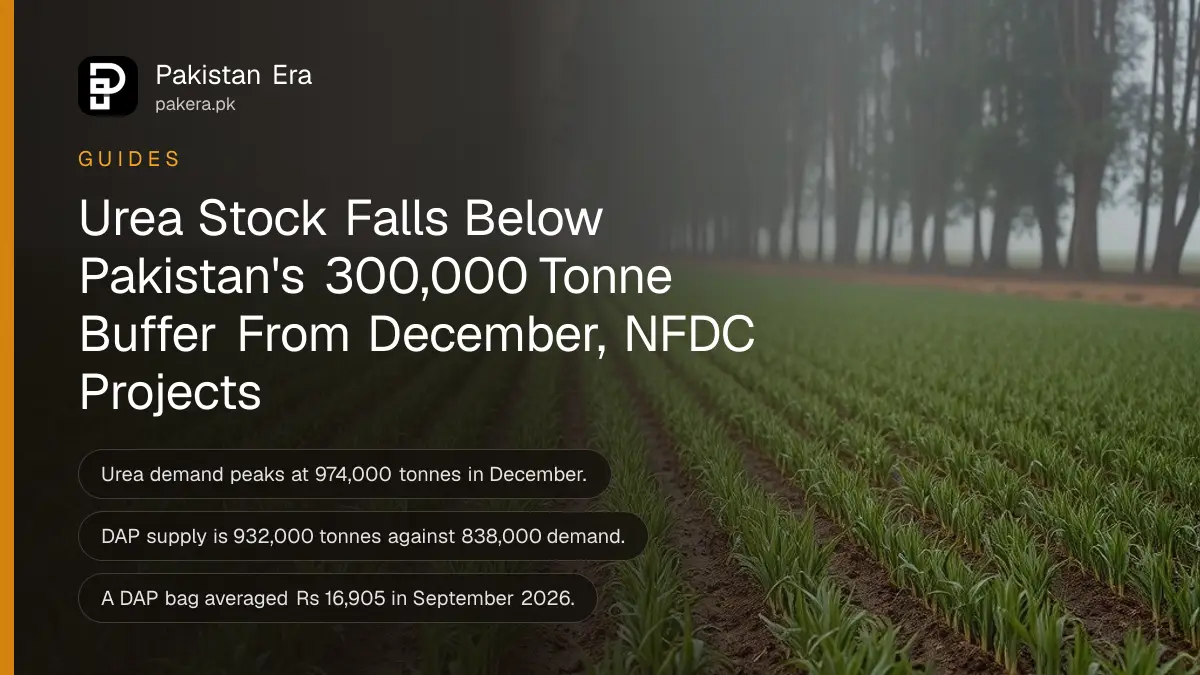
Pakistan has enough urea and DAP for the 2026-27 wheat season on paper, but urea gets tight from December. The National Fertilizer Development Centre (NFDC) projects urea stock falling to 212,000 tonnes by the end of December, below the 300,000 tonne safety buffer, and staying below it until March.
December is also the month of peak demand. NFDC expects farmers to lift 974,000 tonnes of urea that month, more than in any other Rabi month, as wheat gets its first and second doses. For a farmer, the practical reading is simple: plan your urea before the December rush, and buy DAP at sowing while stock is highest.
These figures come from NFDC's Fertilizer Review for September 2026, published by the Ministry of National Food Security and Research on 27 October 2026. NFDC is the ministry's fertiliser data unit.
Urea supply for Rabi 2026-27 is 3.81 million tonnes against 3.60 million demand
NFDC puts total urea availability for Rabi 2026-27, October to March, at 3.81 million tonnes: 643,000 tonnes left over from Kharif plus 3.17 million tonnes of local production. Demand is projected at 3.60 million tonnes. No urea imports are planned for the season.
That leaves 212,000 tonnes at the end of March. Rabi is the winter crop season, led by wheat. The review warns that all urea plants must run at full capacity for supply and prices to stay stable. Its production figures assume two plants supplied with gas by SNGPL stay shut in January 2027.
The national figure was higher a month earlier. When the Federal Committee on Agriculture met on 7 October, it put urea availability at 3.95 million tonnes. The September review, which uses the actual stock left at the end of Kharif, brings that down to 3.81 million.
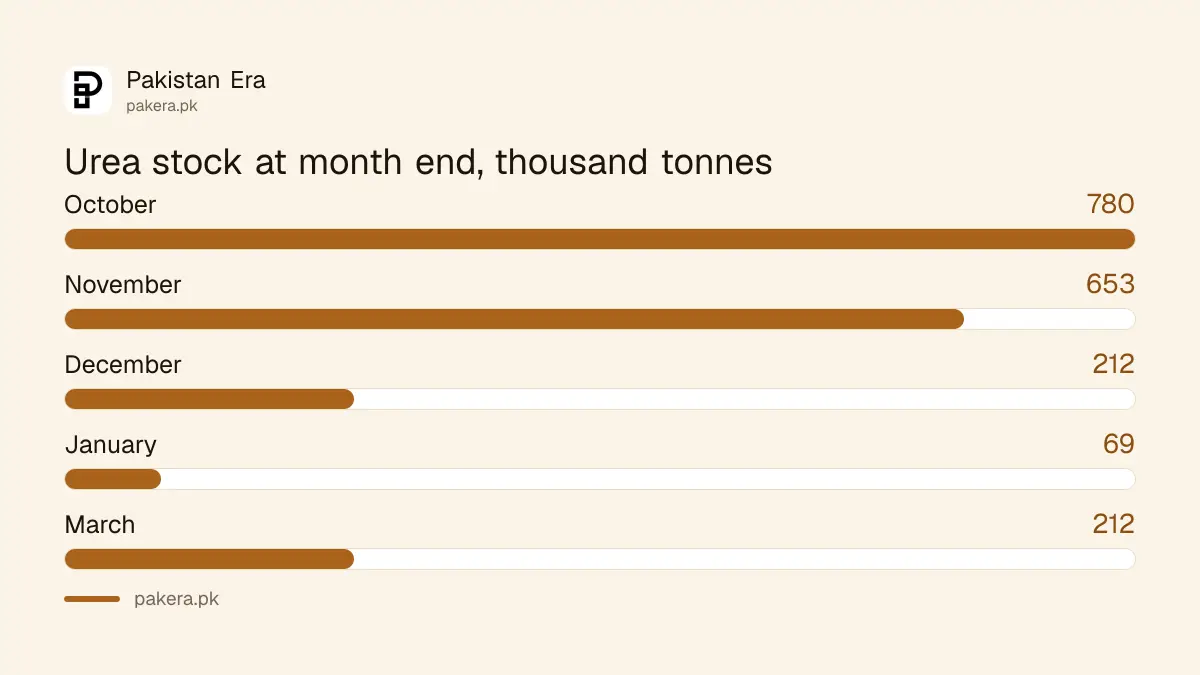
Urea stock drops below the safety buffer in December
NFDC keeps a 300,000 tonne urea buffer as its safety line. Stock stays above it in October and November, then drops to 212,000 tonnes after December's peak demand of 974,000 tonnes. It falls to 69,000 tonnes in January before rising to 212,000 by March.
| Month | Urea demand (tonnes) | Urea production (tonnes) | Stock at month end (tonnes) | Against 300,000 buffer |
|---|---|---|---|---|
| October 2026 | 456,000 | 594,000 | 780,000 | 480,000 above |
| November 2026 | 661,000 | 534,000 | 653,000 | 353,000 above |
| December 2026 | 974,000 | 534,000 | 212,000 | 88,000 short |
| January 2027 | 567,000 | 423,000 | 69,000 | 231,000 short |
| February 2027 | 506,000 | 517,000 | 80,000 | 220,000 short |
| March 2027 | 431,000 | 563,000 | 212,000 | 88,000 short |
A stock below the buffer is not an empty shelf. It means the country has less room to absorb a plant shutdown, a gas cut or a sudden rush. Those are the conditions in which dealers start charging above the market rate or tie urea to other products.
January is the thinnest month. Production drops to 423,000 tonnes because of the assumed plant closures, and month-end stock falls to 69,000 tonnes.
DAP stock peaks at sowing and stays positive to March
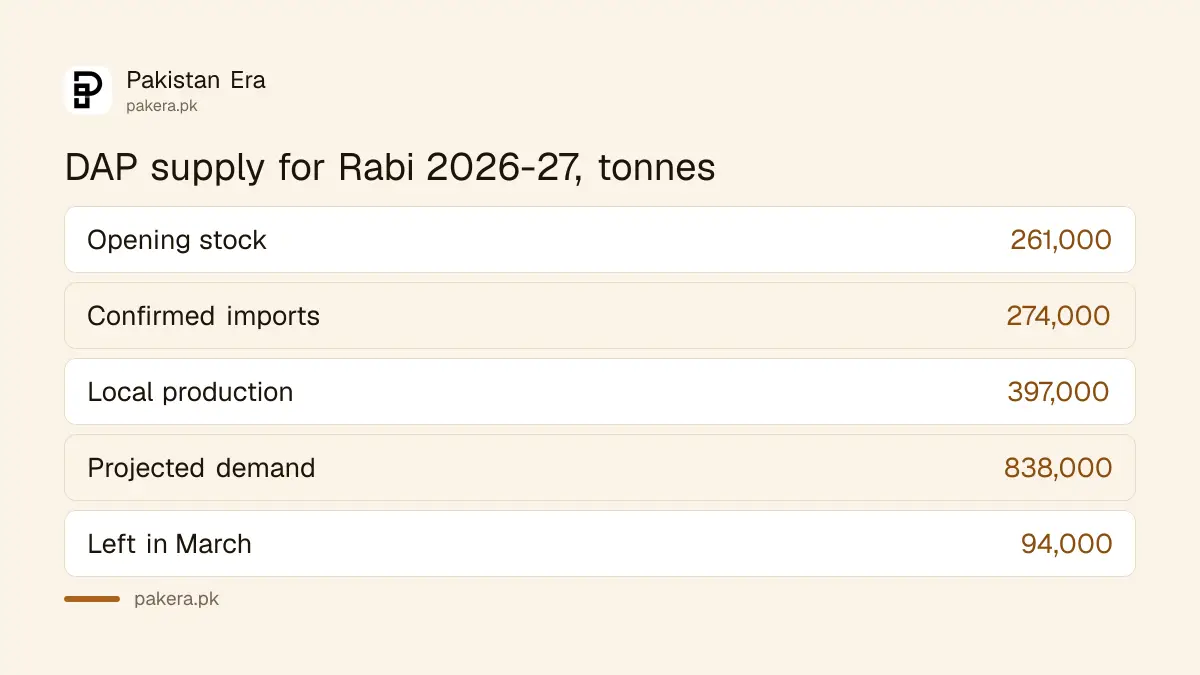
DAP availability for Rabi 2026-27 is 932,000 tonnes: 261,000 tonnes in opening stock, 274,000 tonnes of confirmed imports and 397,000 tonnes of local production. Demand is projected at 838,000 tonnes, leaving 94,000 tonnes at the end of March. Most imports land in October.
| Month | DAP demand (tonnes) | DAP imports (tonnes) | Stock at month end (tonnes) |
|---|---|---|---|
| October 2026 | 219,000 | 234,000 | 352,000 |
| November 2026 | 246,000 | 40,000 | 218,000 |
| December 2026 | 127,000 | 0 | 166,000 |
| January 2027 | 75,000 | 0 | 123,000 |
| February 2027 | 84,000 | 0 | 106,000 |
| March 2027 | 87,000 | 0 | 94,000 |
DAP is applied at sowing, so the October and November figures matter most to wheat growers. NFDC's DAP demand line uses the five-year average. It also says steady gas to the local DAP plant is needed to keep the national stock healthy.
A bag of DAP averaged Rs 16,905 in September, up 22 per cent in a year
NFDC's price table, built on Pakistan Bureau of Statistics data, puts the September 2026 average at Rs 4,711 for a 50 kg bag of Sona urea, Rs 4,560 for other urea brands and Rs 16,905 for DAP. DAP was Rs 13,809 a year earlier, a rise of about 22 per cent.
| Fertiliser (50 kg bag) | September 2025 | August 2026 | September 2026 |
|---|---|---|---|
| Urea (Sona) | Rs 4,388 | Rs 4,679 | Rs 4,711 |
| Urea (other) | Rs 4,237 | Rs 4,540 | Rs 4,560 |
| DAP | Rs 13,809 | Rs 16,480 | Rs 16,905 |
| NP | Rs 8,703 | Rs 10,318 | Rs 10,535 |
| SOP | Rs 12,365 | Rs 15,173 | Rs 15,400 |
The high DAP price is already changing what farmers buy. DAP sales in Kharif 2026 fell 25.4 per cent to 485,000 tonnes, and NFDC links the fall to price. Local urea is also far cheaper than imported urea: the review puts imported Middle East urea at Rs 7,744 to Rs 8,624 a bag, against about Rs 4,700 for local Sona.
For this week's rate in your city, the urea price by city and the DAP price by city track the weekly government figures.
Urea sales in KP and Balochistan fell to almost zero in September
NFDC's September review records urea sales in Khyber Pakhtunkhwa and Balochistan falling to almost zero, and puts this down to a ban on its sale. In the same month, urea sales rose 59.7 per cent in Punjab and 49.5 per cent in Sindh, and national urea sales rose 42.5 per cent to 611,000 tonnes.
DAP sales in September fell 98 per cent in KP and 94 per cent in Balochistan compared with September 2025. Farmers in those two provinces should ask their district agriculture extension office which dealers are allowed to sell this season, before the December urea dose is due. Wheat growers in KP can match their timing to the KP wheat sowing and fertiliser schedule.
Plan your wheat fertiliser before the December rush
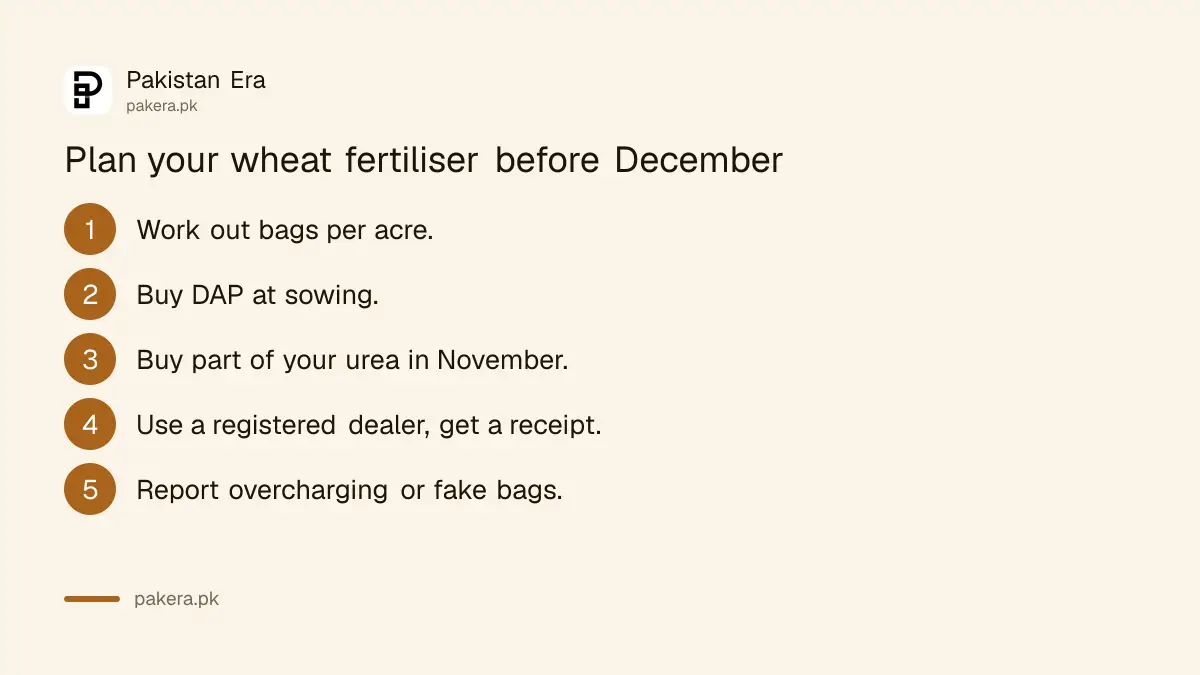
Buy DAP at sowing while stock is at its highest, and arrange the first urea bags in November rather than waiting for the December peak. Buy from a registered dealer, keep the receipt, and check the bag weight. Report overcharging or fake fertiliser to your provincial agriculture department.
- Work out your bags per acre from your soil test or your province's dose chart.
- Buy DAP at or before sowing, when stock is highest.
- Book or buy part of your urea in November, before December demand peaks.
- Buy only from a registered dealer and ask for a printed receipt.
- Check the price against the weekly city rate before you pay.
- Report overcharging, short weight or fake bags to the agriculture department.
Rain-fed farmers can cut waste by matching the dose to rainfall, as set out in the barani wheat fertiliser dose by zone. In Punjab, fake or adulterated fertiliser can be reported through the fake fertiliser complaint route.
Common questions
Will there be a urea shortage in Pakistan this wheat season?
NFDC projects enough urea overall, 3.81 million tonnes against 3.60 million demand. But stock falls below the 300,000 tonne buffer from December, so supply can tighten if a plant shuts or gas is cut.
When is urea demand highest in Rabi?
December. NFDC expects 974,000 tonnes of urea to be sold that month, the highest of the season.
How much DAP is available for wheat in 2026-27?
932,000 tonnes, against demand of 838,000 tonnes. That includes 274,000 tonnes of confirmed imports, most arriving in October.
What was the DAP price in September 2026?
Rs 16,905 for a 50 kg bag on average, up from Rs 13,809 in September 2025.
Is Pakistan importing urea this Rabi season?
No. NFDC's Rabi table shows zero urea imports, so the season depends on local plants and their gas supply.
Why did urea sales stop in KP and Balochistan?
NFDC's September review puts the near-zero urea sales in both provinces down to a ban on its sale. Ask your district agriculture office which dealers can sell this season.
How we verified this
What we checked and where we read it.
Last checked 14 November 2026. Every figure comes from NFDC's Fertilizer Review, September 2026 (report MRR No. 10/2026), listed on the Ministry of National Food Security and Research publications page with the date 27 October 2026. We used its Table 6 for the Rabi month-by-month outlook, Table 7 for retail prices and Table 8 for imported prices. The 22 per cent DAP rise is our arithmetic from Table 7. The province table in the PDF prints its columns out of line, so the province figures here are taken from the report's written text, which gives the same percentages. The review does not say which authority imposed the KP and Balochistan sale ban. The October committee figure comes from the PID release on its 7 October meeting.
About the author

Senior Writer, Public Services and Technology
Shahid joined us in 2024 as an author. He is a senior contributor to Pakistan's leading technology websites. He writes detailed articles, mostly covering his expertise in the latest tech, mobiles, apps, gadgets, and step-by-step guides. His ideology is to help people understand the latest trends and explain complex methods through very easy-to-understand guides.