Wheat Sowing in Khyber Pakhtunkhwa 2026: Dates, 50 to 60 kg Seed an Acre and Fertiliser
Sow wheat in Khyber Pakhtunkhwa from 25 October 2026: 50 to 60 kg seed an acre, 1.5 bags DAP at sowing and five waters. See KP varieties and dates by window.
Sow early wheat in Khyber Pakhtunkhwa from 25 October to 10 November, medium wheat from 11 to 30 November and late wheat from 30 November to 30 December. The KP Agriculture Department's crop chart sets 50 kg of seed an acre for early sowing, 55 kg for medium and 60 kg for late, with 1.5 bags of DAP at sowing on irrigated land.
That puts the first KP window five days away from today, 20 October 2026. Wheat is the main winter crop across the province, from the canal land of Peshawar, Charsadda and Mardan to the rainfed fields of Karak, Kohat and the south. We read the department's "crop cultivation" chart, posted on its crop calendar page, and give its advice here in plain English. The chart is in Urdu and the translation is ours.
KP wheat sowing has three windows from 25 October to 30 December
The KP Agriculture Department splits wheat sowing into three windows. Early sowing runs from 25 October to 10 November, medium sowing from 11 to 30 November, and late sowing from 30 November to 30 December. Seed rate rises as sowing gets later.
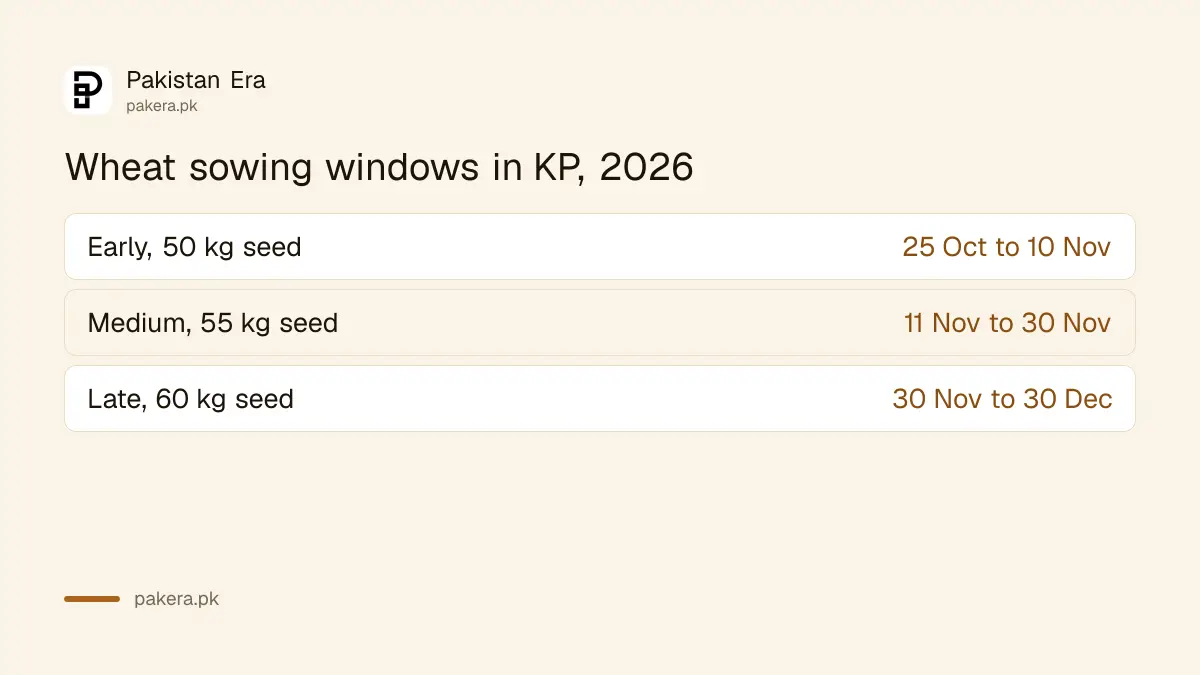
| Sowing window | Dates | Seed per acre |
|---|---|---|
| Early | 25 October to 10 November | 50 kg |
| Medium | 11 November to 30 November | 55 kg |
| Late | 30 November to 30 December | 60 kg |
Late seed rates are higher because a late crop has less time to tiller, which means fewer side shoots per plant. More seed makes up for the thinner stand. Our honest advice is to aim for the early or medium window if your land allows. The late window is a fallback, not a plan.
Land preparation starts well before sowing. The chart says to plough and run the sohaga, a wooden plank that levels and firms the soil, before the monsoon rains. Then leave the field open for 8 to 10 days, plough again and sow.
The chart lists at least 8 irrigated and 6 rainfed wheat varieties
For irrigated land the department names Khaista 2017, Wadan 2017, Pirsabak 2015, Hashim, Shahid 2017, Israr Shaheed, Gulzar 2019 and Pirsabak 2019, among others. For rainfed land it names Wadan 2017, Pirsabak 2015, Shahkar 2013, Pirsabak 2005, Aman and Awaz.
Wadan 2017 and Pirsabak 2015 appear in both lists, so they suit farmers who have some canal water but cannot rely on it. The chart also prints one or two names we could not read with confidence, so we have left them out rather than guess. Check the exact name on the seed bag with your local agriculture extension office before you buy.
Prices for the crop matter as much as the seed. The federal and provincial debate on the wheat support price for 2026-27 has not settled a single figure for KP, so plan your costs on what you know today.
Irrigated wheat in KP needs 1.5 bags of DAP at sowing
On irrigated land, the chart sets 1.5 bags of DAP, half a bag of urea and one bag of potassium sulphate (SOP) an acre at sowing. With the first or second irrigation it adds 1.25 bags of ammonium nitrate and one bag of urea. Rainfed land gets one bag each of DAP, urea and SOP at sowing.
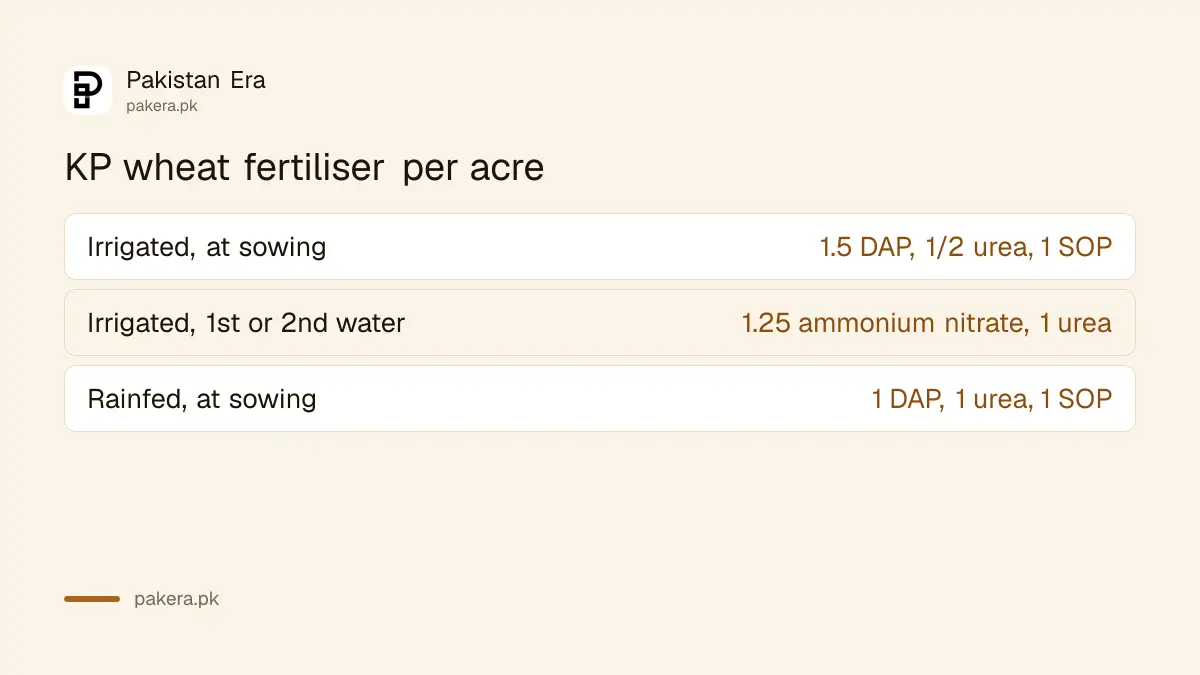
| Land | At sowing, bags of 50 kg | Later |
|---|---|---|
| Irrigated | 1.5 DAP + 1/2 urea + 1 SOP | 1.25 ammonium nitrate + 1 urea with the 1st or 2nd water |
| Rainfed | 1 DAP + 1 urea + 1 SOP | None listed |
Rainfed land gets all its fertiliser at sowing because nobody can promise when the next rain comes. Irrigated land splits the nitrogen, so the plant gets it when it is growing fastest. At the national average prices the Pakistan Bureau of Statistics recorded for the week to 8 October 2026, the irrigated sowing dose costs about Rs 43,504 an acre and the rainfed dose about Rs 37,330. That is our arithmetic, using DAP at Rs 17,127.78, urea at Rs 4,779.51 and SOP at Rs 15,422.22 a bag, the urea and DAP prices for that week.
Shop prices in Peshawar or Bannu will not match the national average exactly. Keep the receipt, and if the bag looks or feels wrong, ask your local agriculture office to have it tested.
Sow with a drill in rows 20 to 25 cm apart
The chart says irrigated wheat should be sown with a drill or a pora, a seed tube behind the plough. Rainfed wheat can be drilled, sown with a pora or broadcast by hand. Rows go 20 to 25 cm apart and seed goes 5 to 8 cm deep.
Depth matters more on rainfed land. Seed placed too shallow dries out before it can root, and that is the most common reason for a patchy rainfed stand. A drill puts every seed at the same depth, which a hand broadcast cannot do.
Irrigated wheat gets five waters, the first 18 to 25 days after sowing
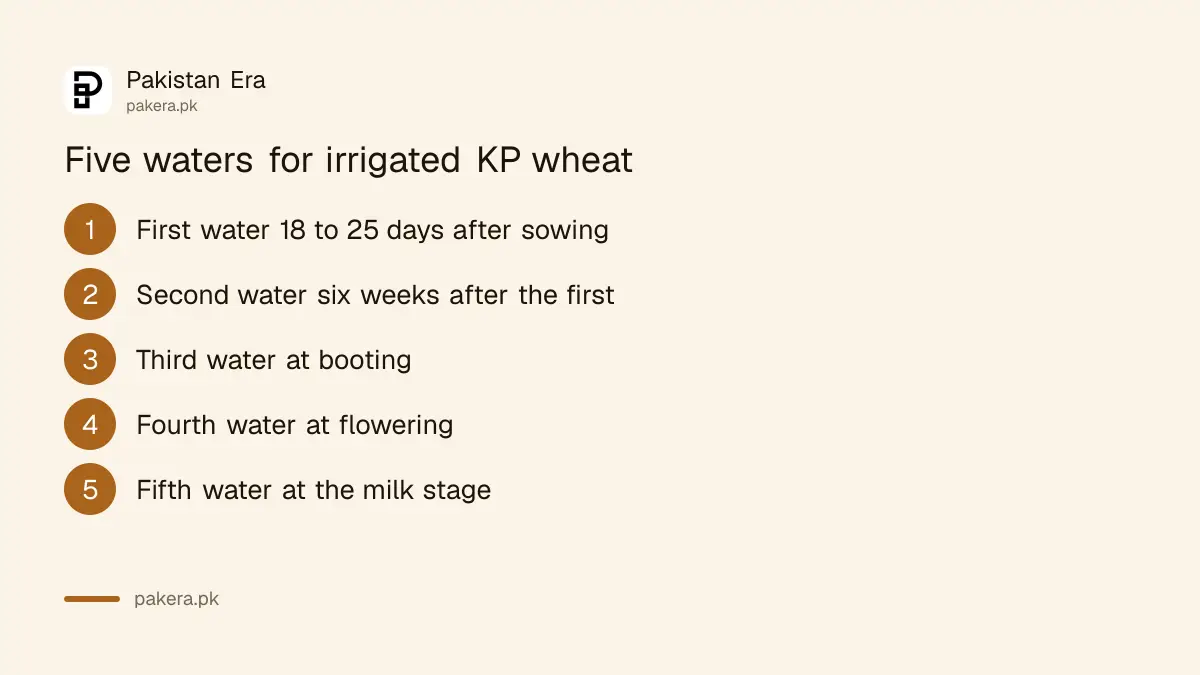
The department gives five irrigations for wheat. The first comes 18 to 25 days after sowing and the second six weeks after the first. The third goes at booting, the fourth at flowering and the fifth when the grain is in the milk stage.
- First water: 18 to 25 days after sowing.
- Second water: six weeks after the first.
- Third water: at booting, when the ear swells inside the leaf sheath.
- Fourth water: at flowering.
- Fifth water: when the grain is soft and milky.
Canal water may be short this winter. The national water regulator expects a shortfall for the rabi season, which is set out in the IRSA rabi water shares. If you can only give three waters, the chart's order suggests the first, booting and flowering waters are the ones to protect. That is our reading, not a department rule. For a cheaper way to stretch water, KP also runs a drip and sprinkler irrigation scheme.
Watch for aphids, armyworm and three rusts
The chart lists wheat aphid, armyworm, termites, American bollworm, pink borer and rats as the main pests. For diseases it names yellow rust, brown rust and black rust, plus smut. It advises harvest when the crop turns golden and storage at 9 to 10 per cent grain moisture in new bags.
Rust shows as yellow, brown or black powdery stripes on the leaves. It spreads fast in cool, damp weather, so walk the field after rain. The chart also says to harvest about one month after flowering, when the stems turn golden, and to clean and spray the store before the grain goes in.
Common questions
When should I sow wheat in KP in 2026?
Early wheat from 25 October to 10 November, medium wheat from 11 to 30 November and late wheat from 30 November to 30 December, according to the KP Agriculture Department chart.
How much wheat seed is needed per acre in KP?
50 kg for early sowing, 55 kg for medium sowing and 60 kg for late sowing.
What fertiliser does irrigated wheat need in KP?
1.5 bags of DAP, half a bag of urea and one bag of SOP at sowing, then 1.25 bags of ammonium nitrate and one bag of urea with the first or second water.
Which wheat varieties does KP recommend for rainfed land?
Wadan 2017, Pirsabak 2015, Shahkar 2013, Pirsabak 2005, Aman and Awaz, among others on the chart.
How many times should wheat be watered in KP?
Five times on irrigated land: 18 to 25 days after sowing, six weeks later, at booting, at flowering and at the milk stage.
How we verified this
What we checked, where we read it, and what we could not confirm.
We read the KP Agriculture Department's crop calendar page on 20 October 2026. Its wheat advice sits in a printed Urdu chart titled "Fasalat ki Kasht", posted as an image in July 2026, which we read and translated ourselves. The chart carries no year, so we cannot say when it was last revised. Fertiliser prices are the Pakistan Bureau of Statistics national averages for the week to 8 October 2026, and the cost per acre is our arithmetic. We could not check seed prices or seed stock for each variety in KP.
About the author

Senior Writer, Public Services and Technology
Shahid joined us in 2024 as an author. He is a senior contributor to Pakistan's leading technology websites. He writes detailed articles, mostly covering his expertise in the latest tech, mobiles, apps, gadgets, and step-by-step guides. His ideology is to help people understand the latest trends and explain complex methods through very easy-to-understand guides.